Facebook payouts range by format. Reels can earn as little as $0.02 per 1,000 views, while long-form in-stream ads can pay $6 or more. So how much does Facebook pay for views to creators in 2026? The honest answer: it depends entirely on format and audience.
A long, ad-supported video and a viral Reel can earn wildly different amounts even with identical view counts. This guide breaks down current Facebook RPM and CPM rates, compares payouts against YouTube and TikTok, and explains why your audience’s location can swing earnings by 10x or more.
How Much Does Facebook Pay for Views? 2026 RPM/CPM Rates
Facebook doesn’t pay a flat rate “per view”. It pays creators a share of the ad revenue generated around their content, split 55% to the creator and 45% to Meta for in-stream ads. What you actually take home depends on which program the view falls under, and long-form in-stream ads and Reels sit on entirely different pay scales. Here’s where most of the confusion comes from: people mix up advertiser CPM (what brands pay Meta) with creator RPM (what you actually receive):
| Metric | 2026 Range | What It Means |
| Advertiser CPM | $10–$20+ per 1,000 ad impressions | What brands pay Facebook. Creators never see this figure directly. |
| In-Stream Ad RPM (videos 3 min+) | $2–$6 per 1,000 views, up to $8–$20 for high-value US/finance audiences | Your 55% cut from mid-roll ads on longer videos. |
| Reels Content Monetization RPM | $0.02–$0.20 per 1,000 views for most creators; $0.50–$5 for top-performing niches with US-heavy audiences | Performance-based payout under Facebook’s unified Content Monetization Program. |
In practical terms: a 3-minute-plus video with mid-roll ads will almost always out-earn a Reel with the same view count, often by 10–50x per 1,000 views. Reels compensate with volume and reach, not per-view rate.
How Much Does Facebook Pay for Views? 1K, 10K, 100K, and 1 Million Views
Because in-stream and Reels rates differ so much, these are blended estimates for a creator running mixed content (some long-form, some Reels) with a moderate-value, US-skewed audience:
➤ 1,000 Views: Typically $2–$6 for in-stream-eligible views; under $0.20 if the views are mostly Reels.
➤ 10,000 Views: Roughly $20–$60 on in-stream content; $0.20–$2 on Reels-only distribution.
➤ 100,000 Views: Around $200–$600 for in-stream video; Reels-heavy pages may see only $2–$20 unless the niche is high-value (finance, tech, health).
➤ 1 Million Views: Anywhere from $2,000–$6,000 on strong in-stream performance. $20–$200 for typical Reels, with outlier niches reaching $1,000–$5,000 at this volume.
➤ Beyond 1 Million: Earnings scale with views but remain shaped by audience geography, niche, watch time, and ad load.
Facebook vs. YouTube vs. TikTok: Who Pays Creators More in 2026?

For those looking into how much does facebook pay for views, it is possible that you may also be checking pay rates for other platforms. Here’s a comparison between Facebook, YouTube, and TikTok:
| Factor | YouTube | TikTok | |
| Long-form RPM (creator payout per 1K views) | $2–$6 (up to $8–$20 for premium niches) | $3–$10 typical, $10–$30+ for high-CPM niches (finance, business, tech) | Not a primary long-form ad-share model |
| Short-form RPM (Reels/Shorts/TikTok videos) | $0.02–$0.20 typical; $0.50–$5 outlier niches | $0.01–$0.07 (YouTube Shorts), offset by very high view volume | $0.50–$1.00 (Creativity Program), stronger than Facebook Reels but weaker than long-form YouTube |
| Revenue share | ~55% creator / 45% Meta | ~55% creator / 45% Google (standard AdSense split) | Varies by program; often opaque, algorithm-driven bonus pools |
| Follower threshold to start earning | ~10,000 followers or 600K minutes viewed | 1,000 subscribers + 4,000 watch hours (or Shorts equivalent) | 10,000 followers and 100,000 views in the last 30 days(Creativity Program) |
| Best suited for | Mixed long/short content, community-driven pages | Long-form, search-driven, evergreen content | High-frequency, trend-driven short video |
Takeaway: YouTube generally still pays the highest per-view rate for long-form content. Facebook’s in-stream ads are competitive but trail YouTube on premium niches. For short-form specifically, TikTok’s Creativity Program typically out-earns Facebook Reels per 1,000 views, though Facebook Reels can catch up or exceed TikTok when the audience is heavily US-based and high-value.
Tier 1 vs. Tier 3 Viewer Demographics: Why Location Multiplies Your Revenue?
Knowing audience geography is important when learning how much does facebook pay for views. It is one of the single biggest swings in creator revenue, often more influential than raw view count.
Tier 1 markets: The US, UK, Canada, Australia, and similar high-ad-spend economies carry the highest advertiser CPMs, frequently in the $11–$20+ range per 1,000 ad impressions. Advertisers in these markets pay a premium because audiences there have higher average purchasing power and stronger e-commerce conversion rates. A creator whose audience is 80%+ Tier 1 can see RPMs 10–50x higher than a creator with an identical view count from a Tier 3 audience.
Tier 3 markets: Many countries across South Asia, parts of Southeast Asia, and other developing ad economies carry much lower advertiser CPMs, often under $1–$2 per 1,000 impressions. This isn’t a platform penalty; it reflects lower overall ad spend and conversion value in those markets. A Reel racking up hundreds of thousands of views from a Tier 3-heavy audience can still earn only a few dollars, while a smaller Tier 1 audience earns far more from fewer views.
Practical Implication: Two creators with identical view counts can see earnings differ by an order of magnitude purely based on where their audience lives. This is why niche (finance, tech, health) combined with a Tier 1-skewed audience produces the “outlier” RPMs referenced throughout this article, while global, entertainment-first audiences sit at the low end of every range.
Facebook Monetization Eligibility Criteria in 2026
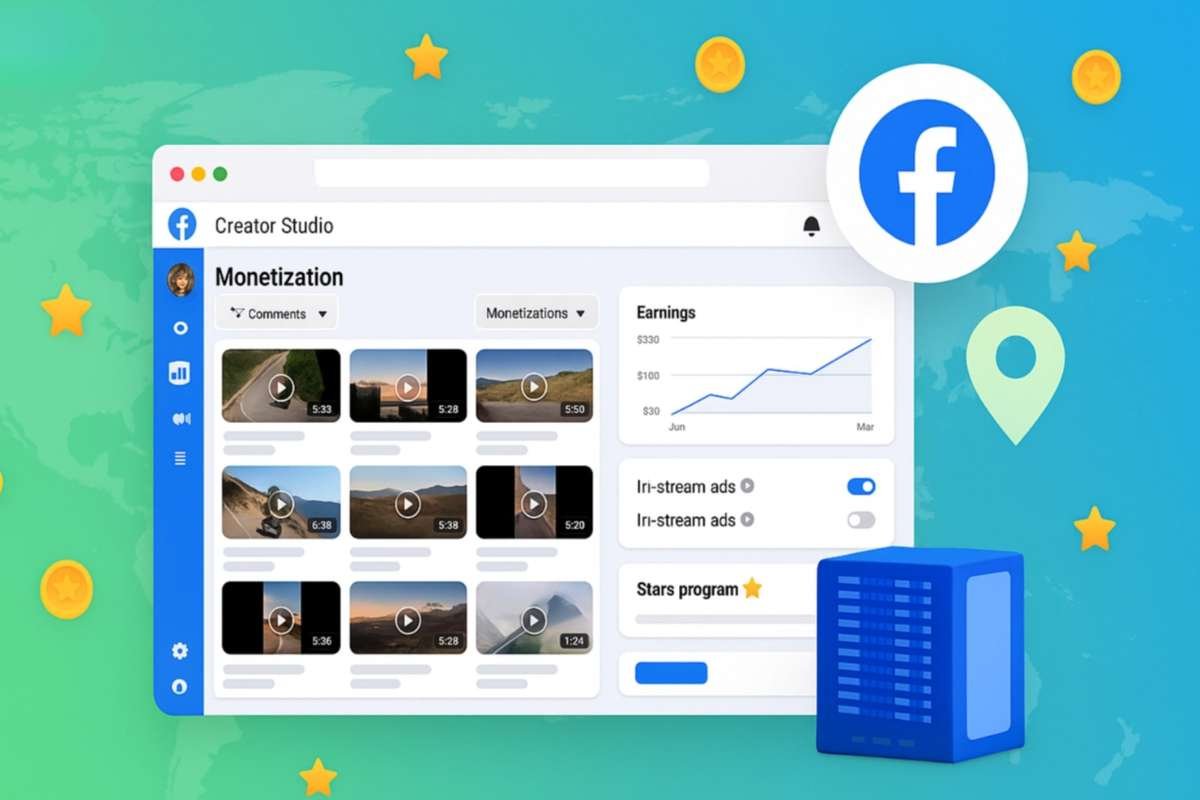
Here are the general eligibility requirements:
- Account Type: Use a dedicated Facebook Page or a personal profile with professional mode turned on.
- Age Requirement: You must be at least 18 years old.
- Location: Your account must reside in a supported country.
- Policy Compliance: Follow Meta’s Community Standards, content guidelines, and payment terms without recent violations.
- Content Quality: Publish original, authentic content that adds value rather than unoriginal reposts or spam.
Apart from the general requirements, here are the tool-specific benchmarks you should know after understanding how much does Facebook pays for views.
- In-Stream Ads (Videos): Generally require at least 10,000 followers and 600,000 total eligible minutes viewed in the last 60 days, with at least 5 active videos.
- Subscriptions: Require 10,000 followers (or 250+ return viewers) alongside 50,000 post engagements or 180,000 watch minutes in the last 60 days.
- Content Monetization (Unified Program): Combines earnings from eligible public reels, photos, stories, and text posts based on qualified views and engagement metrics under Meta’s newer rollout terms.
What are the Different Ways to Earn Money from Facebook Views?

Facebook creators earn through five main channels:
- In-Stream Ads: Mid-roll ads on videos over 60 seconds (full eligibility at 3+ minutes); currently the highest per-view earner.
- Reels: Monetized via the Content Monetization Program based on views, engagement, and watch time. Licensed/trending music can reduce or eliminate eligibility.
- Stars: Fans gift Stars during live videos; $0.01 per Star.
- Subscriptions: Recurring monthly income from paying followers.
- Brand Collaborations: Often the largest single revenue source for mid-to-large creators, independent of Facebook’s own payout rates.
Within any of these, how much does Facebook pay for views depends on a handful of factors:
Audience location (Tier): The single biggest multiplier.
Content niche: Finance, tech, and health command premium CPMs over entertainment or meme content.
Video length & watch time: Longer, fully-watched videos support more and better-placed ads.
Engagement: Likes, shares, and comments boost distribution and ad value.
Ad quality signals: CTR, view duration, and conversion rate all factor into what advertisers pay.Followers/reach: Larger audiences unlock more monetization eligibility, though reach matters less than watch time and audience tier.
Conclusion
So, how much does Facebook pay for views in 2026? It depends entirely on which monetization path a view falls under and who is watching.
In-stream ads on longer videos remain Facebook’s best per-view earner ($2–$6+ per 1,000 views), while Reels pay far less per view ($0.02–$0.20 typically) but can reach a much larger audience. Layer in audience tier, Tier 1 versus Tier 3, and the same view count can produce earnings that differ by 10x or more.
FAQs
1. How many followers or views do you need to start earning?
Requirements vary by program: In-Stream Ads generally require the 10,000-follower/600,000-minute threshold; Stars require 500+ followers; Subscriptions typically require 10,000 followers.
2. How much does Facebook pay per 1,000 views?
How much does Facebook pay for views depends on the format. Around $2–$6+ for in-stream ads on longer videos, versus $0.02–$0.20 for Reels.
3. Does Facebook pay monthly?
Yes. Payments are typically issued around the 21st of each month for earnings from the prior month.