At extreme speed, something unexpected happens: motion disappears.
The vibration fades. Sound dulls. The world outside turns into color rather than detail. At 350 km/h, your body stops registering acceleration and begins registering calm. This paradox of movement without sensation is what defines the fastest trains in the world today.
In 2026, high-speed rail has entered a mature phase. The question is no longer whether trains can go faster, but whether speed can coexist with comfort, sustainability, and scale. Airlines move people quickly, but inefficiently. Cars offer freedom, but extract it back through congestion and emissions. High-speed rail sits in the narrow space where speed, efficiency, and human experience align.
However, speed, here, is economic leverage. When a journey drops below ninety minutes, people stop planning for it. They start living with it. Entire regions gain relevance. This is why the fastest trains in the world are disproportionately built in nations thinking decades ahead.
This list measures what actually matters: sustained operating speed, not test-track heroics. Because the real impact of speed is not how fast a machine can go, but how reliably it does so every day, with hundreds of lives inside it.
Top 12 Fastest Trains in the World in 2026

To assemble this definitive ranking, we synthesized performance data from the International Union of Railways (UIC), manufacturer logs from CRRC and Siemens, and real-world transit reports from the High Speed Rail Alliance.
We ranked these machines based on their maximum commercial operating speeds rather than experimental test records. This methodology ensures the list reflects the actual velocity a passenger can experience today or in the immediate 2026 rollout.
| Rank | Train Model | Country | Top Operating Speed | Key Feature |
| 1 | Shanghai Maglev | China | 460 km/h | Uses magnetic levitation to eliminate friction |
| 2 | CR450 | China | 400 km/h | 2026’s newest conventional rail leader |
| 3 | CR400AF Fuxing | China | 350 km/h | Features 10% lower energy consumption |
| 4 | CRH380A Hexie | China | 350 km/h | Holds a test record of 486 km/h |
| 5 | Talgo 350 (Pato) | Spain | 350 km/h | Unique tilting system for winding tracks |
| 6 | ICE 3 (Velaro D) | Germany | 330 km/h | Offers a driver’s eye view for passengers |
| 7 | TGV M | France | 320 km/h | Modular design with 97% recyclability |
| 8 | E5 Series Shinkansen | Japan | 320 km/h | Specialized nose prevents tunnel sonic booms |
| 9 | KTX-Cheongyong | S. Korea | 320 km/h | Aluminum body allows rapid acceleration |
| 10 | Al Boraq | Morocco | 320 km/h | Africa’s first high-speed rail line |
| 11 | Eurostar e320 | UK/EU | 320 km/h | High-performance design for Channel Tunnel |
| 12 | AVE S-103 | Spain | 310 km/h | Reaches 310 km/h with 16 traction motors |
1. Shanghai Maglev (China) – 460 km/h (286 mph)
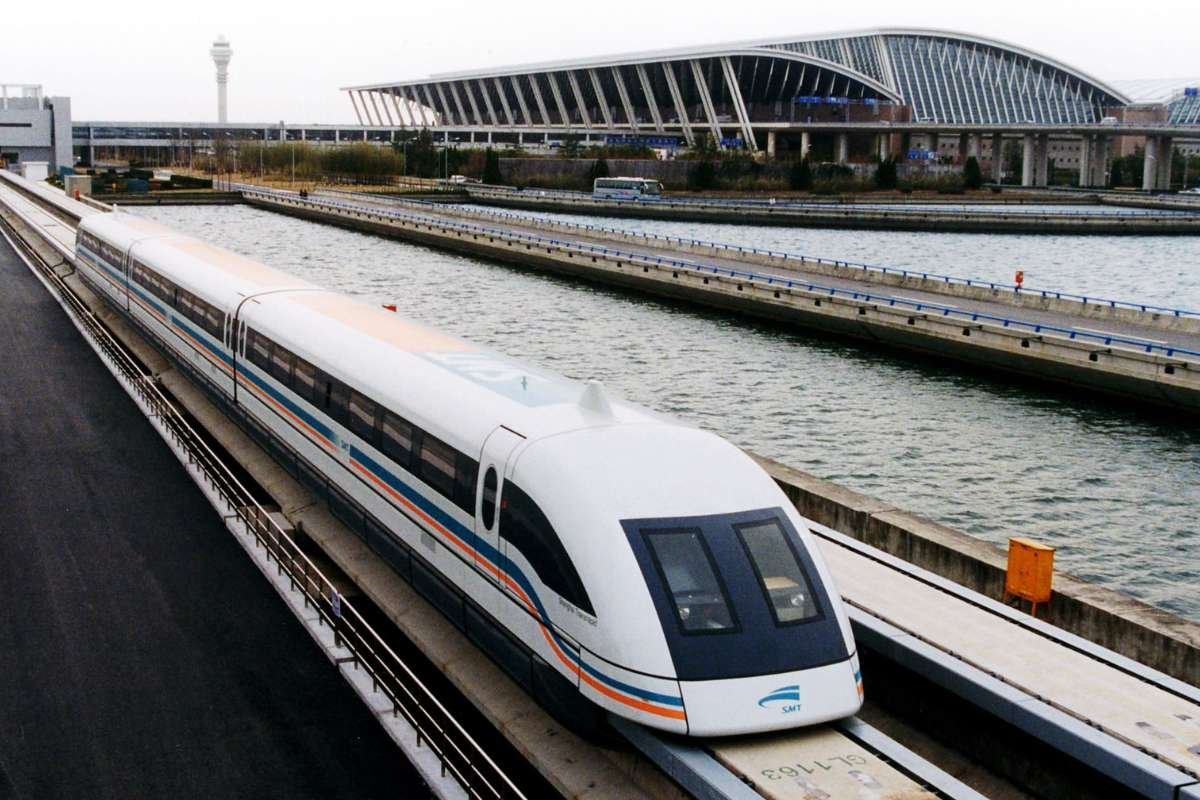
The Shanghai Maglev remains the undisputed king of commercial speed. Unlike traditional locomotives, this machine lacks wheels; it floats on a magnetic cushion, eliminating friction. Passengers travel the 30-kilometer stretch from Pudong Airport to the city center in just over seven minutes. Webuildvalue notes that Maglev technology minimizes mechanical wear, leading to lower long-term maintenance costs and extreme reliability.
- Technology: Electromagnetic Suspension (EMS).
- Capacity: 574 passengers.
- Sustainability: Zero direct CO2 emissions during operation.
2. CR450 (China) – 400 km/h (248 mph)

China recently reinforced its global leadership with the CR450 Innovation Project. Unveiled for commercial debut in 2026, this train represents the newest generation of conventional rail. It operates at a commercial speed of 400 km/h, surpassing the previous 350 km/h benchmark. This machine utilizes advanced 15-meter aerodynamic shielding to reduce noise and vibration during its high-velocity runs, shaving 50 tons off the weight of previous models.
- Technology: Next-Gen Fuxing Distributed Traction.
- Capacity: 600+ passengers.
- Sustainability: 22% reduction in air resistance and noise.
3. CR400AF Fuxing (China) – 350 km/h (217 mph)

While Maglev holds the speed record, the Fuxing handles the heavy lifting of China’s rail network. Engineers designed the CR400AF to operate comfortably at 350 km/h, securing its place among the fastest trains in the world. The train features a “distributed power” system, where motors sit under multiple cars to improve acceleration and energy efficiency. It is the first Chinese-standardized EMU built with entirely proprietary intellectual property.
- Technology: Standardized Electric Multiple Unit (EMU).
- Capacity: 556 passengers (8-car set).
- Sustainability: 10% lower energy consumption than the CRH series.
4. CRH380A Hexie (China) – 350 km/h (217 mph)

The CRH380A Hexie represents China’s earlier leap into indigenous high-speed design. It reached a test speed of 486 km/h, proving its incredible engineering foundation. In daily operations, it comfortably cruises at speeds that rival the best in Europe. This train features a vibration-free design that allows a coin to stand on its edge during travel. The “Harmonious” series was instrumental in building the world’s largest high-speed network.
- Technology: Regenerative Braking and Vibration Control.
- Capacity: 480 to 1,000+ passengers.
- Sustainability: Recovers energy through advanced braking systems.
Also read: The Evolution of Railway Manufacturing Process
5. Talgo 350 (Spain) – 350 km/h (217 mph)

Known affectionately as “Pato” (the Duck) due to its aerodynamic nose, the Talgo 350 is a marvel of stability. It uses a unique “independent wheel” system that allows it to tilt slightly during curves. This keeps the train steady while navigating mountainous or winding terrain at high velocities. This Spanish icon serves the Madrid-Barcelona line, offering a competitive alternative to short-haul flights through superior comfort.
- Technology: Independent Wheel Tilting System.
- Capacity: 600 passengers (Avril configuration).
- Sustainability: 30% lower energy consumption than standard EMUs.
6. ICE 3 (Germany) – 330 km/h (205 mph)

The Intercity-Express (ICE) 3 is Germany’s flagship for speed. Developed by Siemens, this train features traction motors spread throughout its entire length rather than concentrated in power cars. These technical specifications remain a staple when discussing the fastest trains in the world. The multi-system version connects Germany with the Netherlands, Belgium, and France, featuring a glass-walled lounge where passengers view the track from the driver’s perspective.
- Technology: Distributed Power Propulsion.
- Capacity: 441 to 460 passengers.
- Sustainability: Utilizes air-cycle cooling (R-134a-free) systems.
7. TGV M (France) – 320 km/h (199 mph)

France pioneered high-speed rail in Europe, and the new TGV M represents its latest evolution. Alstom designed this train to be modular and eco-friendly, allowing operators to adjust the car count based on passenger demand. It consumes significantly less energy than its predecessors. Sustainability defines this model; 97% of the train’s components are recyclable, making it the most eco-conscious high-speed train in the French fleet.
- Technology: Articulated Double-Deck Architecture.
- Capacity: 740 passengers (max configuration).
- Sustainability: 97% recyclable with 30% lower energy use.
8. JR East E5 Series Shinkansen (Japan) – 320 km/h (200 mph)

Japan’s Shinkansen carries a reputation for absolute precision and safety. The E5 Series, recognizable by its 15-meter “kingfisher” nose, minimizes the sonic boom created when entering tunnels at high speeds. Japan maintains a record of zero passenger fatalities due to derailments since 1964, highlighting its focus on active suspension and seismic safety controls. The E5 is the backbone of the Tohoku and Hokkaido Shinkansen lines.
- Technology: Electric Active Suspension and Long-Nose Aero.
- Capacity: 731 passengers.
- Sustainability: Optimized aerodynamic profile reduces noise pollution.
9. KTX-Cheongyong (South Korea) – 320 km/h (199 mph)

South Korea recently introduced the KTX-Cheongyong, its fastest domestically produced train. It utilizes aluminum-body technology for rapid acceleration, reinforcing the presence of Asian engineering in the list of fastest trains in the world. This train helps decentralize the Seoul metropolitan area by making distant cities like Busan accessible in just over two hours. It features an “airline-style” entertainment system and 10% lower air resistance than older KTX models.
- Technology: Distributed Traction (EMU-320).
- Capacity: 515 passengers.
- Sustainability: Lightweight aluminum body reduces energy load.
10. Al Boraq (Morocco) – 320 km/h (199 mph)

Africa entered the high-speed elite with the Al Boraq. This line connects the industrial hub of Casablanca with the port city of Tangier, cutting travel time from five hours to just over two. Al Boraq proves that high-speed transit creates economic growth beyond the G7 nations. The ONCF reports that the line now runs largely on green energy, significantly lowering the nation’s transport carbon footprint.
- Technology: Alstom Euroduplex Double-Deck.
- Capacity: 533 passengers.
- Sustainability: 90% of operations powered by green energy.
11. Eurostar e320 (UK/France/Belgium) – 320 km/h (200 mph)

The Eurostar e320 connects London to Paris and Brussels through the 50km Channel Tunnel. Based on the Siemens Velaro platform, it features 16,000 kW of traction power. This train makes international travel faster than flying when you factor in airport security times. It is specially designed to withstand the unique humidity and safety requirements of undersea travel, remaining operational for 30 minutes even during fire emergencies.
- Technology: Multi-System Velaro Platform.
- Capacity: 894 to 900 passengers.
- Sustainability: High passenger density reduces per-capita emissions.
12. AVE S-103 (Spain) – 310 km/h (193 mph)

Spain possesses the most extensive high-speed rail network in Europe. The AVE S-103, manufactured by Siemens, holds the record for the fastest speeds on Spanish soil, though it typically operates at a commercial cap of 310 km/h. During a test run, it reached a staggering 403.7 km/h. This model rounds out our exploration of the fastest trains in the world, offering a luxurious three-class interior and 20% more space than previous locomotive designs.
- Technology: Underfloor Distributed Traction.
- Capacity: 404 passengers.
- Sustainability: Regenerative braking returns 10% of energy to the grid.
You may also like:
- Fastest Cars in the World: Icons That Broke the 200, 300, and 400 km/h Barriers
- What is the Fastest Bike in the World Right Now? The Answer will Surprise You
Special Mention: The Future of Rail
Looking beyond the fastest trains in the world currently in service, we must highlight the L0 Series Maglev (Japan). While not yet in commercial operation, this machine achieved a record-breaking 603 km/h (375 mph) during tests on the Yamanashi line.
Japan is currently developing the Chuo Shinkansen line for this technology, with an expected launch between 2034 and 2035. This project will eventually connect Tokyo and Osaka in just 67 minutes.
The Engineering behind the Velocity: Why Speed Matters
When engineers build the fastest trains in the world, they fight a constant battle against physics. At speeds over 300 km/h, air resistance becomes a wall. This is why high-speed trains feature long, needle-like noses and smooth, seamless bodies.
Beyond physics, there is the human element. “High-speed rail is the backbone of the green revolution,” says Dr. Jonathan Moore, a transport economist. He notes that a single high-speed train can replace thousands of car trips or dozens of short-haul flights. This transition is vital for meeting global carbon reduction targets.
Conclusion:
Speed has always been easy to admire and difficult to justify. What makes the fastest trains in the world remarkable is not that they go fast, but that they make speed make sense.
They prove that progress does not require excess. That technology can be ambitious without being violent. That mobility can expand without inflating cost to the planet or the psyche.
As aviation struggles with sustainability and road transport collapses under its own volume, high-speed rail emerges not as an alternative, but as a correction. It restores logic to movement. City to city. Center to center. Human to human.
These trains are not futuristic fantasies. They are operational, repeatable systems shaping real lives today. And in doing so, they quietly redefine what modern civilization looks like when it chooses coherence over chaos.