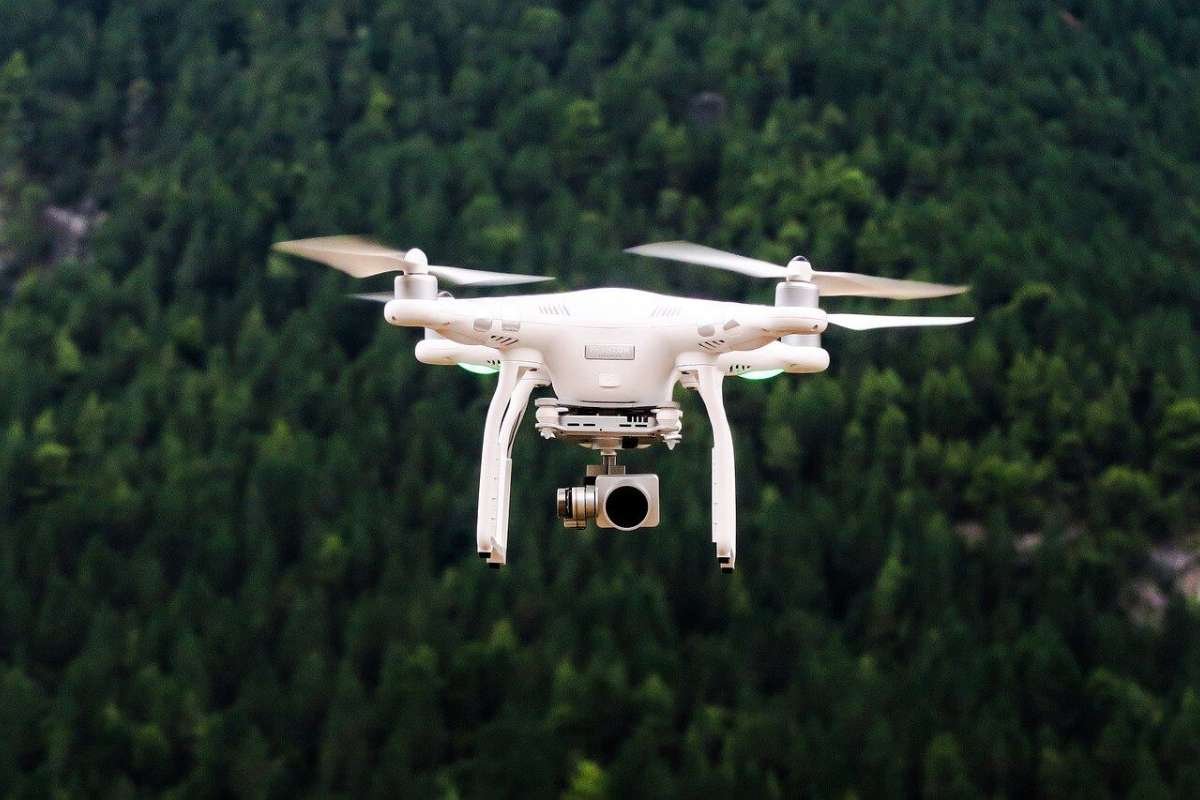
Remember when drones were just fancy toys buzzing around backyards, making us duck and laugh at the “crazy flying gadgets”?
Fast forward a few years, and these little machines are doing things that humans once needed trucks, helicopters, or armies for. They film weddings without stepping on toes, check bridges without dangling from ropes, deliver medicine faster than an ambulance, and even keep borders secure, all while looking cool in the sky.
Drones aren’t just gadgets; they are tiny superheroes with different powers. Some hover like curious birds. Some zoom like mini airplanes. Some follow your every command, while others team up in perfect harmony. Each type has a role, a strength, and a limit, and understanding the types of drones is your ticket to seeing how the future really flies.
This guide will take you through every type in simple, fun words so you’ll never look at the sky or a buzzing machine the same way again.
What Is a Drone?
A drone is a flying machine that does not require a human pilot on board. Instead of having someone sit inside like a traditional airplane or helicopter, drones are controlled remotely or programmed to fly on their own. This is why they are also called unmanned aerial vehicles (UAVs).
Drones can carry different types of equipment depending on their purpose. Many have cameras for photography and video recording. Some carry sensors to measure temperature, air quality, or radiation. Others are designed to transport small packages or medical supplies. Essentially, drones are versatile flying tools that can perform tasks too risky, expensive, or slow for humans.
Modern drones are smart machines. They rely on automation systems, which allow them to follow pre-set routes, maintain stable flight, and react to changes in the environment. Satellite positioning, like GPS, helps them know exactly where they are in the sky. Real-time data processing lets drones detect obstacles, adjust their path, and safely return to their starting point.
In short, drones are like a combination of a mini-airplane, a robot, and a smart computer. They can hover, move forward, backward, or sideways, and complete tasks automatically, making them valuable for work, entertainment, and safety.
History of Drones
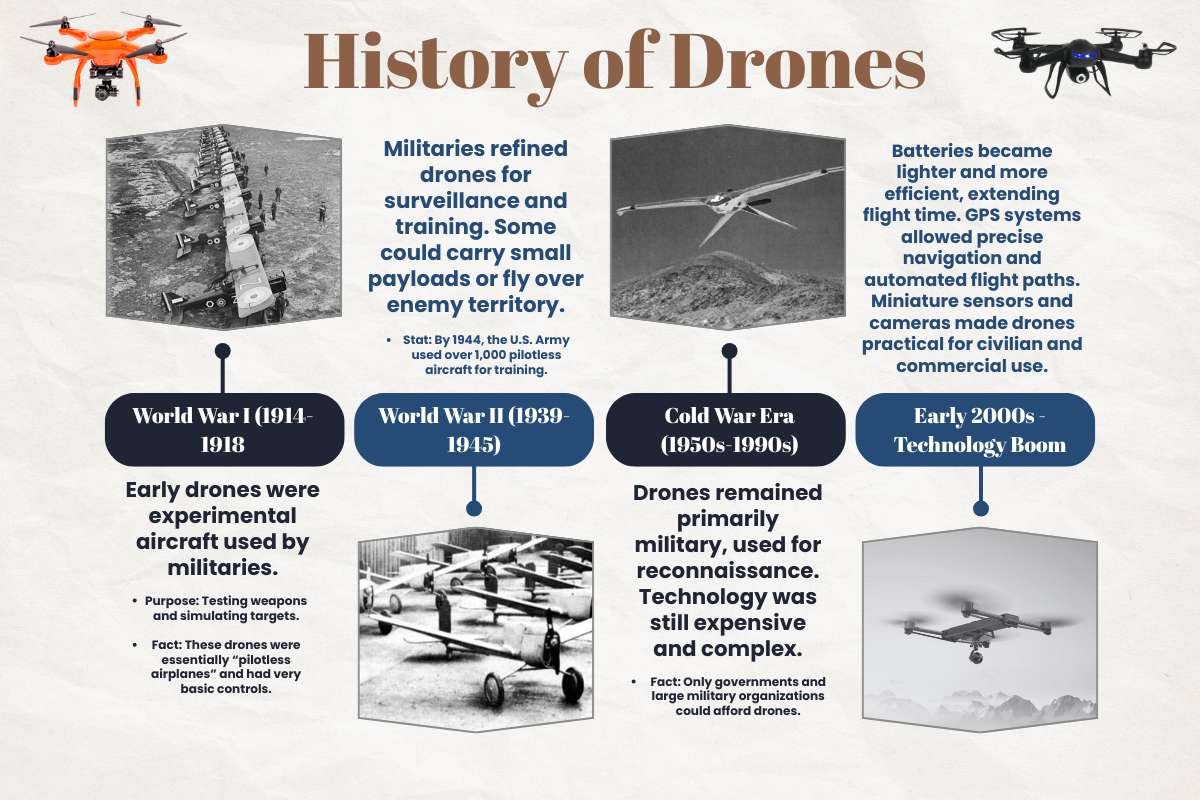
Drones have a surprisingly long and fascinating history. They did not begin as toys or consumer gadgets. Here’s a detailed look:
- World War I (1914-1918): Early drones were experimental aircraft used by militaries.
- Purpose: Testing weapons and simulating targets.
- Fact: These drones were essentially “pilotless airplanes” and had very basic controls.
- World War II (1939-1945): Militaries refined drones for surveillance and training. Some could carry small payloads or fly over enemy territory.
- Stat: By 1944, the U.S. Army used over 1,000 pilotless aircraft for training.
- Cold War Era (1950s-1990s): Drones remained primarily military, used for reconnaissance. Technology was still expensive and complex.
- Fact:Only governments and large military organizations could afford drones.
- Early 2000s – Technology Boom: Batteries became lighter and more efficient, extending flight time. GPS systems allowed precise navigation and automated flight paths. Miniature sensors and cameras made drones practical for civilian and commercial use.
Civilian and Commercial Expansion:
- Farming: Monitoring crops and spraying fertilizers.
- Filmmaking: Aerial shots without helicopters.
- Mapping & Surveying: Faster, safer, and more accurate.
- Search & Rescue: Delivering medical supplies and locating missing persons.
- Stat: By 2025, there were over 12 million drones registered worldwide, including consumer, commercial, and industrial types.
Today, drones are no longer limited to military use. The types of drones have expanded significantly, serving industries like logistics, construction, environmental monitoring, and entertainment. Small quadcopters can now hover steadily, while large autonomous drones can fly hundreds of kilometers for delivery or surveying tasks.
How Does a Drone Work?
A drone works through a balance of lift, control, and navigation.
- Motors spin propellers to create lift.
- Flight controllers adjust speed for balance.
- GPS helps track position.
- Sensors detect altitude and movement.
- Batteries power the entire system.
Software ties all parts together. This software decides how the drone reacts to wind, commands, and obstacles.
Key Components of Drones
- Frame for structure
- Motors and propellers for movement
- The flight controller is the brain.
- Battery for power
- GPS and sensors for navigation
- Camera or payload system
Every component affects performance. That is why different types of drones exist for different tasks.
Types of Drones Based on Design
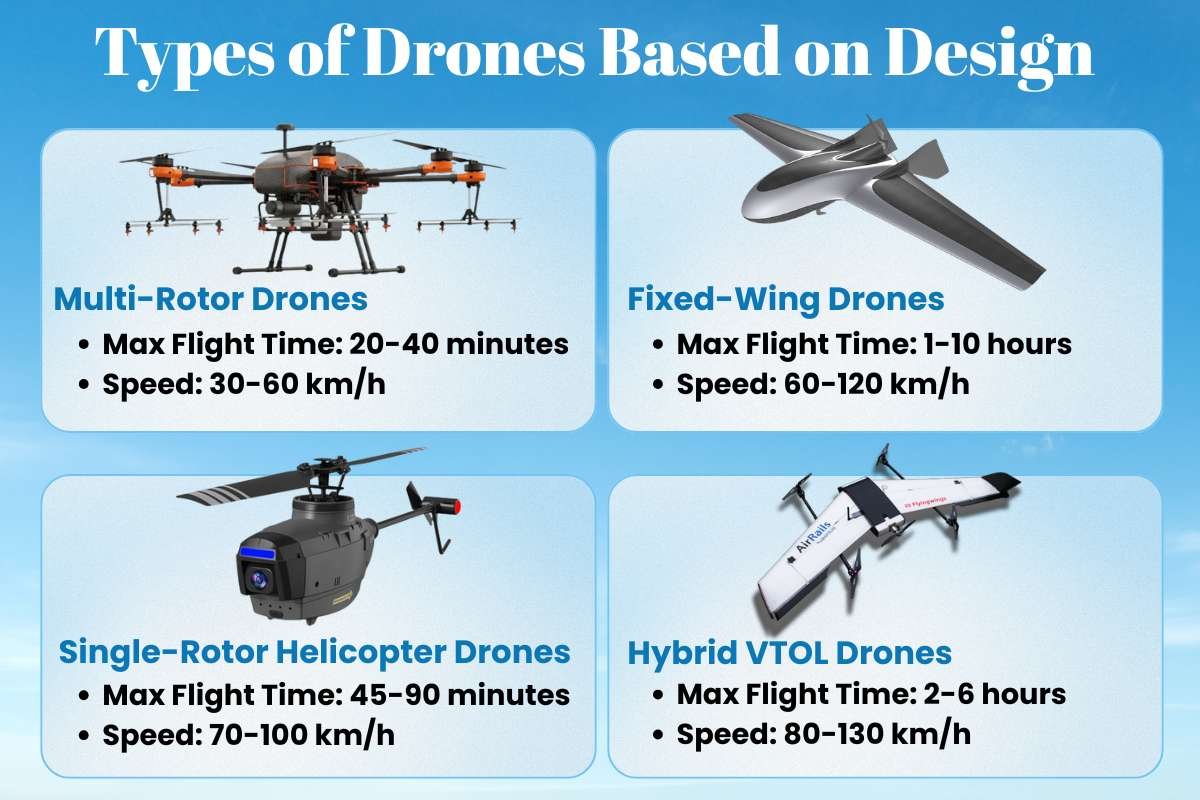
1. Multi-Rotor Drones
Technical Overview
- Size: Small to medium
- Length: 30-70 cm
- Diameter: 20-60 cm
- Weight: 0.5-3 kg
- Max Flight Time: 20-40 minutes
- Speed: 30-60 km/h
Multi-rotor drones use three, four, six, or even eight rotors to stay in the air. These rotors spin in different directions to keep the drone balanced. Because of this design, the drone can take off straight up from the ground and land in very small spaces.
The biggest strength of this design is hovering. The drone can stay still in one spot without drifting. This makes it perfect for taking photos, recording videos, and inspecting buildings or towers. Pilots can move the drone slowly and precisely, even in tight areas.
This design also makes learning easier. The drone corrects itself when it tilts, so beginners feel more confident. The downside is shorter flight time because all motors run at the same time. Still, for close-range work, this design works extremely well.
2. Fixed-Wing Drones
Technical Overview
- Size: Medium to large
- Length: 70-150 cm
- Diameter: Wide wingspan
- Weight: 2-25 kg
- Max Flight Time: 1-10 hours
- Speed: 60-120 km/h
Fixed-wing drones look and fly like small airplanes. They use wings to create lift instead of relying only on spinning rotors. Once airborne, they glide forward using much less power. This is why they can stay in the air for many hours.
This design works best for covering large areas. The drone cannot hover in one place, but it can fly long distances in a straight line. Farmers use it to scan fields. Survey teams use it to map land. Environmental teams use it to monitor forests and coastlines.
Fixed-wing drones usually need a runway or launcher to take off. Landing also needs space. Because of this, they suit open areas better than cities. Their strength is endurance, not close control.
3. Single-Rotor Helicopter Drones
Technical Overview
- Size: Medium
- Length: 80-120 cm
- Diameter: Large rotor span
- Weight: 5-15 kg
- Max Flight Time: 45-90 minutes
- Speed: 70-100 km/h
Single-rotor drones work like real helicopters. They use one large main rotor to create lift and a smaller tail rotor to control direction. This design produces strong lifting power with fewer moving parts in the air.
Because of this setup, these drones can carry heavier loads than most other designs. They can lift large cameras, sensors, or equipment that multi-rotor drones cannot handle. They also perform well in windy conditions.
These drones need more skill to operate. The mechanics are complex, and maintenance requires care. They cost more than common models. Still, when heavy payloads matter, this design delivers reliable performance.
4. Hybrid VTOL Drones
Technical Overview
- Size: Medium
- Length: 90-140 cm
- Diameter: Mixed structure
- Weight: 4-20 kg
- Max Flight Time: 2-6 hours
- Speed: 80-130 km/h
Hybrid VTOL drones mix two designs into one system. They take off and land vertically like a multi-rotor drone. Once in the air, they switch to forward flight like a fixed-wing drone. This gives them the best of both worlds.
This design allows operation in tight spaces without losing long-range ability. The drone does not need a runway. It can still fly far and stay airborne for hours. That makes it useful for surveying, delivery tests, and emergency response.
Hybrid VTOL drones rely on smart software to manage the transition between flight modes. They cost more but save time and energy during long missions. This balance makes them ideal for advanced commercial use.
Don’t miss:
- Industries Gaining Precision and Efficiency with Drone Mapping
- How Drones Are Transforming Commercial Cleaning And Maintenance?
Advantages, Disadvantages, and Uses of Drone Designs
| Drone Design | Advantages | Disadvantages | Common Uses |
| Multi-Rotor Drones | Easy to fly, stable hover, low learning curve | Short flight time, limited range | Photography, videography, and inspections |
| Fixed-Wing Drones | Long endurance, fast coverage, energy efficient | Cannot hover, needs launch space | Mapping, surveying, and agriculture |
| Single-Rotor Drones | Heavy payload capacity, longer hover time than a multi-rotor | Complex mechanics, higher cost | Cargo lifting, spraying, and research |
| Hybrid VTOL Drones | Vertical takeoff with long-range, flexible missions | Expensive, advanced maintenance | Surveillance, delivery, large-area surveys |
Types of Drones Based on Usage
Different jobs need different flying tools. That is why usage-based types of drones exist. Each category solves a specific real-world problem.
5. Consumer Drones
Key Specifications
- Size: Small
- Length: 20-35 cm
- Diameter: 15-30 cm
- Weight: 250 g to 1 kg
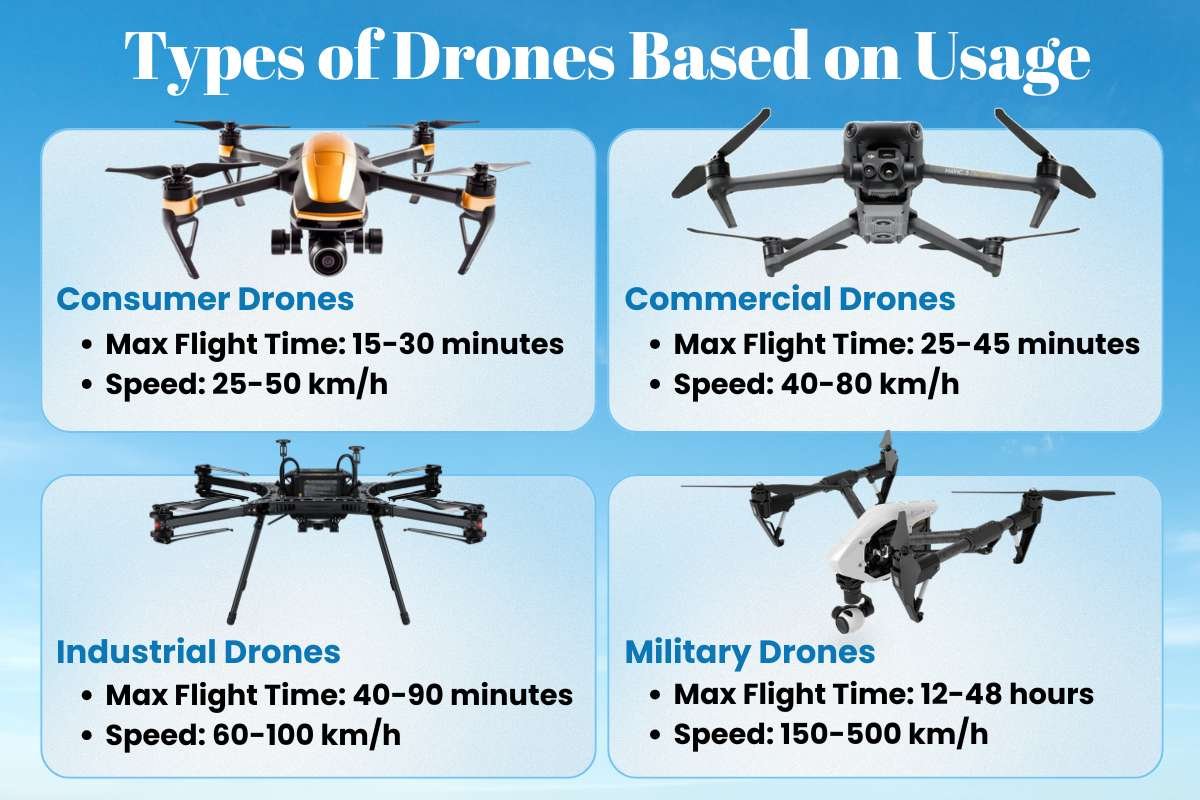
- Max Flight Time: 15-30 minutes
- Speed: 25-50 km/h
Consumer drones are made for everyday people, not experts. These drones focus on fun, learning, and creativity. Most beginners start their drone journey here because these drones feel friendly and forgiving.
They come with built-in cameras that shoot photos and videos in good quality. Many models include safety features like obstacle detection, auto-hover, return-to-home, and beginner flight modes. These features reduce crashes and build confidence.
Controls stay simple. A smartphone app or basic remote handles most functions. Some consumer drones even take off and land with one button. Because of their light weight, they are easy to carry while traveling.
Consumer-focused types of drones focus on safety first, then ease of use, and finally price. They are perfect for hobby flying, travel videos, practice flights, and casual content creation.
6. Commercial Drones
Key Specifications
- Size: Medium
- Length: 40-70 cm
- Diameter: 35-65 cm
- Weight: 1.5-5 kg
- Max Flight Time: 25-45 minutes
- Speed: 40-80 km/h
Commercial drones are built for work, not play. These drones support professionals who rely on accuracy, consistency, and stable performance every day.
They usually carry high-quality cameras, zoom lenses, mapping sensors, or inspection tools. Many can capture detailed images, measure distances, and record data with precision. Flight stability stays strong even in moderate wind.
These drones run longer than consumer models and handle repeated flights without overheating. They also support advanced software for mapping, surveying, and media production.
Commercial types of drones balance strong performance with safety rules and legal limits. They fit industries like real estate, agriculture, filmmaking, construction, and infrastructure inspection.
7. Industrial Drones
Key Specifications
- Size: Medium to large
- Length: 70-120 cm
- Diameter: 60-100 cm
- Weight: 5-25 kg
- Max Flight Time: 40-90 minutes
- Speed: 60-100 km/h
Industrial drones work where humans cannot easily go. These drones operate in harsh, risky, and complex environments.
They feature strong frames, weather resistance, and powerful motors. Many carry thermal cameras, LiDAR sensors, gas detectors, or heavy inspection tools. These sensors help detect heat leaks, structural cracks, or underground details.
Industrial drones fly farther and communicate over longer distances. They often connect to control stations instead of simple remotes. Precision matters here because mistakes can cost time, money, or safety.
Industrial types of drones focus on durability, high payload capacity, and accurate data capture. They serve mining sites, oil rigs, power plants, railways, and disaster zones.
8. Military Drones
Key Specifications
- Size: Large
- Length: 2-15 meters
- Diameter: Wide wingspan
- Weight: 50 kg to several tons
- Max Flight Time: 12-48 hours
- Speed: 150-500 km/h
Military drones serve defense and national security needs. These drones are built for endurance, intelligence gathering, and controlled missions.
They fly for many hours without landing. Some stay airborne for more than a day. These drones use advanced navigation, encrypted communication, and satellite control systems.
Military drones carry powerful cameras, radar systems, and long-range sensors. They monitor large areas, track movement, and relay real-time information to command centers. Many operate without direct human control during missions.
Military types of drones emphasize long range, low visibility, autonomy, and secure communication. Their design focuses on reliability under extreme conditions rather than comfort or cost.
Advantages, Disadvantages, and Uses of Usage-Based Drones
| Drone Category | Advantages | Disadvantages | Common Uses |
| Consumer Drones | Easy to fly, low cost, lightweight | Short-range, limited sensors | Travel videos, hobbies, practice |
| Commercial Drones | High-quality cameras, stable flight | Needs training, legal limits | Photography, farming, and inspection |
| Industrial Drones | Strong build, advanced sensors | Expensive, complex setup | Mining, mapping, energy sites |
| Military Drones | Long endurance, high autonomy | Very costly, restricted use | Surveillance, defense, logistics |
This table clearly shows how different types of drones fit specific roles without overlap.
Types of Drones Based on Range and Autonomy
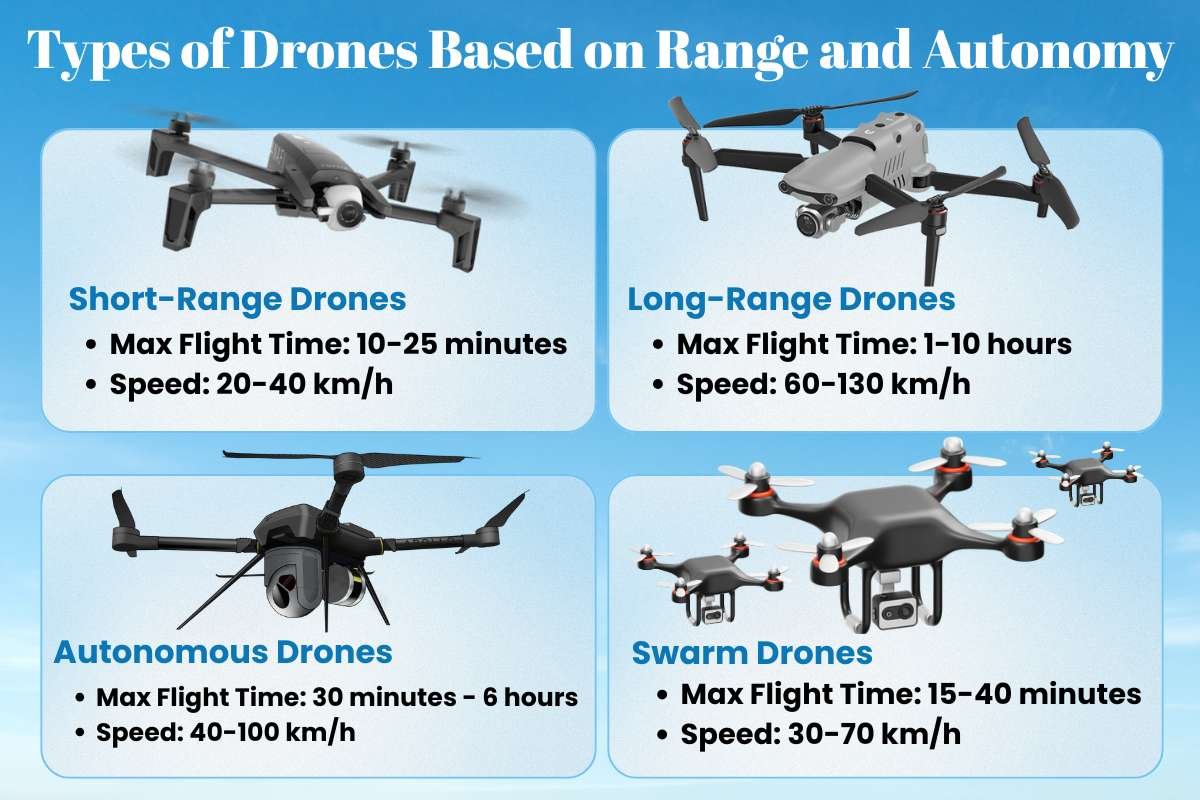
These drone types are defined by how far they fly and how much control they need from humans. As technology improves, these types become smarter, safer, and more independent.
9. Short-Range Drones
Specifications
- Size: Small
- Length: 20-40 cm
- Diameter: 15-30 cm
- Weight: 250 g – 1 kg
- Max Flight Time: 10-25 minutes
- Speed: 20-40 km/h
Short-range drones are designed to stay close to the operator. They work best within the pilot’s line of sight, making them ideal for learning, casual flying, and small tasks like simple photography or inspecting a backyard.
Stability is the main focus of these drones, rather than long-distance travel or speed. Because they are lightweight and easy to control, recovery after a crash is usually simple.
Many people start their drone journey with these models, making them a popular entry point in the world of types of drones.
10. Long-Range Drones
Specifications
- Size: Medium to large
- Length: 80-160 cm
- Diameter: Wide wingspan or rotor span
- Weight: 2-25 kg
- Max Flight Time: 1-10 hours
- Speed: 60-130 km/h
Long-range drones are built for endurance. Unlike short-range drones, they can fly far beyond the pilot’s direct vision, relying on GPS, radio links, and sometimes even satellite communication.
These drones can stay in the air for hours and cover vast areas without landing frequently. Their design emphasizes efficiency and stability over short, fast maneuvers. Long-range drones are perfect for mapping large landscapes, monitoring wildlife, conducting agricultural surveys, and even search-and-rescue operations.
Among the types of drones, they are the choice for professional and commercial use where distance and duration matter.
11. Autonomous Drones
Specifications
- Size: Medium
- Length: 60-120 cm
- Diameter: Varies by design
- Weight: 3-15 kg
- Max Flight Time: 30 minutes – 6 hours
- Speed: 40-100 km/h
Autonomous drones operate with minimal or no manual control. Once programmed, they can handle navigation, altitude adjustments, and route planning independently. These drones use onboard software, sensors, and AI-based decision systems to adapt to wind, obstacles, and unexpected situations.
Because of their ability to make decisions automatically, autonomous drones reduce human error and workload.
They are increasingly used in professional sectors like delivery, industrial inspections, and scientific research. Among the modern types of drones, autonomous models represent a step toward fully self-sufficient aerial systems that can operate reliably even in complex environments.
12. Swarm Drones
Specifications
- Size: Small to medium
- Length: 25-60 cm
- Diameter: 20-45 cm
- Weight: 300 g – 2 kg per drone
- Max Flight Time: 15-40 minutes
- Speed: 30-70 km/h
Swarm drones are among the most advanced types of drones available today. They operate as a coordinated group, communicating in real time to share data and adapt to each other’s movements. This means if one drone fails or encounters a problem, others adjust instantly, keeping the mission on track.
Swarm drones are used in high-tech applications such as defense simulations, large-scale environmental monitoring, and synchronized light shows.
Their collective intelligence allows them to handle complex tasks efficiently, making them a glimpse into the future of collaborative drone systems.
You may also like:
- Enhancing Efficiency: The Benefits of Drones for Business Use
- Is a Drone for Roof Cleaning Right for You? Pros, Cons, and Trends
Advantages, Disadvantages, and Uses
| Drone Type | Advantages | Disadvantages | Primary Uses |
| Short-Range Drones | Easy to control, low cost, safe for beginners | Limited distance and flight time | Training, indoor flight, casual photography |
| Long-Range Drones | Covers large areas, long endurance | Higher cost, complex regulations | Mapping, border patrol, and agriculture |
| Autonomous Drones | Low human effort, consistent routes | Software failure risk, setup complexity | Delivery, inspection, surveillance |
| Swarm Drones | High efficiency, fault tolerance, scalable | Complex control systems, coordination risk | Defense, search operations, and large-area monitoring |
Difference Between UAV and UAS Drones
Many people use the terms UAV and UAS interchangeably, but they are not the same. Understanding the difference is important, especially when discussing advanced types of drones used in industries, research, and defense.
UAV – Unmanned Aerial Vehicle
A UAV is simply the flying part of a drone system. Think of it as the airplane, helicopter, or multi-rotor device itself. It can fly and carry sensors or cameras, but on its own, it cannot complete most tasks without support. It is the hardware that lifts off and moves through the air.
UAS – Unmanned Aircraft System
A UAS is much more than just the flying vehicle. It includes:
- The drone itself (UAV)
- The remote controller or ground control unit
- The software that programs flight paths
- The communication link between the drone and the controller
- Optional ground stations for monitoring
In simple words, if a UAV is the car, a UAS is the car plus the driver, GPS navigation, radio, and fuel. It is the full system that ensures the drone can perform complex missions safely and efficiently.
People often mix these terms, especially in casual conversation. But knowing the difference matters. While a UAV might be used for simple aerial photography, a UAS is necessary for industrial inspections, military surveillance, delivery services, or autonomous drone operations.
Understanding this distinction also helps explain the complexity and capabilities of modern types of drones. Some drones are purely UAVs for hobbyists, while advanced UAS setups handle critical missions that require reliability, automation, and safety.
Future of Drones
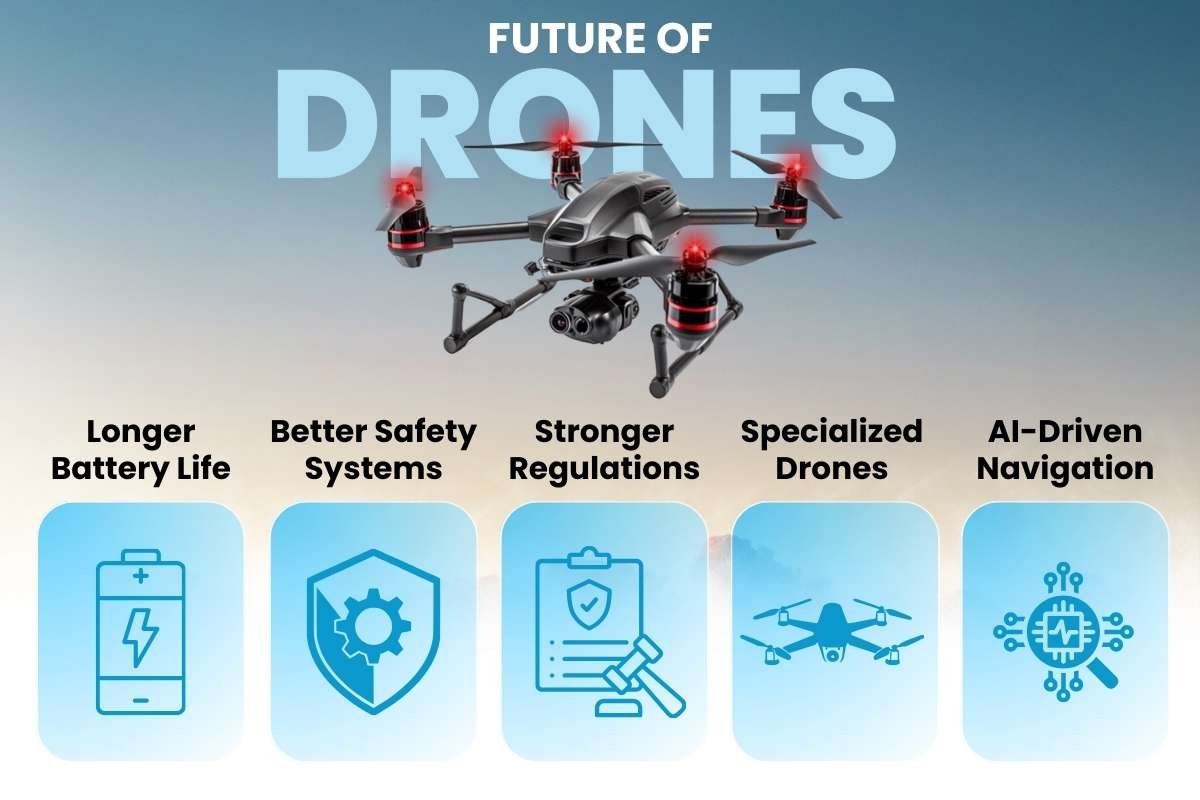
The future of drones looks smarter, safer, and more helpful than ever. Technology is moving fast, and we can expect several major changes in the coming years:
- Longer Battery Life – Batteries are improving, allowing drones to fly longer without landing. This is crucial for delivery drones, mapping missions, and emergency services.
- Better Safety Systems – Drones will have smarter obstacle detection, collision avoidance, and emergency return functions. This will reduce accidents and make flying safer in cities and crowded areas.
- Stronger Regulations – Governments are creating clearer rules for drone use, including no-fly zones, licensing, and public safety measures. This will make drones more accepted for commercial and personal use.
- Specialized Drones – Delivery drones, medical supply drones, and disaster response drones will grow in number. Each of these types of drones will focus on solving real-world problems efficiently.
- AI-Driven Navigation – Artificial intelligence will help drones fly autonomously with minimal human input. They will be able to choose safe routes, avoid obstacles, and coordinate with other drones in swarms.
The next generation of types of drones will focus less on speed and more on reliability, trust, and automation. Drones will become tools that people can depend on for work, safety, and creative projects. From carrying medicine to monitoring forests or capturing breathtaking videos, drones will become smarter partners in everyday life.
Conclusion
Drones started as experiments. They became tools. Now they shape how we work and see the world. From filming moments to saving lives, the types of drones serve clear roles with real value.
Just like shoes or vehicles, one size never fits all. When you understand the types of drones, you make smarter choices, safer flights, and better results. The sky is not crowded. It is organized.
FAQ
Q1) What are the main categories of drones?
- The main categories include consumer, commercial, industrial, and military drones. These types of drones differ in size, power, and purpose.
Q2) Which type of drone is best for beginners?
- Multi-rotor drones work best for beginners. They are stable, affordable, and easy to control compared to other types of drones.
Q3) What is the most common type of drone?
- Multi-rotor drones are the most common. Among all types of drones, they dominate photography and hobby use.