For many teams, the challenge with the GPT-5.2 API isn’t performance — it’s predictability. A feature works in staging, the responses look great, and then the first production invoice lands higher than expected. In most cases, the culprit isn’t input size but output verbosity: reasoning-heavy replies, overly detailed explanations, or repeated structured responses quietly inflate GPT-5.2 API pricing far beyond initial estimates.
When developers understand how the GPT-5.2 model API handles output tokens and how those tokens affect API pricing, they can make simple adjustments that significantly reduce costs. And for teams that find official pricing hard to scale, choosing an API integration platform can offer more predictable cost control without sacrificing model quality.
Where Token Waste Happens in Real GPT-5.2 API Workflows
Even well-designed systems using the GPT-5.2 API can leak tokens in subtle ways. The issue is rarely one large mistake — it’s small inefficiencies that accumulate at scale.
1. Overly Verbose Responses
The GPT-5.2 model API is optimized for deep reasoning, but not every request needs a detailed explanation. Generating step-by-step breakdowns for simple summaries or classifications can double or triple output length. Since output tokens heavily influence GPT-5.2 API pricing, verbosity quickly becomes expensive.
2. Missing Output Limits
Without clear response constraints or max_tokens caps, the model tends to provide fully developed answers. That’s useful during experimentation, but costly in production. Small increases in average response size can significantly affect monthly usage.
4. Retried Structured Outputs
When JSON formatting fails or tool calls return inconsistent fields, developers often resend the request. Each retry produces a full response again. Over time, these repeated calls quietly inflate costs — especially in high-traffic environments.
Comparing OpenAI GPT-5.2 API Pricing with Kie.ai
1. Official GPT-5.2 API Pricing
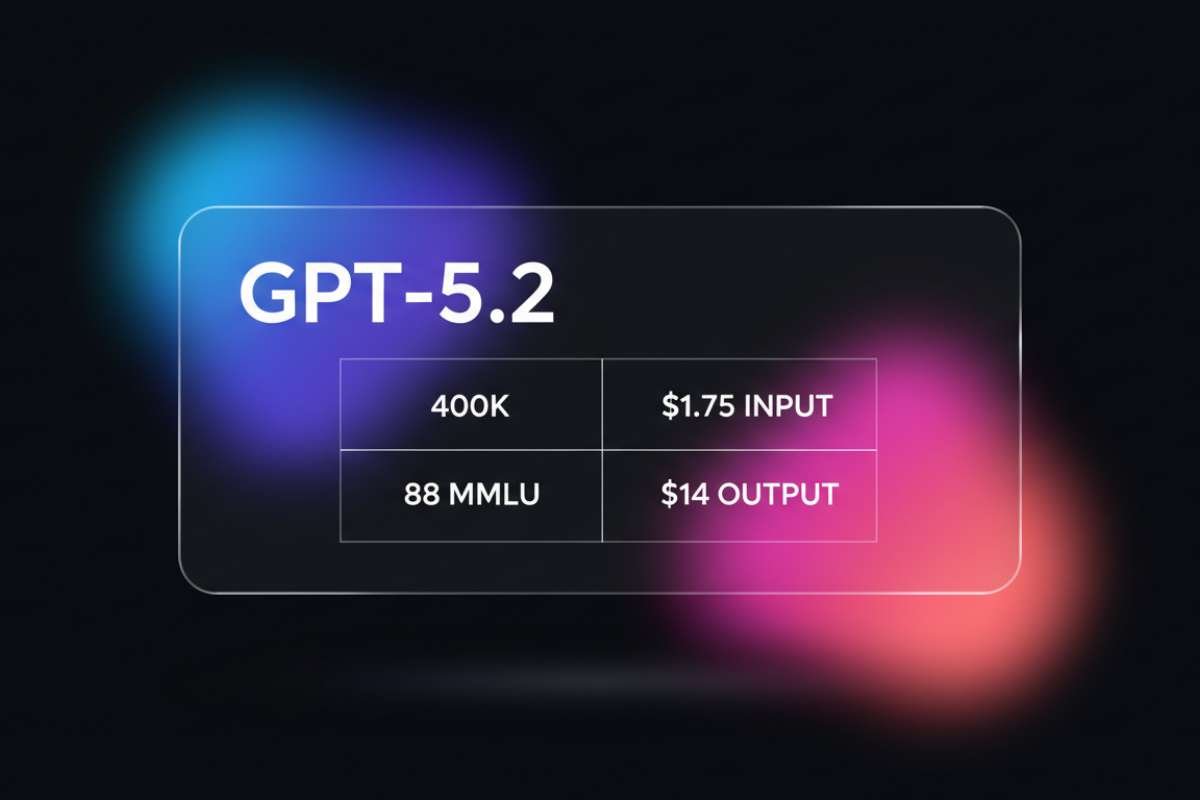
Under OpenAI’s official GPT-5.2 API pricing, input tokens are billed at $1.75 per million tokens, with cached input at $0.175 per million tokens. Output tokens — which typically account for the majority of cost — are priced at $14.00 per million tokens.
2. Kie.ai Pricing for the GPT-5.2 Model API
Through Kie.ai, the GPT-5.2 model API is priced at $0.44 per million input tokens and $3.50 per million output tokens.
That’s roughly 75% lower on output costs compared to official rates. For production systems generating large volumes of responses, the savings scale quickly.
How to Integrate the GPT-5.2 Model API via Kie.ai?
Step 1: Obtain Your API Key and Endpoint
Start by creating an account on Kie.ai and generating your API key. All requests to the GPT-5.2 API are sent to the endpoint, with the model specified directly in the URL path. Authentication is handled through a standard Bearer token in the request header, making integration consistent with common REST-based workflows.
Step 2: Structure Your Chat Request Properly
Requests are sent as JSON payloads containing a messages array. Each message includes a role — such as developer, user, or assistant — and a structured content field. The GPT-5.2 model API also supports unified media input, meaning text, images, audio, or documents follow the same image_url format inside the content array.
Step 3: Control Streaming and Reasoning Depth
By default, responses stream in real time, but streaming can be toggled depending on your application’s needs. The reasoning_effort parameter allows you to choose between “low” and “high” depth. Lower reasoning improves speed and reduces output token usage, while higher reasoning is better suited for complex analysis. Adjusting this setting is one of the simplest ways to balance quality and GPT-5.2 API pricing efficiency.
Step 4: Monitor Usage and Optimize Over Time
Each response includes detailed token statistics, including prompt tokens, completion tokens, and reasoning tokens. Because the GPT-5.2 API provides granular usage data, teams can track where output costs originate and refine prompts accordingly. Combined with Kie.ai’s credit-based billing model, this makes ongoing cost control easier as your application scales.
Practical Tips to Reduce Output Costs Without Sacrificing Quality

Reducing output costs in the GPT-5.2 API doesn’t mean downgrading performance. It means being intentional about how responses are generated.
1. Match Reasoning Depth to Task Complexity
Not every request needs maximum reasoning effort. For straightforward tasks — such as short rewrites, tagging, or simple extractions — lower reasoning settings are often sufficient. Reserve deeper reasoning for complex analysis where the added detail justifies the extra output tokens generated by the GPT-5.2 model API.
2. Avoid Unnecessary Step-by-Step Explanations
Detailed breakdowns are helpful during development, but rarely required in production. If the end user only needs the final answer, instruct the model to provide conclusions without intermediate reasoning. This keeps responses lean while preserving accuracy.
3. Monitor and Refine Prompt Design
Track average completion length and review usage metrics regularly. If certain endpoints consistently generate longer responses, refine the prompt to narrow scope or clarify expected format. With the GPT-5.2 API, small prompt adjustments often lead to measurable cost improvements without compromising quality.
Conclusion: Smarter GPT-5.2 API Usage Beats Bigger Budgets
The real challenge with the GPT-5.2 API isn’t access to capability — it’s managing how that capability is used. As we’ve seen, output tokens often drive the majority of GPT-5.2 API pricing, especially in reasoning-heavy or verbose workflows. Small adjustments in prompt design, reasoning depth, and response limits can make a measurable difference at scale.
Whether you’re working directly with the GPT-5.2 model API or accessing it through a platform that offers more predictable billing, sustainable AI development comes down to discipline. Clear boundaries, aligned model usage, and ongoing monitoring matter more than raw model power. In production systems, smarter usage will always outperform bigger budgets.