
Clinical research stands upon an invisible architecture of trust, rigor, and ethical responsibility. Behind every therapeutic advancement lies a network of professionals whose commitment ensures that clinical data remains credible and that patient safety remains uncompromised. Among these leaders is Melody Sipp, Senior Manager of GCP QA at Blueprint Medicines, A Sanofi Company, whose work represents a powerful blend of scientific discipline, ethical clarity, and patient advocacy.
Across the life sciences industry, regulatory oversight continues to evolve with increasing complexity. Clinical trials expand across multiple regions, technologies reshape monitoring systems, and regulatory expectations demand continuous readiness. Sipp has emerged as a visionary voice in clinical quality and Good Clinical Practice oversight. Her leadership philosophy places the patient at the center of every quality decision while strengthening systems that protect data integrity, regulatory compliance, and therapeutic access.
Her career journey reveals an uncommon combination of ethical conviction, operational expertise, and personal purpose. Through years of navigating clinical oversight, quality frameworks, and regulatory complexity, Sipp has built a reputation for disciplined decision-making anchored in patient advocacy.
A Defining Beginning Rooted in Ethics and Advocacy
Every professional journey carries moments that reshape direction and deepen purpose. For Melody sipp, the path into clinical quality assurance unfolded gradually through experiences that deepened her understanding of the ethical and systemic foundations of healthcare.
Her academic journey began with an undergraduate degree in Biology from Rust College, where she first developed a strong interest in science and the broader healthcare field. As she continued exploring opportunities in healthcare, she spent time studying at Maryville University and later took additional courses at a community college while refining her academic and professional direction.
Her path eventually led her to Saint Louis University, where she had the opportunity to attend Grand Rounds during her studies. Observing real-world clinical discussions and decision-making in these sessions provided an important perspective on the responsibilities healthcare professionals carry and the ethical considerations that guide patient care. The experience offered insight into how clinical decisions are shaped not only by medical expertise but also by the broader systems that support safety and accountability. Although she later chose to leave the program to pursue a master’s degree in healthcare management, the exposure to these clinical conversations helped shape her evolving view of healthcare systems.
In those moments, a powerful realization began to take shape. Protecting patients required more than clinical care alone. It required systems that ensured transparency, accountability, and adherence to ethical standards. That insight planted the seeds for a lifelong commitment to clinical quality.
Personal experience strengthened this conviction even further. Throughout her life, Sipp frequently served as an advocate for family members navigating complex healthcare environments.

The “Mother Test” Philosophy in Clinical Decision Making
Clinical quality environments demand rigorous frameworks capable of balancing regulatory expectations, operational realities, and ethical responsibility. Melody Sipp has developed a personal philosophy that simplifies even the most complex decisions through a human lens.
She often describes a guiding principle known as the “mother test.” When evaluating a quality or compliance decision, she asks a simple question. If this treatment or process affected a loved one, would the outcome inspire confidence and trust?
This perspective ensures that patient safety remains central to every decision. It also reinforces the connection between regulatory compliance and human impact. Behind every dataset stands an individual who entrusted the research process with personal health information and clinical participation.
The “mother test” provides a grounding mechanism that strengthens ethical judgment during moments of uncertainty or operational pressure. This patient-focused lens offers clarity.
Navigating Complexity in Clinical Quality Leadership
Clinical quality assurance operates at the intersection of regulatory oversight, scientific rigor, and operational execution. Every day presents new variables that require careful evaluation and responsible decision-making.
Across her career, Melody sipp has consistently relied upon two guiding priorities when navigating demanding situations: patient safety and data integrity. These principles serve as non-negotiable anchors in environments where regulatory expectations and operational demands continually grow.
These priorities shape every aspect of quality oversight. Decisions surrounding protocol deviations, data discrepancies, inspection readiness, and regulatory documentation all carry implications that extend beyond administrative compliance. Each decision ultimately influences whether therapies remain available to patients and whether clinical outcomes remain trustworthy.
The responsibility associated with this work requires both analytical precision and ethical awareness. Regulatory frameworks such as Good Clinical Practice standards demand strict adherence to procedural requirements. Through this balanced approach, Sipp has demonstrated an ability to guide teams through growing sandboxes.
A Patient Anchored Risk-Based Quality Framework

Effective clinical quality management requires frameworks that strengthen compliance while fostering a culture of accountability across organizations. Sipp has championed a patient-anchored risk-based quality model designed to integrate scientific rigor with practical operational awareness.
Rather than viewing inspection readiness as a periodic exercise, her approach embeds quality into daily operations. Continuous readiness ensures that teams remain prepared for regulatory scrutiny while maintaining strong adherence to Good Clinical Practice standards.
Central to this framework lies scenario-based problem solving. Teams receive encouragement to move beyond procedural checklists and explore the broader consequences of their decisions. This practice promotes a deeper understanding of how clinical actions influence patient safety, regulatory compliance, and data reliability.
Another distinctive element involves connecting data integrity to human behavior. Clinical systems depend upon individuals who collect, document, and interpret research data. Strengthening quality culture, therefore, requires attention to the motivations, understanding, and accountability of those individuals.
Through this lens, quality becomes more than a compliance requirement. It grows into a shared responsibility embedded within organizational culture.
This philosophy aligns strongly with modern regulatory expectations, where authorities increasingly emphasize quality systems that demonstrate proactive oversight rather than reactive corrections.
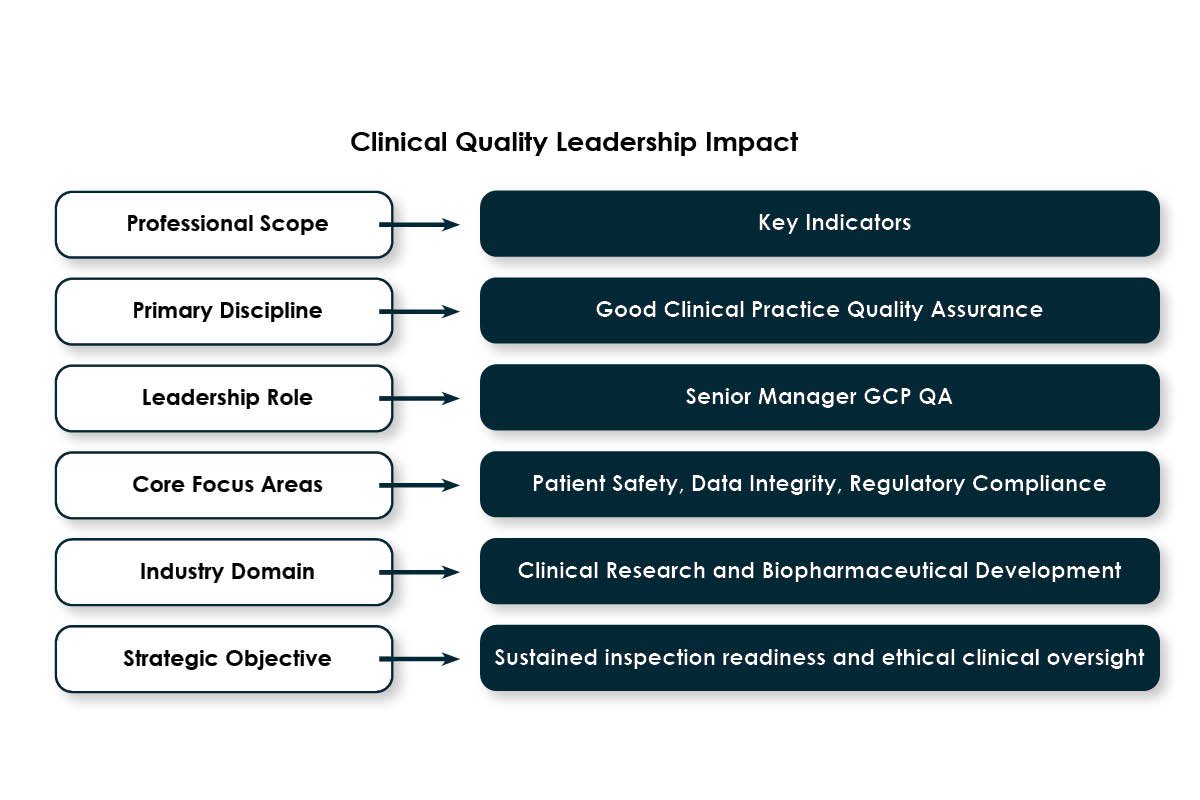
| Clinical Quality Leadership Impact | |
|---|---|
| Professional Scope | Key Indicators |
| Primary Discipline | Good Clinical Practice Quality Assurance |
| Leadership Role | Senior Manager GCP QA |
| Core Focus Areas | Patient Safety, Data Integrity, Regulatory Compliance |
| Industry Domain | Clinical Research and Biopharmaceutical Development |
| Strategic Objective | Sustained inspection readiness and ethical clinical oversight |
Emerging Regulatory Trends Shaping Clinical Research
The next phase of clinical research will experience profound transformation through technological innovation, global regulatory collaboration, and expanding clinical trial complexity.
Melody sipp identifies artificial intelligence as one of the most influential forces shaping quality management in the coming years. AI-powered systems progressively support risk-based monitoring, predictive analytics, and large-scale data analysis within clinical trials.
These technologies introduce new opportunities for early detection of compliance risks and operational inefficiencies. However, they also introduce governance challenges that require careful oversight. Ensuring that automated systems maintain transparency, traceability, and regulatory alignment remains essential.

At the same time, regulatory authorities across the globe continue strengthening collaborative approaches with industry partners. Inspections increasingly emphasize transparency, quality culture, and continuous readiness rather than isolated compliance events.
Sipp believes the most urgent adaptation lies at this intersection of technology and compliance. Maintaining patient safety and data integrity within growing bit-by-bit automated environments will require disciplined governance, ethical awareness, and continuous education.
Ethical Leadership in a Global Regulatory Environment
Clinical research operates within diverse cultural, legal, and regulatory environments. Ensuring ethical practices across these global platforms requires strong leadership principles that remain consistent regardless of geography.
Melody sipp anchors her leadership approach in three foundational values: integrity, character, and passion.
Integrity governs the interpretation and application of regulatory requirements across different regions. It requires transparency in decision-making and adherence to standards that protect patients and preserve scientific credibility.
Character shapes how leaders interact with global teams. Respectful communication, accountability, and openness encourage collaboration across cultural boundaries. These qualities strengthen trust within multinational clinical operations.
Passion sustains the long-term commitment required in a field where outcomes influence human health and therapeutic innovation. This passion reminds quality professionals that behind every data entry stands a participant who placed confidence in the research process.
Through the integration of these principles, Sipp has cultivated leadership grounded in ethical clarity and global awareness. Her approach ensures that quality standards remain consistent while evolution takes place.

Resilience in High-Responsibility Roles
Clinical quality leadership carries considerable responsibility. Regulatory inspections, data reviews, and operational oversight often unfold under significant pressure. Maintaining resilience within such environments requires both perspective and discipline.
For Melody sipp, motivation arises from the understanding that clinical research decisions ultimately affect real people. Every action contributes to protecting patients and ensuring that therapies reach those who depend upon them.
Her resilience strategy relies upon intentional structure and thoughtful boundaries. A disciplined approach to time management supports focus, efficiency, and sustainable productivity.
Faith also plays a meaningful role in shaping her mindset. Reflection and prayer provide opportunities to filter stress, maintain clarity, and respond thoughtfully during demanding situations. This practice strengthens emotional intelligence and supports balanced leadership.
Through these habits, Sipp demonstrates how professionals can sustain excellence in high responsibility environments while maintaining personal balance and purpose.
Recognition and Professional Distinction
Professional recognition often reflects years of disciplined work, ethical commitment, and measurable contribution to an industry. Melody sipp has received several acknowledgments that highlight her dedication to clinical quality and leadership.
She holds certification as a Certified Quality Auditor, a credential that reflects expertise in quality management systems and regulatory oversight.
In addition, her alma mater recognized her with the Rust College 28 Pillars of Excellence honor. This distinction celebrates leadership, service, and commitment to professional excellence.
Her expertise has also received industry attention through a feature in Global Healthcare Magazine, where her work in clinical quality and Good Clinical Practice leadership received recognition among influential professionals within the field.
These achievements illustrate the broader impact of her contributions across healthcare and clinical research communities.

A Vision for the Future of Clinical Quality
As the life sciences industry continues expanding its capabilities, the importance of quality leadership will grow alongside scientific innovation. New therapies, advanced technologies, and global collaboration will create opportunities for progress as well as new regulatory challenges.
Professionals like Sipp demonstrate how strong ethical foundations can guide organizations. Her commitment to patient-centered quality systems offers a model for future leaders who will navigate more and more complex clinical ecosystems.
The role of clinical quality professionals will extend far beyond compliance oversight. These leaders will shape organizational cultures that value transparency, accountability, and patient advocacy at every stage of therapeutic development.
By integrating scientific rigor with ethical clarity, Sipp continues advancing a vision where clinical research operates with integrity and purpose. Melody Sipp’s leadership exemplifies the influence that dedicated professionals can exert in safeguarding both innovation and patient trust.
Key Takeaways
• Patient-centered decision making strengthens ethical clinical quality leadership.
• Continuous inspection readiness improves regulatory resilience across organizations.
• Integration of technology and compliance will shape the future of clinical oversight.
• Strong quality culture requires linking human behavior with data integrity.
• Integrity, character, and passion remain essential pillars of global clinical governance.