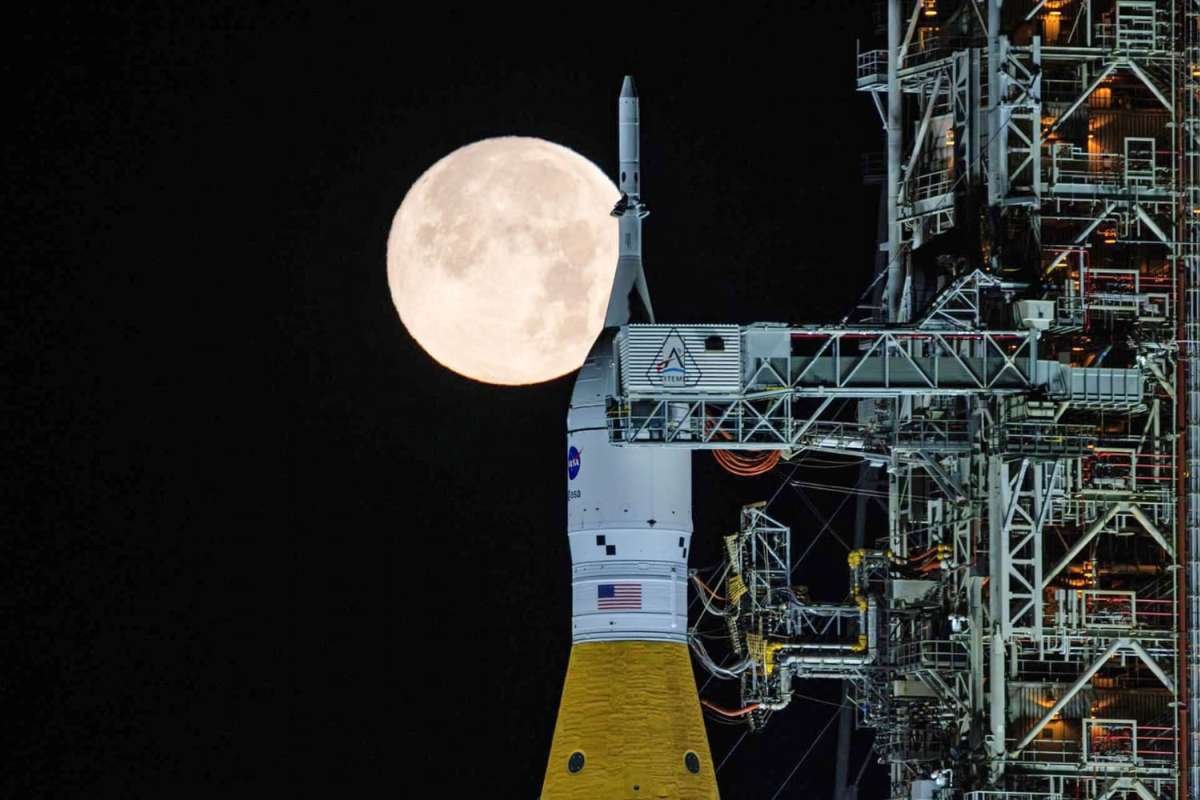
NASA is preparing for a landmark moment in space exploration with the upcoming launch of Artemis II, the first crewed mission to travel toward the Moon in more than five decades. Scheduled for liftoff no earlier than April 2026 from Kennedy Space Center, the mission signals a major return to deep space for human astronauts, something not seen since the final Apollo mission in 1972.
Artemis II follows the success of Artemis I, an uncrewed mission that tested the Space Launch System (SLS) rocket and Orion spacecraft. This time, however, four astronauts will be onboard, marking a critical transition from testing to human exploration. The crew includes Reid Wiseman, Victor Glover, Christina Koch, and Canadian astronaut Jeremy Hansen, representing both experience and international collaboration.
The mission has faced delays due to technical challenges, including system checks and hardware refinements. However, engineers have worked through these issues, and officials now express confidence that the spacecraft is ready for its next phase. The mission is expected to last around 10 days, taking astronauts farther from Earth than any human has traveled in decades.
Inside the Mission and Its Objectives
Unlike future Artemis missions that aim to land astronauts on the lunar surface, Artemis II is designed as a flyby mission. The spacecraft will follow a “free-return trajectory,” looping around the Moon and using its gravitational pull to guide the crew safely back to Earth. This path minimizes risk while allowing NASA to test crucial systems in deep space conditions.
After launch, the Orion spacecraft will first orbit Earth briefly, giving astronauts time to check onboard systems before heading toward the Moon. Once in deep space, the crew will evaluate life-support systems, navigation tools, and communication technologies, key components needed for longer missions in the future.
One of the most important aspects of Artemis II is studying how space affects the human body. Astronauts will be exposed to higher levels of radiation and the challenges of extended travel beyond Earth’s protective magnetic field. These conditions are essential to understand before attempting longer missions, such as those planned for Mars.
The mission will also rely on human observation. While advanced cameras and sensors provide detailed data, astronauts can notice subtle visual features and environmental changes that machines might miss. This human element adds an extra layer of scientific value to the mission.
A critical test will occur during reentry. As the Orion spacecraft returns to Earth, it will enter the atmosphere at extremely high speeds, generating intense heat. The heat shield must perform flawlessly to ensure the crew’s safety. This test is vital for validating the spacecraft’s design for future missions involving lunar landings.
A Foundation for Future Lunar Exploration
Artemis II is not just a standalone mission; it is a stepping stone in a much larger plan. NASA’s Artemis program aims to establish a sustained human presence on the Moon, with future missions targeting lunar landings and the development of infrastructure such as habitats and research stations.
The mission also represents a shift in how space exploration is approached. The crew reflects increasing diversity and international cooperation, signaling a broader era of exploration. These milestones highlight how space missions are evolving to represent not just one nation, but a global effort.
Beyond its technical and scientific goals, Artemis II has captured global attention as a symbol of renewed ambition in space exploration. It bridges the gap between the historic Apollo missions and the future of interplanetary travel. For many, it represents both a return to a familiar destination and the beginning of a new chapter.
As the countdown continues, Artemis II stands as a defining mission, one that will test technology, challenge human limits, and pave the way for humanity’s next giant leap into deep space.