Global internet traffic is expected to surpass hundreds of zettabytes annually, fueled by the rapid rise of cloud computing, video streaming, artificial intelligence, and 5G networks. Behind this explosive growth lies a critical yet often overlooked technology: fiber optics. Capable of transmitting data at the speed of light with minimal loss, fiber optic infrastructure has become the backbone of the modern digital economy.
As countries race to expand high-speed connectivity and businesses demand faster, more scalable networks, the role of the largest fiber optic companies in the world has never been more crucial. These companies are not just supplying cables; they are engineering the global communication framework that powers everything from hyperscale data centers to undersea internet routes spanning continents.
From billion-dollar investments in submarine cable systems to innovations in low-loss optical fiber and smart network solutions, these industry leaders are shaping the future of connectivity. This blog takes a closer look at the key players dominating the market, their technological strengths, and how they are driving the next phase of global digital transformation.
The Global Landscape: Why Fiber Optics is the New Gold
The global economy is becoming increasingly data-driven, and fiber optics sits at the core of this transformation. With internet traffic growing at over 20% annually, the need for faster, more reliable connectivity has made fiber infrastructure a high-value asset. This is why the largest fiber optic companies in the world are rapidly expanding networks and investing in innovation.
Why Fiber Optics Matters?
| High Data Demand | Powers cloud computing, streaming, AI, and IoT at scale |
| 5G Backbone | Essential for low-latency, high-speed mobile networks |
| Global Connectivity | Carries over 95% of international data via submarine cables |
| Scalable Infrastructure | Easily upgradeable without replacing physical networks |
| Strategic Asset | Governments and corporations are investing billions in fiber rollout |
Fiber optics is no longer just infrastructure; it is the foundation of the digital economy, making it one of the most valuable resources in today’s connected world.
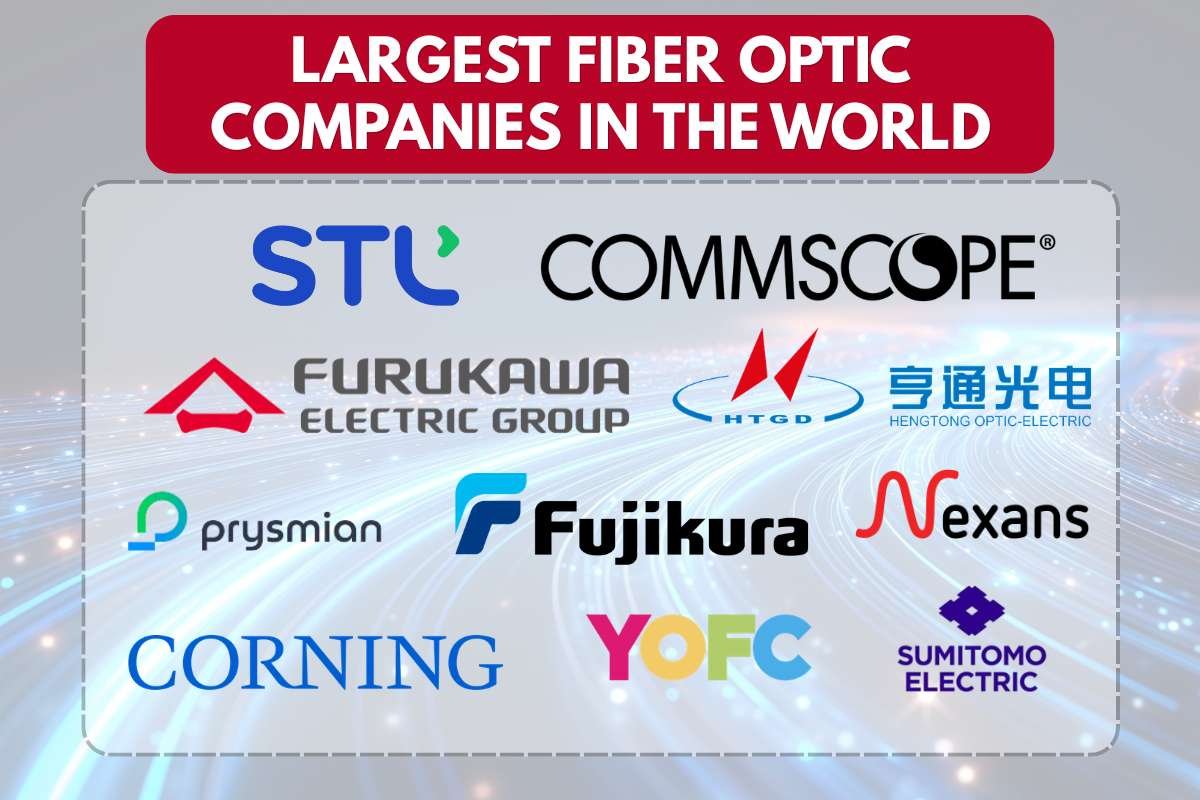
Top 10 Largest Fiber Optic Companies in the World Ranked by Market Capitalization (Least to Most)
The following list is arranged in ascending order, starting from companies with the lowest market capitalization to those with the highest, providing a clear perspective on the scale and financial strength of the key players in the fiber optics industry.
1. Sterlite Technologies (STL)

| Headquarters | Pune, India |
| CEO | Rahul Puri |
| Market Cap | $1.01 Billion USD |
| Primary Specialty | End-to-end optical networking and digital solutions |
| Key Achievement | Key player in India’s digital infrastructure and global fiber rollout |
Sterlite Technologies focuses on building digital networks that support the growing demands of data-driven economies. The company offers integrated solutions that go beyond manufacturing, including network design and deployment services. It has been instrumental in expanding high-speed internet access in emerging markets. STL also prioritizes software-driven network optimization to enhance efficiency. Its approach combines innovation with execution, making it a strong player in global digital transformation initiatives.
2. CommScope Holding Co.

| Headquarters | North Carolina, USA |
| CEO | Charles Treadway |
| Market Cap | $4.33 Billion USD |
| Primary Specialty | Network infrastructure, fiber connectivity, 5G solutions |
| Key Achievement | Major contributor to the global 5G fiber infrastructure deployment |
As one of the largest fiber optic companies in the world, CommScope is known for delivering end-to-end network infrastructure solutions tailored to modern connectivity demands. The company plays a critical role in enabling high-speed broadband access in urban and rural areas alike. Its portfolio includes advanced wireless solutions that complement fiber deployments. CommScope continuously innovates to support the increasing data demands driven by cloud computing and IoT. It also works closely with service providers to enhance network reliability and scalability.
3. Nexans S.A.

| Headquarters | Paris, France |
| CEO | Julien Hueber |
| Market Cap | $5.85 Billion USD |
| Primary Specialty | Electrification systems, cabling, fiber networks |
| Key Achievement | Strong focus on sustainable electrification and smart grid solutions |
Nexans positions itself at the intersection of electrification and digital transformation. The company is actively involved in modernizing power grids and supporting smart city initiatives. Its solutions are designed to improve energy efficiency while reducing environmental impact. Nexans also focuses on circular economy practices, including cable recycling and sustainable sourcing. Through strategic partnerships, it is helping accelerate the global transition toward cleaner energy systems.
4. Furukawa Electric Co.

| Headquarters | Tokyo, Japan |
| CEO | Hideya Moridaira |
| Market Cap | $13.79 Billion USD |
| Primary Specialty | Optical fiber (via OFS), electronics, metals |
| Key Achievement | Developed advanced AllWave® optical fiber technology |
Furukawa Electric has steadily evolved into a technology-driven enterprise with a focus on advanced materials and communication systems. Its global subsidiary network allows it to cater to diverse markets with localized solutions. The company is particularly strong in integrating optical technologies with electronic systems for enhanced performance, positioning it among the largest fiber optic companies in the world. It also plays a role in expanding broadband access in underserved regions. Continuous innovation in fiber design has helped it maintain competitiveness in a rapidly evolving market.
5. Hengtong Optic-Electric

| Headquarters | Jiangsu, China |
| CEO | Jianfeng Zhang |
| Market Cap | $17.04 Billion USD |
| Primary Specialty | Optical fiber cables, submarine cables, and power systems |
| Key Achievement | Major player in subsea fiber optic cable infrastructure |
Hengtong has grown into a major force in the global fiber and power transmission industry. The company is heavily involved in large infrastructure projects, including cross-border connectivity systems. It focuses on delivering integrated solutions that combine optical communication with energy transmission. Hengtong is also investing in smart manufacturing to improve efficiency and scalability. Its rapid expansion highlights the increasing competitiveness of Chinese firms in advanced technology sectors.
6. Prysmian Group

| Headquarters | Milan, Italy |
| CEO | Massimo Battaini |
| Market Cap | $31.56 Billion USD |
| Primary Specialty | Energy cables, telecom cables, submarine fiber systems |
| Key Achievement | World’s largest cable manufacturer and leader in submarine fiber networks |
Prysmian has built a strong global footprint with operations spanning across more than 50 countries. The company is deeply involved in large-scale infrastructure projects, including intercontinental cable systems. Its expertise extends to renewable energy connectivity, particularly offshore wind farms. Prysmian is also known for integrating advanced digital monitoring into its cable systems for improved performance. Strategic acquisitions have further strengthened its leadership position in both energy and telecom sectors, reinforcing its position among the largest fiber optic companies in the world.
7. Sumitomo Electric Industries

| Headquarters | Osaka, Japan |
| CEO | Masayoshi Matsumoto |
| Market Cap | $43.79 Billion USD |
| Primary Specialty | Optical fiber, automotive systems, electronics |
| Key Achievement | Pioneer in global fiber optic communication infrastructure |
Sumitomo Electric benefits from a long-standing legacy of engineering excellence rooted in Japan’s industrial growth. The company operates across multiple high-tech sectors, creating synergies between telecommunications, automotive, and electronics divisions. Its innovations often focus on improving transmission efficiency and durability under extreme conditions. Sumitomo also emphasizes sustainability by developing eco-friendly materials and energy-efficient systems. It maintains strong partnerships with global telecom providers to support next-generation network upgrades.
8. Fujikura Ltd.

| Headquarters | Tokyo, Japan |
| CEO | Naoki Okada |
| Market Cap | $47.61 Billion USD |
| Primary Specialty | Fiber optic cables, fusion splicers, components |
| Key Achievement | Global leader in fiber splicing and connectivity technology |
As one of the largest fiber optic companies in the world, Fujikura has established itself as a specialist in precision technologies that support modern communication systems. The company’s expertise extends to advanced components used in high-performance networks. It continuously refines its manufacturing processes to achieve superior quality and reliability. Fujikura also supports industries like automotive and electronics with specialized solutions. Its commitment to innovation ensures it remains relevant in a fast-changing technological landscape.
9. YOFC (Yangtze Optical Fibre and Cable)

| Headquarters | Wuhan, China |
| CEO | Zhuang Dan |
| Market Cap | $96.80 Billion USD |
| Primary Specialty | Optical fiber preforms, cables, telecom solutions |
| Key Achievement | One of the world’s largest optical fiber preform manufacturers |
YOFC has rapidly expanded its global presence, becoming a key contributor to the fiber optic supply chain. The company emphasizes vertical integration, ensuring quality control from raw materials to finished products. It is actively involved in large-scale telecom projects across Asia, Europe, and Africa. YOFC also invests in research to improve fiber capacity and transmission performance. Its growth reflects China’s increasing influence in the global telecommunications infrastructure market.
10. Corning Inc.

| Headquarters | Corning, New York, USA |
| CEO | Wendell P. Weeks |
| Market Cap | $121.83 Billion USD |
| Primary Specialty | Optical fiber, specialty glass, connectivity solutions |
| Key Achievement | Invented low-loss optical fiber, enabling modern telecommunications |
Corning has played a foundational role in shaping the global telecommunications ecosystem through decades of material science innovation. The company invests heavily in R&D, consistently pushing the boundaries of glass and ceramic technologies, securing its place among the largest fiber optic companies in the world. Its solutions are widely used in data centers, enterprise networks, and emerging 5G infrastructure. Corning also collaborates with major telecom operators to enable faster and more reliable connectivity worldwide. Beyond telecom, it has a strong presence in industries like life sciences and consumer electronics, making it highly diversified.
Read Next:
- 20 Richest Companies in the World: Trillion-Dollar Giants Powering the 2025 Economy
- 20 Innovative Tech Companies Currently at the Frontline of Technology
Conclusion
The largest fiber optic companies in the world are not just competing on market capitalization; they are shaping the very foundation of the global digital economy. As data consumption continues to surge and technologies like 5G, AI, and cloud computing expand, the importance of robust fiber infrastructure will only grow stronger.
What stands out across these companies is their ability to combine innovation with large-scale execution. From developing advanced optical fibers to building cross-continental networks, each player contributes to a more connected and efficient world. At the same time, increasing investments in sustainability, smart networks, and high-capacity systems signal a future where fiber optics will remain central to technological progress.
Looking ahead, the companies that can scale rapidly, innovate consistently, and adapt to evolving digital demands will lead the next wave of transformation. In many ways, fiber optics has become the invisible engine powering modern life, and these industry leaders are driving it forward.
FAQs
1. What makes fiber optic technology essential for the modern digital economy?
Fiber optic technology enables ultra-fast data transmission with minimal latency and signal loss. It supports high-demand applications like cloud computing, AI, streaming, and 5G networks, making it the backbone of global digital infrastructure.
2. Which factors determine the ranking of the largest fiber optic companies in the world?
The ranking is primarily based on market capitalization, but also considers technological innovation, global presence, product portfolio, infrastructure projects (like submarine cables), and contribution to telecom and data ecosystems.
3. How do fiber optic companies contribute to global connectivity?
These companies design, manufacture, and deploy fiber networks, including undersea cables that carry over 95% of international data. They enable seamless communication between continents, data centers, and telecom networks worldwide.
4. Why are governments and corporations investing heavily in fiber optic infrastructure?
Fiber optics is a scalable and future-proof technology that supports growing data consumption. Investments are driven by the need for faster internet, digital transformation, smart cities, and nationwide broadband expansion.
5. What role will the largest fiber optic companies in the world play in future technologies like 5G and AI?
These companies will be critical in building high-capacity, low-latency networks required for 5G, AI, IoT, and edge computing. Their innovations will directly impact how efficiently next-generation technologies operate at scale.