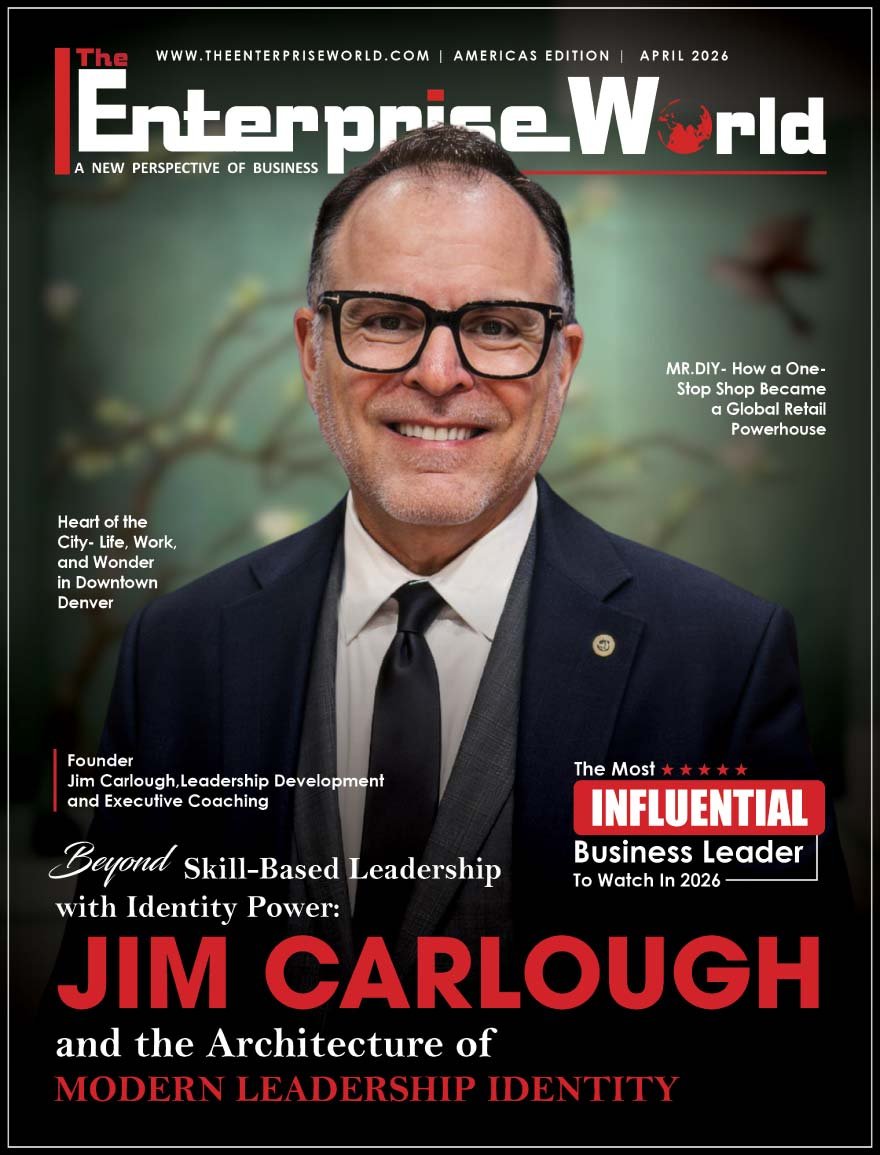
The modern leadership economy stands at a structural inflection point where performance analytics, automation, and artificial intelligence are redefining operational excellence. Technical mastery has become widely accessible. Execution frameworks are abundant. Information is immediate. In this environment, sustainable differentiation rests on a rarer asset: identity.
At this intersection, Jim Carlough has positioned himself as a consequential force in executive development. He is a leadership coach by profession and a Leadership Identity Architect by philosophy, advancing a disciplined thesis that leadership failure rarely originates from inadequate skill. It originates from a fractured belief. Leaders falter when competence outpaces identity.
As Founder of Jim Carlough, Leadership Development and Executive Coaching, headquartered in McKinney, Texas, Carlough advances a structured, identity-first methodology designed to build leaders from the inside outward. His work reframes leadership development from behavioral correction to internal architecture. Skills remain essential. Identity determines whether those skills are consistently and confidently deployed.
The Emergence of Leadership Identity Architecture
Carlough’s journey toward leadership identity work began long before he adopted the title. Across more than three decades in executive roles, he helped scale organizations from $100 million to over $1 billion in enterprise value. During formative years under the mentorship of other leaders from Perot Systems, he observed a disciplined model of values-driven leadership in action.
During volatile economic cycles, including the turbulence surrounding the dot-com era, left a lasting imprint. Integrity functioned as operating infrastructure. Humor diffused pressure during high-stakes negotiations. Character secured loyalty more effectively than authority. These were not personality traits displayed for effect. They were disciplined behaviors anchored in identity.
As Carlough transitioned into coaching in 2024, he encountered a leadership development market saturated with tactical instruction. Communication workshops. Productivity models. Situational management systems. Each provided utility. Few addressed the central constraint he had observed for decades: leaders doubting their own legitimacy.
“The most technically gifted managers I encountered were failing as leaders because they did not see themselves as leaders,” Carlough reflects. “The gap was internal.”
That insight formed the foundation of Leadership Identity Architecture, a methodology structured around building belief before expanding behavior.
A Defining Leadership Inflection

Every leadership philosophy is shaped by lived experience. Early in his executive ascent, Carlough entered a leadership role for which he was operationally prepared and psychologically underdeveloped. He understood the business model, revenue drivers, and execution pathways. He lacked a framework for earning trust, navigating conflict, and making visible decisions under scrutiny.
He equated authority with leadership. Directives replaced dialogue. Problem-solving replaced coaching. The result was predictable: disengagement, underperformance, and tension across the team.
That period became catalytic. The question shifted from tactical execution to personal transformation. Instead of asking, “What should I do?” he began asking, “Who must I become to lead effectively?”
The distinction between doing and being remains central to his framework. Leadership is identity before function. Behavior follows belief.
The Six Pillars of Effective Leadership
At the core of Carlough’s methodology is the Six Pillars of Effective Leadership:
- Integrity
- Focus
- Compassion
- Stability
- Empathy
- Humor
These pillars operate as measurable, trainable competencies grounded in distinctly human capability. In an era increasingly shaped by algorithmic intelligence, Carlough positions these attributes as the enduring competitive advantage.
Integrity establishes credibility under scrutiny.
Focus ensures disciplined execution amid distraction.
Compassion sustains engagement in demanding environments.
Stability anchors teams during volatility.
Empathy builds relational capital across hierarchies.
Humor strengthens resilience during sustained pressure.
The Six Pillars Executive Leadership Accelerator, a structured 12-week program, operationalizes these competencies through individual coaching, cohort-based development, and enterprise deployment.

| Scaling Identity-Centered Leadership | |
|---|---|
| Phase | Evolutionary Shift |
| Executive Career | Led organizational growth from $100M to $1B |
| Mentorship Era | Values-driven leadership under Ross Perot |
| Strategic Insight | Recognition of the widespread identity gap |
| 2020 | Founded an identity-first coaching practice |
| Today | Enterprise-level Six Pillars deployment |
Proprietary Tools and Applied Frameworks
Beyond conceptual philosophy, Jim Carlough has engineered applied decision systems to reinforce identity transformation.
The ANCHOR Decision Framework, Assess, Name, Consider, Hold, Own, Review, provides a repeatable structure for confident decision-making under pressure. It addresses hesitation rooted in self-doubt, a recurring constraint among high-performing managers transitioning into leadership roles.
The Leadership Presence Assessment evaluates credibility across communication patterns, executive posture, conflict navigation, and decision clarity. Leaders identify areas where authority may be undermined by subtle behavioral leakage.
A structured 30-day confidence protocol accelerates early behavioral reinforcement, ensuring identity shifts translate into observable execution.
These tools converge within the Six Pillars Accelerator, integrating belief recalibration with disciplined performance management.

| The Six Pillars Framework | |
|---|---|
| Pillar | Strategic Leadership Impact |
| Integrity | Ethical credibility and trust capital |
| Focus | Strategic alignment and execution discipline |
| Compassion | Talent retention and engagement |
| Stability | Composure during uncertainty |
| Empathy | Cross-functional influence and cohesion |
| Humor | Cultural resilience and morale strength |
Measurable Organizational Outcomes
Identity transformation carries measurable enterprise implications. Carlough’s engagements consistently produce tangible performance outcomes.
One healthcare director, with fifteen years of clinical expertise, had been overlooked for promotion twice. Her competence was widely acknowledged. Her self-perception limited her authority. Through structured Six Pillars application, she strengthened decision clarity, engaged in avoided conversations, and recalibrated her executive presence. Within six months, she secured a promotion. Unit turnover declined. Engagement scores improved.
At scale, organizations facing succession pipeline risk have deployed the Six Pillars framework to prepare emerging leaders. Reported outcomes include stronger internal promotion readiness and reduced external recruitment expenditure.
Supporting research reinforces economic relevance. Gallup reports that managers account for 70 percent of variance in employee engagement, with disengagement costing organizations approximately $1.9 trillion annually in lost productivity. Identity-driven leadership addresses this leverage variable directly.

| Impact Metrics Across Engagements | |
|---|---|
| Performance Dimension | Observed Result |
| Decision Confidence | Measurable improvement within 14 days |
| Succession Readiness | Increased internal promotion viability |
| Leadership Turnover | Reduction in manager-linked attrition |
| Healthcare Engagement | Improved retention and satisfaction indicators |
Leadership in 2026 and Beyond
Carlough identifies three structural shifts shaping the next era of leadership.
The AI Identity Crisis
As automation absorbs technical tasks, organizations require leaders capable of trust-building, ethical discernment, and emotional steadiness. Human distinctiveness becomes strategic capital.
The Succession Emergency
Organizations continue promoting top performers without addressing identity readiness. Capability without confidence weakens pipelines and erodes engagement.
From Compliance to Commitment
Command-and-control systems generate transactional performance. Modern knowledge workers respond to meaning-driven leadership anchored in empathy and integrity.
The organizations that integrate identity development into leadership pipelines will secure long-term talent advantage.
Publishing, Media, and Public Dialogue
Jim Carlough contributes to executive discourse through writing, speaking, and advisory work. His book, The Six Pillars of Effective Leadership: A Roadmap to Success, challenges the myth of the “born leader” and presents a structured alternative rooted in disciplined development.
His ebook portfolio addresses focused leadership challenges including integrity, empathy, focus, humor, and influence without title.
Media features include:
- Digital Journal
- USA News
- All Around Worlds
- ABC, NBC, CBS, and their affiliates
He continues to pursue contributions to leading executive forums including Harvard Business Review and Forbes Business Council.
Ethics, Confidentiality, and Professional Discipline
Integrity anchors both philosophy and practice. Coaching engagements operate under strict confidentiality standards. Development narratives remain sovereign to each leader. Feedback is treated as operational data rather than personal critique.
Carlough maintains that ethical coaching requires alignment with client values and measurable accountability. Influence without integrity erodes long-term credibility.
Strategic Growth and Partnerships

Expansion priorities center on healthcare systems, enterprise HR partnerships, and speaker bureau affiliations. His proximity to healthcare leadership challenges provides contextual fluency within clinical environments.
Train-the-trainer certification pathways are under development to enable scalable enterprise deployment of the Six Pillars methodology.
A Leader to Watch
Jim Carlough represents a disciplined evolution in executive development. By centering leadership identity as the foundational variable influencing performance, engagement, and succession readiness, he advances a model aligned with modern enterprise realities.
In an economy shaped by automation and accelerated change, identity-rooted leadership provides structural resilience. Character precedes charisma. Belief precedes behavior. Architecture precedes scale.
Carlough’s work positions him as a defining contributor to the next chapter of leadership development.
An Open Letter to Emerging Leaders
To the next generation of leaders and entrepreneurs,
Stop waiting to be chosen.
The barrier between potential and influence is rarely technical competence. It is belief. Leadership is a decision enacted before it is a designation granted.
Develop integrity when visibility is limited. Practice empathy before authority demands it. Bring stability into environments defined by volatility. Apply disciplined focus to complexity. Introduce humor where tension accumulates.
You do not require certainty in every decision. You require clarity about who you are and what you stand for.
Leaders are made. The making begins with a deliberate choice.
Jim Carlough
Leadership Identity Architect
KEY TAKEAWAYS
- Identity precedes skill in sustainable leadership development
- Human-centered competencies represent enduring competitive advantage
- Structured frameworks convert belief into measurable execution
- Succession pipelines strengthen through identity preparation
- Leadership begins with internal authorization