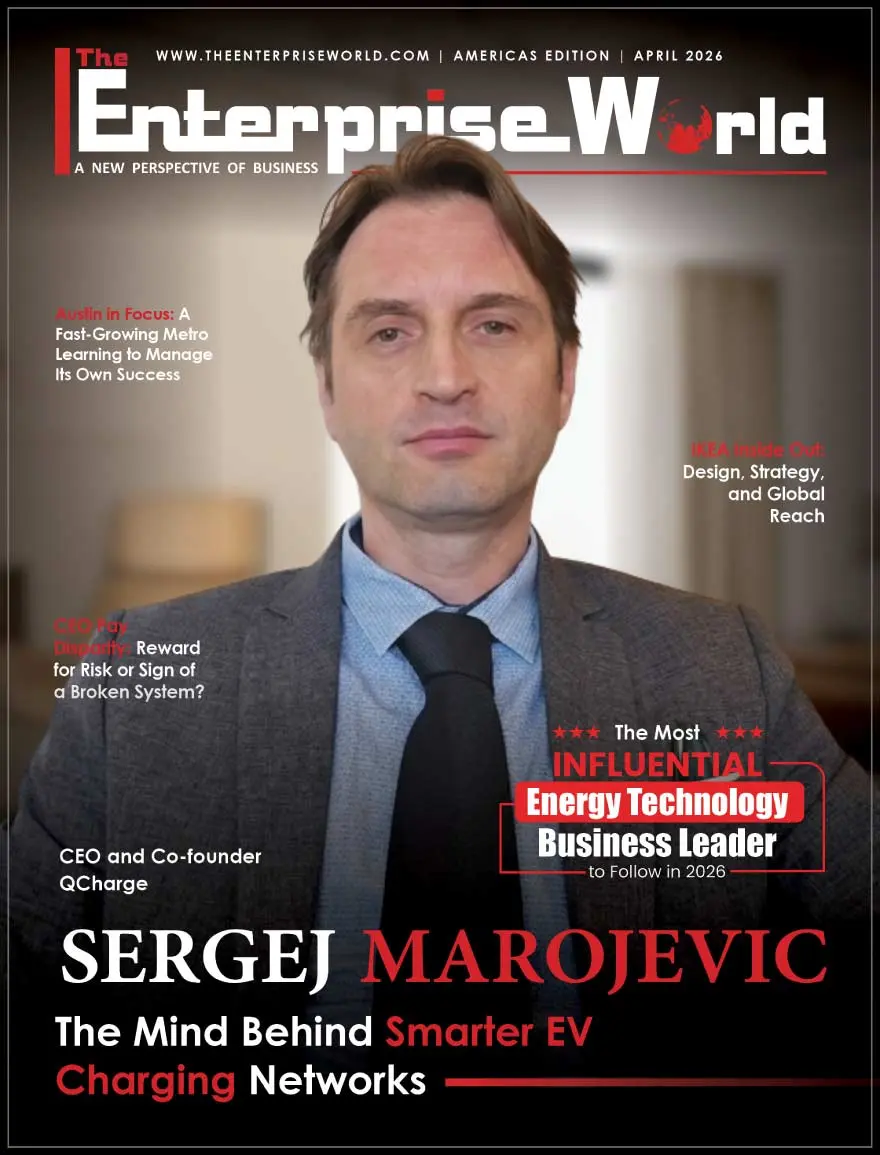
The shift toward electric vehicles is quietly transforming transportation. Electric cars offer cleaner cities and smarter energy use, but their success depends on reliable infrastructure that serves everyone, from city residents to commercial fleet managers. Leaders who combine innovation with dependability are shaping the future of electric vehicle charging.
Sergej Marojevic, CEO and co-founder of QCharge, is a key figure in this change. With more than 20 years of experience in electrical engineering and manufacturing, and a background in mechanical engineering from the University of Belgrade, he has personally helped install over 30,000 EV chargers. In 2023, he started QCharge to provide complete solutions such as charging stations, solar carports, and custom applications. Marojevic’s journey, from fleeing conflict in the former Yugoslavia to building expertise in the United States, reflects a combination of resilience and technical skill focused on making EV charging efficient, affordable, and protected against theft for commercial properties across the country.
Creating a Smarter Approach to Electrification
QCharge did not start in a boardroom but in the field. Before founding the company, Marojevic spent over 20 years working as an electrical contractor and infrastructure specialist, managing and installing complex power systems. He was directly involved in thousands of charging installations across various markets and saw how quickly electrification was advancing – faster than the supporting infrastructure could handle.
Marojevic observed that the early electric vehicle charging industry was fragmented. Hardware manufacturers focused on selling equipment, networks concentrated on gaining users, and installers aimed to complete projects quickly.“What was missing was integration, a long-term performance strategy, and accountability for uptime,” he explained.
He witnessed common problems such as grid limitations overlooked before installation, insufficient transformer capacity, unpredictable utility approval delays, and site owners unsure how to achieve a measurable return on investment. Despite enthusiasm, “there was not enough engineering discipline behind it.”
Recognizing the gap, Marojevic understood the market did not need more chargers but smarter infrastructure solutions built to last. QCharge was founded with the mission to create a fully integrated electrification company providing turnkey services, from engineering and permitting to deployment and long-term operation. “From day one, my vision was not to compete in hardware sales but to modernize how electrification is executed across the United States.”
He stresses that electrification is not just about vehicles but about upgrading the nation’s energy backbone.“The demand is huge, and officials cannot keep up for several reasons: shortage of manpower, bureaucracy, overwhelming applications, and limited resources,” Sergej Marojevic adds.
The Challenges of Scaling EV Infrastructure the Right Way
Every entrepreneurial journey faces critical challenges. For QCharge, the most difficult period was scaling carefully during a time of market excitement and supply chain instability. A major obstacle was funding. These projects require significant upfront investment and involve long sales cycles, making steady financial support essential yet hard to secure. Although governments offer incentives, smaller operators often find it nearly impossible to access these programs without strong political connections. “It’s all about who you know,” Marojevic noted.
As demand for EV infrastructure grew rapidly across multiple states, QCharge faced the temptation to expand quickly. However, Marojevic understood early that infrastructure is unforgiving. “A poorly executed charging site does not just fail quietly; it damages reputation and capital.”
The company also faced challenges such as fluctuating lead times for transformers and switchgear, inconsistent municipal electrical code interpretations, lengthy utility interconnection delays, hardware and firmware issues, slow permitting, and unstable material and labor costs.
QCharge made a strategic choice to grow slowly and strengthen its systems. It invested in detailed engineering documentation, compliance tracking, vendor redundancy, predictive maintenance, project management, and building internal hardware, software, and installation capabilities.
Sergej Marojevic’s key lesson was clear: “Growth without structure creates fragility.” Infrastructure companies must plan for the long term, adopting discipline, documentation, and systems thinking before scaling. This cautious approach ultimately built QCharge’s operational strength and reputation for reliability rather than hype.
Engineered Trust: QCharge’s Framework

- Aligned with NEC standards and utility interconnection rules
- Adheres to municipal codes and ADA accessibility where required
- Follows OCPP interoperability frameworks
- Complies with federally aligned incentive program standards
- Uses encrypted communications and multi-layer data security
- Maintains rigorous, transparent documentation and governance systems
Using Feedback to Build Stronger and More Reliable Systems

QCharge views feedback as valuable operational insight and welcomes constructive criticism. Acknowledging that neither the company nor the world is perfect, it remains committed to delivering on its promises.
In one project, communication instability caused occasional downtime due to carrier signal fluctuations. Rather than using temporary fixes, QCharge implemented a standardized multi-carrier SIM redundancy system for future installations. Additionally, it introduced safe switches to maintain charger operation during outages or network issues.
The results included a significant decrease in communication-related downtime, more reliable remote diagnostics, and increased client confidence in reporting. QCharge also emphasizes the importance of client guidance and education on its systems, relying on proactive collaboration with partners for effective troubleshooting.
Sergej Marojevic believes that setbacks, when examined objectively and addressed cooperatively, strengthen both systems and relationships.
A Smarter Way to Design and Operate EV Charging Systems
QCharge approaches a core problem in the EV charging industry differently. While many see installation as the final step, QCharge views it as the start of a 10 to 15-year operational lifecycle. The main issue it addresses is the gap between initial deployment and long-term performance.
QCharge stands out through a comprehensive framework:
- Turnkey Electrification Engineering: QCharge handles everything from site feasibility, load studies, transformer sizing, trenching design, permitting, commissioning, to network setup. This removes the usual disconnect between contractors, hardware suppliers, and network operators, providing a seamless experience for clients.
- Dynamic Load Intelligence: Instead of oversizing infrastructure, QCharge uses smart load balancing and tariff-aware charging to optimize grid capacity. Each project is individually assessed, with options to go completely off-grid if needed.
- Zero Downtime Protocol (ZDP): Its operations include remote diagnostics, communication redundancy, software monitoring, rapid service response, performance analytics, and multiple ways to activate chargers, ensuring continuous uptime.
- Owner-Operator Strategic Models: QCharge works closely with clients to design systems that align with their goals, maximizing uptime and profitability. While not all client expectations can be met due to evolving technology, transparency about possibilities is a priority.
- Grid-Aware Deployment: Every site is evaluated for grid capacity, demand charges, interconnection risks, and battery storage potential.
Marojevic explains, “Our strength lies not in a single device but in integrating engineering, regulatory knowledge, financial planning, and reliable operations. And if all else fails, we offer off-grid solutions.”
Successful EV Infrastructure Solutions for Commercial Sites
Multi-Site Commercial Portfolio Deployment
A commercial property group needed integrated Level 2 and DC fast charging across multiple locations. Initial analysis showed limited transformer capacity and high expected demand charges.
QCharge’s solution involved conducting detailed site studies, implementing dynamic load balancing, and designing appropriate hardware. It worked closely with local utilities to optimize interconnection timelines, managed procurement, and coordinated local installation crews.
The results included over 98% operational uptime, an 18–22% reduction in projected demand charges, improved tenant retention through sustainability upgrades, and increased property values linked to strong ESG (Environmental, Social, and Governance) performance.
Fleet Charging Optimization at Private Locations
A logistics company was facing rising peak demand penalties due to unmanaged simultaneous charging of its fleet vehicles.
QCharge redesigned the charging schedules to align with tariff structures, integrated smart load distribution algorithms, and provided enhanced monitoring dashboards for fleet managers. It also offered a flexible monthly subscription plan tailored for fleet operators.
This approach reduced peak demand costs by more than 20%, improved charging efficiency, increased transparency for ESG reporting, and minimized downtime through predictive diagnostics.
These examples show how intelligent engineering can turn EV charging from a cost burden into a valuable strategic asset.

QCharge Growth at a Glance

- Double-digit year-over-year operational growth
- Active across multiple U.S. states: private, commercial, and fleet sectors
- Managing both private and public charging connectors
- Client retention consistently above 90%
- Engineering and project teams scaled in line with deployments
- Growing use of battery storage modeling in charging projects
- Continuous system innovations and monthly R&D advancements
- Growth driven by robust systems and sustainability, not speculation

Partnering Across the Industry to Build Better Charging Networks
Strategic partnerships have been essential to QCharge’s growth. The company works closely with electrical contractors, engineering consultants, utility providers, hardware manufacturers, software developers, energy storage integrators, and property portfolio operators. QCharge emphasizes hardware-agnostic flexibility and interoperability to protect client interests, as long as partners are willing to integrate with its software solutions.
Because integration can be complex and time-consuming, QCharge developed its own hardware. This allows faster, more secure deployments and better control over troubleshooting without relying on third parties.
Looking forward, QCharge is exploring partnerships in several key areas: large-scale fleet electrification hubs, public supercharging centers, integrated battery energy storage system deployments, cross-border electrification projects, and infrastructure capital collaborations.
Sergej Marojevic explains, “The next wave of electrification will require ecosystem alignment; not isolated deployment.” This reflects QCharge’s belief that coordinated efforts across the industry are necessary to successfully meet growing demand and build a sustainable electric vehicle infrastructure.

Creating a Culture Focused on Innovation and Accountability
QCharge’s culture is built on engineering rigor, accountability, long-term thinking, continuous improvement, and forward-looking vision. The company attracts talent by offering engineers the chance to make a meaningful impact on real-world infrastructure. Rather than working on theoretical models, QCharge’s engineers modernize power systems using years of practical experience behind every decision and design.
Employee retention is supported through a strong sense of ownership, clear performance metrics, and opportunities for professional growth. This approach fosters a committed and skilled team dedicated to advancing the future of electrification.

The Future of EV Charging Infrastructure and Industry Growth
The electric vehicle infrastructure industry is set to change significantly through 2026 and beyond. In 2025, some U.S. states saw a 22% increase in EV sales and new users, highlighting the urgent need to accelerate infrastructure development and automotive industry changes. Otherwise, China risks dominating the U.S. market. Sergej Marojevic notes, “We are already boxed in,” with U.S. vehicle exports dropping due to high demand for affordable cars that the U.S. struggles to produce. A new, aggressive approach is needed.
Grid constraints will shape deployment strategies. Utility capacity limits, transformer shortages, and interconnection delays will affect project timelines more than available incentives. With growing electricity demand from data centers and crypto miners, the aging grid infrastructure faces increasing pressure.
Battery Energy Storage Systems (BESS) paired with DC fast charging will become essential for peak demand management, grid stability, and reducing costs.
Reliability standards will tighten, with uptime transparency becoming mandatory, following federal guidelines like NEVI.
Artificial intelligence will play a key role by optimizing charging schedules, predicting maintenance needs, forecasting demand, and enabling dynamic pricing.
Industry consolidation is expected, as operators lacking capital and discipline may exit or merge.
Risks often underestimated include long-term maintenance costs, software and hardware integration challenges, and delays in grid upgrades. On the other hand, opportunities lie in fleet electrification depots, integrated solar-storage-charging systems, and viewing infrastructure ownership as an asset.
Marojevic emphasizes, “Electrification is moving from innovation to infrastructure, demanding greater maturity.”
Sharing Ideas and Insights Across the Industry
QCharge’s leadership actively participates in industry discussions, expos, infrastructure panels, investment forums, and strategy sessions focused on EV deployment and energy modernization.
The company also shares its insights through its podcast, “Q in Charge,” which covers not only electric vehicles but also developments in other industries and technologies worldwide.
Sergej Marojevic emphasizes the importance of a global perspective, noting that “we need to work on a global level since resources and challenges extend beyond U.S. borders.” He also highlights the complexity and time required to make projects operational.
QCharge maintains a presence on social media platforms such as Facebook, Instagram, and TikTok to engage with a wider audience and share updates.

Open Letter to the Next Generation
Dear emerging leaders in energy technology,
Master the fundamentals before chasing scale. Understand power flow, study grid economics, and learn regulatory frameworks. Combine engineering discipline with financial literacy. Above all, stay resilient—obstacles will test you at every turn, and giving up is the easy path to avoid.
Electrification will shape the next industrial decade. It demands integrity, resilience, and systems thinking. Build credibility, protect your reputation, and prioritize reliability over speed. Infrastructure rewards patience.
Sergej Marojevic
CEO and Co-Founder, QCharge

5 Key Takeaways from Sergej Marojevic’s Impact on EV Infrastructure
- Building Infrastructure, Not Just Chargers: The success of electric vehicles depends on reliable infrastructure. A long-term, engineering-driven approach is essential to ensure EV charging networks operate efficiently and sustainably.
- Experience from the Field Matters: Years of hands-on experience in power systems helped shape practical solutions for real-world challenges in EV charging deployment and operations.
- Careful Growth Creates Strong Foundations: Expanding too quickly can weaken infrastructure projects. Strategic planning, strong systems, and disciplined execution are critical for long-term success.
- Collaboration Drives Industry Progress: Partnerships with utilities, contractors, engineers, and technology providers play a key role in building scalable and reliable EV charging networks.
- The Future of Electrification Requires Smarter Systems: As EV adoption grows, technologies like smart load management, battery storage, and AI-driven optimization will become essential for efficient and reliable charging infrastructure.