Account-Based Marketing vs. Inbound Marketing is no longer about choosing one over the other. This blog explores the strengths, differences, and shared principles of both strategies while showing how an integrated approach helps B2B businesses attract the right prospects, engage buying committees with personalized experiences, and accelerate revenue growth. Learn practical frameworks and actionable steps to build a scalable, high-performing B2B marketing engine.
What if your growth strategy reaches only 5% of your market?
The debate around Account-Based Marketing vs. Inbound Marketing is no longer about choosing one over the other. According to Gartner, the average B2B buying decision involves 6–10 stakeholders, while research from the LinkedIn B2B Institute and the Ehrenberg-Bass Institute shows that up to 95% of buyers aren’t actively in-market.
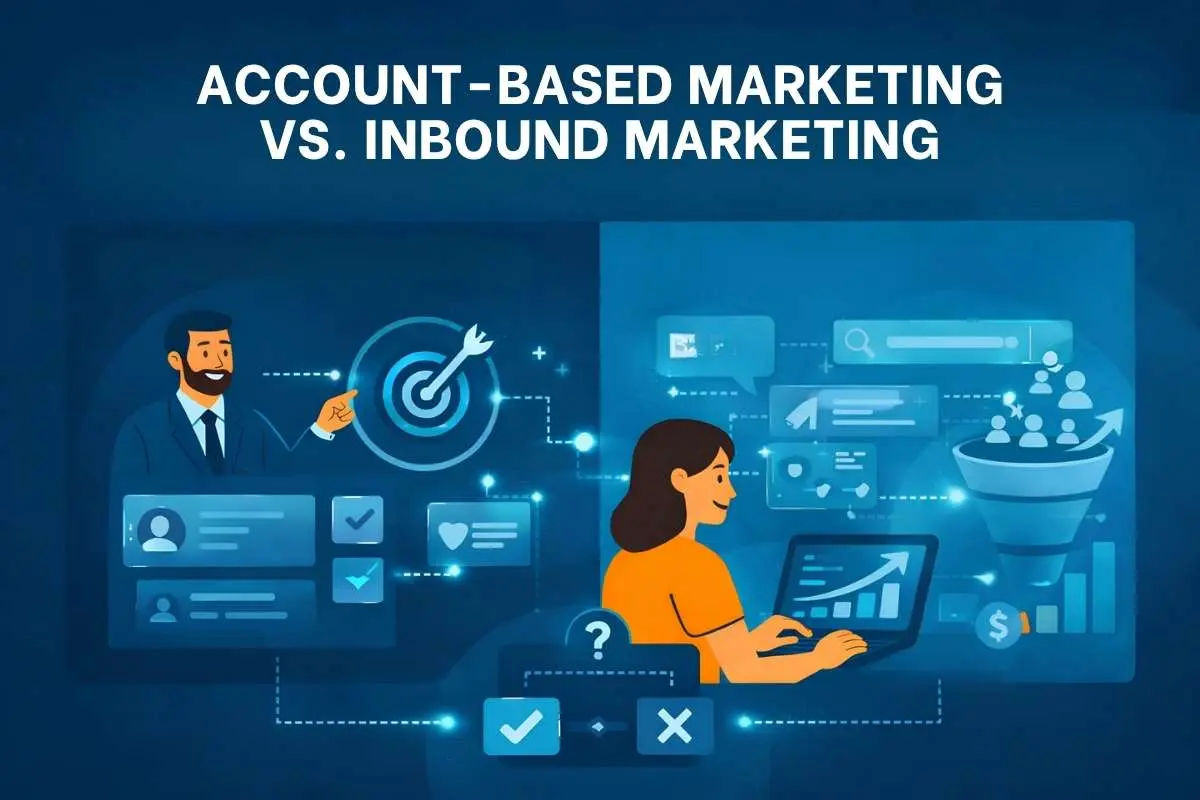
Inbound captures existing demand, while ABM focuses on high-value accounts. The most successful B2B teams combine both using inbound to build trust and ABM to engage the right accounts at the right time. The question isn’t Account-Based Marketing vs. Inbound Marketing, it’s how to make them work together.
Demystifying the core frameworks: funnels vs. Fishing nets
Before looking at how these two strategies work together, we need to strip away the marketing jargon and look at how they actually operate on the ground. At their core, Inbound and Account-Based Marketing (ABM) reverse the traditional sales funnel; they just approach the buyer journey from opposite directions.
1. INBOUND METHODOLOGY (The Fishing Net)
ATTRACT ───► ENGAGE ───► DELIGHT
│ │ │
▼ ▼ ▼
Bring the right, build trust, create loyalty
audience and convert advocates
THE FISHING NET
Awareness Content SEO Social Media
\ | /
\ | /
\ | /
\ | /
\ | /
\ | /
Qualified Leads
│
▼
Customers
│
▼
Promoters
- Net Components:
| Top of the Net (Attract) | Blogs, SEO, videos, social media, and guides bring prospects into your ecosystem. |
| Middle of the Net (Engage) | Email nurturing, webinars, and personalized content build trust and convert leads. |
| Bottom of the Net (Delight) | Excellent customer experience, support, and advocacy programs turn customers into promoters. |
Key Idea:
Unlike outbound marketing, Inbound Marketing is like casting a fishing net, creating valuable content and experiences that consistently attract and retain the right customers.
2. ABM METHODOLOGY (THE SPEAR)
IDENTIFY → ENGAGE → CONVERT → EXPAND
│ │ │ │
▼ ▼ ▼ ▼
Select Ideal Personalize Win the Grow the
Target Accounts Outreach Account Relationship
────────────────────────────────────
THE SPEAR
Market Research
│
▼
Ideal Customer Profile
│
▼
High-Value Target Accounts
│
▼
Personalized Content
│
▼
Multi-Channel Outreach
(Email • LinkedIn • Events • Calls)
│
▼
Sales Conversations
│
▼
Closed-Won Account
│
▼
Customer Success & Expansion
(Upsell • Cross-sell • Advocacy)
───────────────────────────────────────
PRECISION OVER VOLUME
The spear framework
| Identify | Define Ideal Customer Profile (ICP)Build a list of high-value accountsPrioritize accounts based on revenue potential |
| Engage | Create personalized messaging and contentUse multiple channels (email, LinkedIn, webinars, events)Align sales and marketing teams |
| Convert | Build relationships with decision-makersAddress specific business challengesMove accounts through the pipeline |
| Expand | Deliver customer successUpsell and cross-sell opportunitiesTurn customers into advocates and long-term partners |
Account-based marketing vs. Inbound marketing: key difference

| Feature | Inbound Marketing | Account-Based Marketing (ABM) |
| Audience Scope | Broad market, segmented by individual personas. | A finite, predefined list of high-value Target Accounts (ICPs). |
| Sales Lifecycle | Typically, a longer organic nurturing timeline leads to filtering themselves. | Compressed timeline; proactively engages all stakeholders simultaneously. |
| Content Strategy | Educational, scalable, and publicly accessible to solve broad problems. | Hyper-personalized, account-specific, and tailored to proprietary company pain points. |
| Team Alignment | Marketing generates leads and hands them off to Sales. | Marketing and Sales operate in continuous, daily lockstep alignment. |
| Primary Metric | Traffic, Conversion Rates, Marketing Qualified Leads (MQLs). | Account Engagement, Pipeline Velocity, Annual Contract Value (ACV). |
The common ground: what they share
Despite their contrasting approaches, ABM and Inbound are built on the same intellectual foundation. Understanding Account-Based Marketing vs. Inbound Marketing from this perspective makes it easier to see why the two strategies complement rather than compete with each other.
They are not competing philosophies; they are different expressions of the same core principle: customer-centric marketing.
- Deep Audience Empathy: Neither strategy works if you rely on guesswork. Inbound requires deep persona research to understand what content your audience searches for. ABM requires identical research, just scaled up to understand the friction points of an entire corporate department.
- Content Dependency: Both engines run on high-quality content. ABM cannot exist in a vacuum; it relies on the thought leadership, whitepapers, and case studies typically built by your inbound team. ABM simply takes that content foundation, refines it, and wraps it in a personalized bow for a specific account.
- The Shared End Goal: Both methodologies abandon traditional, interruptive outbound spam. They focus on adding genuine value, building trust, and fostering long-term relationships that prioritize customer retention over transactional spikes.
The power of synergy: how to combine both techniques

When you fuse Inbound and ABM, you eliminate the weaknesses of both. Instead of treating Account-Based Marketing vs. Inbound Marketing as an either-or decision, leading B2B organisations use both to maximise reach and conversions.
Here are three practical ways to build an integrated ‘Inbound-Led ABM’ engine:
1. The lead-gen flip (the Boston digital model)
Instead of guessing which accounts belong on your ABM target list, let your inbound content find them for you.
Use top-of-funnel inbound content (like a high-traffic blog post on industry trends) to attract a broad audience pool. Next, use IP tracking or reverse-DNS software (like Leadfeeder or Clearbit) to identify which high-value companies are repeatedly reading those articles. The moment a target company shows high organic intent, flip them into your ABM pipeline for hyper-personalized sales outreach.
2. The multi-stakeholder playbook
Remember that the average enterprise deal involves 6 to 10 stakeholders. You can use your inbound content mapping to speak to all of them simultaneously within a single target account.
For example, while your ABM team actively pitches the VP of Operations via direct message, your marketing team can serve tailored inbound content across paid channels to the rest of the committee:
- A case study on implementation speed for the End Users.
- A deep-dive technical whitepaper for the IT Security Director.
- A clear ROI calculator for the CFO.
3. The unified technical engine
To make this work seamlessly, your marketing automation platform (Inbound) must talk directly to your customer relationship management (CRM) and intent tools (ABM).
When a priority target account interacts with an inbound email or visits your pricing page, your CRM should instantly alert the dedicated sales representative. By unifying your data, your ABM outreach is backed by real-time behavioral context, ensuring you reach out exactly when the account is warmest.
While discussions around Account-Based Marketing vs. Inbound Marketing often focus on strategy, success ultimately depends on execution. The following framework shows how businesses can combine both approaches into a single, results-driven marketing process.
Practical execution: the 5 steps of an integrated strategy

Shifting from theory to practice doesn’t require rebuilding your marketing department overnight. You can activate a combined Inbound and ABM model using five straightforward steps.
1. Identify your target accounts
Start by layering your inbound insights over your data-driven Ideal Customer Profile (ICP). Look through your CRM for your highest-value, happiest customers and identify their common traits (e.g., specific industries, revenue benchmarks, technology stacks). Combine this static profile with real-time inbound intent data: Which high-fit companies are currently consuming your top-of-funnel content?
2. Expand your account footprint
Once you have highlighted a target company, you need to map out its internal ecosystem. Use platforms like LinkedIn Sales Navigator to identify the 6 to 10 stakeholders who make up that specific buying committee. Do not just target the ultimate decision-maker; map out the end-users, the technical gatekeepers, and the procurement officers who will influence the final signature.
3. Engage with personalized omnichannel content
This is where your inbound content asset library shines. Instead of sending generic cold outreach, take your best-performing inbound assets (like an industry report or a deep-dive webinar) and customize them for the target account.
The Personalization Rule: Change the introduction, swap in industry-specific metrics, or address a public challenge that the company is currently facing on its personalized landing pages.
4. Build internal champions (advocate)
Enterprise sales are won from the inside out. Use hyper-relevant, ungated inbound content such as templates, checklists, and quick-win tools to build trust with the actual end-users at the target company. When you solve a daily frustration for the team on the ground, they naturally become internal champions who will advocate for your solution to upper management.
5. Measure account velocity and depth
Throw out traditional single-lead inbound metrics like total Marketing Qualified Leads (MQLs) or generic page views. For your integrated strategy, measure account-level metrics:
| Account Engagement | Is the buying committee’s total time on your site increasing? |
| Pipeline Velocity | How quickly are targeted accounts moving from initial discovery to a closed deal compared to traditional leads? |
| Win Rates | The percentage of target accounts that convert into closed revenue. |
Conclusion:
The debate between Account-Based Marketing vs. Inbound Marketing is officially over. In a complex B2B landscape where buying groups are larger and more cautious than ever, relying on a single methodology leaves your pipeline vulnerable.
Inbound builds the digital ecosystem, establishes your brand’s organic authority, and pulls in the market’s active five percent. The real advantage of Account-Based Marketing vs. Inbound Marketing comes when businesses integrate both approaches into a unified growth strategy. ABM steps in to weaponize that data, allowing you to proactively hunt the highest-value accounts within your reach.
Do not abandon your inbound engine to chase ABM; use ABM to accelerate your inbound momentum. By merging the wide fishing net with the precise spear, you build a sustainable, highly targeted revenue engine designed for modern B2B growth.
FAQs
1. What is the main difference between Account-Based Marketing and Inbound Marketing?
Inbound Marketing attracts a broad audience through valuable content, while Account-Based Marketing (ABM) focuses on engaging specific high-value accounts with personalized campaigns.
2. Should businesses choose ABM or Inbound Marketing?
Not necessarily. Most B2B businesses achieve better results by combining both strategies to attract, nurture, and convert high-value prospects.
3. Is Account-Based Marketing only for large enterprises?
No. SMBs can also use ABM by targeting a small list of ideal customers with personalized outreach.
4. How can Inbound Marketing support an ABM strategy?
Inbound content builds awareness and trust, while ABM uses that engagement to personalize outreach and accelerate conversions.
5. What are the key metrics for measuring an integrated ABM and Inbound strategy?
Track account engagement, pipeline velocity, win rate, customer lifetime value (CLV), and annual contract value (ACV).