
Collaborative decision-making models provide structure to how teams share ideas, evaluate options, and reach clear outcomes. This article explains different models, such as consensus, majority vote, Delphi method, and RACI, showing how each fits different situations. It also highlights the benefits of using structured approaches and how teams can choose the right model based on context.
Ever sat through a discussion where everyone talks, ideas keep coming, but no one is sure how a final decision will actually be made? The energy is there, the intent is right, yet the outcome still feels unclear.
The problem is not a lack of collaboration. It is the absence of a clear way to move from conversation to conclusion. Without that, teams either keep circling the same points or settle on decisions that few fully understand.
Different collaborative decision-making models bring order to that chaos. They define how input is gathered, how it is weighed, and how a final call is reached, so involvement leads to clarity instead of confusion.
In this article, we will take a look at different models that give a structure to collaborative decision-making and help teams and businesses achieve their targets. So, without wasting another second, let us dive into them!
What are the types of collaborative decision-making models?
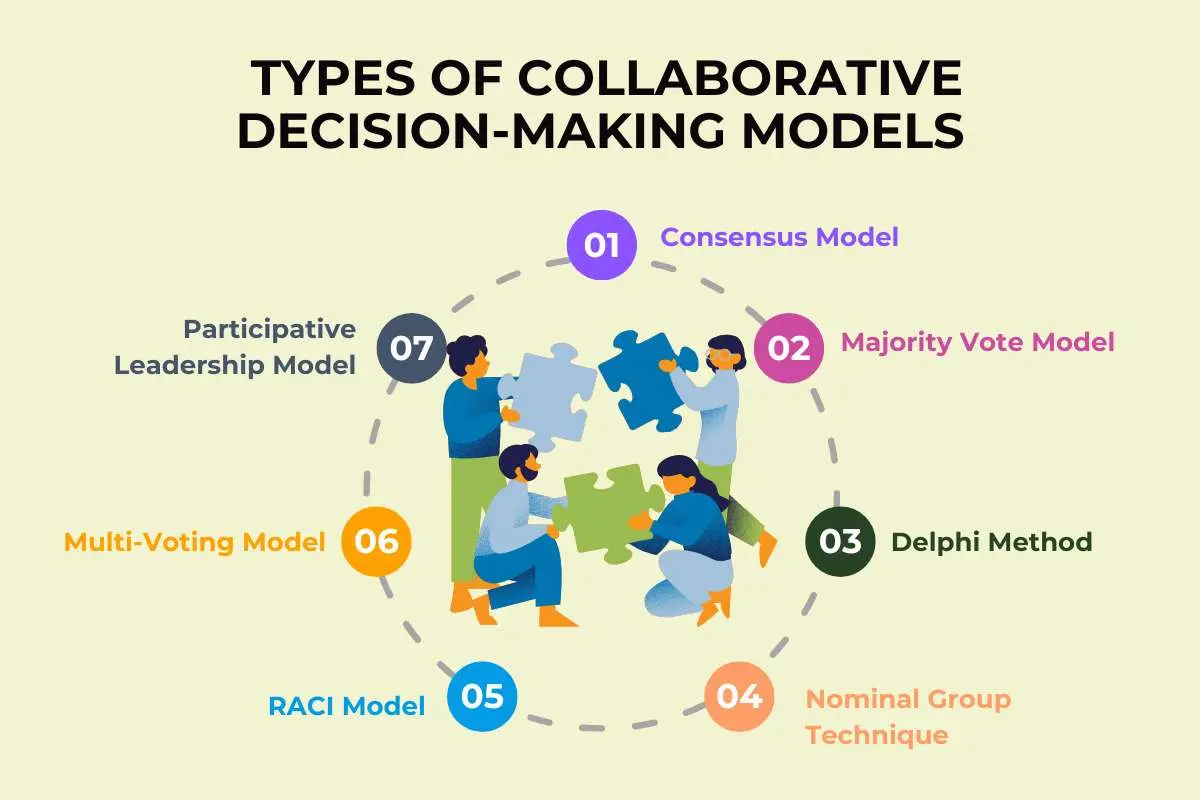
Collaborative decision making becomes more effective when teams follow a clear and repeatable approach. Instead of relying on random discussions, teams can use structured models to guide how ideas are shared and how decisions move forward.
The models below outline different ways teams can organize input, assign roles, and reach decisions with clarity. Each one fits a specific type of situation, depending on the team and the task.
1. Consensus model
The consensus model focuses on reaching a decision that everyone can accept, even if it is not their first choice. The group explores the problem in depth, shares concerns, and refines ideas through open discussion. Members listen, respond, and adjust their views until strong objections fade. This process often includes multiple rounds of feedback, in which ideas evolve rather than being rejected. It takes time, but it builds strong alignment and trust. People feel involved, so they support the final decision with real commitment.
Best For: Teams that need strong alignment and long-term support, especially when decisions affect everyone directly.
2. Majority vote model
The majority vote model follows a simple and direct approach. The group discusses options, weighs key points, and then moves to a vote. Each member gets an equal say, and the option with the most votes becomes the final decision. This is one of the collaborative decision-making models that allows teams to move forward even when full agreement is not possible. While some members may disagree, the process still feels fair because everyone had a voice. It works best when the group accepts that speed matters more than full consensus.
Best For: Large groups or time-sensitive decisions where quick closure matters more than complete agreement.
3. Delphi method
The Delphi method gathers input from experts through structured and repeated feedback rounds. Participants share their views independently, often without knowing who said what. After each round, responses are summarised and shared with the group. Members then review the insights and adjust their opinions if needed. This cycle continues until the group moves closer to a stable conclusion. The method reduces bias, limits peer pressure, and encourages honest input. It works well when decisions rely on deep knowledge and careful thinking.
Best For: Complex problems that require expert input and benefit from reduced bias or influence.
4. Nominal group technique
The nominal group technique blends individual thinking with group evaluation. Each member first writes down ideas on their own, which prevents early influence from others. The group then shares these ideas in a structured way, without immediate debate or criticism. Once all ideas are on the table, the team discusses them to add clarity and context. Members then rank or vote on the ideas to identify the best option. This process ensures balanced participation and gives equal weight to every voice.
Best For: Teams that want structured input from all members and a fair method to evaluate ideas.
5. RACI model
The RACI model brings clarity by defining roles within the decision process. It identifies who is responsible for the task, who is Accountable for the final decision, who needs to be consulted, and who should be informed. This structure keeps discussions focused and prevents confusion about who does what. People know when to contribute and when to step back, which reduces delays and overlap. It also helps teams avoid too many opinions while still keeping key voices involved.
Best For: Organizations that need clear roles and accountability, especially in projects with many stakeholders.
6. Multi-voting model
The multi-voting model helps teams narrow down many options in a clear and structured way. After brainstorming, each member receives a limited number of votes. They use these votes to select the ideas they believe have the most value. The group then focuses only on the top-voted options for further discussion.
This method reduces clutter and keeps the decision process focused. It also gives each person a fair chance to influence the outcome without long debates.
Best For: Situations with many ideas where the team needs to filter, prioritize, and move forward quickly.
7. Participative leadership model
The participative leadership model combines team input with clear leadership direction. The leader invites ideas, listens to feedback, and encourages open discussion among team members. Instead of deciding alone, the leader uses group input to shape the final decision. This approach keeps the process inclusive while still maintaining speed and direction. Team members feel heard, but the leader ensures that the discussion stays focused and leads to a clear outcome.
Best For: Teams that want active participation but still rely on a leader to guide and finalize decisions.
What are the benefits of using collaborative decision-making models?

Collaborative decision-making models bring more clarity to group decisions. People understand the problem better because they hear different views and questions. This often leads to smarter choices, as ideas get tested and improved before the final call. The process also reduces blind spots, since more people review the same issue from different angles.
These models build stronger team ownership. When people take part in shaping a decision, they feel responsible for the outcome. Collaborative decision-making models support the plan with more intent and follow-through with less resistance. This reduces friction during execution and keeps teams aligned even when challenges appear later.
They also improve communication within teams. Members learn to listen, respond, and build on each other’s ideas instead of working in isolation. Over time, this creates a more open and respectful work environment. Teams become more confident in sharing input, which leads to better discussions and clearer outcomes.
How to choose the right collaborative decision-making model?

With several collaborative decision-making models available, the real challenge is knowing when to use each one. A model that works well in one situation may slow things down or create confusion in another.
Choosing the right approach depends on factors like team size, time, and the nature of the decision. The steps below help you match the model to the situation without adding unnecessary complexity.
- Step 1: Define the problem clearly
- Step 2: Assess the level of impact
- Step 3: Check team size and structure
- Step 4: Evaluate time available
- Step 5: Identify expertise needed
- Step 6: Decide the level of participation
- Step 7: Match the model to the situation
- Step 8: Review and adjust
Start with a clear problem and a tight scope. This keeps the team focused and avoids confusion later. Then look at how much the decision matters and who it affects. Bigger decisions often need more input and stronger agreement, while smaller ones can move faster.
Next, consider your team and the time you have. Large groups need more structure to stay organized, while smaller teams can work through open discussion. Time also matters, since some models need deeper input and take longer. At the same time, check if the decision needs expert knowledge or general team input.
Now think about how much involvement you want from the group. Some decisions need full participation, while others work better with guided input and a clear decision maker. Choose a model that fits these factors without making the process too complex.
After the decision, review how the process worked. Look at what helped and what slowed things down. Use that insight to improve how you choose models in the future.
Conclusion:
Decisions only hold when people can act on them without hesitation. That comes from a process that is clear, visible, and consistent every time a choice is made. When teams know how input turns into direction, they spend less time second-guessing and more time executing.
Over time, that consistency compounds. Discussions become sharper, expectations stay aligned, and follow-through improves because there is no confusion around how the outcome was reached. Collaborative decision-making models support this shift by turning scattered conversations into decisions that carry weight beyond the meeting room.
People also ask
1. What are collaborative decision-making models?
They are structured approaches that guide how teams gather input, evaluate ideas, and reach a final decision together.
2. Why are these models important for teams?
They prevent confusion, reduce delays, and ensure that discussions lead to clear and actionable outcomes.
3. Do collaborative models slow down decision-making?
Not when used correctly. They bring structure, which often makes decisions faster and more effective.