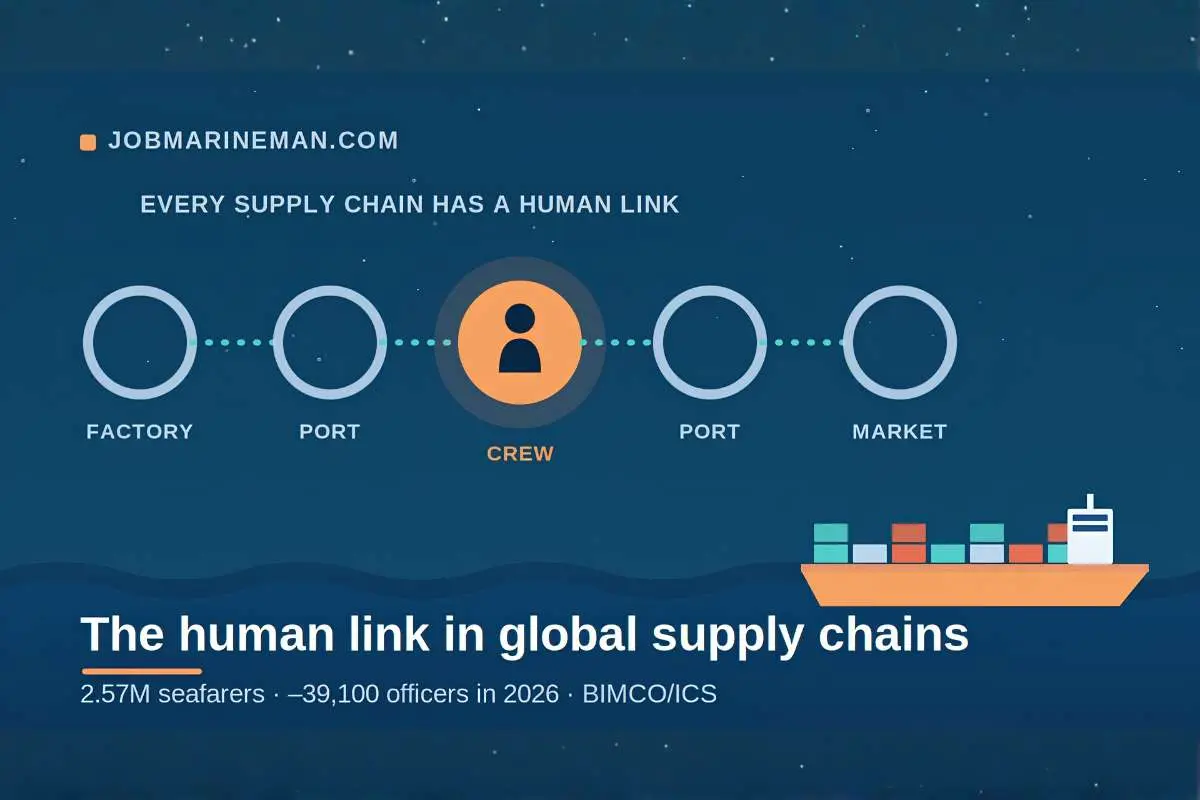
Supply chain executives have spent the past five years stress-testing everything: rerouting around canal disruptions, diversifying suppliers, building buffer inventory, and digitizing visibility from factory gate to warehouse dock. Yet the newest systemic risk to the movement of goods is one that no control tower dashboard displays. It is the widening shipping industry workforce shortage, driven by a lack of availability among the 2.57 million people who actually sail the ships.
The Seafarer Workforce Report 2026, published in June by BIMCO and the International Chamber of Shipping, quantifies the exposure: the world merchant fleet of 85,148 vessels is short 39,100 STCW-certified officers this year, and will need an additional 113,735 by 2030 — around 22,700 newly qualified officers annually. Demand for certified seafarers has risen 35% since 2021, driven by fleet growth and by the shift to alternative fuels and digital systems that require increasingly specialized skills. Roughly 90% of world trade moves by sea; every container, every barrel and every bulk cargo ultimately depends on a crew list being complete.
Workforce risk is supply chain risk

For enterprises that ship goods, the mechanics of this exposure are simple. A vessel missing one certified officer does not sail — flag state and insurance requirements make the manning certificate as binding as a seaworthiness survey. A failed crew change can hold a ship in port for days, rippling into missed berthing windows, rolled cargo and contractual penalties down the chain. Unlike a port strike or a weather event, a crewing failure is invisible to shippers until their cargo is already late.
The industry’s response, according to the report’s authors, must run on two tracks: expanded maritime training and more effective recruitment. Training is the long game — an officer’s license takes years of academy study and sea time. Recruitment efficiency, however, can return lost capacity now, because a striking share of the shortage is really a matching failure: qualified officers idle between contracts while operators elsewhere search for precisely their rank, separated only by fragmented, agency-based hiring channels.
Digitizing one of the last analog labor markets

This is where marketplace technology has entered the picture to address the shipping industry workforce shortage. jobmarineman.com, an international crewing platform operated by Marine MAN — a Ship and Crew Management company with nearly two decades in the shipping industry — applies the direct-marketplace model to maritime labor. Its database of roughly 200,000 seafarer profiles spans every rank and vessel category, from container and tanker fleets to offshore and passenger ships, and the platform runs in eleven languages.
The mechanics mirror what digital freight platforms did for cargo capacity, applied to human capacity instead. Shipowners search directly by rank, certificates, vessel type and sea service, contact verified candidates within hours, and post vacancies with global visibility. Seafarers register free of charge, maintain one professional profile with their documents and sea time, and apply directly to Maritime jobs across the world fleet rather than waiting for a local agency to call.
For operators who want resilience engineered into the process rather than bolted on, the platform connects to managed Crew Management services: certificate verification against international requirements, MLC-compliant employment contracts, payroll, travel logistics and rotation planning that confirms a qualified relief before the current contract expires. Each crew change that happens on schedule is a supply chain disruption that never registers — which is precisely why nobody outside the industry hears about it.
What shippers and operators should watch
The shipping industry workforce shortage will not close quickly; the training pipeline is measured in years, and the fleet keeps growing. In the interim, the difference between reliable and unreliable tonnage will increasingly be decided by crewing discipline—and cargo owners are beginning to ask about it in vetting, alongside emissions data and safety records. For an industry that learned the hard way that resilience cannot be inspected in after the fact, the lesson extends naturally: the most sophisticated supply chain is still, at the water line, a team of certified professionals who agreed to be on board. Making sure they are is no longer a back-office detail. It is infrastructure.
Let’s discuss cooperation
Want to know how our team can help your business?
Contact us: b2b@marineman.eu