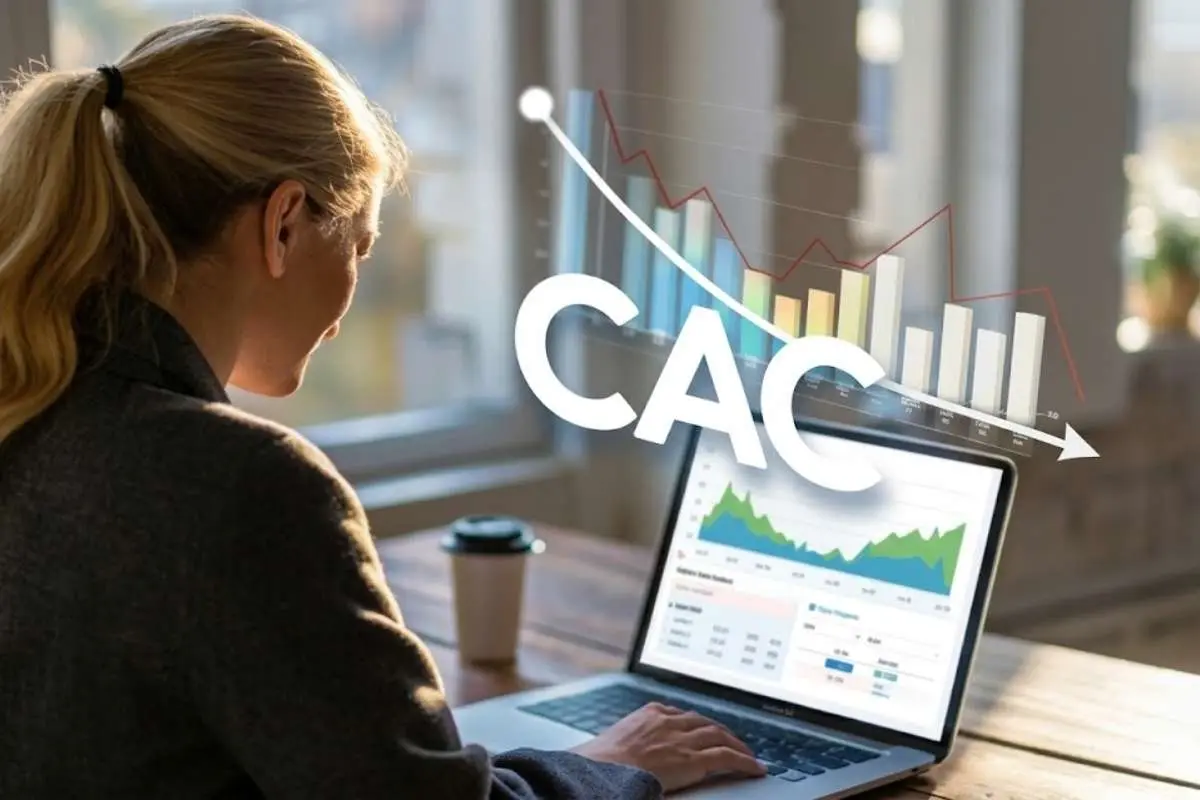
This article explores how rising acquisition costs are putting pressure on modern businesses and why simply increasing ad spend is no longer a sustainable solution. It introduces a more efficient approach to reduce CAC with growth marketing by focusing on how users move through the funnel and where value is either created or lost.
Customer acquisition costs (CAC) on major ad platforms keep climbing year over year, squeezing margins for direct-to-consumer and B2B brands alike. Bidding wars for high-intent search keywords and social media placements make traditional customer acquisition increasingly unsustainable on its own.
Integrating tactics to reduce CAC with growth marketing forces your team to extract more value from existing traffic instead of simply inflating media budgets. Optimizing conversion rates at key drop-off points, refining offer messaging, and building referral loops naturally lowers the average cost per acquired customer.
Focusing on lifecycle economics turns acquisition into an efficient engine. Improving your conversion math across every stage of the funnel protects your margins and frees up cash flow for reinvestment.
The 7 Proven Methods to Reduce CAC with Growth Marketing

Reducing CAC with growth marketing requires a clear focus on efficiency across the entire funnel. Each stage affects how much you spend to gain a customer. Small improvements in targeting, conversion, and user experience can lower costs over time. The following methods show how to reduce waste, improve returns, and make your acquisition efforts more sustainable.
1. Improve activation rate early
Many teams spend heavily to acquire users but lose them within minutes. This pushes CAC higher because you keep paying for users who never see value. Focus on the first user experience instead. Guide users to one clear action that shows value fast. This could be setting up a profile, completing a task, or seeing a result. When more users activate, each acquisition becomes more efficient. You get more value from the same spend, which lowers CAC over time.
Tips:
- Remove extra steps in onboarding
- Use checklists or progress bars
- Highlight one key action, not many
2. Focus on high-intent channels
Not all traffic has the same value. Some users click out of curiosity, while others search with a clear need. If you spend more on low-intent traffic, CAC rises fast. Shift your focus to channels where users already show intent. Search ads, comparison pages, and niche communities often bring better users. These users convert faster and stay longer, which reduces CAC.
Tips:
- Track conversion rate by channel
- Cut spend on low-performing sources
- Double down on channels with strong intent
3. Use retargeting to capture warm leads
Many users visit once and leave. If you ignore them, you lose a low-cost opportunity. Retargeting helps you bring them back at a lower cost than new acquisition. These users already know your product, so they need less push to convert. This reduces the average cost per customer when compared to cold traffic campaigns. Retargeting also lets you stay visible without starting from zero. It keeps your brand top of mind while users compare options. Over time, this repeated exposure increases trust and improves conversion rates.
Tips:
- Segment users based on behavior
- Show tailored messages, not generic ads
- Limit frequency to avoid fatigue
4. Improve conversion rates across funnel
If your funnel leaks, CAC goes up. You keep paying for users who drop off at each stage. Small improvements at each step can lower CAC in a big way. Fix landing pages, simplify forms, and remove friction in checkout. When more users convert at each stage, you need fewer users to reach the same goal. Even small gains at each stage can stack into a big impact. A slight lift in conversion at multiple steps reduces the need for extra spend. This makes your overall acquisition more efficient without increasing budget.
Tips:
- Run A/B tests on key pages
- Reduce form fields
- Improve page load speed
5. Invest in organic growth channels
Paid channels drive fast results, but they can get expensive over time. Organic channels can reduce CAC with growth marketing. These channels take time to build but bring consistent traffic at a lower cost. Over time, they balance your acquisition mix and reduce dependency on paid ads. Organic traffic also compounds as your content grows. Each new piece adds to your reach without adding cost per click. This creates a steady flow of users at a lower average acquisition cost.
Tips:
- Create content that answers real user questions
- Build backlinks and authority
- Encourage referrals with simple incentives
6. Align marketing with product experience
If marketing promises one thing and the product delivers another, users churn fast. This increases Customer acquisition costs (CAC) because you must replace them with new users. Align your messaging with real product value. When users get what they expect, they stay longer and bring in more value. This can reduce CAC with growth marketing over time. Clear alignment also builds trust early in the journey. Users feel confident in their decision and are less likely to drop off. This reduces wasted spend on users who would not have stayed anyway.
Tips:
- Match ad copy with landing page experience
- Use real product use cases in campaigns
- Collect feedback and adjust messaging
7. Leverage customer referrals
Happy users can bring in new users at a low cost. Referral programs turn your existing base into a growth channel. So, user retention strategies should focus on referrals, as they can often convert faster. This lowers CAC compared to paid acquisition. Referrals also improve user quality in many cases. People tend to invite others with similar needs, which increases fit. This leads to better, stronger lifetime value.
Tips:
- Offer simple and clear rewards
- Make sharing easy within the product
- Track referral conversion rates
How can CAC rise?

Customer acquisition cost tends to rise over time when inefficiencies build across the funnel. These issues often come from weak targeting, poor conversion paths, or low retention. As these gaps grow, each new customer requires more spend. Below, we have listed some ways through which your customer acquisition cost can increase without you noticing.
- Inefficient Channel Spend: CAC can rise when you keep investing in channels that no longer perform. Costs rise, but conversions stay flat or drop. Over time, you pay more for each customer without clear returns.
- Poor Targeting: Targeting that is too broad or unclear can also be a sign. You attract users who are not a good fit, so they do not convert or stay. Such growth marketing mistakes lead to wasted spend and higher acquisition costs.
- Weak Activation Experience: CAC can creep up when users do not see value early. They sign up but drop off before taking key actions. You keep paying for users who never activate, which drives costs higher.
- Low Conversion Rates: Sometimes users can drop off across the funnel. Landing pages, forms, or checkout steps may create friction. Even small leaks at each stage can increase overall acquisition cost.
- Overdependence on Paid Ads: CAC can increase when you rely too much on paid channels. As competition increases, ad costs rise. Without strong organic channels, your cost per customer keeps increasing.
Tracking these patterns early helps you stay in control. Fixing drop-offs, improving user quality, and tightening your growth marketing funnel can slow down cost increases. This keeps your acquisition efforts stable and more efficient.
How to track CAC?

When you want to reduce CAC with growth marketing, it is best that you track it alongside supporting metrics. A single number does not explain performance across channels or user behaviour. You need to use growth marketing tools to get a clear view of how users convert, how much value they bring, and how quickly you recover costs.
1. CAC by channel
CAC by channel shows which sources bring customers at the lowest cost. It helps you compare paid ads, organic traffic, referrals, and other channels. You can shift budget to the channels that perform better.
Tools:
- Google Ads Dashboard
- Facebook Ads Manager
- Attribution tools like AppsFlyer
2. Customer lifetime value (LTV)
LTV shows how much revenue a customer brings over time. When LTV is higher than CAC, your growth stays healthy. If CAC rises and LTV stays flat, your margins shrink.
Tools:
- CRM platforms like HubSpot
- Subscription tools like Chargebee
- Analytics tools like Amplitude
3. LTV to CAC ratio
This is one of the growth marketing metrics that compares the value of a customer to the cost of acquiring them. A strong ratio means your acquisition is efficient. A weak ratio signals that CAC is too high or customer value is too low.
Tools:
- Excel or Google Sheets
- BI tools like Tableau
- Data platforms like Looker
4. Payback period
Payback period shows how long it takes to recover your CAC. A shorter period means faster returns and better cash flow. A longer period can strain your growth and budget.
Tools:
- Financial dashboards
- ProfitWell
- Baremetrics
When you monitor these metrics together, patterns become easier to spot. This helps you make better decisions on spend, improve efficiency, and build a stronger growth marketing system over time.
Conclusion:
Rising media costs and shifting ad algorithms make traditional customer acquisition increasingly risky for growing brands. Implementing strategic frameworks to reduce CAC with growth marketing builds long-term resiliency into your business model by wringing maximum efficiency out of every touchpoint.
Stabilizing your blended acquisition costs turns paid performance into a predictable profit driver. Focusing on full-funnel activation and organic expansion protects your profit margins, giving your team the financial runway needed to dominate your category.
FAQs
1. How to reduce CAC with growth marketing?
Growth marketing optimizes the entire conversion pipeline, improving conversion rates at every funnel stage to yield more paying users from existing traffic.
2. What is the difference between paid CAC and blended CAC?
Paid CAC measures the cost to acquire a customer strictly through ad spend, while blended CAC averages total marketing and sales costs across all acquired customers, including organic channels.
3. Which funnel stage has the biggest impact on reducing CAC?
Mid-funnel onboarding and user activation yield the fastest results, as fixing drop-off friction instantly increases the percentage of paid visitors who become paying customers.