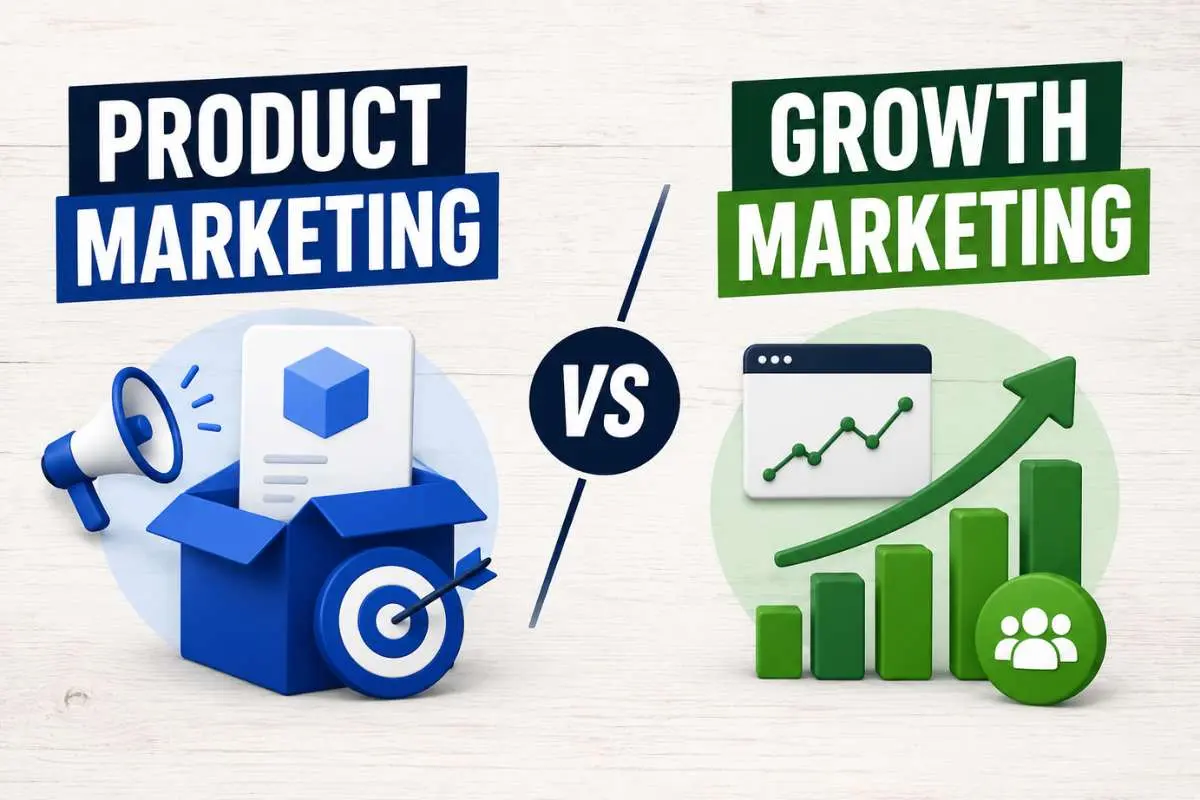
The difference between product marketing vs growth marketing is defined by their overall role in the marketing strategy. Product marketing defines how a product is positioned and understood, while growth marketing focuses on scaling users, revenue, and retention through continuous testing. One builds clarity; the other drives expansion. Businesses typically start with product marketing to establish strong foundations, then rely on growth marketing to scale what works.
Watching your revenue flatline after a massive product launch is every founder’s absolute nightmare. Pushing out constant feature updates won’t save a business that fails to convert curious visitors into paying, active users.
Smart companies build systematic pipelines that turn one-time shoppers into repeat customers. Deciding between product marketing vs growth marketing forces teams to balance long-term brand narrative against rapid, data-driven experiments. Blending compelling product stories with relentless onboarding tweaks ensures customers stick around for the long haul.
Balancing clear messaging with smart funnel tweaks builds a defensible advantage over your competition. Combining emotional brand appeal with quick conversion wins keeps your pipeline full.
Product marketing and growth marketing often get mixed up. Both aim to drive business success, but they take different paths. One focuses on shaping how the product is understood. The other focuses on scaling how it grows. Knowing the difference helps teams work better and avoid overlap.
Product marketing vs growth marketing: key differences explained

Product marketing and growth marketing often get mixed up. Both aim to drive business success, but they take different paths. One focuses on shaping how the product is understood. The other focuses on scaling how it grows. Knowing the difference helps teams work better and avoid overlap.
| Product Marketing | Aspect | Growth Marketing |
| Focuses on product value and messaging | Core Focus | Focuses on user growth and revenue |
| Ensures product fits market needs | Goal | Scales users, engagement, and revenue |
| Strong before and during launch | Stage | Strong after launch and ongoing |
| Uses research and storytelling | Approach | Uses data and experimentation |
| Handles positioning, messaging, launches | Key Activities | Handles testing, funnels, lifecycle campaigns |
| Targets buyers, users, and sales teams | Audience | Targets full user journey across channels |
| Tracks adoption, usage, win rates | Metrics | Tracks CAC, LTV, retention, conversions |
| Works on long-term clarity | Time Horizon | Works in fast, iterative cycles |
1. Core focus: Product marketing centers on the product itself. Teams define what it does and why it matters. They shape how people see it. Growth marketing focuses on expansion. Teams work to bring in users and grow revenue.
2. Goal: Product marketing aims for strong product-market fit. It ensures the product solves a real problem. Growth marketing aims to scale results. It increases users, engagement, and revenue over time.
3. Stage: Product marketing plays a big role before and during launch. It prepares the product for the market. Growth marketing becomes stronger after launch. It keeps improving results over time.
4. Approach: Product marketing relies on research and insight. Teams study users and build clear messaging. Growth marketing relies on data and testing. Teams run experiments and improve based on results.
5. Key activities: Product marketers handle positioning, messaging, and launches. They also support sales teams. Growth marketers run tests, optimize funnels, and manage lifecycle campaigns.
6. Audience: Another major difference between product marketing vs growth marketing is the audience it is targeted at. Product marketing targets buyers and users. It also supports internal teams like sales. Growth marketing covers the full user journey. It focuses on every stage, from first visit to retention.
7. Metrics: Product marketing tracks adoption and product usage. It also looks at win rates. Growth marketing tracks CAC, LTV, retention, and conversion rates.
8. Time horizon: Product marketing works with a long-term view. It builds clarity and strong positioning. Growth marketing works in fast cycles. Teams test, learn, and improve often.
The battle between product marketing vs growth marketing is not about competing functions. They solve different problems at different stages. One builds clarity and trust around the product. The other drives scale through continuous testing and improvement.
When both work together, the impact is stronger. Clear positioning makes growth efforts more effective, and growth insights help refine the product story over time.
Product marketing vs growth marketing: where do they overlap?
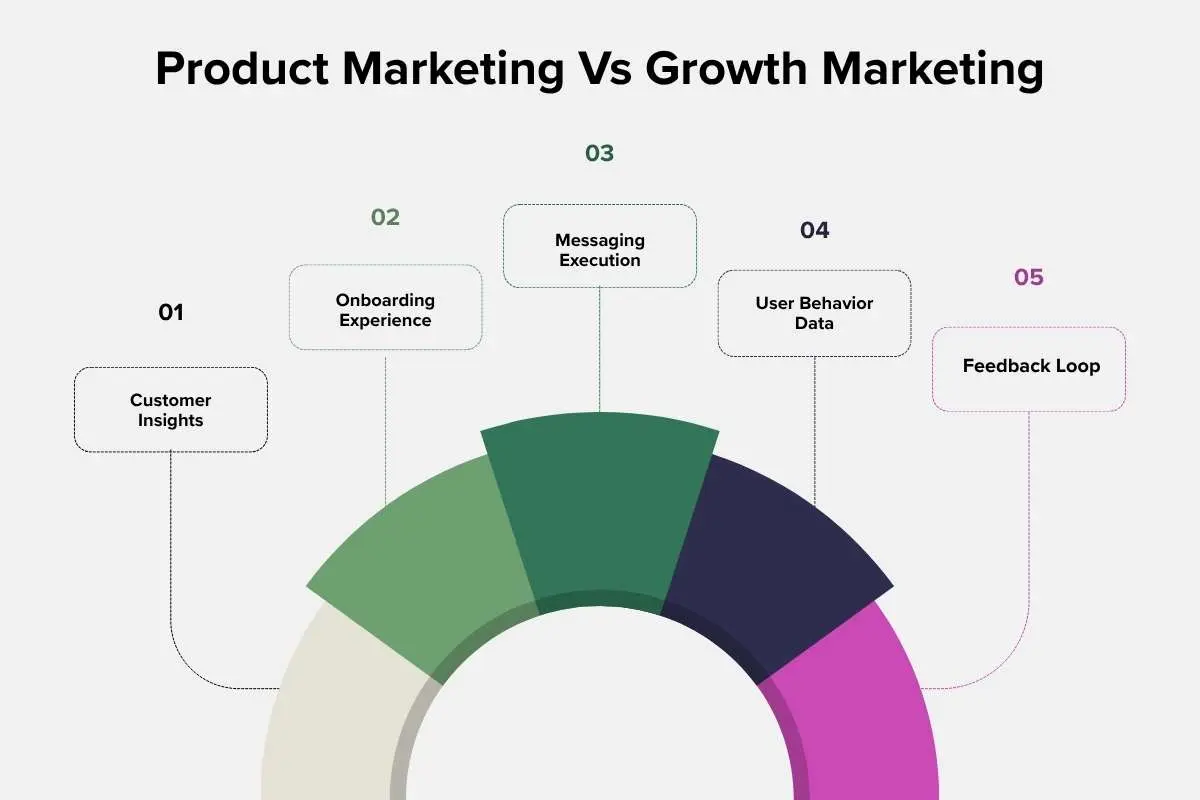
The differences between product marketing and growth marketing can often be bridged. They can work on the same journey if the growth marketing strategy calls for it. They focus on different parts, but their paths cross in key areas. These overlaps help teams stay aligned and drive better results.
1. Customer insights: Both teams rely on user data. Product marketing gathers insights to shape positioning. Growth marketing uses the same data to test and improve campaigns. When both align, messaging stays clear and relevant.
2. Onboarding experience: Product marketing defines the first user experience. It highlights key values early. Growth marketing improves that flow through testing. This helps increase activation and reduce drop-offs.
3. Messaging execution: Product marketing creates the core message. Growth marketing applies it across channels. This includes ads, emails, and landing pages. These are important channels. In fact, email is one of the most effective channels for driving conversion, with a 2.8% conversion for B2C brands and a 2.4% conversion for B2B brands.
4. User behavior data: Growth marketing tracks how users move through the growth marketing funnel. It identifies what works and what fails. Product marketing uses this data to refine positioning and product communication.
5. Feedback loop: Both teams create a cycle of improvement. Product marketing sets the foundation. Growth marketing tests and brings back real results. This helps improve both messaging and product direction.
These shared areas create strong alignment across teams. Product marketing sets the direction, while growth marketing tests and improves it. When both work together, they create a clear message and a smoother user journey.
Do businesses need both?
Most businesses don’t need both functions at the same time, but they will need both as they grow. Early on, the main challenge is clarity. Teams must define what the product does, who it serves, and why it matters. Product marketing handles this. It builds a clear story that helps users understand the value.
When teams skip this step and jump into growth, problems show up fast. Campaigns may bring traffic, but users don’t convert or stay. The message feels unclear, and the experience does not match expectations. This leads to wasted spend and weak retention.
On the other hand, product marketing alone cannot drive scale. A business may have strong positioning, but growth stays slow without testing and optimization. Growth marketing solves this by improving customer acquisition cost, onboarding, and retention through continuous experiments.
As the business grows, the balance shifts. Product marketing builds the foundation, while growth marketing drives scale. Over time, both work together to support steady and sustainable growth.
Product marketing vs growth marketing: which is better?

There is no single winner here. The right focus depends on the stage of the business.
Early-stage businesses should focus on product marketing. At this stage, the biggest risk is not growth. It is building something people do not understand or need. Clear positioning, strong messaging, and product-market fit matter more than traffic. Without this base, growth efforts will struggle.
Once the product gains traction, the focus should shift to growth marketing. The goal now is to scale what works. Teams need to test channels, improve conversion rates, and increase retention. Growth marketing helps turn early success into steady momentum. But recent trends are changing; in fact, mature product-centric organisations are seeing a 30% increase in growth
Many businesses make the growth marketing mistake of investing in ads and campaigns without a clear message. This often leads to low conversions and high churn. It is hard to scale something that is not clearly defined. More than 70% of organizations consider the alignment between product and marketing teams to be the most critical part of their digital transformations. At the same time, staying only focused on product marketing can slow progress. A strong product with no growth system will struggle to reach more users. The business may remain stable but not expand.
The smart approach is to shift focus over time. Start with product marketing to build clarity. Then move toward growth marketing to scale results. As the business matures, both should work together, with the focus changing based on current needs.
Conclusion:
Building a category-defining business requires blending compelling storytelling with relentless funnel optimization. Deciphering product marketing vs growth marketing reveals that while one crafts the core value proposition and market position, the other builds the engine that drives user adoption and retention.
Harmonizing product messaging with rapid testing prevents wasted ad spend and reduces customer churn. Unifying strategic positioning with full-funnel experiments creates a seamless customer journey that scales predictably.
FAQs
1. What is the main difference between product marketing vs growth marketing?
Product marketing focuses on defining target audiences, messaging, and product launches, while growth marketing tests rapid tactics across the entire sales funnel to drive acquisition and retention.
2. Which function should a company hire first?
Early-stage startups usually need product marketing first to establish clear market positioning and messaging before growth marketing scales acquisition channels.
3. Do product marketers and growth marketers work together?
Yes, product marketers provide the positioning and user insights that growth marketers use to run targeted experiments and optimize conversion flows.