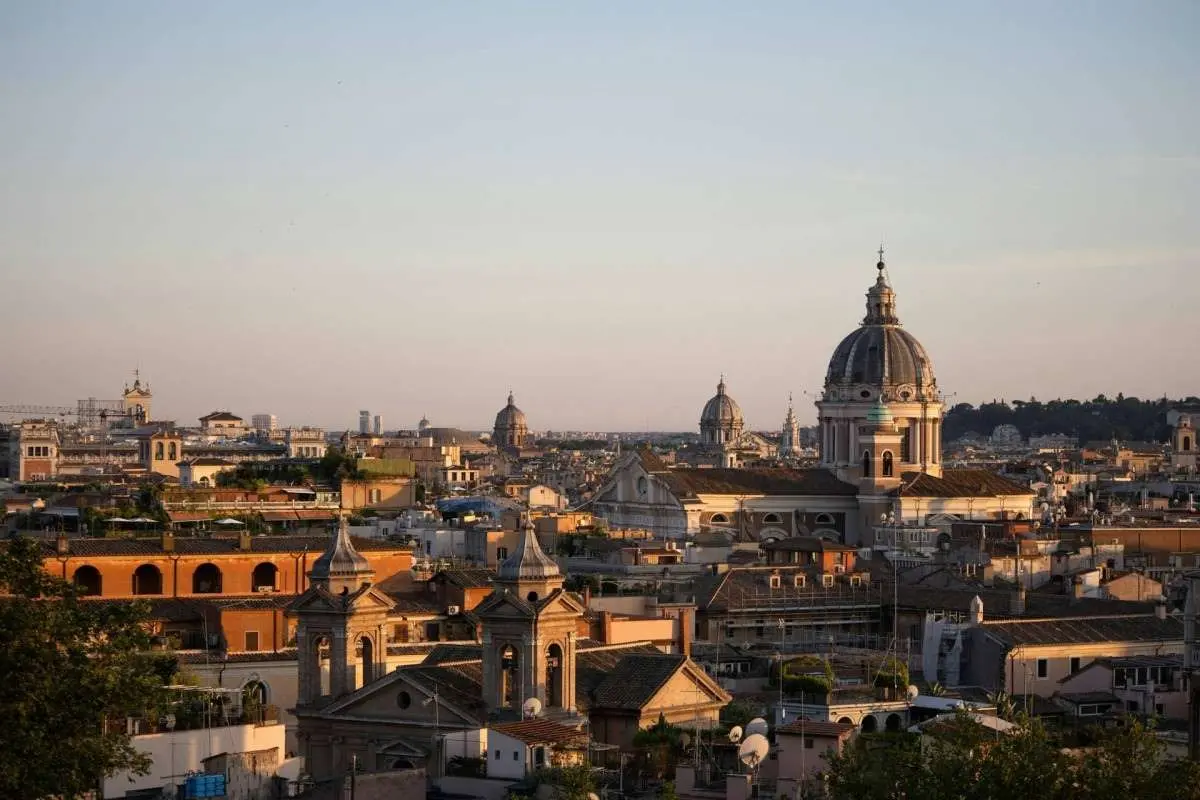
Rome property market entered the second half of 2026 still rising but no longer accelerating. Idealista puts the average asking price at €3,767 per square meter in July, up 5.0 percent year over year.
That combination – decelerating capital growth, resilient rents – is exactly the environment in which the difference between a good and a bad Roman acquisition stops being about timing and becomes almost entirely about pricing and location within the city. Rome is not one market. It is roughly a dozen, and the spread between the cheapest and the most expensive is close to €5,000 per square meter.
The yield test, before the story
Here is the most useful arithmetic I know for a first pass on any Roman zone. Take the average asking price per square meter, and calculate the monthly rent per square meter you would need to gross 5 percent on the purchase price alone. Then compare it with the citywide average asking rent of €18.68. Anything priced above roughly €4,485 per square meter cannot clear a 5 percent gross yield at the city’s average rent – it needs a rent premium to justify itself. Anything below it has room.
Rome asking prices, July 2026, against the rent required for a 5 percent gross yield on price :
| Zone | € per m² | Year over year | Rent needed for 5% gross | Investor read |
| Centro | 7,817 | −2.2% | €32.6/m² | Trophy and short-let logic only; yield case is very hard on price |
| Trastevere Testaccio | 6,718 | +2.3% | €28.0/m² | Strong demand, premium already paid |
| Prati Mazzini | 6,345 | +3.3% | €26.4/m² | Institutional tenant base, thin yields |
| Nomentano Tiburtino | 5,285 | +4.6% | €22.0/m² | Student and hub demand, but no longer cheap |
| San Giovanni Re di Roma | 4,877 | +8.2% | €20.3/m² | Best connectivity in the mid-band; momentum already visible |
| Garbatella Ostiense | 4,122 | +2.0% | €17.2/m² | Multiple demand engines: Metro B, Roma Tre, offices, rail |
| EUR Torrino Giuliano Dalmata | 3,965 | +5.2% | €16.5/m² | Business district and family demand; longer tenancies |
| Aniene Collatino | 3,519 | +13.7% | €14.7/m² | Cheapest near Tiburtino, but it has already repriced hard |
| Portuense Trullo | 3,319 | +3.0% | €13.8/m² | Works only in the microzones with real rail access |
| Prenestino | 3,249 | +4.5% | €13.5/m² | Solid entry price with east-side and central access |
| Trionfale Monte Mario Ottavia | 3,101 | +8.4% | €12.9/m² | Largest discount to Prati in the city |
| Casilino Centocelle | 2,784 | +4.8% | €11.6/m² | Lowest entry on the Metro C axis; verify local rents, not city averages |
Two warnings on that table. First, these are asking prices, not closing prices. Second, the €18.68 citywide rent is an average.
The friction is the investment case

The mistake I see most often from foreign investors is underwriting the sticker price. In Italy, the gap between the sticker price and the all-in cost is wide, and it is wider for an investor than for an owner-occupier, because the prima casa relief does not apply. Registration tax on a purchase from a private seller runs at 9 percent rather than 2 percent, IMU is payable on a property that is not a main residence, and renovation deductions fall to the lower bracket rather than the 50 percent available to a qualifying owner-occupier on spend up to €96,000.
The table below models two €300,000 acquisitions on that basis: purchase from a private seller with no first-home relief, a hypothetical cadastral taxable base of €150,000 used purely for illustration, agency at 3 percent plus VAT, notary at €3,500, an independent surveyor at €1,500, and a full renovation at the mid-range of the €750 to €1,100 per square meter I would budget in Rome property market in 2026. Floor area is derived by dividing €300,000 by the zone average, so it describes an arithmetic apartment, not a real one.
All-in cost of two illustrative €300,000 buy-to-let acquisitions
| Line item | Garbatella Ostiense | Casilino Centocelle |
| Purchase price | €300,000 | €300,000 |
| Derived floor area at the zone average | about 73 m² | about 108 m² |
| Registration and fixed taxes, no first-home relief | €13,600 | €13,600 |
| Agency, assumed 3% plus VAT | €10,980 | €10,980 |
| Notary and independent surveyor, assumed | €5,000 | €5,000 |
| Renovation, mid-range assumption | €65,700 | €91,800 |
| Contingency, about 10% of works | €6,570 | €9,180 |
| Total capital deployed | €401,850 | €430,560 |
| Equity required with a 60% mortgage | €221,850 | €250,560 |
| Monthly rent required for 5% gross on all-in cost | €1,674 | €1,794 |
Read the last line carefully, because it is where most spreadsheets break. At the citywide average asking rent, 73 square meters in Garbatella would command around €1,364 a month – roughly €310 short of a 5 percent gross return on capital actually deployed. Centocelle looks better on paper simply because €300,000 buys more area there, but local rents run below the city average, and the larger unit costs materially more to renovate. Cheap per square meter is not the same as cheap to own.
On financing, the Agenzia delle Entrate observed an average rate of 3.6 percent on the first installment in the first quarter of 2026, with 47.8 percent of purchases by individuals mortgage-assisted. For non-residents, or buyers whose income is largely foreign, I would plan around 60 percent loan-to-value rather than 80, and stress the budget for a 10 percent depreciation of the income currency against the euro. Neither figure is a bank commitment; both are planning discipline.
Where the structural case actually is?

My preference, for capital deployed today, sits in the band between roughly €2,800 and €4,200 per square meter, and specifically in zones with more than one demand engine. Garbatella, Ostiense, and San Paolo combine Metro B, Roma Tre, the Ostiense office corridor, and the FL1 line to Fiumicino. EUR Torrino draws on the business district and family demand, which tends to mean longer tenancies and lower turnover cost. Trionfale and Monte Mario trade at less than half of Prati Mazzini while serving the same institutional employment base. San Giovanni and the Metro C axis gained real utility when the Colosseo and Porta Metronia stations opened in December 2025.
Infrastructure under construction is a different asset class from infrastructure in service. The Termini–Vatican–Aurelio tramway is in progress; works began in 2026 on future Metro C stations around Chiesa Nuova, Castel Sant’Angelo, Ottaviano, and Mazzini, and rail works for the new Pigneto stop are underway. All of it can reset the relative standing of a microzone. None of it should be capitalized into today’s offer as though it were already carrying passengers.
Two variables are quietly repricing the market. The first is energy performance: Nomisma reports that the share of homes sold in the top energy classes rose from 6 percent in 2024 to 8 percent in the first half of 2026, and the discount on inefficient stock is widening. The second is building-level connectivity. AGCOM’s broadband map allows verification down to the street number for FTTH, FTTC, FWA, and 5G, and for anything aimed at remote-working tenants or short lets, coverage at the address is the only version of that fact that matters.
The due diligence that protects the return
For a non-Italian investor, the legal work belongs at the front of the process, not at the closing table. Capacity to purchase, the reciprocity condition where it applies, title and encumbrance checks, the codice fiscale issued by the Agenzia delle Entrate rather than generated online, and the structure through which you hold the asset all shape the net return. Working with an international property lawyer in Rome before you sign anything binding is considerably cheaper than unwinding a purchase afterwards, particularly where a mortgage condition should have been written into the offer and was not.
Three checks recover their cost almost every time. An independent technical survey confirming that the physical unit matches its cadastral and planning documentation. The condominium file – recent minutes, accounts, and any extraordinary works approved or under discussion on facades, roof, elevator, or shared systems – because an approved assessment lands on the new owner. And a documented rental comparison for the specific street and floor area, rather than the zone average. Detailed guidance on the sequencing of these steps for foreign buyers is set out in ILF Law Firm’s legal services for property buyers in Rome.
The verdict for 2026 is narrower than the growth figures suggest. Rome property market still offers a genuinely investable mid-band, but the return comes from buying a structural transport connection in a zone with diversified demand, at a price that leaves room for the 9 percent tax line and the renovation bill, and holding it long enough for the transaction friction to amortize. The famous neighborhoods are where capital goes to be visible. The mid-band is where it goes to work.
Also Read: 5 Property Investment Tips For First Time Property Investors