Think about the last time your company needed to solve a difficult problem. The first instinct was probably to look for someone who already understood your industry. Fair enough. They speak your language, know your customers, and probably won’t need a 40-minute explanation of why the thing everyone calls “simple” is, in fact, not simple.
But familiarity has a downside. Companies in the same industry often bring similar capabilities, assumptions, and blind spots. A different industry can bring the missing piece.
That is why Cross-industry Collaboration is gaining ground. The World Economic Forum’s 2026 research argues that competitive advantage is shifting from simply owning the right technology to combining capabilities across people, data, and partners. In other words, having the right piece is no longer enough. Knowing who can help you put the pieces together matters too.
Why Looking Outside Your Industry Can Create a Bigger Advantage?
It is easy to assume the best partner is the company that looks most like yours. They know the market, understand the customer, and probably won’t need a crash course in your industry’s alphabet soup. But that similarity can also create a problem: both companies may bring the same strengths, assumptions, and blind spots.
The bigger opportunity often comes from combining what each company does best:
- Complementary capabilities: One company brings the technology, while another brings distribution, customer access, regulatory expertise, or operational know-how.
- Different perspectives: An outside partner can challenge assumptions that two similar companies might never think to question.
- New market access: A partner can open a customer group or value chain that would otherwise take years to enter.
That is where Cross-industry Collaboration becomes interesting. The right partnership is not about finding a company that looks impressive. A strong Business Partnership Strategy starts by identifying a capability gap and finding someone who can fill it.
PwC’s 2026 research found that companies generating more revenue from new sectors tend to have higher profit margins and greater confidence in growth. That does not prove the partnership caused better performance, but it makes the opportunity hard to ignore.
Similarity makes collaboration easier. Differences can make it more valuable.
What Makes a Cross-Industry Collaboration Worth Pursuing?
Not every unusual partnership is a smart one. Just because two companies can work together does not mean they should. Before getting excited about the possibilities, ask a simpler question: what does each side actually gain?
A useful outside-sector partner should bring something your business would struggle to build, access, or learn on its own.
| What the partner brings | What it can unlock |
| New capability | Something you cannot build yourself quickly |
| Customer access | A market or audience you struggle to reach |
| New technology | A capability that improves your product, service, or economics |
| Operating knowledge | Expertise your industry has not traditionally developed |
Then comes the fifth test: does the partnership solve a problem that actually matters to the business?
That question keeps Cross-industry Collaboration grounded in business reality. Healthcare and technology can combine for digital care or diagnostics. Banking and technology can improve payments and fraud prevention. Manufacturing and energy can tackle efficiency and electrification. Mobility and energy can build charging infrastructure.
The point is not to collect partnerships like loyalty cards. Before deciding How to Find Business Collaboration Partners, define the strategic job the partner needs to do. If you cannot explain that job clearly, the partnership probably needs more thinking, not another meeting.
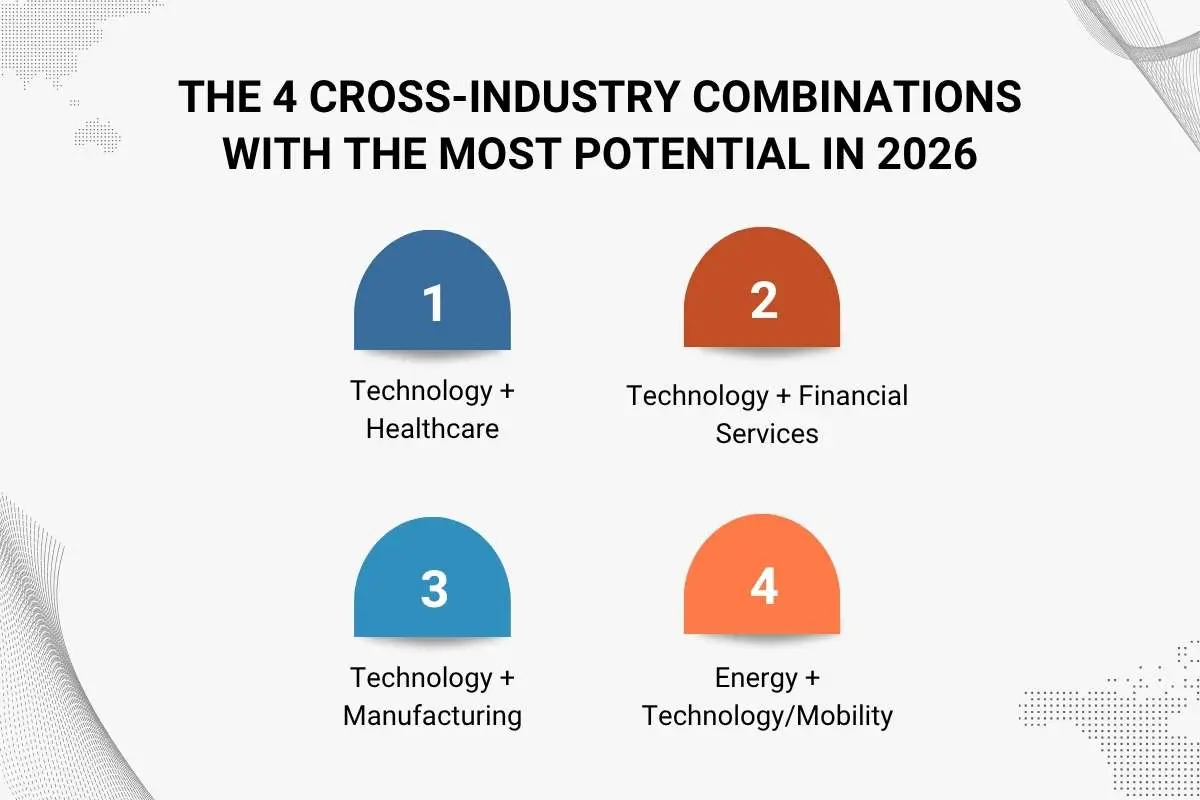
The 4 Cross-Industry Combinations With the Most Potential in 2026
There is no official leaderboard for the best industry combinations, and anyone claiming otherwise probably has a spreadsheet with far too much confidence in it. But some pairings stand out in 2026 because they bring together fast-moving technology, major capability gaps, and industries facing pressure to change.
Here are four worth watching.
1. Technology + Healthcare
Healthcare has no shortage of complex problems, and technology has no shortage of tools looking for useful ones. That makes this pairing particularly practical. Cross-industry collaboration can bring AI and data into diagnosis, patient monitoring, administration, and personalised care, while healthcare provides the clinical expertise and real-world settings needed to make those tools useful.
PwC’s 2026 CEO research points to growing technology investment across healthcare, while the World Economic Forum identifies healthcare as one of the sectors being reshaped by technology convergence.
2. Technology + Financial Services
This combination goes well beyond flashy banking apps. Financial services can use technology partnerships to improve fraud detection, payments, digital banking, financial infrastructure, and personalised products. Technology companies, meanwhile, gain access to highly valuable use cases and regulated financial environments.
PwC’s CEO research highlights technology’s growing interest in banking and capital markets, another sign that industry boundaries are becoming less tidy.
3. Technology + Manufacturing
Forget the vague promise that AI will “transform manufacturing.” The interesting part is how. Robotics, predictive maintenance, digital twins, industrial AI, and automated quality control can connect digital capabilities with physical operations.
That matters because manufacturing has something technology companies often lack: complex real-world environments where better technology can produce measurable gains. The World Economic Forum’s 2026 research identifies manufacturing among the sectors where technology convergence is creating new opportunities.
4. Energy + Technology/Mobility
Energy and mobility are increasingly becoming one connected problem. EV charging, intelligent grids, battery systems, energy optimisation, and AI infrastructure all depend on digital and physical systems working together.
That is where Cross-industry Collaboration becomes especially useful. Technology is no longer simply another sector to partner with. It is increasingly part of the infrastructure that allows industries to connect.
For businesses looking beyond today’s partnerships, the Future of Business Collaboration points toward this broader shift: competitive advantage is increasingly built across ecosystems, not neatly inside one industry.
How to Build the Business Case for an Outside-Sector Partnership
A good partnership idea can sound brilliant over coffee and look considerably less brilliant when someone asks, “So, what does this actually do for the business?” Before getting lawyers, product teams, and twelve calendars involved, put the idea through five questions.
1. What problem are we solving?
Start with a real business problem, not a vague ambition to “innovate.” What needs to improve, and why does it matter now?
2. Why does an outside company solve it better?
Pinpoint the capability gap. Is the missing piece technology, expertise, distribution, data, customers, or something else?
3. What does each partner bring?
Map the assets on both sides. The strongest partnerships are complementary, not two companies bringing nearly identical capabilities to the same table.
4. What is the economic upside?
Look beyond revenue. Consider cost savings, faster time to market, customer acquisition, risk reduction, and new products. This is where Collaboration KPIs Metrics become useful. Define measurable outcomes before the partnership starts, not after someone asks why the budget disappeared.
5. What happens if we do nothing?
If the answer is “not much,” congratulations. You may have just saved six meetings.
A simple way to pressure-test the idea is:
Partnership value = strategic fit + complementary capability + economic upside − coordination cost − risk
It is not meant to produce a magical score. It forces the harder questions that turn Cross-industry Collaboration from an interesting idea into an investment decision.
KPMG’s research shows why that discipline matters: 75% of surveyed executives say partnerships fuel growth, innovation, and agility, but 71% struggle to align partners with strategic goals, and only 36% consistently measure partner performance.
Strategic Alliance vs Joint Venture: Which Structure Fits?
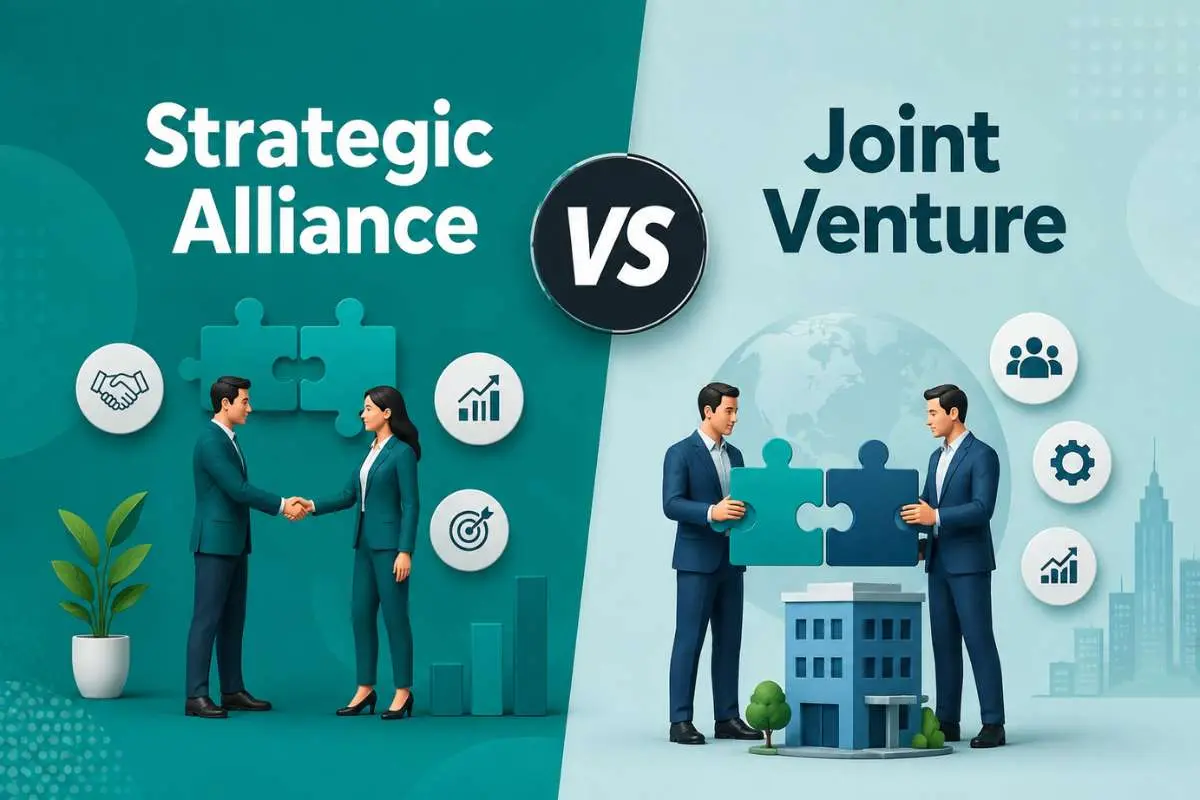
Once the business case makes sense, there is another question to answer: how much should the two companies actually build together? You do not need to create a new company every time two businesses decide to cooperate.
A strategic alliance usually works when both companies want to remain independent while sharing specific capabilities, technology, customers, or resources. It suits partnerships with a defined purpose where flexibility and speed matter.
A joint venture makes more sense when both sides are committing substantial resources, and the opportunity is large enough to justify a dedicated business. Shared ownership, economics, and longer-term commitments can make the relationship more formal, but they also bring more governance.
| Choose a strategic alliance when… | Choose a joint venture when… |
| The companies can remain independent | The opportunity needs a dedicated business |
| The purpose is clearly defined | Both sides are making major commitments |
| Flexibility matters | Ownership and economics need formal sharing |
| Capabilities need to be shared | The relationship is expected to be long-term |
The basic rule for Strategic Alliance vs Joint Venture is simple: start with what needs to be shared, decide what needs to be governed, then choose the structure.
That matters in Cross-industry Collaboration because the partnership model should support the business case, not become the business case.
Finding the Right Partner Without Falling for the Shiny-Object Trap
A big-name company can make a partnership look impressive before anyone has checked whether it makes sense. But the biggest company is not necessarily the best partner. The best partner is the one that closes the capability gap that matters most to your business.
A simple screening test can help:
| Question | What to look for |
| Capability | Can they actually do what you need? |
| Strategic fit | Do their goals align with yours? |
| Customer fit | Do you serve compatible users or markets? |
| Execution | Can they move at the pace you need? |
| Culture | Can your teams actually work together? |
| Risk | What happens if the relationship goes wrong? |
This matters even more in Cross-industry Collaboration because companies from different sectors may have very different priorities, decision speeds, risk tolerance, and ways of working. That difference can create value, but it can also create friction.
So look for complementarity over prestige. A famous partner with little strategic fit is still a bad partner. It just makes for a better press release.
Before signing anything, proper due diligence matters. Look closely at incentives, capabilities, financial stability, governance, and potential conflicts. Understanding Why Do Business Collaborations Fail can help you spot warning signs before they become expensive lessons.
Making Two Very Different Companies Work as One Team

Signing the agreement is the easy part. Then the actual work begins.
A successful Cross-industry Collaboration needs a shared operating rhythm, not just a shared contract. Get these basics clear from the start:
| What needs to be clear | Why it matters |
| Shared goals | Both sides know what success looks like |
| Ownership | Everyone knows who is responsible for what |
| Decision rights | Teams know who gets the final say |
| Escalation paths | Problems have somewhere to go before they become disasters |
| Success measures | Progress can be judged with evidence |
| Executive reviews | Leaders can fix issues before they become expensive |
Then there is the human side. Different industries can have very different risk tolerance, decision speeds, terminology, compliance expectations, and customer priorities. Even communication styles can clash. One team wants a decision by Friday. The other wants a working group to discuss whether Friday is strategically appropriate.
This is where Cross-Functional Collaboration Between Departments becomes important. Each company needs its own teams aligned before they can operate smoothly with an external partner.
And if the partnership crosses borders too, Cross-Cultural Collaboration in Business matters as well. Different communication and decision-making norms need to be understood early, rather than discovered during a very expensive misunderstanding.
Conclusion
The point is not to partner outside your industry because it sounds innovative. It is to look beyond your usual circle when the capability you need already exists somewhere else.
Start by finding the gap, then find the complementary capability that can close it. Build the economic case, choose a structure that fits, and agree on how success will be measured. If the economics stop working, be willing to walk away. Not every partnership deserves a sequel.
That is what makes Cross-industry Collaboration useful rather than just another corporate buzzword. For the wider principles behind effective partnerships, Business Collaboration provides the bigger picture.
Your next competitive advantage may not come from beating the company next door. It may come from figuring out why the company three industries away has something you desperately need.
FAQs
1. What is an example of cross-industry collaboration?
A retailer partnering with a fintech company to offer embedded payment services is one example.
2. What are the risks of cross-industry collaboration?
Common risks include intellectual property disputes, data concerns, conflicting priorities, and unclear accountability.
3. How do companies measure cross-industry collaboration?
Companies can track revenue impact, customer adoption, time savings, innovation output, and return on partnership investment.
4. When should a company avoid cross-industry collaboration?
Avoid it when the partnership lacks a clear business need, strategic fit, or measurable potential value.
5. How long does a cross-industry partnership typically take?
Timelines vary widely, from several months for focused projects to multiple years for complex strategic partnerships.