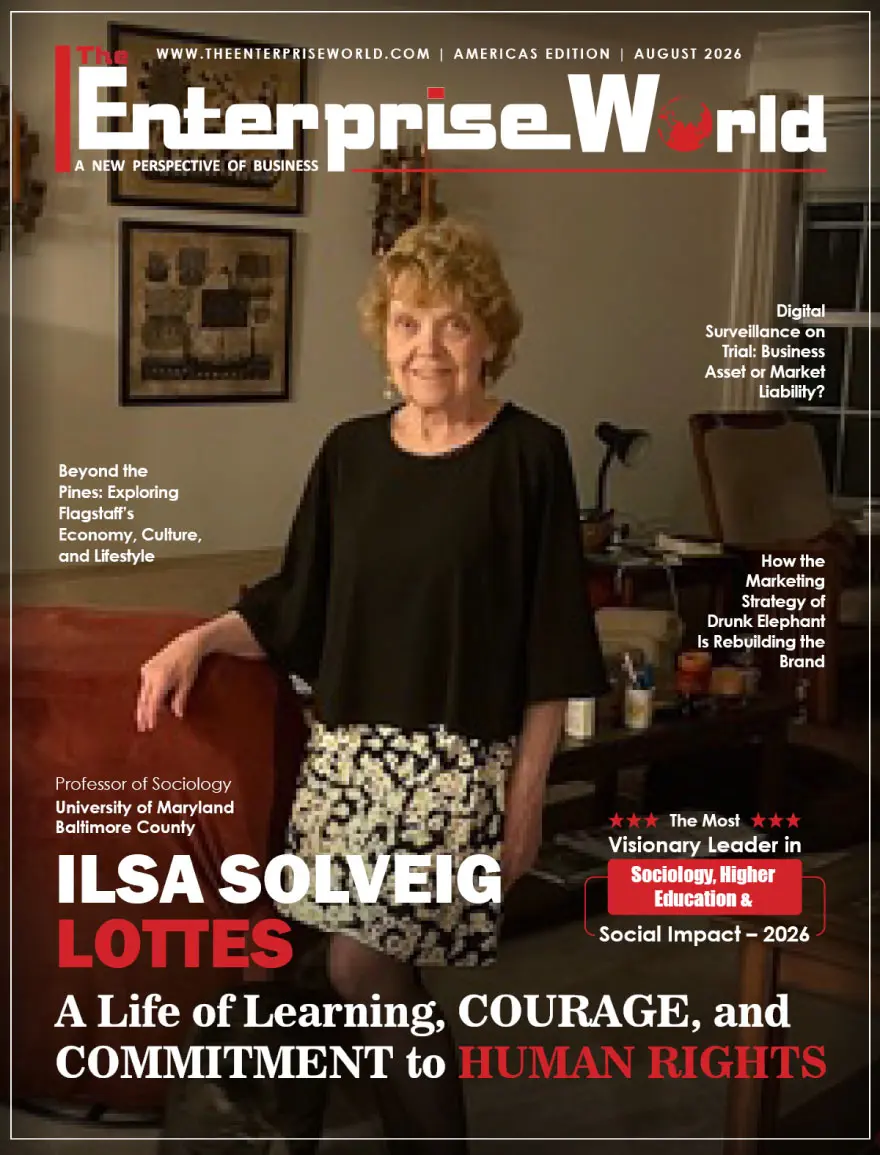
There was a time when the path to becoming a professor was not one that many women were encouraged to imagine for themselves. Yet, some journeys begin precisely where expectations end. A love for learning can open an unexpected door, and a question about society can eventually become a lifelong search for answers. What begins as a conventional career can take an entirely different direction when curiosity refuses to remain within familiar boundaries.
That spirit of questioning became the defining thread of Ilsa Solveig Lottes’ remarkable journey. Beginning with mathematics and 15 years of teaching, her career gradually moved toward sociology, sexuality, health, social policy, and human rights. As Professor of Sociology at the University of Maryland Baltimore County, she has spent decades examining how policies and social systems affect real people, particularly vulnerable communities.
From Mathematics to Academia and Human Rights
Ilsa Lottes’ academic journey was far from predetermined. For nearly half her life, she had not imagined becoming an academic or writing a book about human rights. When she attended university, becoming a professor was not among the careers typically pursued by women. Yet, her deep appreciation for learning, likely influenced by her highly educated parents who both taught at Purdue University, remained a constant.
After earning her B.S. in mathematics with highest distinction and an M.S. in mathematics in 1967, she became a mathematics teacher, spending 15 years developing educational materials and curricula. During this period, her growing interest in social policies and their impact on different groups, combined with a lifelong sensitivity to injustice, led her to question the suffering created by governmental policies.
Seeking a deeper understanding, she pursued graduate studies at the University of Pennsylvania in sexuality and quantitative research methods, while studying history, anthropology, and sociology. Her involvement with the Society for the Scientific Study of Sexuality introduced her to sociologist Ira Reiss, who became her mentor and influenced her first publication. In 1986, she earned her Ph.D. with meritorious honors in the METER program, marking a defining transition into academia, research, and human-rights scholarship.
From Sociology to Sexual Rights Advocacy
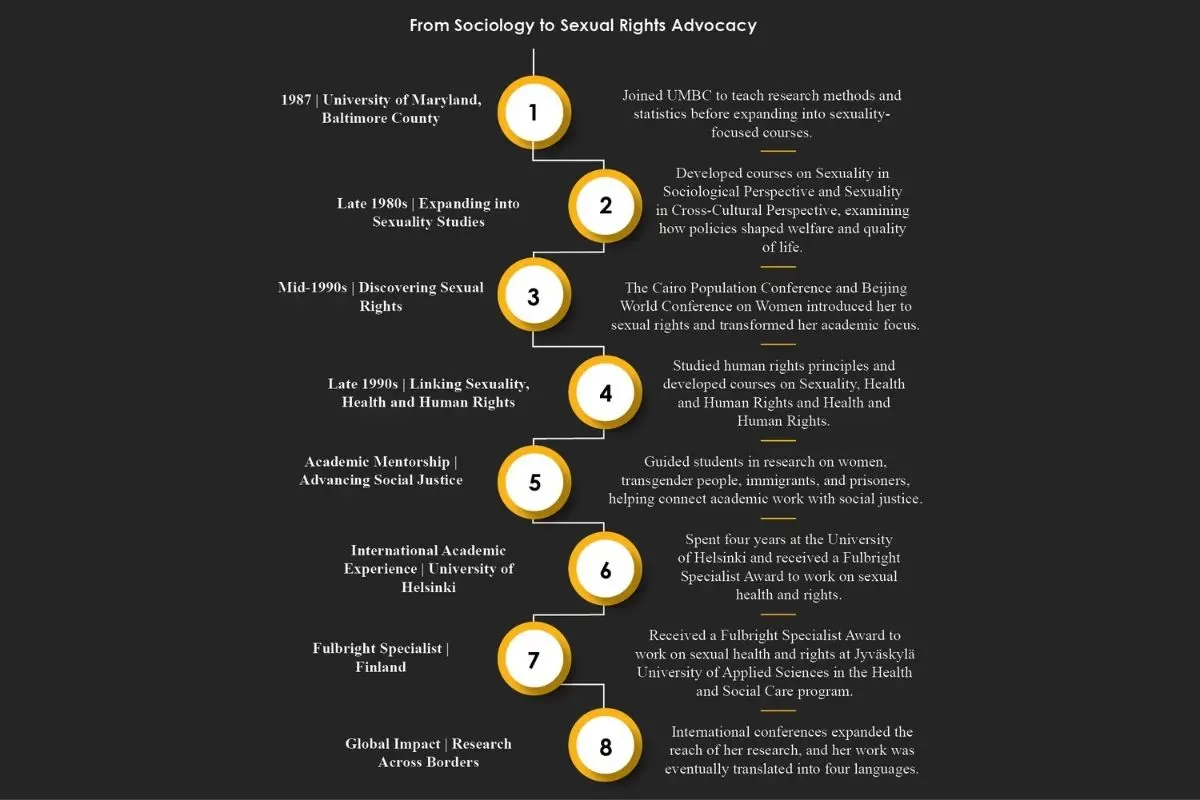
- 1987 | University of Maryland, Baltimore County
Joined UMBC to teach research methods and statistics before expanding into sexuality-focused courses.
- Late 1980s | Expanding into Sexuality Studies
Developed courses on Sexuality in Sociological Perspective and Sexuality in Cross-Cultural Perspective, examining how policies shaped welfare and quality of life.
- Mid-1990s | Discovering Sexual Rights
The Cairo Population Conference and Beijing World Conference on Women introduced her to sexual rights and transformed her academic focus.
- Late 1990s | Linking Sexuality, Health and Human Rights
Studied human rights principles and developed courses on Sexuality, Health and Human Rights and Health and Human Rights.
- Academic Mentorship | Advancing Social Justice
Guided students in research on women, transgender people, immigrants, and prisoners, helping connect academic work with social justice.
- International Academic Experience | University of Helsinki
Spent four years at the University of Helsinki and received a Fulbright Specialist Award to work on sexual health and rights.
- Fulbright Specialist | Finland
Received a Fulbright Specialist Award to work on sexual health and rights at Jyväskylä University of Applied Sciences in the Health and Social Care program.
- Global Impact | Research Across Borders
International conferences expanded the reach of her research, and her work was eventually translated into four languages.
Living and working internationally challenged some of Ilsa’s ethnocentric assumptions and broadened her understanding of human rights, sexuality, health, and social justice.
The Classroom as a Place for Dialogue and Discovery
Ilsa’s teaching philosophy was shaped by the realities of both large and small classrooms. For classes of approximately 100 students, she relied primarily on lectures while encouraging students to ask questions and contribute their ideas. Smaller seminars created a different dynamic. In a first-year seminar limited to 15 students, she was able to foster considerably more participation and discussion.
But what made her teaching particularly meaningful was not simply the opportunity to transmit information. It was the opportunity to learn from the people she taught. One gay student once wrote to her during the height of the HIV/AIDS epidemic to express gratitude for her views on homosexuality and her research on gay issues. He later became a social worker on a Native American reservation. She remains in contact with many of her former gay students and values those relationships because they have helped her understand experiences outside her own.
That humility is central to her approach. Although she was an accomplished researcher and professor, she never positioned herself as someone who had nothing left to learn. She understood that teaching works both ways.
Turning a Love for Learning into Purpose
Her journey evolved from conventional mathematics teaching into a deeper pursuit of knowledge and social understanding. Growing concerns about injustice encouraged her to question her path and seek a career where research and learning could create greater impact.
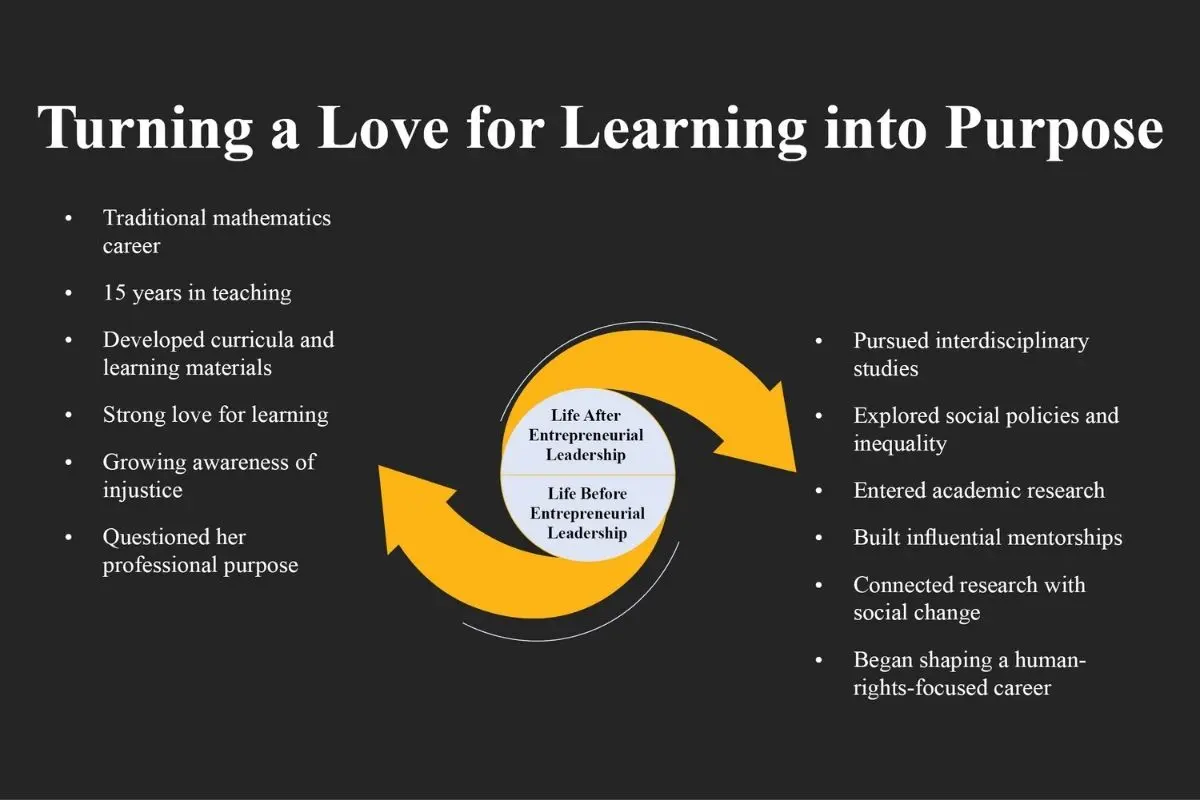
Life Before Entrepreneurial Leadership
- Traditional mathematics career
- 15 years in teaching
- Developed curricula and learning materials
- Strong love for learning
- Growing awareness of injustice
- Questioned her professional purpose
Life After Entrepreneurial Leadership
- Pursued interdisciplinary studies
- Explored social policies and inequality
- Entered academic research
- Built influential mentorships
- Connected research with social change
- Began shaping a human-rights-focused career
Confronting the Human Cost of Inequality
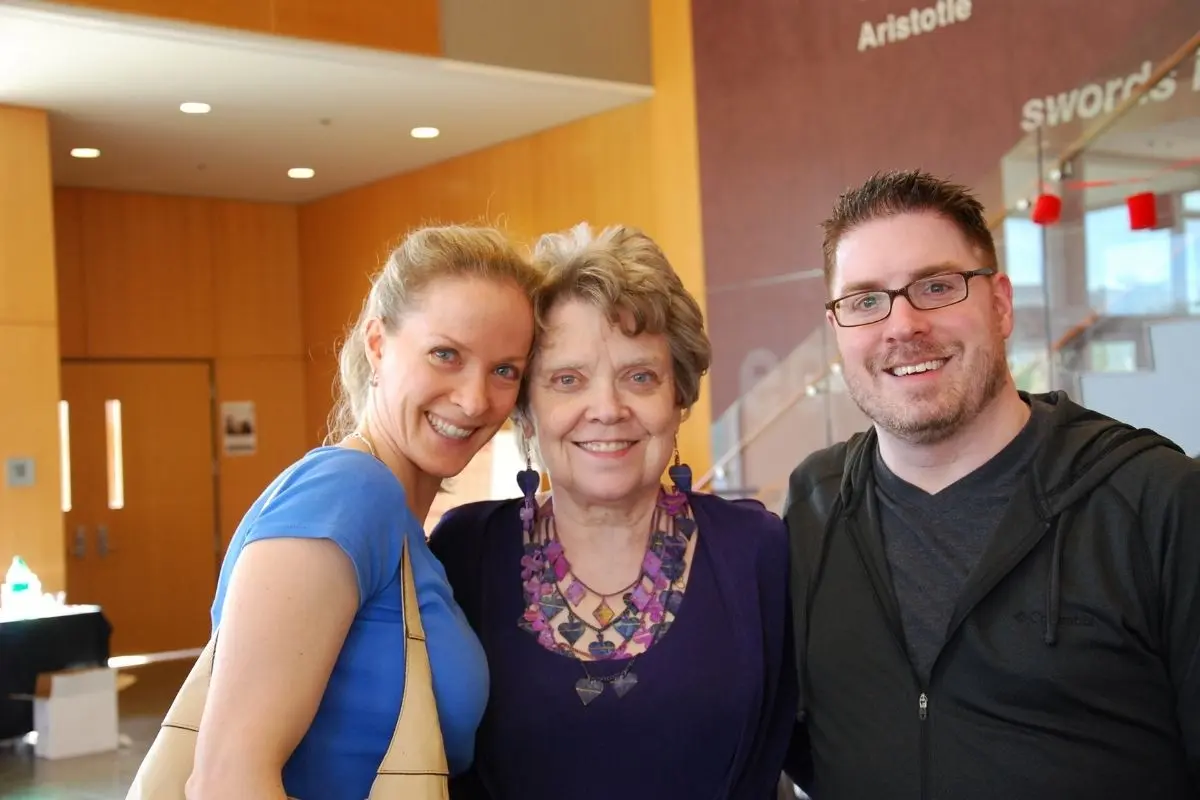
One of the most troubling realities of the present day is the growth of anti-human-rights practices and laws enacted by people with political power and significant wealth. The dramatic increase in inequality concerns her deeply. What troubles her is not simply economic disparity, but the extent to which political systems can permit or even reinforce conditions that harm vulnerable populations.
Ilsa’s concern reflects the central thread running through her career. Whether she has been teaching research methods, studying sexuality, examining social policy, or writing about human rights, she has consistently looked beyond systems and statistics to consider the people affected by them. Her perspective is rooted in the belief that progress should be judged by its effect on human beings.
Scholarship with Human Rights at Its Core
Among the publications closest to Ilsa’s heart are those that bring her academic expertise directly into the field of human rights. Her article, “Sexual Rights: Meanings, Controversies and Sexual Health Promotion,” published in The Journal of Sex Research, became an important contribution to discussions surrounding sexual rights.
Her edited book with Finnish colleague Osmo Kontula, New Views of Sexual Health: The Case of Finland, contains four chapters written by her and explores how Finland approaches sexual health and values sexual rights. Her 2026 book, Quality of Life and Human Rights Policies in the U.S.: How Can the U.S. Reduce its Human Rights Violations, represents her most comprehensive work on human rights.
Together, these publications reflect the evolution of her career. What began as an academic interest gradually became a sustained examination of the relationship between policy, social conditions, and human dignity.
A Career That Crossed Borders and Perspectives

Ilsa Lottes has delivered more than 90 talks and invited lectures across the United States, Canada, and Europe. These experiences exposed her to people from different cultures, professional disciplines, and intellectual traditions. One of the most memorable moments came when she and her Finnish colleague were invited to meet Tarja Halonen, then President of Finland, to present their book on sexual health in Finland. Halonen’s own history of advocacy for LGBTQ communities made the encounter particularly meaningful to her.
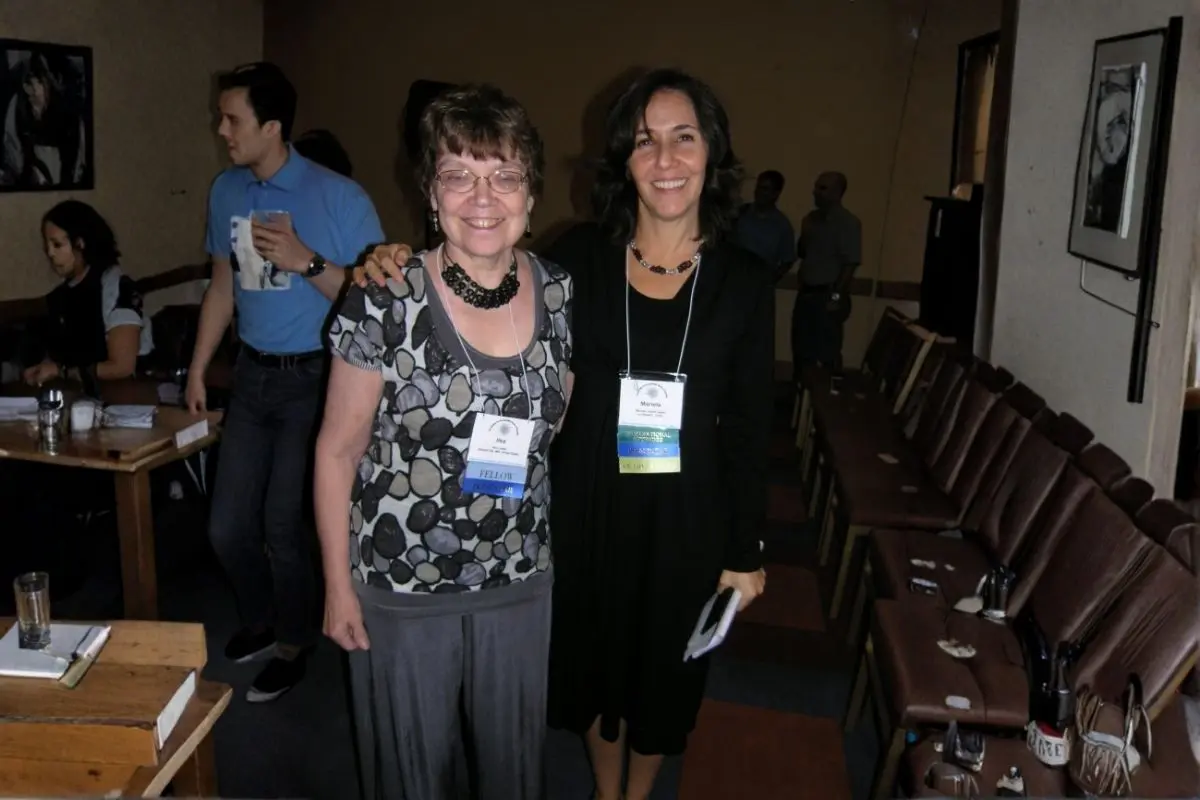
Another significant experience was meeting Mariela Castro Espín, known for her work in sexuality and transgender rights in Cuba. Castro Espín had conducted research on transgender rights and worked to promote greater acceptance of sexual and gender minorities. These encounters demonstrated the importance of international dialogue. Human-rights questions may be shaped by different cultures and political systems, but the need to understand dignity, equality, and social well-being transcends national borders.
Holding Research to an Ethical Standard
As an instructor of research methods, Ilsa Lottes taught research ethics and therefore approached the integrity of research with particular seriousness. Her own early research included surveys examining sexual attitudes and behaviors. Some involved questions about sexual violence, which occasionally created an ethical tension for her.
Although such questions could be necessary for understanding difficult social realities, she was conscious of the emotional burden placed on people who had experienced violence and were being asked to revisit those experiences. The experience reinforced an important principle: research must never lose sight of the human beings behind the data. Methodological rigor and empathy were not opposing values. Both were necessary.
When Scholarship Became Action
Ilsa Lottes has never confined her commitment to human rights to academic publications. Her understanding of injustice has motivated her to participate in protest marches, sign petitions, and write to elected officials. Yet one of the experiences she is particularly proud of was much closer to home.
She volunteered as a mathematics tutor for African American boys in Baltimore, spending two hours each week helping them with mathematics. The program’s sponsor later told her that the students’ grade-point averages had increased significantly. The experience reinforced something she had understood throughout her teaching career: students can achieve considerably more when they receive adequate attention and support. This was social justice in its most practical form. It was not simply about discussing inequality, but about providing an individual with an opportunity to overcome it.
Speaking Truth to Political Power
Ilsa Lottes remains concerned about political changes taking place at the national level in the United States. She believes too many politicians fail to consider how certain policies negatively affect both the institution of democracy and vulnerable groups. She describes many of these policies as “anti-human rights.”
Her hope is ultimately rooted in civic participation. She wants American citizens to vote for leaders who genuinely seek to improve the lives of the people they serve. This reflects another recurring principle in her work: responsibility cannot be outsourced entirely to institutions. Citizens also have a role in determining the direction of society.
A Day in Ilsa Lottes’s Life
With retirement since 2014, the leader’s days are shaped by personal passions, creativity, and meaningful connections rather than a traditional work schedule.
- Reading – Enjoys spending time with books and learning.
- Argentine Tango – Pursues dancing as a favorite activity.
- Piano Practice – Keeps creativity alive through regular piano practice.
- Time with Friends & Family – Values quality time with friends and two adult children.
- Playing with the Cat – Makes room for simple moments of joy and companionship.
Success Changed Confidence, Not The Values
Despite the professional recognition Ilsa has received, she does not believe academic success fundamentally changed who she was. Much of that consistency, she attributes to her mother, whom she describes as kind and wise. The values established early in life continued to guide her even after she became an accomplished academic.
Her divorce represented one significant personal change. She realized that she could not comfortably speak or act according to her values alongside someone who did not share them. Her subsequent marriage to a Finnish partner with a similar worldview has allowed her to live more openly according to her conscience. One quality did change over time: her self-confidence. Recognition from prestigious organizations helped Ilsa Lottes understand that her work mattered and was valued.
An Open Letter to Professionals Committed to Human Rights
Dear Professionals,
My advice to all professionals is to work toward the realization of human rights for all. When suggesting a policy or idea, examine who benefits and who loses. Do not lie, and consider how your industry promotes or hurts acts of kindness and empathy.
I do not have an app to suggest, but I would recommend examining both history and science relating to the issue. Further, communicate and seek advice from people with multiple views before deciding what actions to take.
At the beginning of each chapter of my book, I include quotes by famous people, and it is difficult to choose only one. However, these two have guided me throughout my career:
“If you are neutral in situations of injustice, you have chosen the side of the oppressor.” — Desmond Tutu
“The test of progress is not whether we add more to the abundance of those who have too much. It is whether we provide enough for those who have little.” — Franklin D. Roosevelt
With commitment to human rights,
Ilsa Solveig Lottes
Professor of Sociology,
University of Maryland Baltimore County
Transforming Scholarship into a Lifelong Commitment to Human Rights
- Turned a foundation in mathematics and teaching into an interdisciplinary career focused on inequality, sexuality, health, and human rights.
- Consistently connected academic research and policy analysis to the real-world experiences of vulnerable communities.
- Built her teaching philosophy around dialogue, humility, and learning from students whose experiences differed from her own.
- Extended her commitment beyond academia through advocacy, civic engagement, and hands-on mentoring of underserved students.
- Cross-border research, international collaborations, and decades of scholarship transformed her work into a broader call for equality, dignity, and human rights.