
Small business owners frequently watch their best employees leave for larger competitors offering structured training and clearer career progression. Losing trained staff creates a constant cycle of recruitment costs, lost productivity, and stalled operations. Prioritizing workforce development breaks this cycle by transforming everyday jobs into clear avenues for internal career growth.
When lean companies invest directly in upskilling their current teams, they build deep operational stability. Workforce development for small businesses entails teaching employees to manage new software, run automated workflows, or handle higher-level client accounts, boosting internal productivity while significantly improving retention. This approach allows growing firms to scale their output and build an agile workforce without the overhead of constant hiring.
Employees who understand modern operational tools can spot inefficiencies early and suggest practical fixes. That internal expertise builds a resilient organization capable of handling market disruptions without losing momentum.
What workforce development for small businesses looks like
Workforce development for small businesses can look different. A company does not need a large training team or a formal learning system to help employees build skills. It can use simple methods that fit its team, work, and budget.
Consider a 20-person business where the owner handles most employee development. New employees may learn by working with the owner or a senior employee. They can learn how to serve customers, manage daily tasks, use business tools, and solve common problems. This approach can work well for a small team. However, it also puts much of the training work on the owner. As the business grows, the owner may have less time to guide every employee.
Now consider a small franchise group with three or four locations. Each location may need training on similar tasks and processes. The group can create shared training materials and use them across locations. It can also hold joint training sessions for employees from different locations. Experienced employees can support other locations when needed. This model allows the group to share both knowledge and training costs.
Small businesses can use several other workforce development approaches:
- Cross-train employees: Employees learn tasks outside their main roles. This gives the business more flexibility when someone takes leave or leaves the company.
- Use informal mentorship: Owners and experienced employees can guide newer workers through regular support and feedback. The business does not need a formal mentorship program to make this work.
- Share training resources: A few business locations can share trainers, workshops, learning materials, and other training costs. Local businesses can also work together when they need similar training.
- Use low-cost external resources: Community colleges, industry associations, local business groups, and public programs can provide training at little or no cost.
These approaches show how workforce development for small businesses can be built into everyday work. The business does not need a large HR department or a complex training system. It needs to identify the skills employees need and create practical ways for them to build those skills.
The specific challenges small businesses face
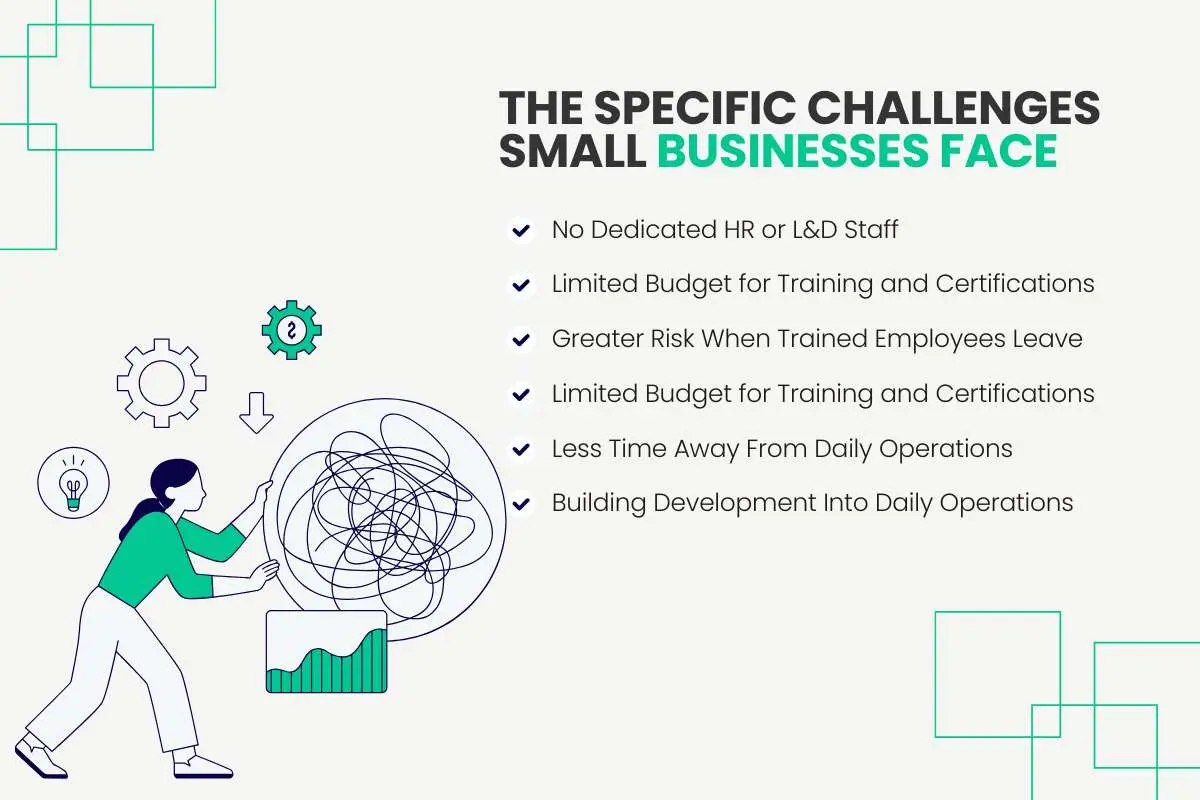
Workforce development for small businesses often includes helping employees build new skills. They also face limits that larger companies can handle more easily. These limits can affect how they plan training, how much they spend, and how much time employees can spend away from their regular work.
1. No dedicated HR or L&D staff
Many small businesses do not have a dedicated HR or learning and development team. The owner or a manager may handle employee training along with hiring, payroll, operations, and other tasks. They may need to identify skill gaps, find training options, guide employees, and track their progress.
This adds more work to an already busy role. It can also make training less consistent. A business may train employees when a need appears instead of following a regular development plan.
2. Limited budget for training and certifications
Training costs can create another barrier. External courses, industry certifications, workshops, and professional programs can require a large investment for a small company. Even when employees need several types of training, the business may have enough money to support only a few.
Small businesses may then rely on free or low-cost options. These can include community college courses, industry groups, local business programs, and online resources. Such options can help, but they may not cover every skill the business needs.
3. Greater risk when trained employees leave
Employee turnover can feel more costly when a business has a small team. If a trained employee leaves, fewer people remain to handle that person’s work. The business may also need to spend more time recruiting and training a replacement.
This can create a concern for owners. They may spend money and staff time developing an employee, only to lose that employee later. Some owners may then hesitate to invest in training because they fear losing that investment. At the same time, avoiding training can leave employees without the skills they need to grow with the business.
4. Less time away from daily operations
Time can be just as limiting as money. Small businesses often have fewer employees available to cover daily work when someone attends training. Taking one employee away for several hours can affect customer service, sales, production, or other tasks.
For example, a small retail team may struggle to send an employee to a full-day workshop during a busy sales period. A service business may face a similar problem when it needs every worker to serve customers. This makes it harder to schedule long training sessions.
Small businesses can respond by using shorter sessions, on-the-job learning, peer mentoring, or training during quieter periods. These methods reduce the time employees spend away from their regular work while still giving them opportunities to build new skills.
5. Building development into daily operations
For a small business, employee development does not need to sit outside the normal workday. It can become part of the routines the team already follows. This approach makes learning easier to manage because employees can build skills while they continue their regular work.
Consider a small retail shop with a weekly team meeting. The manager could add a 10-minute skill-sharing session to each meeting. One week, an employee could show the team how to handle a difficult customer. The next week, the manager could cover a new sales technique. Another session could focus on using the store’s inventory system more effectively.
The shop does not need to create a separate training day for these lessons. It can use a meeting that already happens. Employees also spend less time away from customers and daily tasks. Over time, these short sessions can cover a wide range of skills.
Small businesses can use the same approach in other parts of their daily work. A senior employee can explain a task while working with a newer team member. Managers can discuss a recent problem and use it as a learning opportunity. Teams can also review what worked after completing a project and discuss what they could improve next time.
The main benefit comes from making development part of work rather than treating it as an extra task. Small teams often have plenty of ideas for employee development. The harder part is finding the time and structure to keep those ideas going. When learning fits into routines that already exist, employees have more chances to practise new skills and managers have fewer extra tasks to manage.
What are some signs it’s starting to work?

Progress might not always show through formal reports or detailed workforce development metrics. In a small business, early signs can appear in the way employees handle their work. These signals can show that employees are learning, gaining confidence, and using new skills.
1. Employees take on new tasks
Employees may start taking on tasks outside their original roles without being asked. A sales employee might help train a new team member. A customer service employee might learn how to manage inventory. These actions can show that employees feel ready to use skills beyond their usual duties.
2. New hires need less help
New employees may begin asking fewer repeated questions as they gain experience. They may also make fewer common mistakes. This can show that the business is giving them useful guidance and that employees are learning from it. The change may happen slowly, so managers can look for patterns over time.
3. Employees refer people they know
Current employees may start referring friends, former colleagues, or professional contacts for open roles. This can offer another useful signal. People are more likely to talk about a workplace when they see value in the experience. If employees speak positively about the skills they are gaining and the support they receive, they may feel comfortable recommending the business to others.
These signs do not replace formal workforce metrics. They simply give small business owners an easy way to notice whether development efforts are becoming part of everyday work.
Where small businesses can access outside support?

Small businesses do not have to build every part of workforce development on their own. Public agencies, colleges, industry groups, and business support organizations offer resources that can help smaller employers train their teams. These resources can reduce both the cost and the work involved in implementing workforce development strategies.
Consider a local manufacturer that needs to hire several new employees. The company may not have enough money or staff to create a full training program. Instead, it could work with a state-funded workforce program that helps employers train new workers. The program may cover part of the training cost or connect the company with local training providers. This can help the manufacturer prepare new hires without carrying the full cost of training on its own.
Small businesses can look for support through several types of organizations:
1. Community colleges
Community colleges often work with local employers and can provide job-focused training. A business may partner with a college to train employees in technical, digital, or industry-specific skills.
2. State and local workforce boards
Workforce boards connect employers with training programs, funding, and employment services. Small businesses may be able to access programs that support hiring and employee training.
3. Industry associations
Industry groups often provide training, workshops, certifications, and other learning resources. These programs can help small businesses give employees access to skills that match industry needs.
4. SBA resources
The U.S. Small Business Administration provides resources that can help small businesses find training, support, and guidance. Owners can use these resources alongside local programs to identify options that fit their needs.
The right support will depend on the business, location, industry, and skills employees need. A closer look at public workforce development programs can help small business owners understand what support may be available and how these programs can reduce the cost of workforce development(Pillar).
Conclusion
Closing these global skills gaps could boost the world economy by $6.5 trillion over seven years. This is why investing in workforce development for small businesses provides the foundation needed to build a stable, adaptable organization. Upgrading internal skill sets helps small business owners reduce costly employee turnover, improve operational efficiency, and protect their companies against sudden talent shortages. Cross-training employees and building clear career progression paths ensures that daily operations run smoothly even during unexpected team transitions.
Targeted training programs give smaller firms a distinct competitive edge over larger enterprise rivals. Lean teams that continuously master new digital tools and refine operational workflows can adapt to market shifts faster and deliver higher-quality customer service. Prioritizing structured skill development transforms local businesses into resilient, high-performing enterprises equipped for long-term growth.
FAQs
1. What is workforce development for small businesses?
It is a structured strategy focused on upskilling, cross-training, and educating employees to improve internal productivity and align team capabilities with company growth goals.
2. Why is workforce development important for small business growth?
It lowers costly turnover, removes operational single points of failure, and prepares lean teams to handle modern technology and shifting market demands.
3. How can a small business implement workforce development on a tight budget?
Owners can utilize low-cost methods like peer mentorship, cross-department shadowing, micro-learning modules, and local apprenticeship programs.
4. How does workforce development directly improve employee retention?
Offering clear skill training demonstrates a visible path for internal career advancement, keeping top performers from seeking outside offers.
5. What specific skills should small business training programs prioritize first?
Focus on cross-functional job duties, essential software tools, digital workflow automation, and core customer service standards.