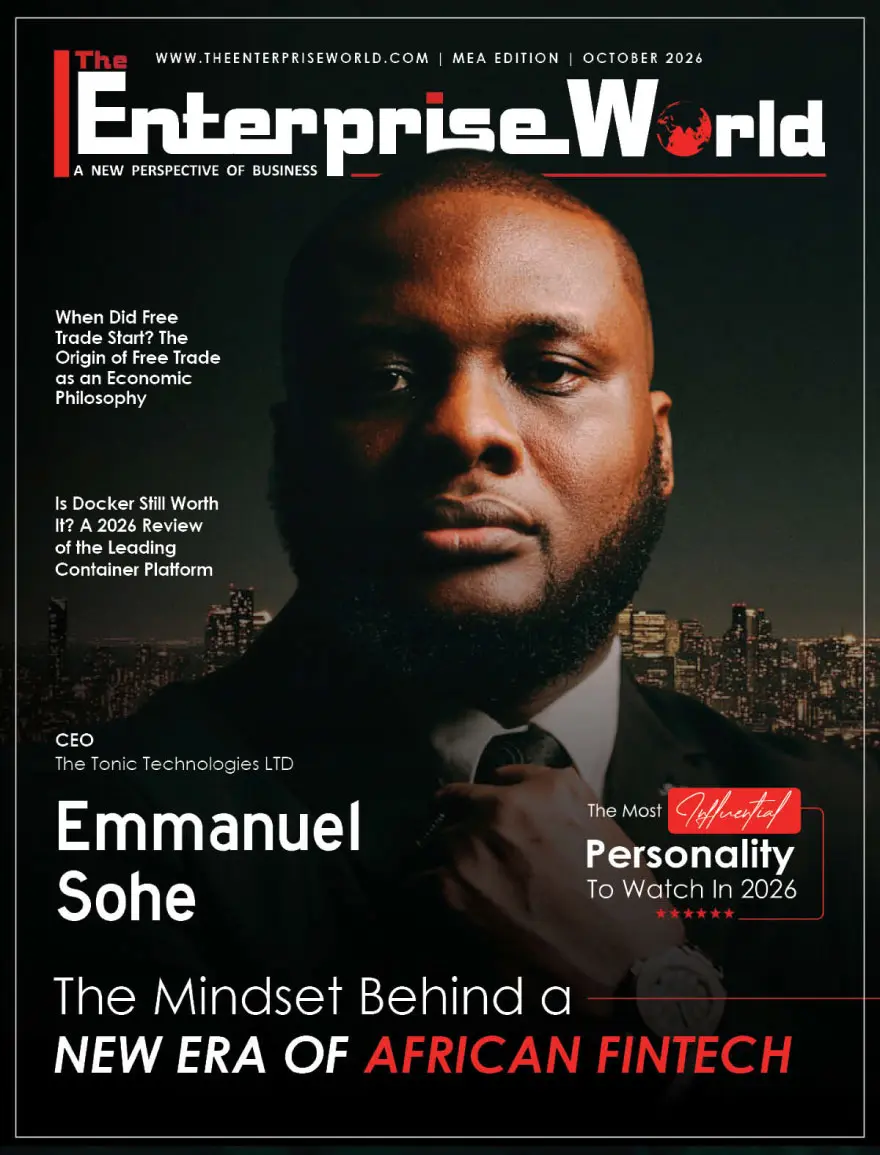
Some leaders are defined by the size of what they build. Others are better understood by the questions they keep asking.
Emmanuel Sohe belongs to the second kind.
What problem are people actually trying to solve? What makes a product worth trusting? And perhaps the more uncomfortable question: when something is already working, how do you know when “good” is no longer good enough?
These questions have become part of how Emmanuel Sohe approaches his work as CEO of The Tonic Technologies LTD, the company behind Cardtonic. They also reveal something about the person behind the title. He is curious about what sits underneath the obvious answer, skeptical of noise for the sake of noise, and drawn to the discipline of making complicated things simpler.
Data, business, technology, customers, and the realities of building in Africa have shaped his perspective. But the most revealing parts of his leadership have not necessarily come from the moments when everything went according to plan.
They have come from the moments that forced him to question what mattered, what needed to change, and what was worth building again.
That is where the story of Emmanuel Sohe becomes more than a career journey.

A Different Route to Technology
“I actually began by studying people.”
At Obafemi Awolowo University, Emmanuel Sohe studied Demography and Social Statistics, the science of how populations live, move, earn, and spend. He graduated as the best student in his faculty, supported by Federal Government, Lagos State, and MTN scholarships.
The grades were important, but Emmanuel remembers a different lesson from that period: learning to see an entire society inside a dataset.
That perspective led him into years of work as an expert data analyst for international clients and into co-founding DataHUB_360 to train young Nigerians in research and data science. He later moved into business development and consulting, working with institutions including Ecobank and the Federal Inland Revenue Service.
Those experiences gradually changed how he looked at information.
“Data tells you what is true, but leadership is about turning what is true into decisions people will act on.”
In 2020, Emmanuel joined The Tonic Technologies as a Product Manager. He grew into Chief Product Owner before becoming CEO in January 2025.
“Fintech is simply where my two instincts, understanding people and building for them, finally met.”
The Problem That Started It All
Cardtonic began with a surprisingly ordinary problem.
In 2018, one of the company’s co-founders needed to buy makeup for his then-girlfriend, now wife. His Naira cards would not work abroad, so he turned to a Sephora gift card instead.
The workaround revealed something bigger. What looked like one frustrating purchase was actually a problem thousands of Nigerians were experiencing: local cards did not always work when they needed to pay for things beyond their home market.
“The company began in 2018 from a very human frustration,” Emmanuel says.
The response was to build a bridge between Africans and the global digital economy. The company started almost entirely by hand, using an initial ₦5 million in personal savings and no external funding. Its first app launched in 2020.
Since then, that original problem has expanded into a broader platform for cross-border payments and purchases, including virtual dollar cards, gift cards, international bill payments, and more, serving over 1.5 million users in Nigeria and Ghana.
Yet the lesson from those early days remains simple for Emmanuel: “Solve a real, painful problem for real people, do it so reliably that trust compounds, and treat revenue as fuel and discipline as your compass.”
When the Rails Suddenly Disappeared

On 5 February 2021, Cardtonic’s own rails suddenly disappeared.
The Central Bank of Nigeria had ordered banks to stop dealing with crypto exchanges and close associated accounts. At the time, Cardtonic had a crypto off-ramp embedded in its platform. Overnight, the company’s payment rails were cut.
“I remember it vividly,” Emmanuel says.
Five members of the management team, including the founding CEO who flew straight back to Nigeria, sat in a small conference room weighing what the development meant for the product, their livelihoods, and their future.
For Emmanuel, it was deeply personal. Months earlier, he had left a relatively stable job to join the company.
One thing, however, was not up for debate: they would not fail to pay their users.
The weekend became a scramble. The team pulled the crypto off-ramp from the app, shipped a new web and mobile application, and began onboarding new payment providers. At some points, they processed thousands of payouts manually through personal accounts simply to keep their promise.
The crisis could have ended the story. Instead, it changed its direction.
The crypto off-ramp eventually lived on as Breet, an independent product making crypto spendable in Nigeria and Ghana.
For Emmanuel, the experience left a lasting lesson: challenges can build momentum rather than destroy it.
“Regulators and markets can misunderstand innovation, but you never let anything kill the dream.”
Closing the Distance to Digital Access
“Cardtonic solves access.”
That simple description captures what Emmanuel sees as the company’s purpose: reducing the friction between Africans and the global digital economy.
Through one platform, users can buy and sell gift cards, create virtual dollar cards, pay bills, buy gadgets, and access services such as eSIMs using Naira or Cedis.
But Emmanuel’s attention goes beyond what appears on the screen. He is equally focused on what happens underneath it, how quickly problems are identified, how transparently customers are charged, and whether an initiative is actually creating value.
Cardtonic uses customer feedback at scale, including sentiment analysis, to identify problems early. As CEO, Emmanuel also introduced a “good to great” cadence, breaking larger annual goals into measurable quarterly milestones and judging initiatives by “value over noise.”
Being fully bootstrapped adds another layer to that thinking. The company can focus its incentives on users rather than someone else’s growth targets.
The result is a product philosophy built around a straightforward question: is this genuinely making something easier for the customer?
The Responsibility Behind the Product

“We treat trust as the product and everything else as a feature.”
For a fintech company, that distinction matters. Behind the interface are KYC and compliance systems, transaction-security measures, partnerships, and decisions about how transparent to be with customers.
Sohe’s standard is straightforward.
“We would rather lose a transaction than cut a corner on security.”
That approach extends to Cardtonic’s international ambitions, including its registration as a Money Services Business with FINTRAC in Canada.
But trust is not built only through compliance. It is also built by listening when customers are unhappy.
“Customer feedback is not a suggestion box for us; it is a control system.”
In-app support, public reviews, and sentiment analysis feed into product decisions. Some improvements began as complaints the company chose to take seriously.
Something is humbling about that responsibility. Customers are not simply using a technology product; they are trusting it with their money.
As Emmanuel puts it, “Interfacing with users at scale is humbling; they hold you accountable for their money, and rightly so.”
When the Card Made the Difference
Some of the most meaningful feedback reaches Emmanuel without being requested.
He regularly hears from users who were abroad and suddenly needed to pay for a hotel, book a flight, or settle medical or school fees when their usual payment options failed.
In those moments, a virtual dollar card becomes more than a convenience.
“One product, issued in minutes and funded in Naira or Cedis, quietly rescued someone thousands of miles from home.”
That, for Emmanuel, is where the value of the product becomes clearest. Behind every transaction is someone trying to get something done, often at a moment when the usual options have stopped working.
Cardtonic’s role is to remove that friction when it matters.
Creating a Culture That Moves Forward
There comes a point in a company’s journey when success creates a new question: what if being good has become too comfortable?
That was the question Emmanuel and his team began asking at Cardtonic.
The goal was no longer simply to do well. They wanted to understand whether the mindset that had taken the company to “good” could actually take it to “great.”
“How do we go from good to great?” became a question the company chose to take seriously.
Sohe’s answer was direct: “The mindset that gets you to good will not get you to great.”
The thinking eventually became the company’s Greatness Whitepaper, which the whole team opted into. It set expectations around ownership, ambition tempered by discipline, and honesty about setbacks.
The idea is not that every goal will be achieved. Unmet goals can become lessons. The company aims high enough that even a miss can create progress.
But Emmanuel’s idea of greatness is not simply about demanding more from people. He believes talent needs clarity and trust to do its best work.
“Give people a real problem, the context to own it, and the safety to fail forward, and they will surprise you.”
And there is another part of his approach that is less visible in a company document: appreciation.
“I also never miss a chance to appreciate the humans behind the work.”
That balance, high expectations without losing sight of the people doing the work—is central to the culture Emmanuel is trying to build.
A Record That Speaks
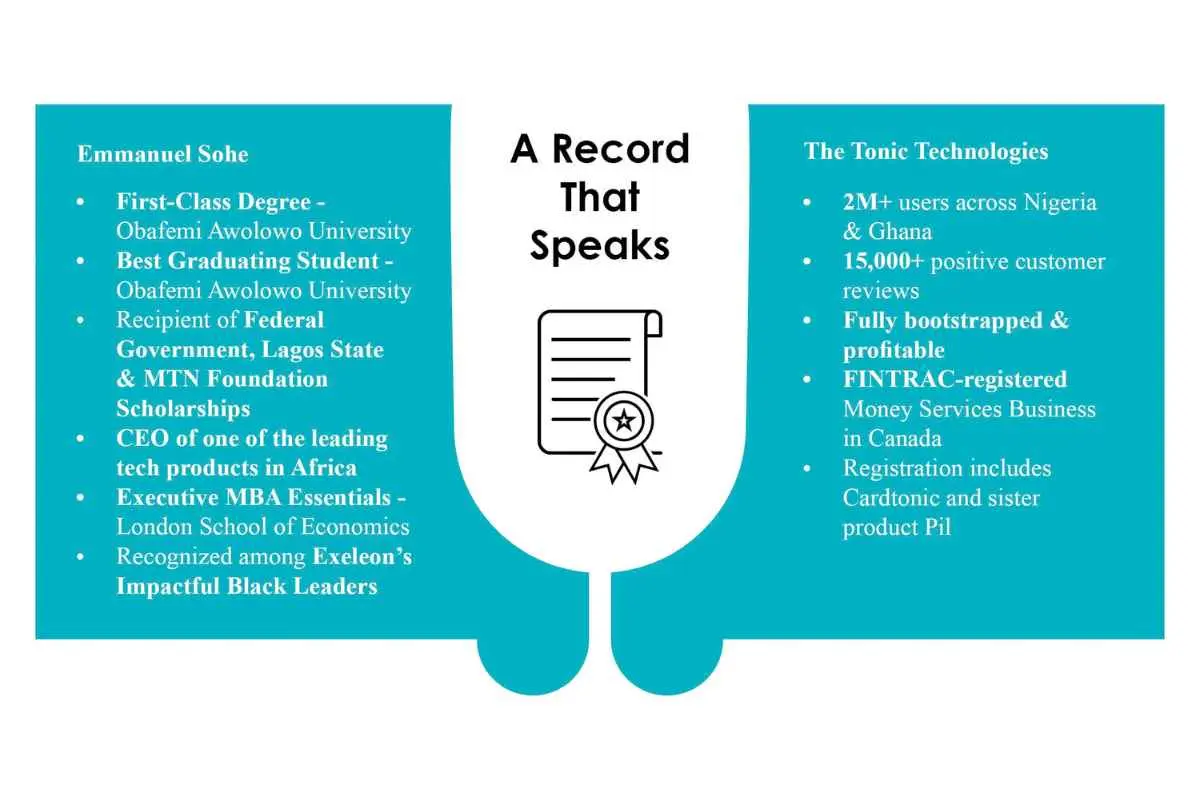
Emmanuel Sohe
- First-Class Degree – Obafemi Awolowo University
- Best Graduating Student – Obafemi Awolowo University
- Recipient of Federal Government, Lagos State & MTN Foundation Scholarships
- CEO of one of the leading tech products in Africa
- Executive MBA Essentials – London School of Economics
- Recognized among Exeleon’s Impactful Black Leaders
The Tonic Technologies
- 2M+ users across Nigeria & Ghana
- 15,000+ positive customer reviews
- Fully bootstrapped & profitable
- FINTRAC-registered Money Services Business in Canada
- Registration includes Cardtonic and sister product Pil
Beyond the AI Hype
Sohe is interested in AI, but beyond just talking about it. He uses it almost every day as a core tool for solving live problems.
He expects AI-driven fraud detection, customer experience, intelligent automation, and data to reshape fintech over the next three to five years. He also sees cybersecurity becoming increasingly central because, in finance, security is trust.
His bigger concern is what companies may overlook while chasing the technology.
“AI is only as good as the data and the operational discipline behind it.”
In emerging markets, that means paying attention to data quality, localisation, and reliability rather than assuming the model itself is the answer.
“The winners will not be those who talk about AI the loudest,” Emmanuel says, “but those who deploy it dependably, on problems that actually matter to the customer.”
Cutting Through the Noise
Sohe’s thinking extends beyond his role at Cardtonic. Through Musings by E.S., he writes about fintech, leadership, and building in Africa. He also mentors talent and remains involved in developing data-science skills.
He has taken those conversations beyond his own ecosystem as well, including speaking about building beyond Africa’s home markets at Web Summit in Vancouver.
But one idea perhaps captures his thinking better than most.
“There are no complex problems, only complex solutions.”
For Emmanuel, difficult problems often become complicated because too much noise gets layered around the original need. The challenge is to keep cutting through it until the simple truth becomes visible.
It is an idea that connects his different chapters, from studying populations and analysing data to building products for millions of users.
Find the real problem. Then have the discipline to solve it.
The Leader’s Wider Lens
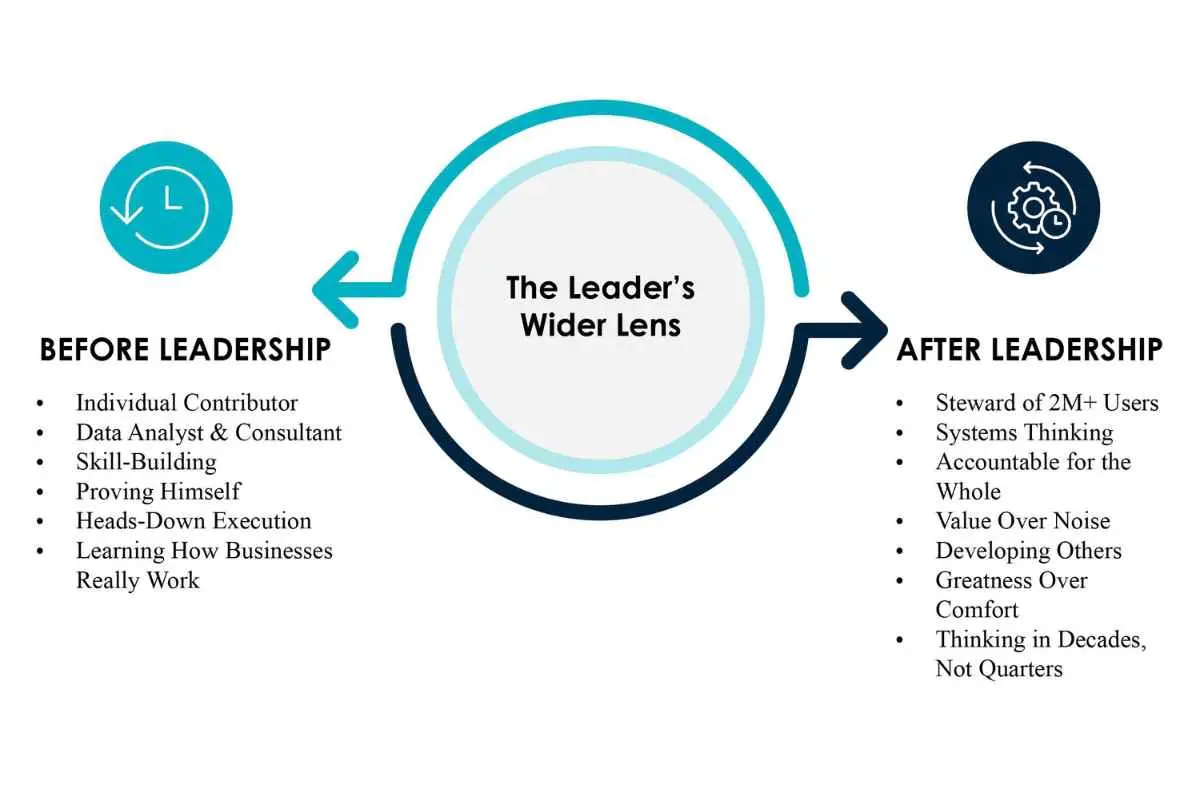
| BEFORE LEADERSHIP | AFTER LEADERSHIP |
| Individual Contributor | Steward of 2M+ Users |
| Data Analyst & Consultant | Systems Thinking |
| Skill-Building | Accountable for the Whole |
| Proving Himself | Value Over Noise |
| Heads-Down Execution | Developing Others |
| Learning How Businesses Really Work | Greatness Over Comfort |
| Thinking in Decades, Not Quarters |
A Day in Emmanuel’s Rhythm
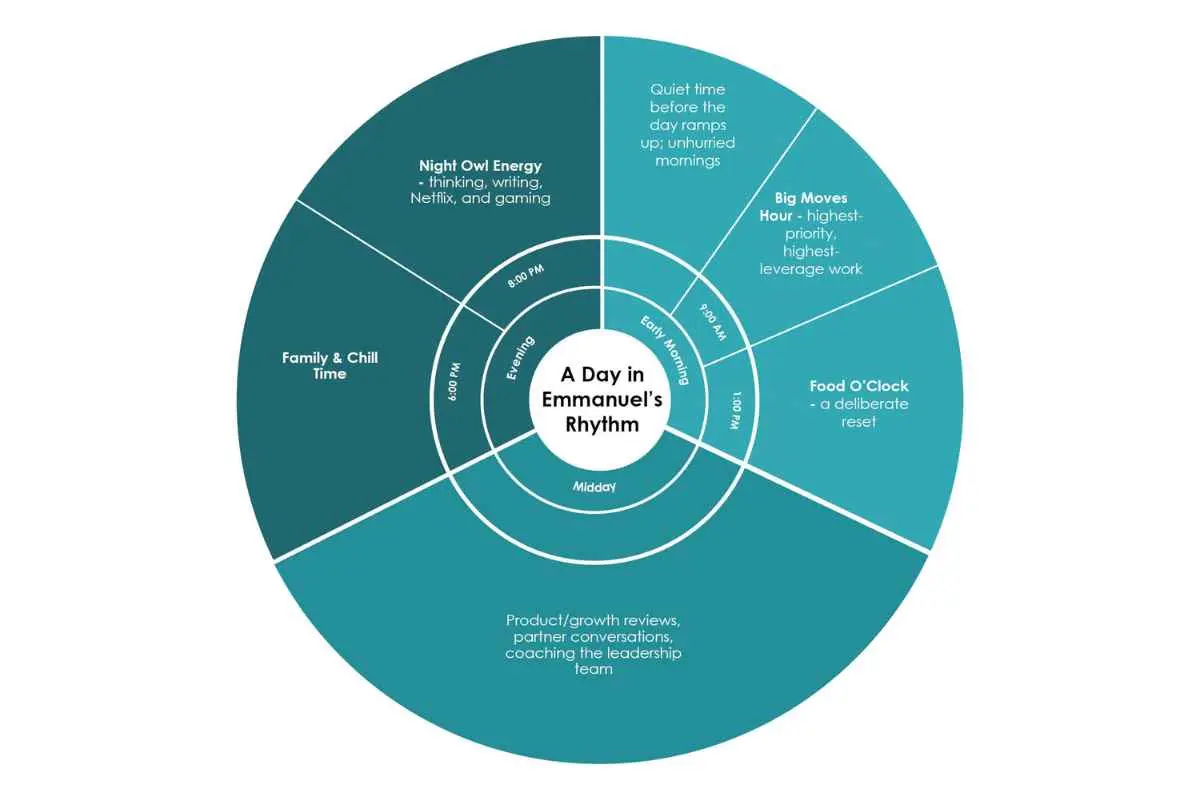
| Time | Activity |
| Early Morning | Quiet time before the day ramps up; unhurried mornings |
| 9:00 AM | Big Moves Hour – highest-priority, highest-leverage work |
| 1:00 PM | Food O’Clock – a deliberate reset |
| Afternoon | Product/growth reviews, partner conversations, coaching the leadership team |
| 6:00 PM | Family & Chill Time |
| 8:00 PM | Night Owl Energy – thinking, writing, Netflix, and gaming |
Quick Takes
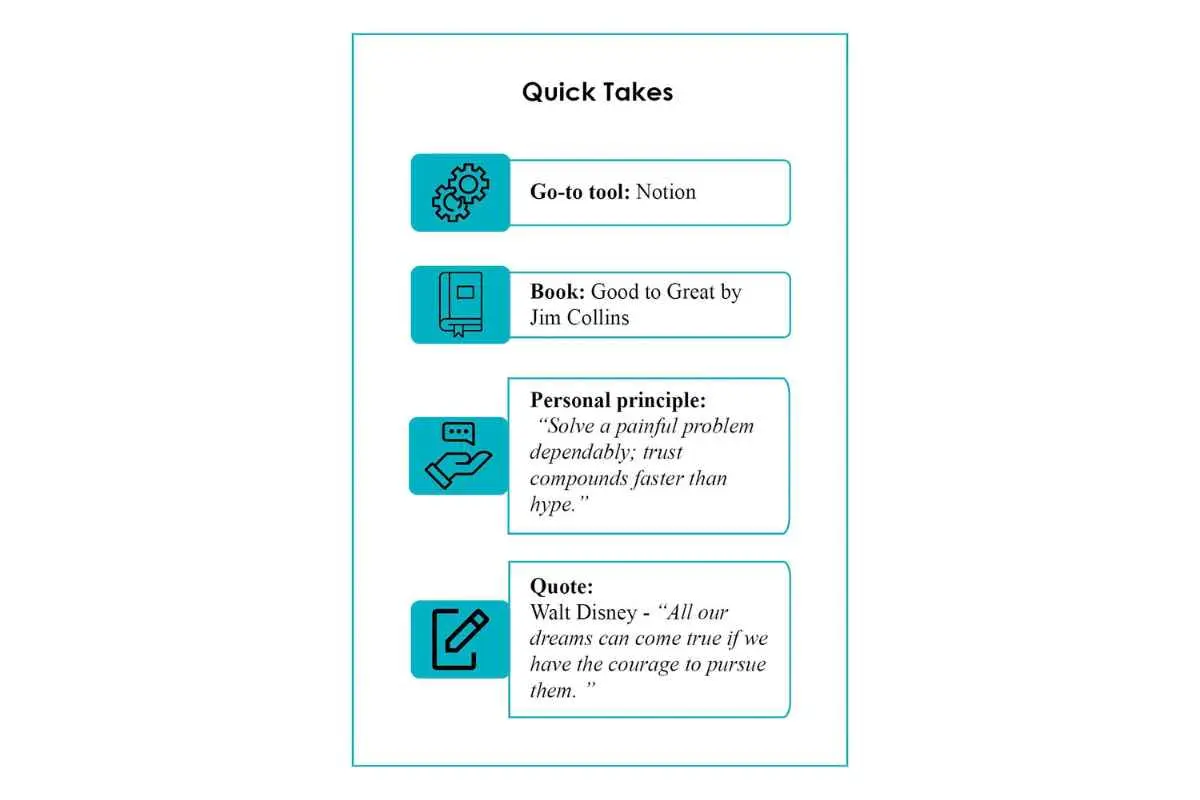
Go-to tool: Notion
Book: Good to Great by Jim Collins
Personal principle:
“Solve a painful problem dependably; trust compounds faster than hype.”
Quote:
Walt Disney – “All our dreams can come true if we have the courage to pursue them. ”
Open Letter
Dear Readers,
To the next generation building in Africa and beyond: don’t wait for perfect conditions; they never come. You can’t outrun your environment, so build for it. Solve a real problem for real people, and solve it so dependably that trust compounds in your favour. Building resilient fintech products for Africa’s dynamic economy requires a deep understanding of the challenges and opportunities that come with it.
Personally, I’ve learned that resilience is not just about weathering the storms, but about harnessing the power of challenges to build momentum. As you continue to innovate and push boundaries, be reminded that it is not just about building a product or a company, but about empowering millions of Africans to participate in the global economy.
To all the innovators, entrepreneurs, and dreamers out there, we urge you to stay focused, stay consistent, and stay resilient. The future of Africa’s fintech industry is bright, and it is exciting to be part of it.
From,
Emmanuel Sohe | Chief Executive Officer
The Tonic Technologies LTD (Cardtonic)
Key Takeaways
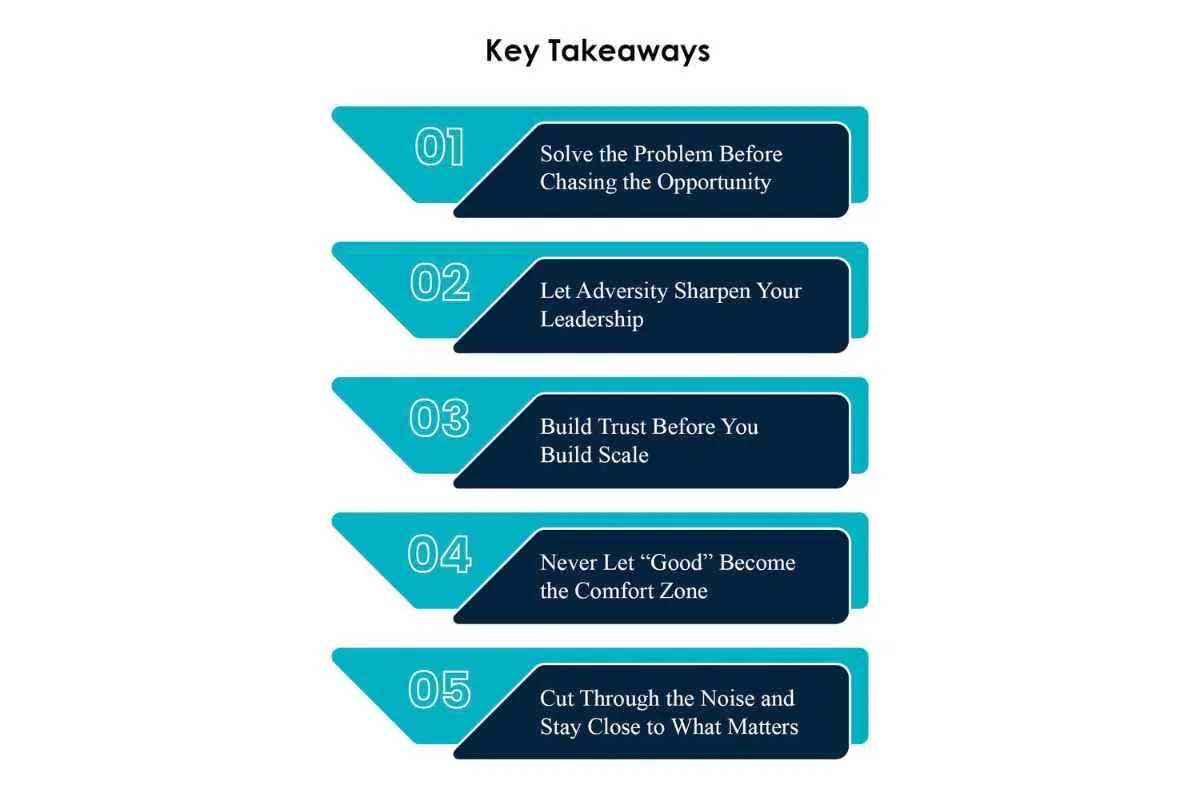
- Solve the Problem Before Chasing the Opportunity
- Let Adversity Sharpen Your Leadership
- Build Trust Before You Build Scale
- Never Let “Good” Become the Comfort Zone
- Cut Through the Noise and Stay Close to What Matters
The Questions That Keep Him Moving
Perhaps that is the thread running through Emmanuel’s story. The numbers matter. The products matter. The milestones matter. But underneath them is a recurring instinct to look past the obvious and ask what is actually needed.
He began by trying to understand people through data. He moved into building products around what people needed. Along the way, difficult moments tested the company, customers challenged it to do better, and success itself became something worth questioning.
The questions have changed as his responsibilities have grown. The instinct has not.
Find the real problem. Make the solution dependable. Keep asking whether good is good enough.
For Emmanuel Sohe, perhaps the next chapter is not about having all the answers. It is about continuing to ask better questions.