
A room full of brilliant executives nodding along in a meeting does not mean you have actual alignment. The moment those leaders leave the boardroom, quiet doubts set in, execution stalls, and departmental priorities begin pulling the project in four different directions.
Relying on majority votes often leaves a frustrated minority ready to passively resist new workflows. Adopting a structured consensus decision-making process solves this friction by requiring the group to address objections and refine proposals until every stakeholder can actively support the outcome.
Eliminating hidden disagreement keeps high-performing departments focused on unified execution. Balancing deep group buy-in with decisive momentum turns collective planning into a smooth operational advantage.
But how does this work?
How Does The Consensus Decision-Making Process Differ From Other Collaborative Methods?
Consensus decision-making gives every group member a chance to shape the final choice. However, it differs from other methods that also involve group input. The main difference lies in how the group reaches and accepts a decision.
Consensus vs. Collaborative Decision-Making
Collaborative decision-making is a broad term for making decisions with input from several people. It can include methods such as voting, group discussion, and shared problem-solving. The group may use different ways to reach its final choice.
Consensus decision-making is more specific. It aims to build broad support for one decision through discussion and shared agreement. So, consensus can form part of collaborative decision-making. But not every collaborative decision uses consensus. Overall, collaborative vs consensus decision-making comes down to how much control the group has over the final decision.
Consensus vs. Majority Voting
Majority voting counts individual choices. The option with the most votes wins, even if some members disagree. This method works well when a group needs to decide quickly or choose between clear options.
Consensus takes a different path. The group discusses the issue, raises concerns, and works toward a choice that everyone can support. Members do not always need to prefer the final option, but they should be willing to accept it.
Consensus vs. Consultative Decision-Making
Consultative decision-making allows people to share their views before one person makes the final choice. A manager, leader, or team head may ask for ideas and then decide based on the input received.
Consensus gives the group more control over the final decision. Members take part in both the discussion and the decision. No single person holds the final say.
Consensus vs. Unanimous Agreement
Consensus and unanimous agreement may sound similar, but they have a key difference. Unanimous agreement means every member fully agrees with the decision. Consensus does not require full agreement. Instead, members can accept a decision even when they have some concerns.
Overall, consensus focuses on shared acceptance. Other collaborative decision-making methods may focus on voting, advice, or group input.
The Consensus Decision-Making Process
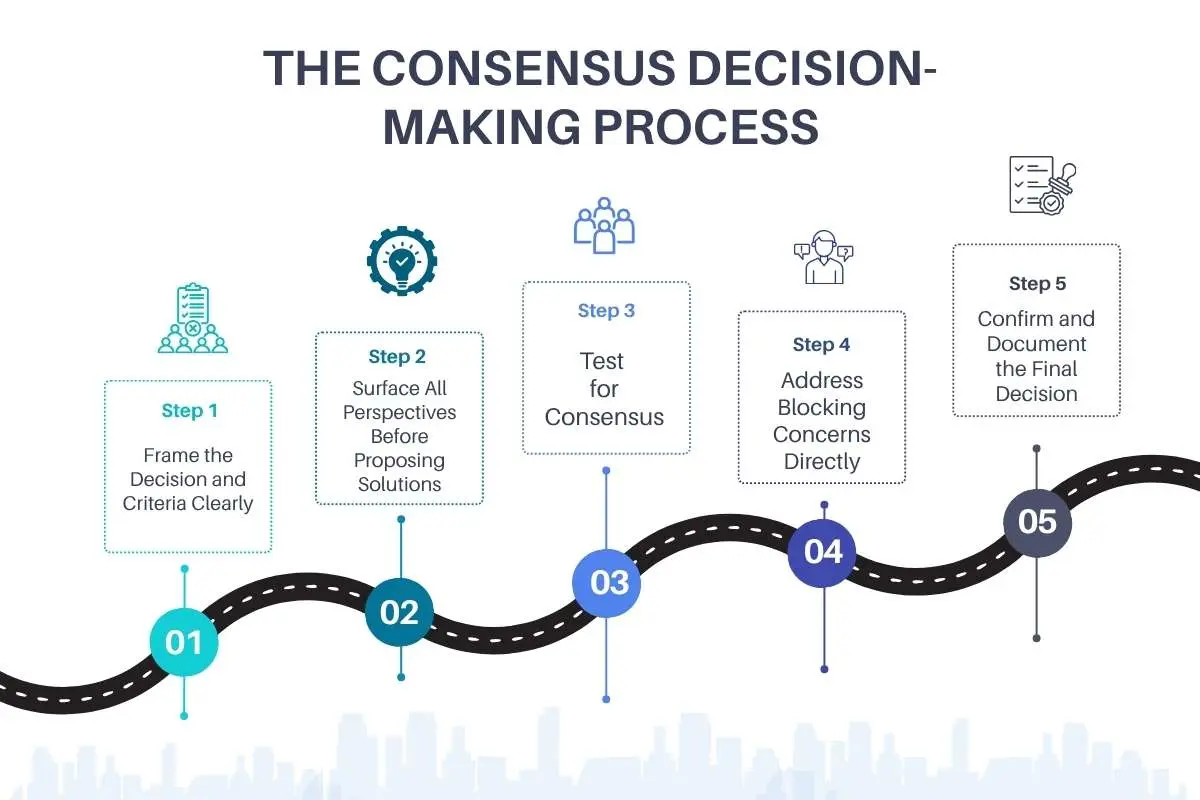
Consensus decision-making works best when teams follow a clear process. Each step helps the group understand the issue, share concerns, and build support for the final choice. A clear process also keeps strong opinions from taking over the discussion.
Step 1 — Frame the Decision and Criteria Clearly
Start by defining what the group needs to decide. State the main question in simple terms, and explain why the decision matters. The team should also agree on the criteria it will use to judge each option.
For example, a team choosing new project software may consider cost, ease of use, security, and support. Clear criteria give the discussion a shared focus. They also help the group compare ideas based on facts rather than personal preferences.
Step 2 — Surface All Perspectives Before Proposing Solutions
Give each member a chance to share their view before the group starts choosing solutions. Ask open questions and listen to concerns, risks, and different needs.
This step can reveal issues that the first few speakers may miss. It also gives quieter members space to contribute. Leaders should avoid pushing their preferred option too early, as this can limit honest discussion.
Step 3 — Test for Consensus
Once the group has discussed the options, test whether members can support a decision. Do not ask only, “Does everyone agree?” A person may disagree with some details but still support the final choice.
Instead, ask whether each member can accept and support the decision. The consensus decision-making process separates full agreement from a willingness to move forward. It also gives members a chance to raise concerns before the group closes the discussion.
Step 4 — Address Blocking Concerns Directly
A major concern can stop the group from reaching consensus. The team should examine that concern instead of ignoring it or moving straight to a vote.
Ask what would help resolve the issue. The group may adjust the proposal, add a safeguard, or gather more information. However, members should explain their concerns clearly and avoid blocking a decision without a valid reason.
Step 5 — Confirm and Document the Final Decision
Once the group reaches consensus, state the decision clearly. Record what the team agreed to, who owns each action, and when the team will review the outcome.
Documentation prevents confusion later. It also creates a shared record that everyone can refer to. A strong consensus process ends with clear ownership, action, and follow-up. This helps turn group agreement into meaningful action.
When Does Consensus Decision-Making Work Best?
According to a report by McKinsey, teams that scored above average on decision-making were 2.8 times more innovative than below-average teams.
Consensus decision-making fits situations where teams need strong support for a choice. It may take more time than voting, but it gives members a chance to raise concerns and support the final decision.
High-Stakes Decisions
The consensus decision-making process suits decisions that affect people, budgets, or major business plans. Open discussion helps teams identify risks and build support before they commit.
Smaller Groups Where Every Voice Can Be Heard
Small teams can use consensus more easily because everyone gets enough time to speak. Members can share views, ask questions, and raise concerns without making the process too slow.
Situations Where Long-Term Commitment Matters
Consensus works well when teams must support a decision for a long time. Members understand the reasons behind the choice and can raise concerns before the group commits.
Overall, consensus fits decisions that need shared support, open discussion, and lasting commitment.
What Are Some Common Challenges With The Consensus Decision-Making Process?

Reaching consensus takes time because everyone needs a chance to speak, ask questions, and raise concerns. The process can become even slower as the group grows. Teams with tight deadlines may find voting or delegated decisions more practical.
The search for agreement can also weaken a decision if members avoid conflict. A team may keep changing a strong proposal until everyone can accept it, even if the final version loses some of its value. Good facilitation keeps debate open while helping the group protect the main goal.
Consensus can also stall when one or two members block a decision without a clear reason. Teams should define what counts as a valid concern and separate serious risks from personal preferences. Clear rules help the group address real issues without letting one objection stop the entire process.
What Are The Tips for Making the Consensus Decision-Making Process Work?
Consensus can take time, but a clear approach can keep the discussion moving. Teams can set simple rules, manage disagreements, and give members enough space to share their views.
1. Set a Clear Time Limit
Give the discussion a reasonable time limit before it starts. This keeps the team focused and prevents the same points from being repeated. If the group cannot reach consensus within the set time, use an agreed fallback method.
2. Define What Counts as a Valid Block
Teams should agree on what can stop a decision. A serious risk, missing requirement, or major concern may justify a block. A minor personal preference usually should not. Clear rules help separate real issues from simple disagreement.
3. Keep the Discussion Focused
A consensus meeting can drift when members bring up issues that do not affect the decision. Keep the conversation tied to the agreed criteria and main goal. The facilitator can bring the group back to the topic when needed.
4. Give Everyone Space to Speak
Strong voices can take over group discussions. Give each member a fair chance to share their view before the team settles on a choice. This also helps quieter members raise concerns that others may miss.
5. Use a Neutral Facilitator When Needed
Larger or high-stakes decisions may benefit from a neutral facilitator. This person can guide the discussion, manage conflict, and make sure no single voice controls the process. The neutral facilitator may use decision management software to help with the process.
6. Know When to Move Forward
Using the consensus decision-making process does not mean solving every disagreement. Once the team has addressed serious concerns and members can support the decision, the group should move ahead. Clear ownership and follow-up can then keep the decision on track.
Used well, these practices help teams protect the value of consensus without letting every disagreement delay action. The goal is to reach a decision people can support while keeping the process focused and practical.
Conclusion:
Implementing a well-structured consensus decision-making process framework helps organizations balance deep alignment with daily momentum. Teams that refine their internal workflows to foster genuine buy-in reduce friction during execution, making it easier to launch new initiatives without facing passive pushback from department heads.
Long-term success relies on maintaining clear communication channels across every level of the company. Integrating these collaborative decision-making models into standard operational reviews ensures leadership can make well-informed, high-impact choices while keeping every department focused on shared goals. But keep in mind that consensus alone is not a strong enough marker of a decision’s quality.
FAQs
1. How does the consensus decision-making process differ from standard majority voting?
Majority voting creates clear winners, whereas consensus focuses on addressing objections until the whole group can support the final choice.
2. What is the biggest operational downside of trying to reach full agreement?
Debates can easily drag out and stall progress if the team lacks a clear timeline or a defined method for resolving persistent standstills.
3. Can a team use this framework when making fast-paced emergency choices?
No, urgent situations usually require decisive top-down leadership, making this approach better suited for complex, long-term strategic planning.
4. Who holds final accountability if a group decision leads to a bad outcome?
The department head leading the initiative retains ultimate responsibility for execution and monitoring the final results.
5. How do leaders handle a single team member who refuses to agree?
Focus on understanding their specific technical or operational objection, then work together to adjust the proposal until it meets baseline requirements.