
Politeness is the enemy of sound strategy. When a team prioritizes keeping the peace over challenging weak assumptions, groupthink takes over, leaving massive operational flaws undetected until after a major project goes live.
Shifting a team away from dangerous consensus requires learning how to facilitate group decision-making using intentional friction. Designating a formal “Devil’s Advocate” for high-stakes calls grants team members explicit permission to tear down proposals without risking personal or professional fallout.
Isolating structural vulnerabilities upfront saves months of expensive damage control. Equipping leaders with structured dissent tools ensures that final choices survive real-world stress tests long before execution begins.
How to facilitate group decision-making? The process explained
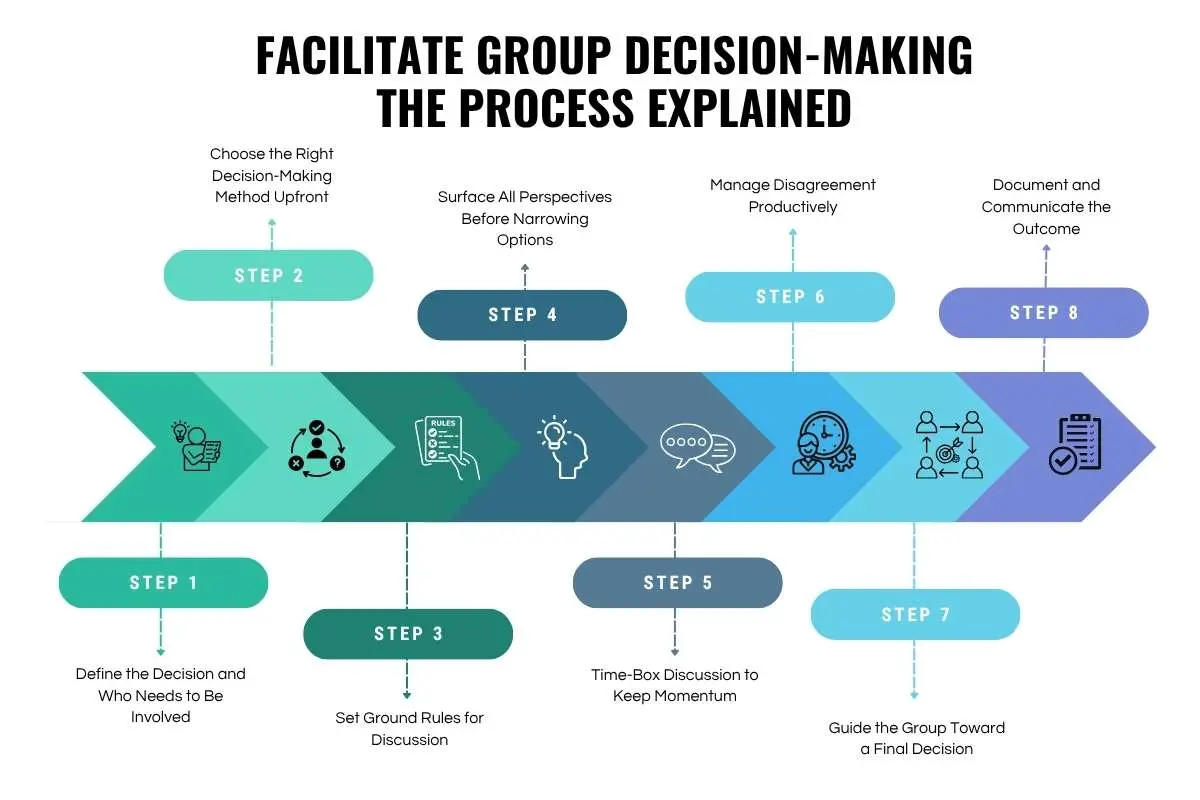
Good group decisions need a clear process. Without one, a few people may control the discussion, key views may go unheard, or the team may spend too much time on one issue. A step-by-step process gives everyone a clear role and keeps the group focused on the decision.
The facilitator should guide the process without controlling the outcome. Each step should help the team understand the problem, compare options, handle disagreement, and agree on what happens next.
Step 1: Define the decision and who needs to be involved
Start by stating the decision in clear terms. Everyone should know what the group needs to decide, why it matters, and what limits the team must follow. A clear question keeps the discussion focused and cuts off side topics.
Next, decide who needs to take part. Include people with useful knowledge, direct responsibility, or a clear stake in the result. You do not need every employee for every decision. A smaller group can often work faster when the right people take part. In fact, a Harvard Business Review study indicates that seven (7) is the optimal size
For example, a team choosing new project software may include the project lead, IT staff, finance team, and regular users. Each person can bring information that affects the final choice.
Things to consider:
- What exact decision does the group need to make?
- Who has useful knowledge about the issue?
- Who will carry out the final decision?
- Who will feel the impact of the decision?
- Does the group include too many or too few people?
Step 2: Choose the right decision-making method upfront
Decide how the group will reach its final choice before the discussion starts. Different decisions need different methods. A team may use consensus when everyone needs to support the choice. A majority vote can work well when the group needs a quick choice between clear options. A consultative method can work when one person owns the final decision but wants input from others.
Tell the group which method you will use and what each person can expect. This removes confusion later. People may think they have equal voting power when the team leader actually has the final say.
A clear method also helps the group avoid repeated debates. For complex decisions, teams can use consensus decision-making when broad agreement matters more than speed. But keep in mind that consensus alone is not a strong enough marker of a decision’s quality.
Things to consider:
- Does the decision need full agreement?
- Does one person hold final authority?
- Would a vote save time?
- How much input does the group need?
- Does the chosen method fit the size and type of decision?
Step 3: Set ground rules for discussion
Set a few simple rules before the discussion begins. The rules should help people speak freely while keeping the meeting focused. Ask members to listen without interrupting, question ideas rather than people, and give each person a fair chance to speak.
You can also set rules for how the group will handle facts and opinions. For example, ask members to explain the reason behind a strong view or share data that supports a claim.
The facilitator should step in when someone breaks the rules. A simple reminder can bring the group back on track. You might say, “Let’s focus on the idea rather than the person who raised it.”
Things to consider:
- How will members take turns speaking?
- How will the group handle interruptions?
- Can members challenge ideas without personal attacks?
- How will the facilitator handle dominant speakers?
- What should the group do when the discussion goes off topic?
Step 4: Surface all perspectives before narrowing options
Give the group time to hear different views before choosing a few options. If the team starts judging ideas too early, some people may stop sharing. Quiet members may also hold useful information that the group could miss.
Start with an open round where each person shares their view. You can also collect ideas in writing before the discussion. This gives people time to think and limits the effect of the loudest voices.
For example, a team planning a new customer service process could ask each member to name one problem with the current system and one change they would make. The facilitator can group similar ideas before the team compares them.
Things to consider:
- Has every member had a chance to speak?
- Are quiet members getting enough space?
- Does the group have different views on the issue?
- Are members sharing facts as well as opinions?
- Have you judged any option too early?
Step 5: Time-box discussion to keep momentum
Set a clear time limit for each part of the discussion. A time box gives the group enough room to think without letting one topic take over the meeting. Share the time limit before the discussion starts so people know what to expect.
You can give 15 minutes to collect ideas, 20 minutes to compare options, and 10 minutes to review the final choice. A visible timer can help the facilitator manage each stage.
Time limits can also show which issues need more work. If the group cannot settle a key question within the set time, record it and decide how to address it later.
Things to consider:
- How much time does the decision need?
- Which parts of the discussion need the most time?
- Are people spending too long on minor issues?
- What should happen if the group needs more time?
- Can the facilitator move the group forward without rushing it?
Step 6: Manage disagreement productively
Disagreement can help a team make a stronger decision. The facilitator should make sure the group uses disagreement to test ideas rather than attack people. Ask members to explain why they support or reject an option.
Try questions such as, “What concern do you see?” or “What information would change your view?” These questions move the conversation toward facts and useful points.
The facilitator should also watch for repeated arguments. If two people keep making the same point, summarize both views and ask what evidence could help the group move forward.
Things to consider:
- Is the disagreement about facts, goals, or personal views?
- Does the group have enough evidence?
- Are people listening to opposing views?
- Has the same point come up several times?
- Can the facilitator turn conflict into a useful question?
Step 7: Guide the group toward a final decision
Once the group has reviewed the main options, bring the discussion toward a clear choice. Summarize the key points, the main concerns, and the areas where people agree. Then use the decision method chosen at the start.
If the group uses a vote, make the options clear before voting. If the group seeks consensus, ask whether members can support the preferred option, even if it was not their first choice.
The facilitator should also check for hidden concerns before closing the discussion. Ask, “Does anyone have a major concern that we have not addressed?” This gives people one final chance to raise an issue.
Things to consider:
- Does the group understand the final options?
- Have members raised their main concerns?
- Does the decision follow the agreed method?
- Does anyone have a serious unresolved concern?
- Does everyone understand what the group decided?
Step 8: Document and communicate the outcome
Write down the final decision, the main reasons behind it, and the actions that follow. Record who owns each task and when the team expects the work to move forward. Good records help the group stay aligned after the meeting ends.
Share the outcome with people who need to act on it. Keep the message simple and direct. For example, after choosing new project software, the team could share the selected tool, the reason for the choice, the launch date, and each person’s next task.
Knowing how to facilitate group decision-making relies a lot on documentation. It creates a useful record for later review. If the decision does not produce the expected result, the team can look back at the reasons, data, and concerns that shaped the choice.
Things to consider:
- What decision did the group make?
- Why did the group choose this option?
- Who owns each next step?
- When should each task happen?
- Who needs to know about the decision?
- When will the team review the result?
A clear step-by-step process helps teams make better decisions without losing focus. It is a method that goes hand-in-hand with the nominal group technique and gives each person space to share ideas and keeps disagreements useful. It makes the final choice easier to understand and act on. It is a method that goes hand-in-hand with the nominal group technique.
What are some common facilitation mistakes to avoid?

Good facilitation can break down when the person leading the discussion misses key parts of the process. A few common mistakes can limit participation, create confusion, or push the group toward a weak decision.
1. Letting the loudest voices dominate
Some people speak more often or with more confidence than others. If the facilitator lets them control the discussion, quieter members may hold back. Their ideas or concerns may never reach the group.
Check in with people who have not spoken. You can ask each member to share a view or use written input before an open discussion.
2. Skipping the decision-making method
The group should know how it will reach a decision before the discussion begins. Without a clear method, members may have different ideas about who has the final say. Agree on whether the group will use consensus, a vote, or another method.
3. Rushing to avoid disagreement
Disagreement can feel uncomfortable, but ending it too soon can hide useful concerns. Give members time to explain their views and test the options. A short delay can lead to a collaborative decision-making effort that the group understands and supports.
Conclusion:
Establishing a repeatable process for group choices prevents high-stakes meetings from dissolving into endless circular debate. Organizations that train team leaders to navigate group dynamics cleanly see faster project rollouts, higher compliance from department heads, and far less post-implementation friction across all levels of the business.
Long-term execution relies on maintaining clear boundaries between the initial debate phase and final executive approval. Mastering how to facilitate group decision-making with objective evaluation tools ensures that every participant contributes valuable operational data while giving leadership the clarity needed to make confident, business-critical calls and build a collaborative workplace.
FAQs
1. What is the best way to handle a dominant personality who hijacks group discussions?
Implement structured, written feedback rounds like dot-voting or anonymous digital input so every team member gets equal sway regardless of who speaks loudest.
2. How do you prevent groupthink when facilitating a high-stakes decision?
Assign a dedicated team member to act as a formal “Devil’s Advocate” whose sole job is to surface hidden flaws and challenge core assumptions.
3. What should a facilitator do when a group reaches a complete deadlock?
Shift the team back to agreed-upon core criteria and use a fallback voting rule or escalate the tied data points to the final project owner.
4. How do you ensure quiet team members contribute their perspectives during meetings?
Use “round-robin” feedback prompts or pre-meeting submission forms so introverted experts can share technical insights without competing for airtime.
5. How to facilitate group decision-making effectively without wasting time in meetings?
Establish clear decision criteria beforehand, assign a designated facilitator to enforce time limits, and use structured techniques.