Preamble
What if humanity’s greatest developmental challenge is not learning how to repair psychological fragmentation, but recognizing why we continue perpetuating the conditions that produce it?
In this inaugural article of an eleven-part series exploring Consciousness (Cs), human identity, and the nature of the Self, I challenge a fundamental assumption about human development: that we must become someone before we can recognize who we already ARE.
Drawing upon more than four decades of clinical and transpersonal practice and approximately 60,000 therapeutic encounters, I invite readers to examine a different philosophical paradigm—one grounded in intrinsic wholeness, conscious awareness, and the recognition of the Self that cultural conditioning has obscured.
The Greatest Illusion of the Human Experience
The greatest tragedy of human conditioning is not that we forget what we have learned, but that we forget who we are while learning who we are supposed to become. Perhaps no assumption has more profoundly influenced human development than the belief that we arrive in this world incomplete, awaiting the external construction of an identity that will eventually make us acceptable, worthy, and whole.
From our earliest experiences, we are introduced to systems of interpretation that precede our capacity to question them. Families transmit beliefs about identity and belonging. Cultures establish standards of acceptability. Educational institutions organize knowledge within established paradigms. Social structures communicate which expressions of individuality will be rewarded and which must be suppressed.
Gradually, we learn not merely how to participate in the world, but how to define ourselves according to the world’s expectations. And somewhere within this process, a profound misidentification can occur. We begin confusing what we have acquired with who we fundamentally ARE.
But what if the premise itself is mistaken? What if the human being does not enter existence as an incomplete Self requiring construction, but as an intrinsically whole expression of Being whose recognition and expression can become obscured through conditioning?
This distinction lies at the foundation of my understanding of Consciousness and human transformation. The Self does not require construction. It requires recognition.
The Developmental Distortion: How We Become Estranged From Ourselves
The human brain is an extraordinarily adaptive biological organ. Through neuroplasticity, experiences influence the development and modification of neural pathways associated with learning, memory, emotional responses, and behavior.
This adaptability makes learning possible. Yet it also provides the neurological conditions through which culturally acquired beliefs, inherited fears, external judgments, and repeated expectations can become deeply established.
The distinction is crucial: the development of neurological capacities is not synonymous with the construction of the essential Self. Because from the moment we are born, we are taught to divorce ourselves, from ourselves, from others, from silence. The irony of it is that no one recognizes this divorce because everyone around us is divorced as well. We are born human and conditioned by narrative. We are seeing the fall of the human intellect. All this affect neurological capacities; it does not affect the essential Self.
Within my philosophical framework, the brain belongs to the physical domain of matter. Mind is understood as an aspect of the biofield, while Consciousness (Cs) represents the fundamental ground of Being. Localized consciousness (cs) is the individual’s everyday awareness through which experience is encountered.
These distinctions reflect my metaphysical understanding and should not be mistaken for conclusions established by contemporary neuroscience. Although living systems exhibit measurable bioelectrical and biomagnetic activity, the proposition that Mind exists as an aspect of a distinct biofield (our second anatomy of Light) remains a subject of theoretical and philosophical inquiry. Yet I know through quantum exploration and being informed by quantum physics that we cannot know ourselves apart from this biofield, this ecosystem, because this reality exceeds us. What is well established is that experiences can shape the physical brain.
What I am challenging is the assumption that the patterns acquired through this conditioning constitute the essential nature of the individual. The brain acquires conditioning. The recognition and expression of Self can become distorted. But the essential Self remains unchanged. The individual may become so identified with learned interpretations that these interpretations are experienced not as acquired patterns, but as the very definition of personal existence.
An individual repeatedly told that love must be earned may eventually experience worthiness as conditional upon performance. Another taught to fear disapproval may organize an entire life around external acceptance. A child whose authentic emotional expression is repeatedly invalidated may learn to distrust the very experience through which personal authenticity could otherwise be recognized.
These adaptations may persist long after the original circumstances have disappeared. And thus begins the psychological incongruence that can accompany a lifetime of misidentification. We have not necessarily lost ourselves. We have learned to mistake what covers us for who we are.
The Mud That Obscures the Self
Imagine that someone throws mud over a beautiful, pristine surface. The mud accumulates, layer upon layer, until the original surface is no longer visible. Eventually, someone looking at it may conclude that the mud-covered appearance represents the surface’s actual nature. Yet the underlying surface has never disappeared. Its essential existence has not been altered by what conceals it. So it is, within my philosophical understanding, with the human Self.
The accumulated layers of cultural conditioning, inherited beliefs, externally imposed identities, and learned interpretations can obscure our recognition of who we fundamentally ARE. The tragedy is not that the Self has ceased to exist. The tragedy is that we have mistaken the mud for ourselves.
And perhaps the greater tragedy is that we subsequently devote enormous portions of our lives to modifying, reconciling, and perfecting the very conditioned identity that has obscured our recognition of Self. We attempt to improve the mud-covered image without sufficiently questioning why the mud was imposed in the first place.
This is not an argument that every acquired belief is destructive, or that human learning is inherently alienating. It is an examination of the conditions under which acquired interpretations become confused with essential identity. The question is not simply how we remove the accumulated layers. It is why we continue creating the conditions through which those layers are imposed.
The Beauty That Was Always There
In the early years of our marriage, when financial resources were limited, my husband and I furnished our home largely through consignment shops. I vividly remember purchasing two tables that had been covered with paint. We brought them home and began sanding away the painted surfaces, eventually discovering something extraordinary beneath them: remarkably beautiful oak.
The oak had been there all along. We had not created its beauty. We had not transformed the wood into something it was not. We had simply removed the layers that prevented us from recognizing what had always existed beneath them.
That memory offers a powerful illustration of what I have come to understand about the essential Self. Human beings spend extraordinary amounts of time attempting to improve, correct, reconstruct, and reconcile identities acquired through cultural conditioning. Yet perhaps our most fundamental misunderstanding lies in believing that the Self itself requires reconstruction.
Within my philosophical understanding, the essential Self is never altered by the conditioning that obscures its recognition. The acquired layers may distort our perceptions, influence our expressions, and lead us to identify with interpretations that were never intrinsic to our Being. But those interpretations do not determine the nature of the Self.
Just as the paint never transformed the oak into something other than oak, conditioning does not transform the essential Self into the identity we have learned to accept. The oak did not become oak when we removed the paint. It was oak before we ever touched it. And so the fundamental task is not to manufacture wholeness, but to recognize the wholeness that has never ceased to exist. We did not create the beauty. We revealed it.
The Epistemological Captivity of the Conditioned Brain
Epistemology, the philosophical examination of knowledge, asks how we know what we believe we know. This question becomes especially consequential when applied to human identity. Much of what individuals accept as personal truth originates in interpretations acquired before they possessed the capacity for independent discernment.
Through repetition, reinforcement, and emotional association, these interpretations can become deeply familiar. Familiarity is then mistaken for validity, and validity for unquestionable truth. The individual may no longer recognize the difference between an interpretation acquired through experience and an accurate understanding of reality. This is what I describe as the cage of orthodoxy. The hardest cage to recognize is one with invisible bars. Its boundaries are especially difficult to recognize because they are experienced not as restrictions, but as the natural parameters of existence.
One of the most profound consequences of conditioning is therefore not merely that it influences what we think. It can influence the very range of possibilities we are prepared to consider.
A person may defend a limitation without recognizing that the limitation was inherited. An individual may experience a conditioned emotional response as evidence of truth rather than as a learned interpretation. And when those interpretations become incorporated into identity, questioning them may evoke the psychological experience of threatening the Self. But the Self is not what is being threatened. It is the acquired identification that is being examined.
We have confused the authority of conditioned interpretation with the authority of Being.
Consciousness, Awareness, and the Nature of Self
A central distinction in my work concerns Consciousness (Cs) and localized consciousness (cs).
Within my philosophical understanding, Consciousness (Cs) is the fundamental ground of Being, while localized consciousness (cs) refers to the everyday awareness through which the individual experiences existence.
The physical brain participates in the processing of sensory information, memory, learning, and behavioral responses. Yet I distinguish these neurological processes from Mind, which I understand as an aspect of the biofield. This conceptual framework invites a question extending beyond conventional behavioral psychology: Is the identity constructed through conditioned neurological patterns synonymous with the essential nature of the individual? Or have we become so thoroughly identified with culturally inherited beliefs, socially prescribed identities, and conditioned interpretations of reality that we have obscured our recognition of the essential Self?
The question is not whether we possess awareness. It is whether our awareness has become so occupied with conditioned interpretations that we mistake those interpretations for who we fundamentally ARE.
This is also where philosophy must remain intellectually disciplined. Neuroscience has established important relationships between brain activity and conscious experience, while the ultimate nature of subjective experience remains debated. My understanding of Cs, cs, Mind, and the biofield represents a particular philosophical interpretation, not a universally established scientific model.
Yet the distinction between the Self and acquired identity has profound implications for the way we approach human transformation. If the Self is intrinsically whole, then the purpose of transformation cannot be the manufacture of wholeness. It must concern the recognition of what has become obscured.
Why Information Alone Cannot Produce Transformation
After more than four decades of clinical practice, I have repeatedly encountered a striking paradox. Individuals can possess extraordinary intellectual understanding of their psychological difficulties while remaining profoundly constrained by the very patterns they understand.
They may recognize the origins of fear yet continue to experience its influence. They may identify destructive relational expectations yet repeatedly recreate them. They may intellectually affirm personal worth, while remaining emotionally organized around expectations of rejection.
Why does insight not necessarily produce transformation? Because conditioning is not maintained exclusively through conscious verbal beliefs. It may also involve implicit learning, physiological responses, emotional associations, relational expectations, and habitual neurological patterns that operate outside immediate awareness. Understanding a pattern does not automatically interrupt the processes sustaining it.
This is why I distinguish information from transformation. Information may expand the intellectual understanding of experience. Transformation involves a change in how the individual recognizes, encounters, and participates in that experience.
People do not come to me merely for information. They come seeking transformation. And from my perspective, transformation is not fundamentally the creation of a more acceptable identity. It is the process through which identification with acquired psychological structures becomes increasingly transparent.
What has been mistaken for Self can begin to be recognized as conditioning. What has been experienced as an immutable identity becomes available for examination. And what becomes available for examination may no longer exercise the same unquestioned authority.
Silence and the Recognition of Being
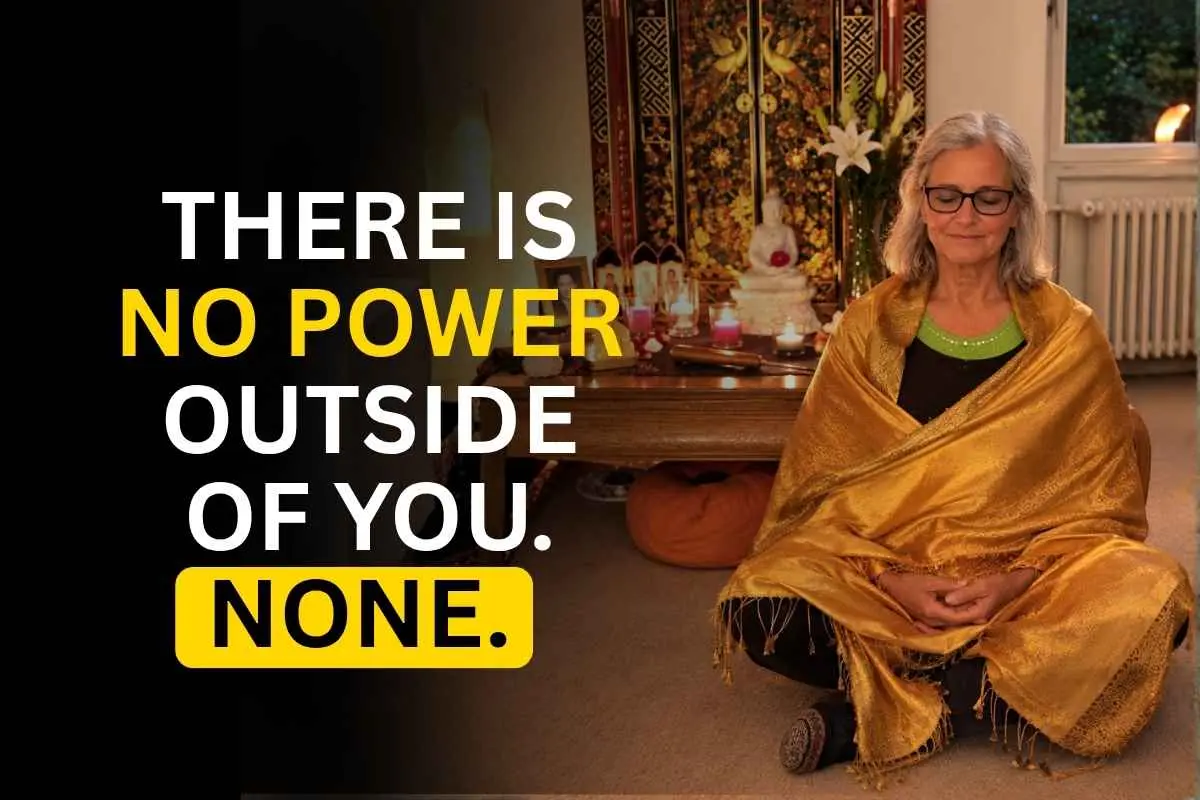
For more than forty years, meditation has formed the foundation of my personal life. I do not regard it simply as a relaxation technique or a temporary means of reducing psychological distress or a luxury. For me, contemplative silence is an opportunity to explore the relationship between thought, awareness, and Being. It is the foundation upon which my life is built. Utter Stillness. Expectant Silence. They are our primary capital and pregnant with possibilities. Look in. Go in. There is no power outside of you. None. It has always been within.
The thinking processes associated with the brain are extraordinary instruments of human functioning. They enable reasoning, analysis, planning, memory, and the organization of experience. Yet when conditioned interpretations dominate our sense of identity, we may become so occupied with mental activity that the possibility of recognizing the Self beyond those interpretations remains unexplored.
Meditation offers an opportunity to observe thoughts without automatically granting them authority. To experience emotion without immediately constructing identity around it. To recognize a memory without requiring that memory to define the present. And to encounter silence without interpreting stillness as an absence of intelligence. Stillness is the presence of Cs. Stillness is the bridge to Cs.
Research has examined meditation in relation to attention, emotional regulation, stress, and patterns of self-referential processing. These findings do not establish the metaphysical nature of Consciousness, but they contribute to our understanding of how contemplative practices may influence psychological experience.
Within my own philosophical and experiential understanding, silence offers something further: an invitation to recognize the distinction between the conditioned interpretations of existence and the essential experience of Being. Sit in stillness until it becomes Cs. A mind turned inward merges with Source.
We do not enter silence to manufacture the Self. We enter silence to examine what has prevented us from recognizing it. Before you enter the world, each morning, enter silence.
Psychological Sovereignty: Reclaiming Inner Authority
When I declare, “There is no power outside of you. None,” I am challenging the assumption that external authority must determine our essential worth and identity. I am not suggesting that external circumstances have no influence upon human existence. Illness, trauma, injustice, biological vulnerability, material deprivation, and relational suffering are real and consequential. Nor am I suggesting that every adverse experience results from a failure of awareness. Rather, I am distinguishing between the influence of circumstances and the unquestioned authority we may grant those circumstances to define the entirety of who we believe ourselves to be.
Psychological sovereignty involves recognizing that external influences need not become the ultimate arbiters of intrinsic worth. It requires discernment, responsibility, and the willingness to question the interpretations through which experience has acquired its meaning. It does not demand rejection of relationships, education, science, or legitimate guidance. Instead, it challenges the surrender of essential identity to any external system of interpretation. It restores agency.
The Self is not granted existence or worth by the approval of the world. Within my philosophical framework, its essential nature precedes those judgments. The task is not to become worthy. It is to recognize that worthiness was never dependent upon the conditions through which we learned to evaluate ourselves.
What If We Stopped Throwing Mud on Our Children?
And now we arrive at what may be the most consequential implication of this inquiry.
Why should humanity continue organizing development around the imposition of conditioned identities, only to spend decades attempting to resolve the psychological incongruence those identities may produce?
Why do we devote such considerable resources to addressing the consequences of misidentification while giving insufficient attention to the conditions that encourage it? What if we reconsidered the developmental paradigm itself?
Imagine a child whose intrinsic worth is recognized from the beginning. A child who is guided without being taught that obedience determines personal value. Who is educated without being required to surrender independent discernment. Who encounters boundaries without interpreting those boundaries as evidence of personal inadequacy. Who learns to participate in relationships without being taught that authenticity must be sacrificed to secure belonging. Who is fully aware he or she is not mere fodder for the algorithm. Who is aware from birth of the mind-cage.
Such a developmental environment would not eliminate the need for education, discipline, guidance, or the acquisition of practical knowledge. Nor would it guarantee freedom from suffering, conflict, or psychological difficulty. But it would begin from a fundamentally different premise. The purpose would not be to manufacture an acceptable Self. It would be to nurture the capacities through which an intrinsically whole Self can be consciously expressed. And this brings us back to the mud.
What if, instead of spending a lifetime washing away the mud, we stopped throwing mud on our children in the first place? What if we stopped imposing the very distortions that later require reconciliation? What if we recognized that the human being does not need to become worthy of existence, but deserves to have that inherent worth honored from the beginning?
This is not merely a question about psychotherapy. It is a question about parenting, education, culture, institutional authority, and the future direction of human development. Perhaps our greatest responsibility is not to teach children how to become whole. Perhaps it is to stop obscuring the wholeness with which, in this philosophical understanding, they begin.
The Evolutionary Invitation: Begin Whole, Knowing Self
We have become remarkably sophisticated at examining the consequences of psychological conditioning. We have developed theories of personality, models of development, therapeutic interventions, and increasingly detailed understandings of the neurological processes associated with learning and behavior. These contributions have genuine value. Yet perhaps another dimension of human development deserves equal attention.
What if our greatest evolutionary opportunity lies not simply in improving our methods of psychological remediation, but in reconsidering the assumptions that make such remediation necessary? What if we stopped approaching the human being as an incomplete project awaiting external construction? What if the purpose of development were not to produce an identity that satisfies inherited expectations, but to cultivate the discernment through which individuals can participate in life without becoming estranged from their essential nature?
The distinction is profound. We do not begin with deficiency and work toward worthiness. We begin with intrinsic worth and seek to preserve conscious recognition of it. We do not need to manufacture the Self. We need to recognize the Self that conditioning has obscured. And perhaps the most consequential question confronting humanity is not how to become someone better, but how to create a world in which individuals are no longer taught to forget who they ARE.
We do not want humanity to spend a lifetime undoing what never needed to be imposed. We want to begin WHOLE. We want to begin KNOWING. We want to begin as SELF. The mud was never who we were. And the Self never disappeared.
THERE IS NO POWER OUTSIDE OF YOU. NONE.
Continuing the Exploration
This inaugural article introduces an eleven-part exploration of Consciousness, conditioned identity, the biofield, psychological sovereignty, and the possibilities of conscious human development.
In the next installment, we will examine how cultural conditioning shapes the physical brain, how acquired interpretations become mistaken for personal identity, and why the recognition of these processes may fundamentally alter our understanding of the human experience.
For those wishing to explore these principles more deeply, The Quantum Life: There Is a Better Way to Live offers an invitation to question inherited limitations and examine the nature of Consciousness.
Learn more at DrMTDaunter.com.
About the Author
Dr. M. Teri Daunter is a Clinical Psychologist, Quantum Physician, and author of The Quantum Life: There Is a Better Way to Live, a three time internationally recognized award-winning book. Her literary distinctions include a Nautilus Silver Book Award and recognition as an Author of the Year finalist. Through more than four decades of clinical and transpersonal practice, encompassing approximately 60,000 therapeutic encounters, she has explored the relationship between psychological conditioning, the biofield, Mind, and Consciousness. Her work challenges conventional assumptions about human identity and invites a reconsideration of how intrinsic wholeness can be recognized and nurtured throughout life.