


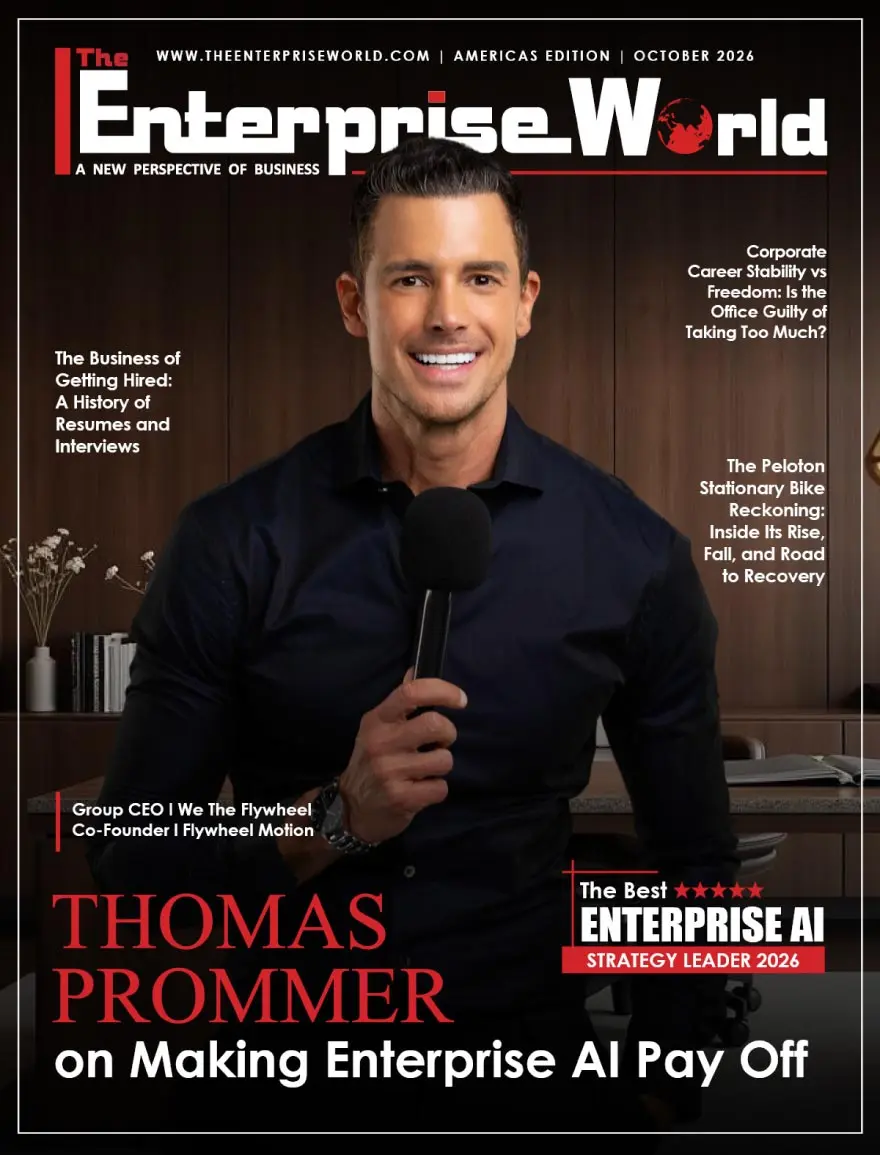
Don’t wait for the perfect plan. Run the experiment, keep what works and kill what doesn’t. It is also a fair summary of his career. Over three decades, that approach took him from a humanoid robotics lab at Carnegie Mellon to the C-suite of global consumer brands, and today to setting enterprise AI strategy for the companies he runs and advises.
Thomas Prommer is Group CEO of We The Flywheel and Co-Founder of Flywheel Motion, and the leader behind that philosophy. Through every transition in his career, one conviction held steady: technology succeeds or fails on organizational design and communication, not on the technology itself. His group runs on its own AI operating model every day, and he only recommends to clients what has held up there first.
From robotics labs to the C-suite
Thomas Prommer’s path into AI began well before the current wave. He studied computer science at the Karlsruhe Institute of Technology and the University of Massachusetts Amherst, focusing on web systems and artificial intelligence in the early 2000s. He completed his thesis at Carnegie Mellon University’s humanoid robotics lab, where he worked on speech and interaction systems that won a People’s Choice Award at Interspeech.
What strikes him about today’s AI moment is how little of its foundation is new: reinforcement learning, neural networks, and the linguistics behind language models have not changed at their core. What changed is that computing and data-processing speed and volume finally reached the point where these ideas support real-time, intelligent applications organizations can trust. That early work taught him something he still relies on: AI only matters when it changes what a person can actually do.
He moved from architect to team lead to executive, spending eight years at Huge as President, Technology, consulting on technology strategy for McDonald’s, Google, Apple, and Toyota while overseeing a hybrid technology team of 300+, based primarily across the United States and Colombia. Later came the C-suite: interim CIO at Sweetgreen, CTO at Moment, and Technology Advisor to Bain Capital. Across his career, he has led more than 3,000 engineers, run yearly IT budgets of up to $500M, and been responsible for an $11B e-commerce business.
The turning point came when he stopped treating the technology as the hard part. That conviction is what led him to build We The Flywheel and co-found Flywheel Motion.
A day in Thomas Prommer’s life
Thomas Prommer runs a genuinely global schedule, with his time spread across Europe, the Americas, Asia and Oceania. His agent fleet runs through the night wherever he is, so most mornings begin with work that was finished while he slept. The day itself is built around when his brain and body are actually at their best, rather than around a calendar.
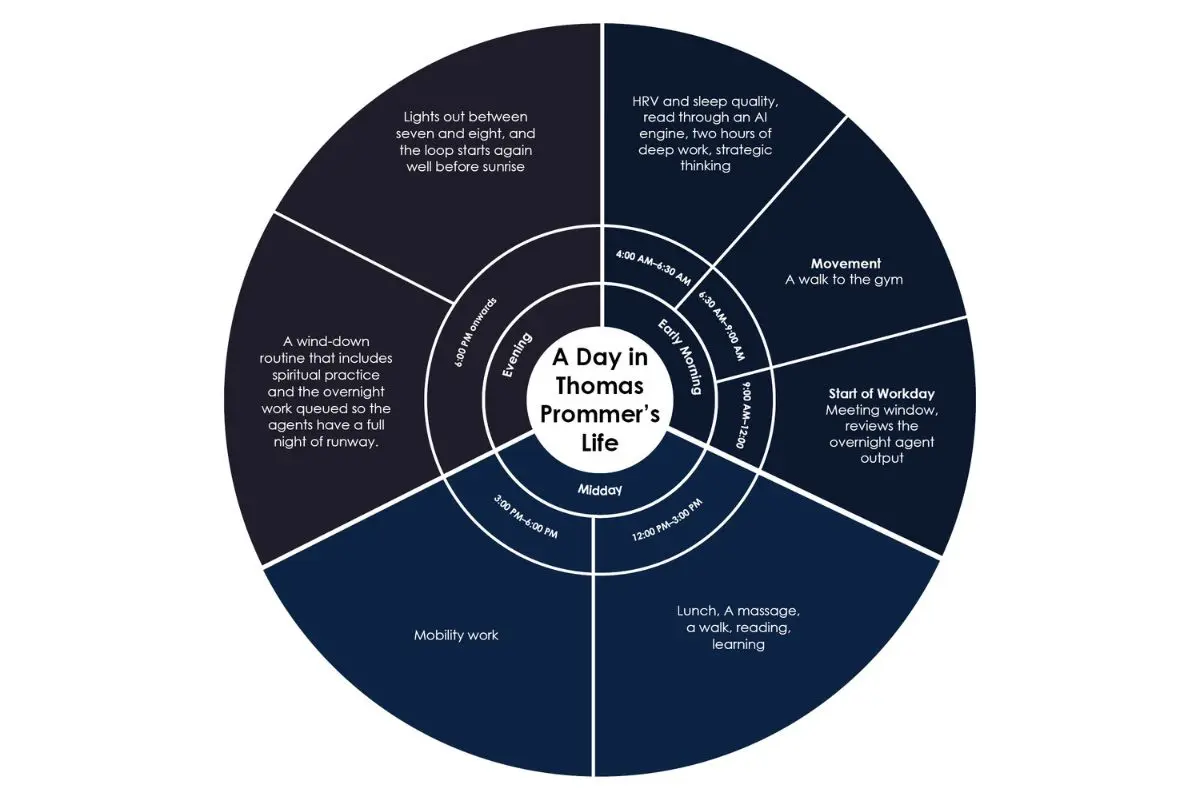
- 4:00 AM–6:30 AM | Early Morning
Vitals first: HRV and sleep quality, read through an AI engine that sets the shape of the training day around them. Then two hours of deep work while his brain is at its highest performance. Strategic thinking only; no routine work allowed anywhere near this window. Engine, two hours of deep work, strategic thinking - 6:30 AM–9:00 AM | Movement
A walk to the gym, deliberately outdoors for the sunlight and to get the body in motion, then a strength session. - 9:00 AM–12:00 PM | Start of Workday
A tightly governed meeting window, kept short on purpose, then back into deep work. This is also where he reviews the overnight agent output: publishing, analytics, recruiting, and finance all ran while he slept. His job is to approve, correct, or kill, not to produce. - 12:00 PM–3:00 PM | Midday
Lunch, usually protein with a lot of vegetables, then genuine downtime. A massage, a walk, reading, or learning something unrelated to the day’s work. - 3:00 PM–6:00 PM | Afternoon and Evening
A second walk to the gym for a cardio session and mobility work. Then home for the work he saves until his brain is tired: agent sign-offs, applying more automation, some learning. Family and friends get this window too, alongside any meeting that has to accommodate another time zone. - 6:00 PM onwards | Night / Wind-down
A wind-down routine that includes spiritual practice and the overnight work queued so the agents have a full night of runway. Lights out between seven and eight, and the loop starts again well before sunrise.
The discoverability problem his latest venture Flywheel Motion is addressing
The vision started with a problem: the people doing the most critical work, from science to conservation, are the hardest to find online, not the easiest. Discovery today is decided by machines, across search rankings, AI answers, and social feeds, and their rules change faster than any individual or organization can keep up with.
Flywheel Motion is their answer: a growth engine for the people and organizations redefining what it means to drive good impact. Its autonomous agents keep pace with the algorithms so members do not have to. The ecosystem is the point. Members are mission-driven brands that cite, link to, and appear alongside one another, so every new member makes the rest easier to find. Growth stops being linear and becomes a flywheel.
We The Flywheel is the AI-native digital group Thomas Prommer built to industrialize that engine: a small human team and a fleet of autonomous agents that build, measure, and improve digital properties, drawing on 30 years of platform and growth experience. What the group actually sells is discoverability. Members who were close to invisible in search results and AI answers become findable by the people looking for exactly what they do.
Strategy before systems
Thomas Prommer starts every AI strategy from the value at stake and the ideal workflow or customer experience, never from the technology. He views an enterprise AI strategy as a portfolio of bets, and each bet has to map to a named outcome: revenue growth, customer value, operational efficiency, or durable competitive advantage. If an initiative cannot name its outcome, it does not get resources.
Every bet then gets three things: an accountable owner, a measurable target, and a kill criterion agreed up front. Most AI programs fail because they are allowed to drift as pilots forever. The other half of the work is foundations, meaning data quality, talent, and governance. Strategy is what connects the two layers. The bets create business pull, the foundations set how fast one can execute, and leadership keeps the two honest with each other.
He also favors initiatives that strengthen shared systems and data, so each project makes the next one faster, cheaper, or better.
Compounding your impact
His core framework is the flywheel itself: picking loops where every cycle makes the next cycle cheaper or better, then compounding them relentlessly. Inside that sit a few working principles. The first is agents as workforce, humans as owners: AI does the volume, while a named human holds accountability for every consequential action. The second is boring first: automating high-volume, low-judgment work before touching anything glamorous. The third is evidence gates: no AI output ships without verification that was designed before the work started.
For an enterprise, the lasting asset is the company context and memory that builds up over time, far more than any single model. Context engineering at enterprise scale is, in his view, the new moat.
The difference from conventional transformation advice is that his group runs on these principles every day. Anything he recommends to a client has been tested on his own operations first.
He also publishes Solo Billionaire Club (solobillionaireclub.com), a public leaderboard of solo founders racing to build the first one-person billion-dollar company, with every revenue claim graded against its source. For Thomas Prommer, it is a running test of how far AI agents can take a business with almost no headcount, tested against the public statements of Sam Altman of there being soon the first AI-led billionaire as a solopreneur.
“Governance isn’t a brake on AI adoption. Done right, it’s where the speed comes from.”
Governance as velocity
For him, governance is not a brake on AI adoption; it is the source of its speed. Every consequential action taken by an AI system within his group, whether a payment, an outbound communication, or a deployment, must pass through a human approval gate. Each of these actions is logged and attributed to the individual who requested it, ensuring there is always a named person accountable on record.
Data handling within the organization follows European privacy standards, with access scoped tightly per system. No AI is granted broader credentials than a given task requires. Human oversight at the right stages is non-negotiable, though he is careful to pair that oversight with tools and enablement designed to keep it efficient rather than burdensome.
The operating principle he offers other leaders is a simple classification: separate failures into recoverable and irreversible. Within the recoverable space, automation can move freely, and that freedom is where speed comes from. Anything irreversible keeps a human firmly in the loop, and that discipline is where trust comes from. Companies that skip this distinction do not move faster. They only postpone the moment they discover the risk.
He also extends this philosophy to his own workforce, encouraging employees across the organization to actively shape and refine the AI tools they use daily, rather than treating governance as something handed down from above.
A track record of global recognition and expertise

A career built at the intersection of artificial intelligence, enterprise technology, research, and strategic advisory has earned recognition from leading institutions, publications, and global investment firms.
Global recognition
- HotTopics Global CIO 100 (2026)
- CTO Craft 100 (2026)
- Several scholarships awarded
Trusted by global institutions
- Retained by Bain Capital for technical due diligence
- Advised McKinsey on AI and enterprise software
- Engaged by Berenberg Capital Markets for technical due diligence
- Member of the partner advisory boards of Acquia, Adobe, Sitecore, and Salesforce
Industry thought leadership
- Analysis cited in press coverage of Gartner AI research
- Featured in Business Insider and CIO.com
- Writing published in Adweek, Digiday, The Next Web, CMSWire and CTO Craft
- Several high-profile podcast guest appearances
Academic excellence
- Executive leadership programs completed at MIT Sloan, Harvard Extension School, and Wharton
- Computer Science master’s degree from the Karlsruhe Institute of Technology
- Graduate studies in artificial intelligence and web-based systems at UMass Amherst and the Karlsruhe Institute of Technology
- Thesis researcher at Carnegie Mellon’s humanoid robotics lab
- Research earned a People’s Choice Award at Interspeech
Innovation and team achievements
- Flywheel Motion and Edges of Earth were named honorees in Fast Company’s 2026 World Changing Ideas Awards
- Several Webby Awards for work he led
- Founded His First Digital Company At 12
- 30+ Years In Enterprise Technology Leadership
- 3,000+ Engineers Led Across His Career
- $500M Yearly IT Budget and $11B E-Commerce Responsibility
- Fortune 500 Brands Advised: McDonald’s, Google, Apple, Toyota, Nike, Porsche, adidas
(More at prommer.net) - Currently 500+ Digital Properties Operated
- 100% of Internal Workflows AI-Augmented: AI-Native, Agentic-Led, Human-In-The-Loop, With Continuous Context And Memory Building
- 10+ Completed Marathons/Ironmans/Hyrox
Beyond the boardroom
Thomas Prommer’s influence is not confined to the organizations he runs. Through his own platforms, prommer.net and aistrategy.guide, he writes on enterprise AI strategy, AI maturity, and platform engineering, work that has been referenced in press coverage of Gartner’s AI maturity research and quoted in outlets including Digiday, Adweek, Business Insider, CIO.com, and CTO Craft.
He also hosts CTAIO Labs, the podcast at the center of the CTAIO community, on AI leadership, aimed at a rising generation of technology and AI executives navigating decisions his own career has already stress-tested.
A quieter part of his footprint sits outside the office entirely. Thomas Prommer competes in HYROX, marathons and IRONMAN, and he approaches the training the way he approaches building technology: pick the finish line, then build the system that gets you there. That principle produced a self-tracking app he vibe-coded for himself, optimized for training performance, wellbeing, and longevity, and running on his own measured data rather than on received wisdom about what should work. Two products came out of it, and he gives both away.
findmynextrace.com helps athletes find the right race, and aitrainingplan.app builds the plan that gets them to the start line. Both are free contributions to the ecosystem he trains in.
Engineering the flywheel of AI, leadership and enterprise transformation
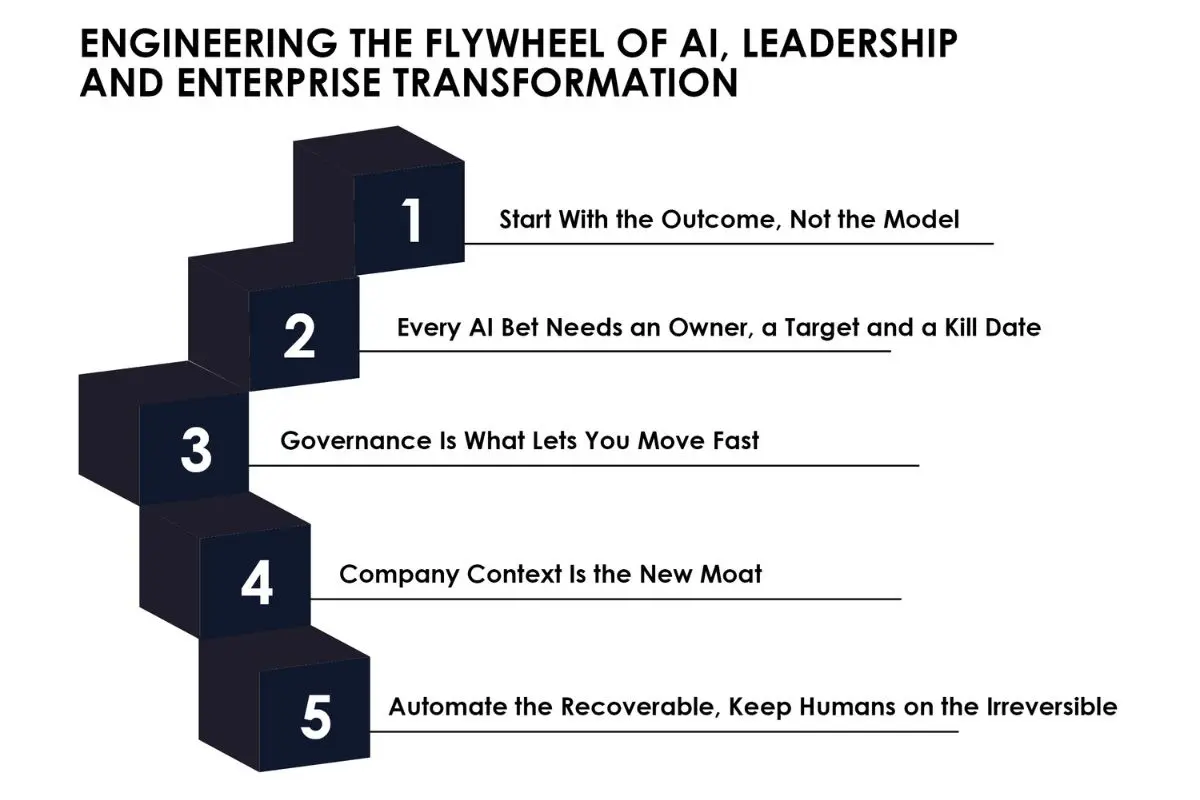
- Start With the Outcome, Not the Model
- Every AI Bet Needs an Owner, a Target and a Kill Date
- Governance Is What Lets You Move Fast
- Company Context Is the New Moat
- Automate the Recoverable, Keep Humans on the Irreversible
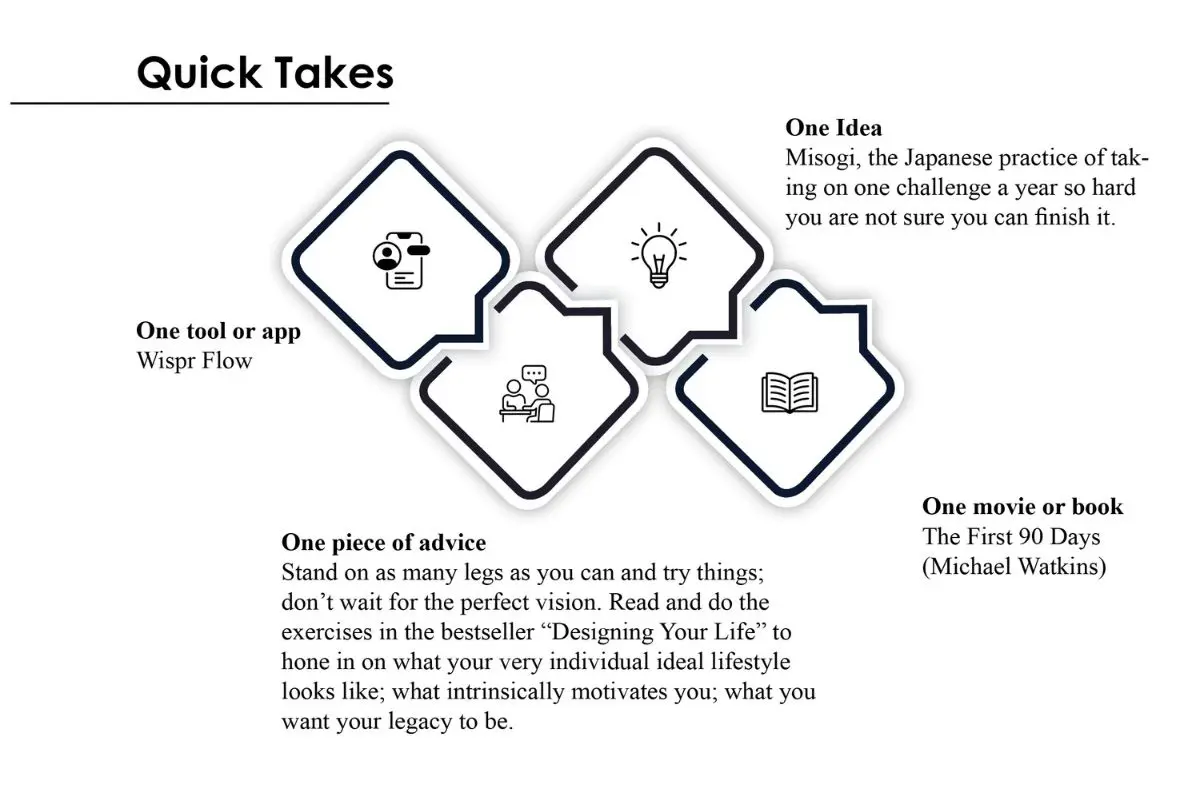
| Quick Takes | |
| One tool or app | Wispr Flow |
| One Idea | Misogi, the Japanese practice of taking on one challenge a year so hard you are not sure you can finish it. |
| One piece of advice | Read “Designing Your Life” and actually do the exercises. They help you work out what your ideal life looks like, what motivates you, and what you want your legacy to be. |
| One movie or book | The First 90 Days (Michael Watkins) |













