

AI developers want the real work locked inside your systems, and the financial offers can be serious. But when it comes to licensing company data for AI, asking these five questions turns a flashy payment headline into a strategic decision a board can actually defend.
The proposal shows up as item seven on the board agenda. Someone in operations has realized that the company’s support history, sales records and project files could be licensed for AI training. A payment estimate is attached, and it is larger than anyone expected for data that has been sitting in storage.
A director asks the obvious question: do we keep our files? Yes. The meeting starts to move on, and that is exactly the moment to slow down. Keeping the originals is one good answer. A serious board wants five more.
Why this item is on the agenda at all
The timing is no accident. AI developers have already worked through much of the openly available text on the web, and they are looking for new sources of real-world data. Many prefer data licensed with the owner’s agreement.[1] That shift has been public for a while. In 2023, OpenAI invited organizations to share large datasets that are not easily accessible online,[2] a useful marker of where the industry was heading, with no SourceX relationship implied.
What developers want is the way businesses actually run: how a customer problem gets resolved, how an exception gets approved, how a deal moves from first call to signature. That work lives inside company systems, and most of it has never been public. Scarcity explains the estimate.
Licensing company data for AI is a lucrative market, with Los Angeles-based SourceX telling suppliers they can earn up to $4 million.[1] However, that $4M figure is an absolute ceiling reserved for the largest enterprise datasets, not a guaranteed payout. A serious board must treat it as an upper bound and demand a realistic valuation for their specific collection, which is where a true enterprise data strategy actually begins.
Question one: what exactly are we licensing?
“Our data” is not something a board can approve. A support archive, an engineering ticket history and a CRM are different assets with different owners, customer terms and preparation work. Fold them into one volume figure and the proposal looks simpler than it is.
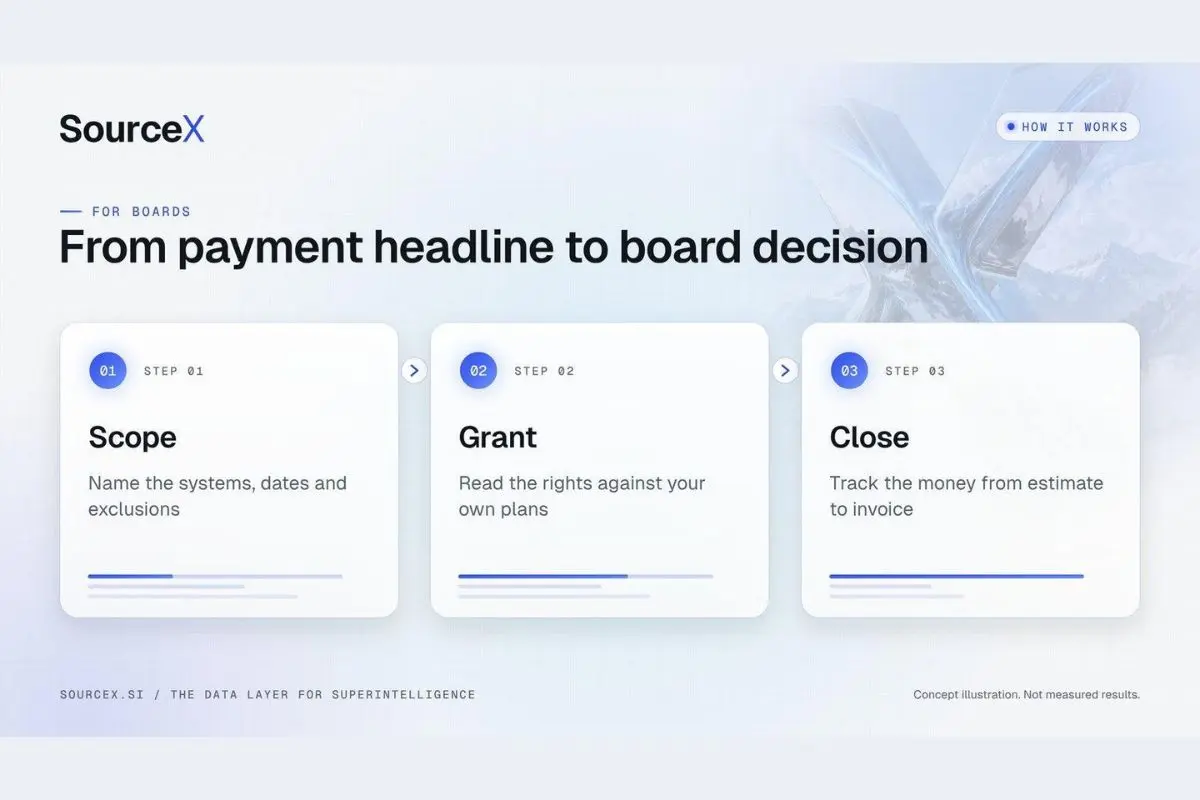
The board paper should name the source systems, the date ranges, the record types and anything excluded. It should also say whether the deal covers a fixed historical collection or recurring deliveries. In the SourceX model, the supplier decides which systems, records and date ranges are in scope.[1] Scope is a choice the company makes, so make it on purpose.
Question two: do we have the right to license it?
Owning the server does not mean owning every right in what sits on it. Customer contracts, vendor agreements and data-processing terms can all limit what a company may license. SourceX runs a rights review that asks two plain questions: does the supplier own these records, and can it license them, including any limits in customer or vendor contracts?[3]
Ask management who ran that review on the company’s side, which contracts they read and what they found. If one large customer’s agreement restricts reuse of its tickets, the board should hear that now, while those records can still be carved out.
Question three: what do we give, and what do we keep?
This is where a headline number can hide the real exchange. Under SourceX’s structure, originals stay with the supplier. The rights granted can include exclusive AI-training rights for a term set in the deal confirmation, plus lasting rights over the prepared, de-identified dataset.[1] Those are meaningful grants, and they deserve a careful read.
Put the company’s own plans next to them. Is an internal model on the roadmap? A second licensing opportunity? A sale process in which an acquirer will ask what was granted and to whom? For each planned use, the paper should say whether the deal permits it, restricts it or leaves it unclear. Unclear items get settled in the documents before approval.
None of this makes lasting rights a bad trade. Usually the deal is a one-time fee per agreed dataset, and that can be excellent value for records that would otherwise sit idle. The board simply needs to know it is making the trade.
Question four: how safe is the prepared data?
SourceX de-identifies data through approved processing routes before it is used or shared, and a diligence packet documents source, rights, preparation and permitted use.[3] Its trust center is also candid on a point boards should welcome: no method is perfect, and the agreement records that re-identification may still be possible.[3]
That candor makes the follow-up easy. For this specific collection, what residual risk remains, and who accepted it? Controls in place today include organization-level access, private storage with short-lived links, a full audit trail and terms locked per deal. Large datasets can stay in the company’s own storage or ship on encrypted drives. SOC 2 Type II, ISO/IEC 27001 and ISO/IEC 27701 are all in progress, not issued, and the board summary should say exactly that.
Question five: when does the money become real?
Proposed, contracted and received are three different numbers. SourceX signs one Master Supplier Licensing Agreement after qualification, then a short Dataset Deal Confirmation per deal that fixes the exact dataset, net payout and terms. Nothing is delivered until both are signed and SourceX gives the go-ahead.[1] After delivery, SourceX reviews the data for up to 30 days and may accept sooner. At Closing the supplier receives a Closing Notice and invoices, and standard payment follows within 60 calendar days of a valid invoice unless the signed terms say otherwise.
Lay that sequence out as a timeline, next to the internal effort it takes: system owners, legal, security and whoever still knows how to export from the legacy tools. The estimate minus that effort is the real benefit, and the board should see both numbers.
The first step costs nothing. A fit check is a few quick questions, with no uploads and no commitment, and a company can back out at any point before it signs. Management can come back with real answers instead of a headline. Start the conversation with SourceX, and let the payment figure sit inside a decision everyone in the room can explain.
About the founder
Noah Loul is a four-time founder and the founder and CEO of SourceX, which licenses business data directly from companies for AI training and evaluation. He previously founded B2B Rocket, acquired by Blackpearl Group. His work focuses on building permission-based data infrastructure for AI.
Sources
- SourceX: License your business data for AI
- OpenAI: Data Partnerships (November 2023)
- SourceX trust center