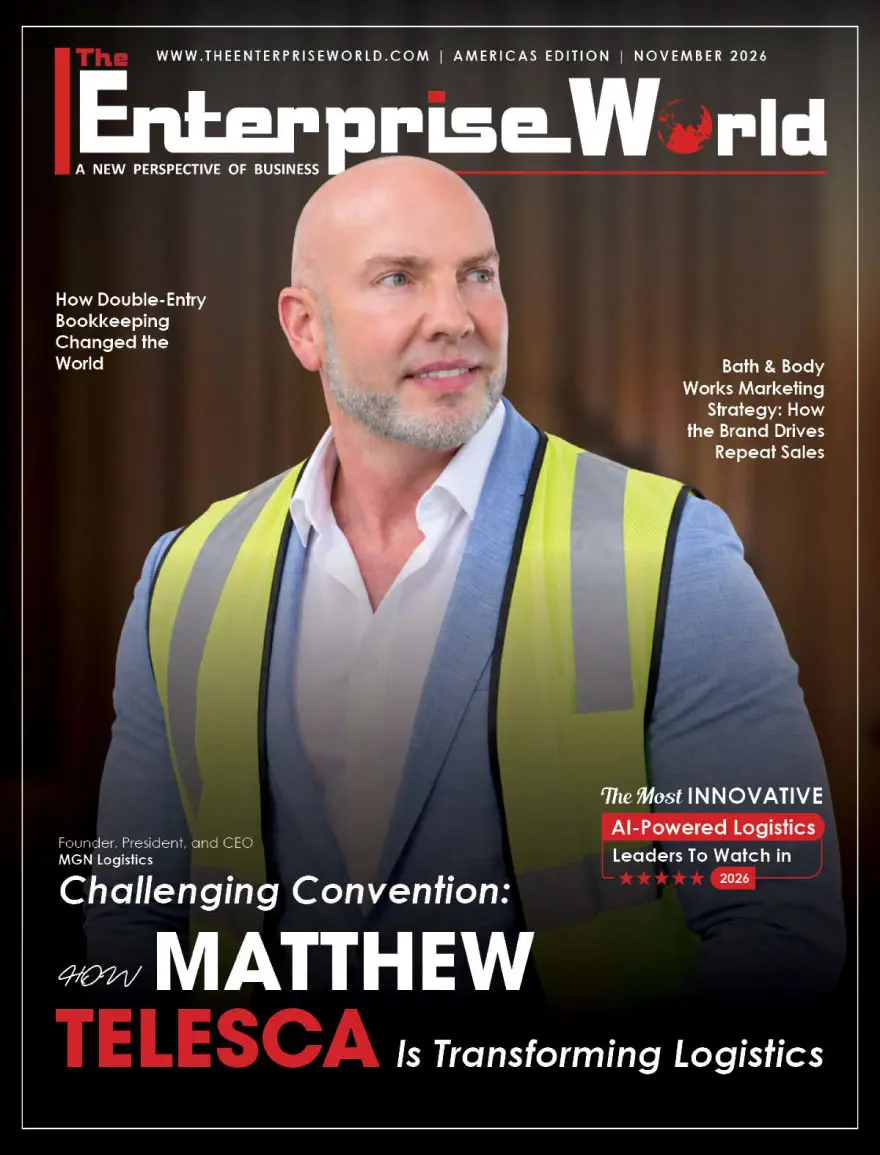


An inefficient process can become so familiar that nobody thinks to question it. Matthew Telesca did.
In 1998, while working in warehousing for a manufacturer, he encountered the difficulties of comparing freight rates and recognized an opportunity to simplify the process. The idea did not immediately win everyone over, but his belief in the possibilities of internet technology encouraged him to pursue a different approach.
That conviction helped lead to LogisticsQuote.com, an early online freight platform that allowed customers to compare rates, prepare shipping documents, and track shipments. Its sale in 2004 marked an important milestone, but it did not end Matthew’s interest in solving transportation challenges through technology.
As Founder, President, and CEO of MGN Logistics, Matthew Telesca has continued to examine how established freight processes can work better. Business expansion, acquisitions, transportation analytics, and artificial intelligence have become part of that effort. Across these different stages, one principle connects his work: meaningful innovation begins by questioning what others have come to accept.
Turning Everyday Friction into a Vision for Better Logistics
Sometimes, a business idea begins with a simple question: Why does this have to be so complicated? For Matthew Telesca, that question arose while working in warehousing, where comparing transportation rates was an unnecessarily cumbersome process. Rather than accepting it as the norm, he saw an opportunity to simplify freight decisions.
In 1998, Matthew partnered with a friend to develop software that could streamline the process. Although the idea met resistance, he recognized the possibilities internet technology held for an industry accustomed to conventional methods.
In May 2000, he founded MGN Logistics as a truckload brokerage, and the company launched LogisticsQuote.com, one of the first online brokerage platforms where customers could compare rates, create shipping documents, and track freight. Its sale to a private-equity group in 2004 confirmed the commercial potential of online freight technology, and Matthew turned his full attention to building MGN.
The experience shaped a principle that still guides his work: industry challenges can become opportunities when someone dares to question the usual way of doing things.
Today, Matthew applies that same instinct to artificial intelligence, exploring how it can improve business decisions and make useful solutions more accessible to customers.
Building Through Uncertainty, Growing with Purpose
With MGN Logistics established, Matthew set out to pair its technology with a larger operating base.
The 2007 acquisition of D & S Transportation helped bring that ambition into practice. MGN Logistics could now apply technology within an established freight operation, connecting software development with the demands of managing shipments and serving customers. The move represented an important shift in Matthew’s approach: technology could be more effective when paired with operational experience.
That strategy faced a different test during the Great Recession, when commercial credit became difficult to obtain. With acquisition financing constrained, MGN turned toward organic growth, including opening an Orlando office in 2009. Rather than allowing limited access to financing to halt expansion, the company pursued a different route.
The experience illustrates an important dimension of Matthew’s leadership: adapting the growth path when circumstances change. In 2026, MGN completed its ninth self-funded acquisition, reflecting Matthew’s commitment to disciplined growth and continued investment in the business. The acquisition of Fast Service, an expedited transportation provider, represents another step in expanding the company’s operational capabilities.
For him, growth is not only about increasing the company’s size. It is also about developing the capabilities needed to serve customers across changing market conditions.
MGN Logistics: A Journey of Growth and Innovation
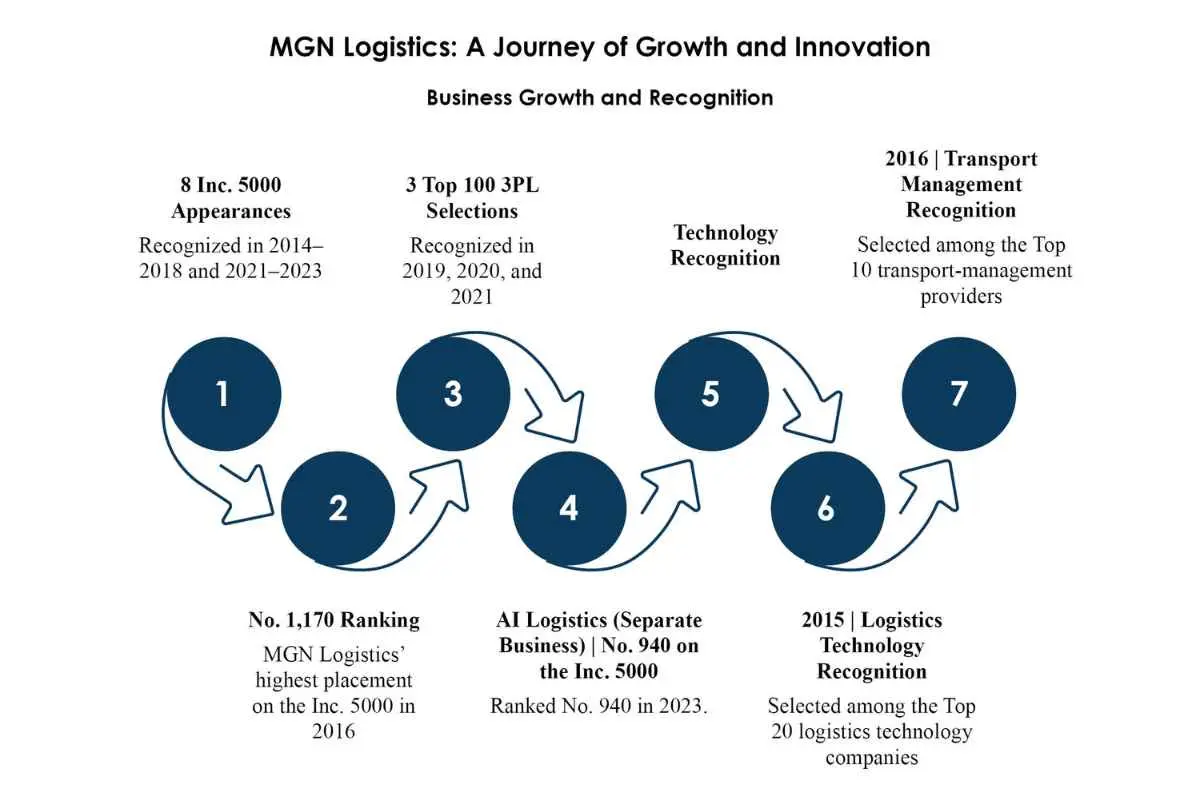
Business Growth and Recognition
- 8 Inc. 5000 Appearances
Recognized in 2014–2018 and 2021–2023 - No. 1,170 Ranking
MGN Logistics’ highest placement on the Inc. 5000 in 2016 - 3 Top 100 3PL Selections
Recognized in 2019, 2020, and 2021 - AI Logistics (Separate Business) | No. 940 on the Inc. 5000
Ranked No. 940 in 2023.
- Technology Recognition
- 2015 | Logistics Technology Recognition
Selected among the Top 20 logistics technology companies - 2016 | Transport Management Recognition
Selected among the Top 10 transport-management providers
Strategic Milestones
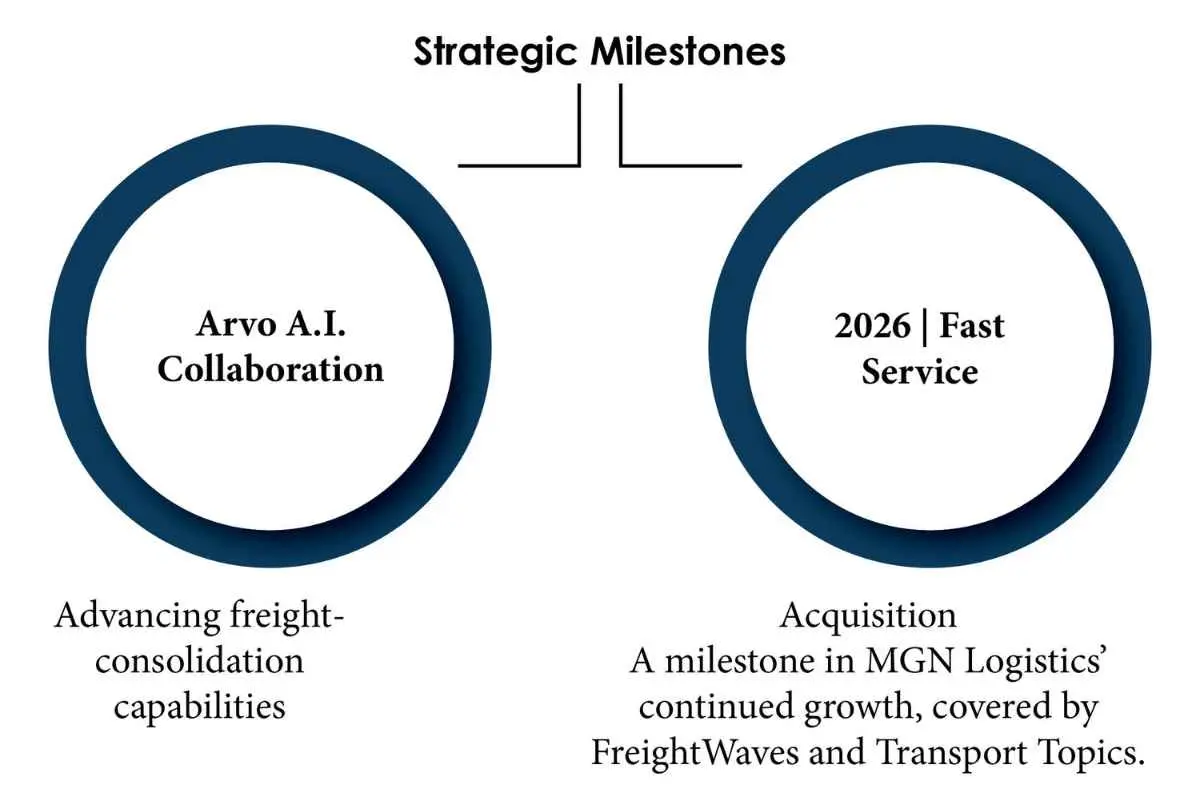
- Arvo A.I. Collaboration
Advancing freight-consolidation capabilities - 2026 | Fast Service Acquisition
A milestone in MGN Logistics’ continued growth, covered by FreightWaves and Transport Topics.
Developing the Next Generation of Logistics Technology
CeresGrid | Hay-Export Supply Chain
Developing solutions for:
- Documentation and scheduling
- Inventory visibility
- Load coordination
Matthew Telesca’s focus: Sustaining business growth while investing in technology and operational capabilities that deliver greater value to customers.
Making Sense of Data, One Shipment at a Time
In logistics, shipping costs can be difficult to understand when carrier records, invoices, and transportation systems tell only parts of the story. MGN Logistics brings these sources of information together to identify billing discrepancies, assess service choices, and uncover opportunities to improve freight spending.
Its capabilities span transportation management, parcel auditing, analytics, and managed services. Proprietary solutions such as MarketMaker Pricing support freight-rate intelligence, while MyMGN Marketplace allows customers to compare their negotiated carrier rates with alternative private third-party logistics (3PL) spot rates.
The value lies in connecting data with operational knowledge. Shipment characteristics, service requirements, and carrier options all influence which decisions make sense for a particular business. By combining analytical tools with logistics expertise, MGN helps customers evaluate their options with a clearer understanding of cost and service.
Looking Beyond the Obvious Problem
A request for better freight rates can appear straightforward. Yet Matthew Telesca’s approach to logistics recognizes that the visible problem is not always the one that needs to be solved.
A manufacturing case featured by Logistics Tech Outlook illustrates the distinction. The customer struggled with less-than-truckload (LTL) rate negotiations because inconsistent freight volumes and dock congestion increased carrier loading times. The difficulty was not simply a matter of pricing; operational inefficiencies were making the customer’s freight less attractive to carriers.
MGN developed a dock-management suite to track pallet movement, allocate staging locations, and monitor loading times. The resulting visibility helped the customer identify bottlenecks and make operational adjustments. Once loading issues improved, carriers became more willing to return to negotiations.
The case illustrates how a visible pricing problem can have its roots in daily operations. By addressing pallet movement, staging, and loading delays, MGN helped the customer improve the conditions affecting carrier negotiations. The result was not simply a technology intervention, but a more informed approach to solving the underlying business problem.

Turning Fragmented Shipping Spend into More Than $3.49 Million in Savings
When acquisitions bring multiple businesses under one portfolio, transportation spending can become difficult to track and optimize. A client success story published by Inbound Logistics in October 2021 illustrates how Matthew’s team at MGN Logistics addressed this challenge for a private-equity group whose growing portfolio had increased its shipping costs.
MGN analyzed each company’s shipping operations, restructured carrier utilization, and used the portfolio’s combined shipping volume to negotiate better contract terms. Transportation reporting and parcel-spend analysis supported the work, alongside the team’s logistics expertise.
The financial results were substantial. The published account reported more than $900,000 in LTL and truckload savings, $1.6 million in parcel savings alongside a spending reduction of more than 15%, and $990,000 in international savings alongside a 10% cost reduction. Together, the reported savings exceeded $3.49 million. The engagement also improved shipping visibility and reduced administrative work.
Although the client was not named, the results demonstrate how MGN combined portfolio-wide purchasing power, transportation analysis, and logistics expertise to deliver savings while accommodating future acquisitions.
Putting Artificial Intelligence to Work in Logistics

Matthew Telesca launched AI Logistics in Puerto Rico in 2019, more than three years before ChatGPT made artificial intelligence a mainstream business topic. He was convinced that artificial intelligence and machine learning would become central to transportation, and the timing reflects his approach to innovation: anticipate where technology could take the industry and begin developing solutions while those opportunities are still emerging. In 2023, AI Logistics ranked No. 940 on the Inc. 5000 and was the only Puerto Rico logistics company on the list, the same year MGN Logistics made its eighth appearance.
At MGN Logistics, this work informs the company’s focus on intelligence in pricing, freight coverage, and execution. Its transportation technology, rate intelligence, and analytics provide the foundation, while MyMGN Marketplace connects insights with practical shipping decisions. The 2024 collaboration with Arvo A.I. on freight consolidation extends this development journey.
Matthew also remains involved in development. He uses AI agents to organize tasks alongside his email and calendar, while continuing to engage with coding and product reviews. This hands-on involvement keeps him connected to the practical questions that determine whether a tool is useful in everyday work.
For Matthew, the important measure is whether a technology improves the quality of a decision or makes a meaningful task easier to complete. Its value must be demonstrated in practice, not assumed because it uses AI.
Keeping Human Judgment at the Heart of Intelligent Systems
Logistics decisions depend on accurate shipment details, reliable pricing information, customer requirements, and operational constraints. An AI-generated recommendation can appear persuasive while overlooking a factor that matters in practice.
At MGN Logistics, all AI outputs receive human review, and customer data is isolated to protect privacy and security. Matthew also emphasizes accurate shipment and pricing information, clear accountability, and the ability of experienced professionals to question recommendations that conflict with operational realities. Privacy, security, and compliance must remain considerations throughout technology development and deployment.
The principle is straightforward: automation can expand the options available to logistics professionals, but people must remain accountable for decisions affecting customers and operations. Matthew’s view is that AI works best as infrastructure around well-defined business rules, such as rating logic and audit criteria, rather than as a replacement for them. Intelligent systems are most useful when their recommendations can be assessed against the realities of the business.
The Next Frontier: Connected and Predictive Logistics
Matthew Telesca sees an opportunity for logistics technology to connect information that businesses have traditionally evaluated in separate systems. Better-connected transportation data could help customers compare shipment options, identify freight-consolidation opportunities, and understand the potential trade-offs between cost and service.
For MGN Logistics, this direction builds on its existing work in freight-rate intelligence, marketplace development, and consolidation. The opportunity is to make these capabilities work together more effectively, giving customers a clearer basis for evaluating their transportation choices.
He sees lasting potential in AI-assisted optimization, predictive analytics, and connected transportation platforms, but he is cautious about claims that technology can take over transportation decisions entirely. Freight operations involve physical constraints, service commitments, and customer requirements that automated systems must account for. The opportunity lies in combining more capable technology with operational knowledge and a clear focus on customer value.
Matthew Telesca’s journey in logistics began with a simple observation: a process accepted as normal could still be made better. That instinct led him to explore online freight technology, build MGN Logistics, and pursue solutions that connect transportation data with operational decisions. As the industry considers the possibilities of AI and predictive tools, the underlying challenge remains familiar: turning new capabilities into something customers can use and trust. For Matthew, the next chapter is a continuation of that original pursuit, finding better ways to solve the problems businesses face every day.
Matthew Telesca: Extending His Impact Beyond Logistics
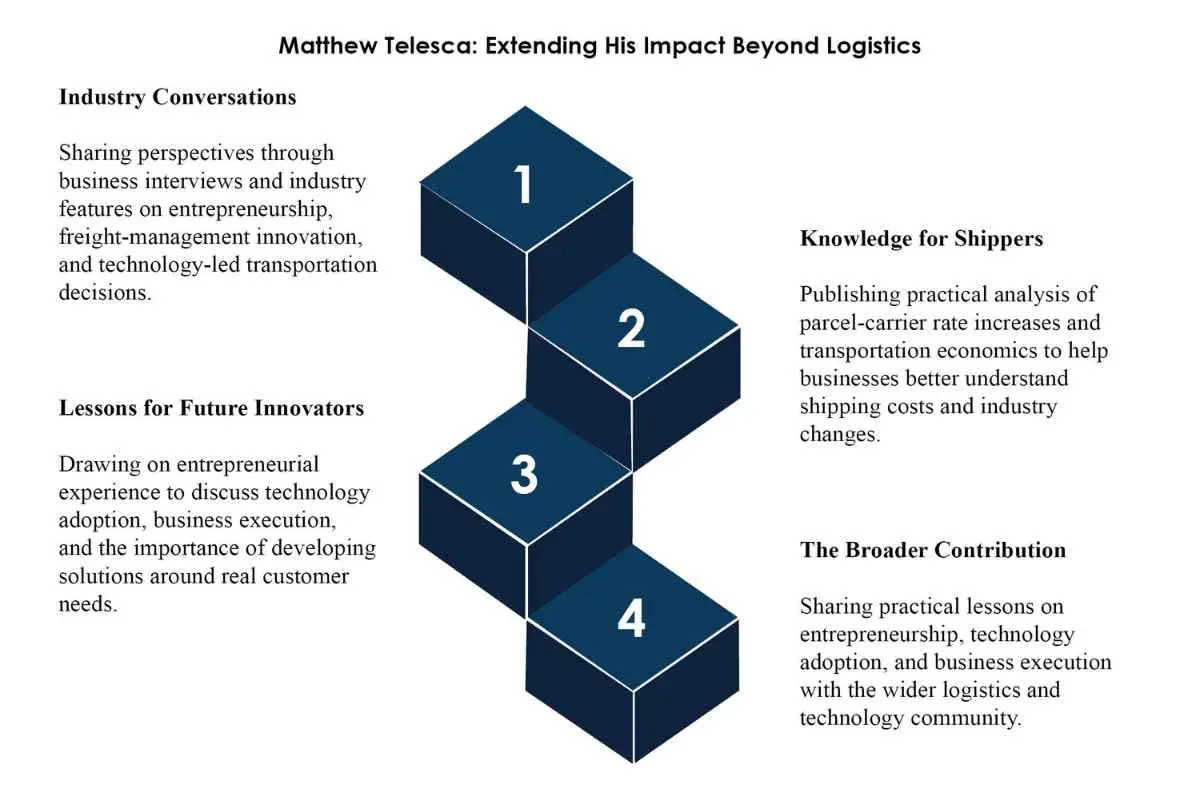
Industry Conversations
Sharing perspectives through business interviews and industry features on entrepreneurship, freight-management innovation, and technology-led transportation decisions.
Knowledge for Shippers
Publishing practical analysis of parcel-carrier rate increases and transportation economics to help businesses better understand shipping costs and industry changes.
Lessons for Future Innovators
Drawing on entrepreneurial experience to discuss technology adoption, business execution, and the importance of developing solutions around real customer needs.
The Broader Contribution
Sharing practical lessons on entrepreneurship, technology adoption, and business execution with the wider logistics and technology community.
A Day in Matthew Telesca’s Life
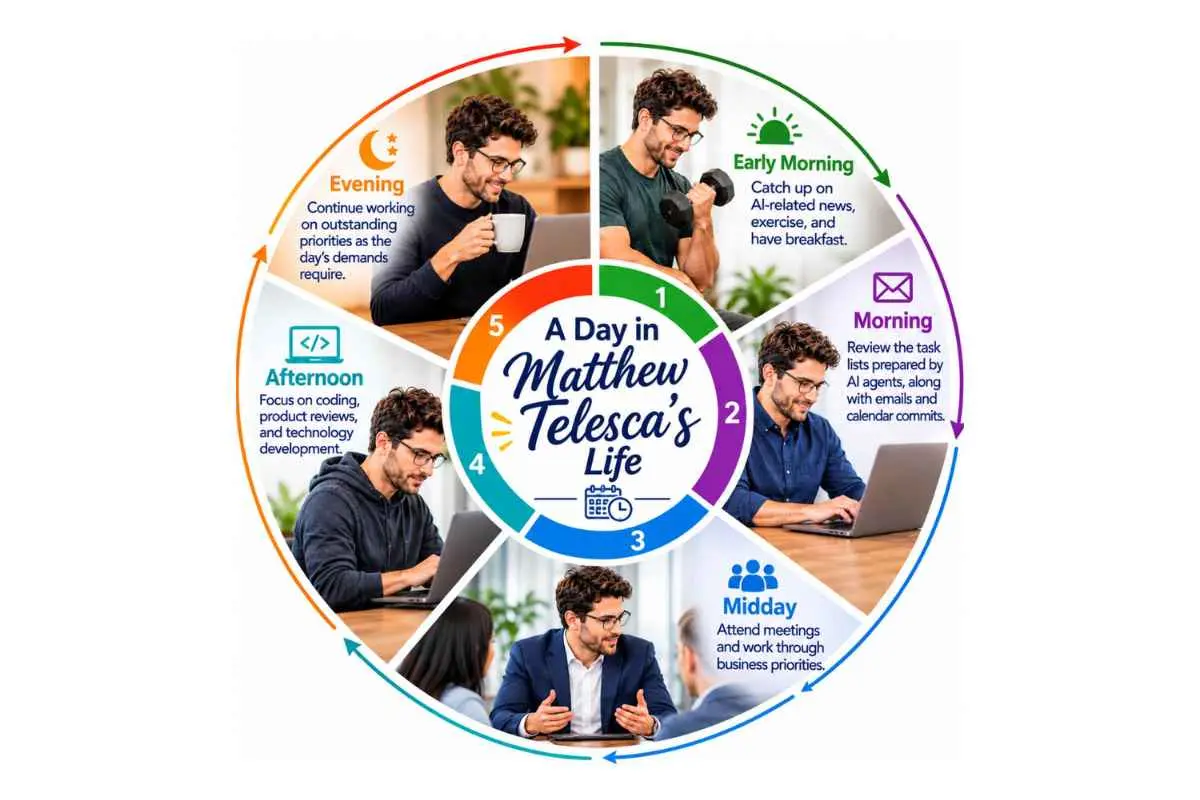
- Early Morning: Catch up on AI-related news, exercise, and have breakfast.
- Morning: Review the task lists prepared by AI agents, along with emails and calendar commitments.
- Midday: Attend meetings and work through business priorities.
- Afternoon: Focus on coding, product reviews, and technology development.
- Evening: Continue working on outstanding priorities as the day’s demands require.
Matthew Telesca: The Making of a Logistics Entrepreneur
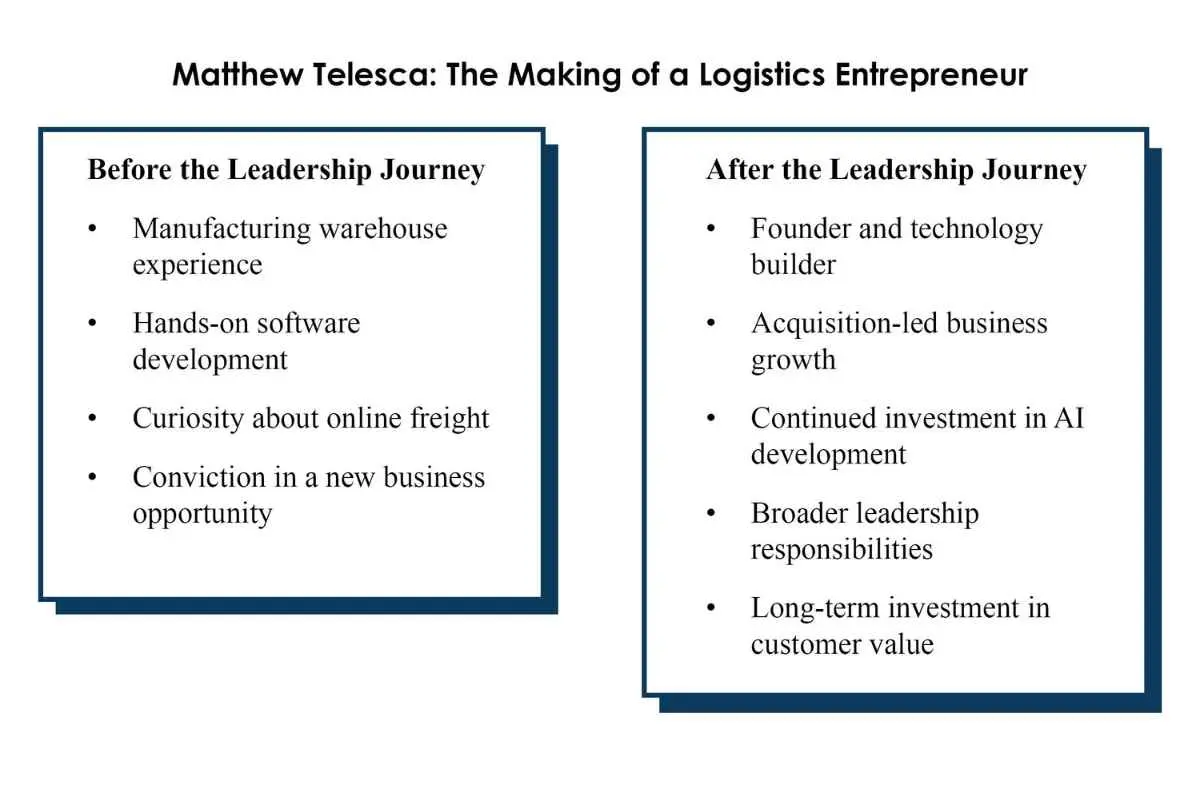
Before the Leadership Journey
- Manufacturing warehouse experience
- Hands-on software development
- Curiosity about online freight
- Conviction in a new business opportunity
After the Leadership Journey
- Founder and technology builder
- Acquisition-led business growth
- Continued investment in AI development
- Broader leadership responsibilities
- Long-term investment in customer value
Open Letter
To the next generation of logistics and supply-chain leaders,
Start by understanding the work deeply. Spend time with the people making freight decisions, managing docks and resolving shipment problems. Their experience will show you where technology can create value.
Then be willing to build. When I first saw the potential for online freight technology, the opportunity was not obvious to everyone around me. Taking that idea seriously led to a successful software business and a much longer entrepreneurial journey. Conviction matters, especially before a new approach has become familiar.
AI now opens another remarkable period of possibility. Use it to examine more options and give people better information. Keep the customer’s requirements and the consequences of each decision at the center of development.
My biggest lesson is that lasting success comes from turning an idea into something customers can depend on. Keep investing in your capabilities, listen closely, and build a business strong enough to keep improving. The frontier will move again. Your opportunity is to keep moving with it while creating value people can recognize.
From,
Matthew Telesca, Founder, President and CEO,MGN Logistics, Inc.
Quick Takes
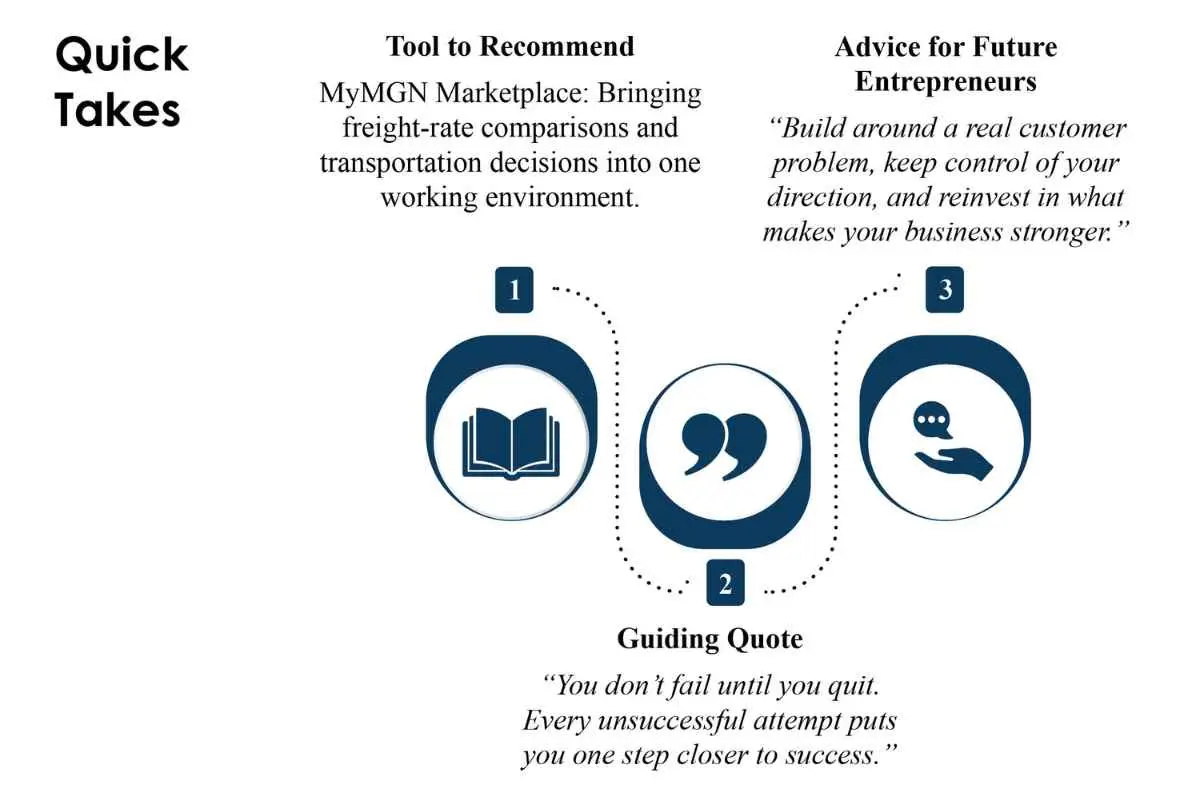
- Tool to Recommend
- MyMGN Marketplace: Bringing freight-rate comparisons and transportation decisions into one working environment.
- Guiding Quote
- “You don’t fail until you quit. Every unsuccessful attempt puts you one step closer to success.”
- Advice for Future Entrepreneurs
- “Build around a real customer problem, keep control of your direction, and reinvest in what makes your business stronger.”
Key Takeaways
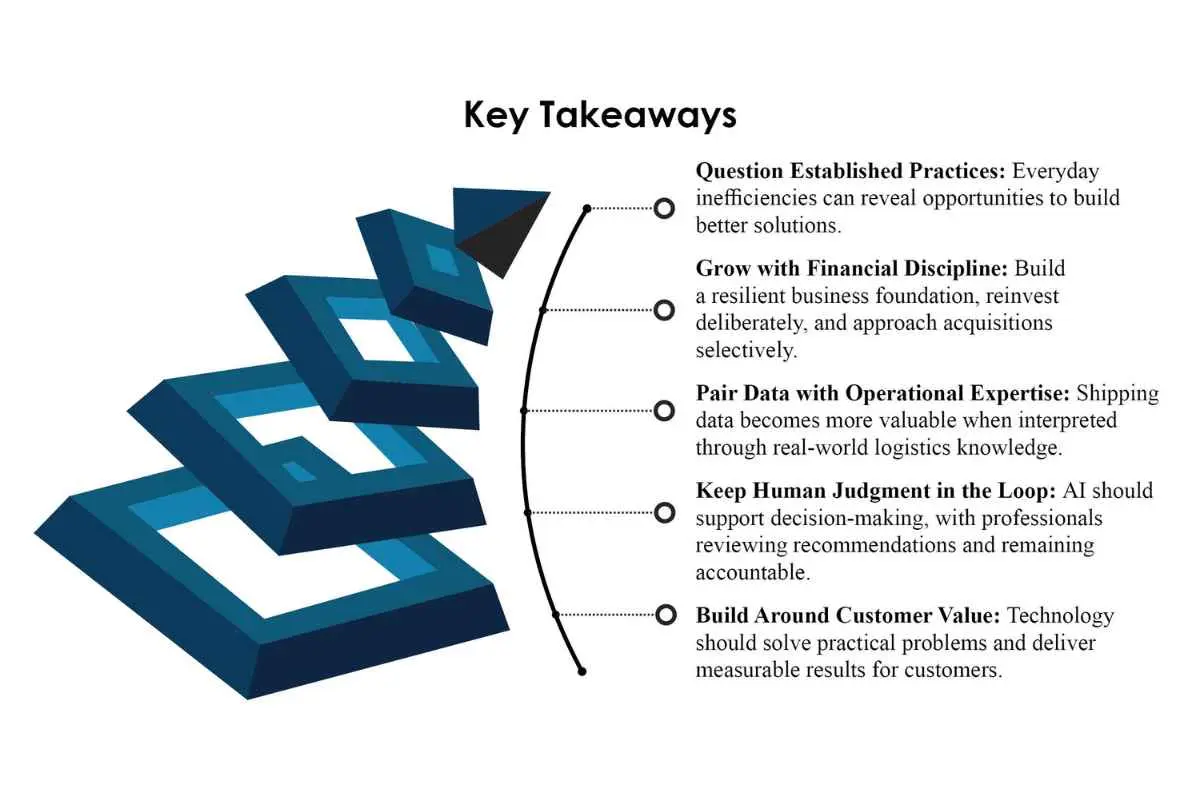
- Question Established Practices: Everyday inefficiencies can reveal opportunities to build better solutions.
- Grow with Financial Discipline: Build a resilient business foundation, reinvest deliberately, and approach acquisitions selectively.
- Pair Data with Operational Expertise: Shipping data becomes more valuable when interpreted through real-world logistics knowledge.
- Keep Human Judgment in the Loop: AI should support decision-making, with professionals reviewing recommendations and remaining accountable.
- Build Around Customer Value: Technology should solve practical problems and deliver measurable results for customers.