

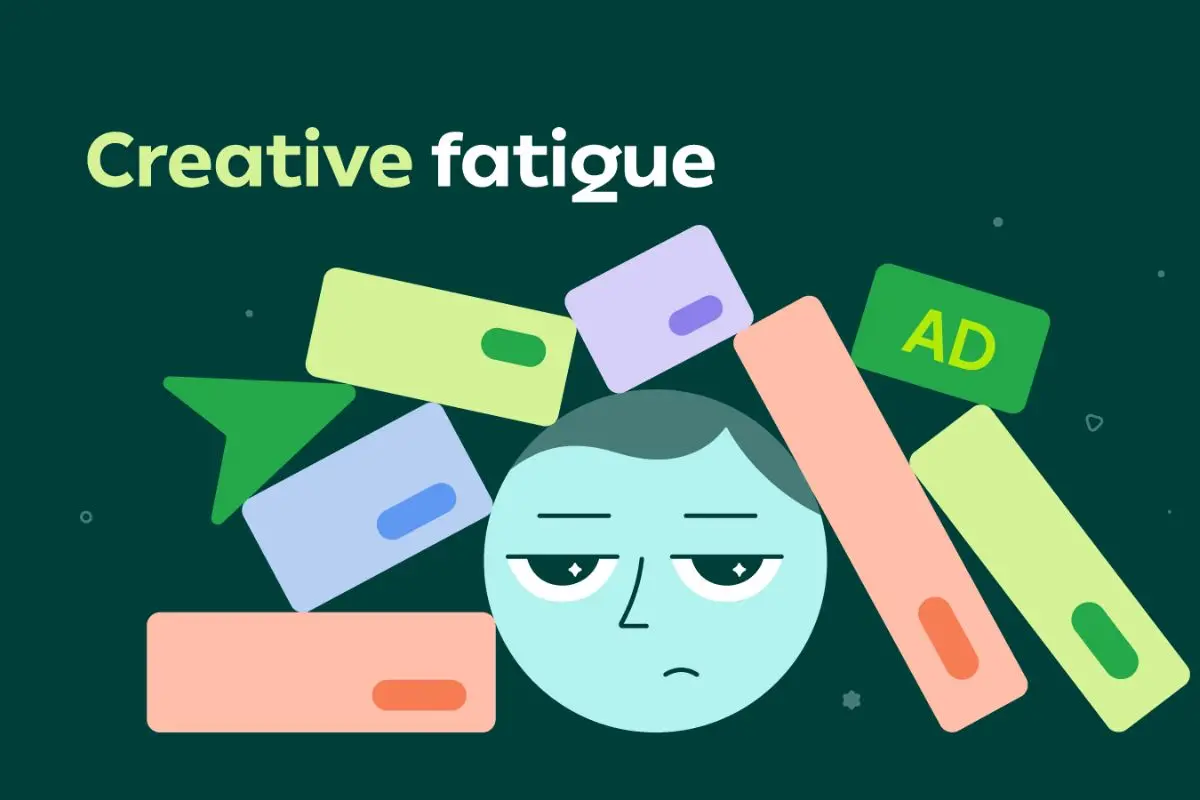
An ad that performed well last week does not necessarily mean it will perform well this week. The audience has not changed. The targeting has not changed. The ad itself has not changed, and that is the problem. The same person seeing the same creative for the fifth or sixth time will process it differently. Attention drops. Clicks drop. Cost per acquisition rises. The campaign looks like it is losing effectiveness when what it is actually losing is the creative’s ability to hold attention.
This is ad creative fatigue, and it is one of the most common causes of gradual performance decline on any ads platform where campaigns run continuously. It does not announce itself with a sudden crash. It shows up as a slow bleed across metrics that are easy to miss if the monitoring cadence is weekly rather than daily.
The wear-in and wear-out curve
Pechmann and Stewart published a review of advertising repetition research in 1988 that established the framework most of the industry still uses. Their model describes two phases: wear-in, where repeated exposure increases the ad’s effectiveness as the message registers and builds recognition, and wear-out, where continued exposure past the peak begins to erode effectiveness. The response curve is an inverted U. Performance rises, peaks, and then declines.
The shape of that curve depends on the creative itself, the audience, and the medium. A simple static banner on a high-frequency placement may peak and decline within days. A video ad shown at a lower frequency across a broad audience may hold up for weeks. Les Binet and Peter Field, in The Long and the Short of It, found that emotional creative tends to produce longer-lasting effects than rational, direct-response creative, which means wear-out timelines are not fixed. They vary by creative type, and a testing process that treats all creatives as having the same lifespan will rotate some too early and others too late.
What the metrics show

The first signal of ad creative fatigue is usually a declining click-through rate at stable or rising frequency. If the same audience is seeing the ad more often and clicking less often, the creative is losing its pull. Meta’s internal research on creative fatigue used a logistic regression model to measure how the likelihood of a click changed as individual users saw the same creative multiple times. They controlled for audience saturation, estimated click-through rate, and ad set history. The finding was that repeated exposures to the same creative were independently associated with a declining probability of a click, even after accounting for other factors.
The second signal is rising CPM. On auction-based platforms, the system penalizes ads with low engagement by charging more per impression. An ad that used to clear auctions cheaply starts costing more because fewer people interact with it, and the platform’s quality score adjusts accordingly.
The third signal is the cost per acquisition climbing while the conversion rate remains flat or declines. At that point, the creative is actively making the campaign less efficient. TrafficJunky’s campaign reporting breaks out click-through rate and impression data at the creative level, so advertisers running multiple creatives within a campaign can compare performance per creative.
When to rotate
There is no universal threshold. The right moment to rotate depends on the frequency, audience size, and how many creative variations are in rotation. A campaign with one creative running against a narrow audience will fatigue faster than a campaign with five creatives running against a broad audience, because each person in the narrow audience accumulates exposures faster.
A practical approach is to set a monitoring rule: if click-through rate drops more than 15% over seven days with no change to targeting, bid, or placement, check the frequency. If frequency has increased over the same period, the creative is the likely cause, and a rotation is warranted. Waiting for cost per acquisition to spike before acting means the budget has already been spent inefficiently during the period between when the creative started declining and when the metric crossed an obvious threshold.
The better practice for avoiding ad creative fatigue is to have the next creative ready before the current one peaks. That means creative production is not a response to fatigue. It is a parallel process that runs alongside the campaign so that a replacement is available the moment the data says the current creative is past its peak. Teams that treat creative as a one-time production step and then run it until it fails will always be slower to rotate than teams that treat creative as an ongoing output with a planned shelf life.