


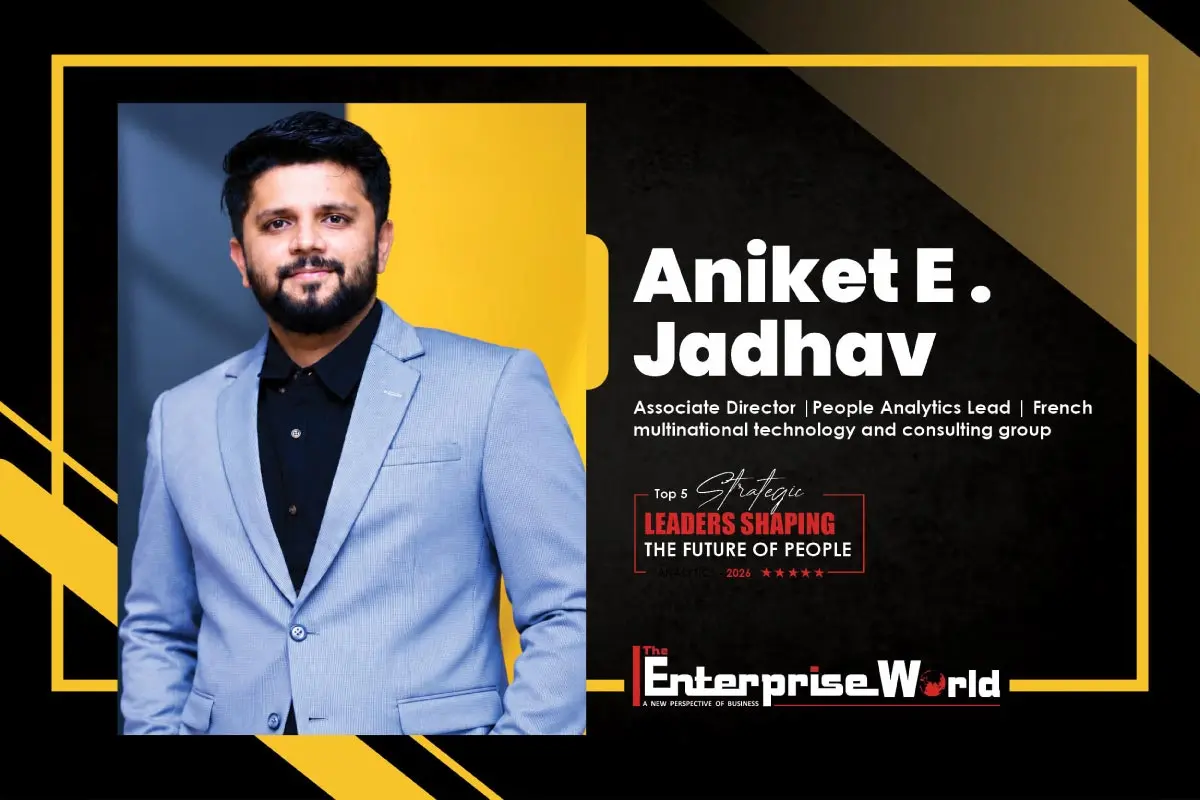
Good workforce decisions require more than numbers on a dashboard. Organizations need to understand why employees leave, where critical skills may be missing, and how workforce needs may change as business priorities evolve. Yet many companies have large amounts of workforce data without knowing how to turn it into timely and useful action.
For Aniket E. Jadhav, Associate Director – People Analytics Lead at a French multinational technology and consulting group, this is one of the key challenges People Analytics can address. He leads a 120-person team of AI experts, BI developers, and analysts, working across areas such as employee attrition, skills gaps, strategic workforce planning, and talent intelligence.
His experience across analytics, customer intelligence, business intelligence, and People Analytics has given him a practical understanding of how organizations can use data to identify workforce risks earlier while keeping human judgment at the center of important decisions.
In a recent interaction with The Enterprise World, Aniket shared his perspective on the workforce challenges organizations face, the role of People Analytics in addressing them, and the practical steps leaders can take to make better decisions.
Q: Aniket, your career has taken you across several industries and data-focused roles. What led you to People Analytics?
My journey has been shaped by different roles across industries, and each experience helped me understand how data can solve real business problems. I started my career as a Tableau specialist at a global analytics and business process outsourcing firm. I then worked in customer intelligence in shipping and logistics, business intelligence in telecom, and consumer data analysis for global CPG and beauty brands through consulting and in-house roles.
One lesson remained consistent throughout my career: data creates value only when people trust it and act on it.
In 2019, I joined a French multinational technology and consulting group when its People Analytics function was still developing. My earlier experience in understanding customer behavior, including churn, sentiment, and loyalty, helped me see how similar insights could support workforce decisions.
Since then, I have helped grow the function from a small specialist team into a practice of more than 100 professionals, developing capabilities in employee attrition prediction, strategic workforce planning, and skills intelligence. For me, success is not only about building strong models. It is also about earning leaders’ trust so they can use analytics with confidence.
Q: Employee attrition can be difficult to predict. What makes it challenging for organizations to identify workforce risks early?
A common challenge is having plenty of workforce data but not knowing how to use it before a problem occurs. High-performing employees may leave without warning, while important succession gaps may become clear only after someone has already left.
My work focuses on helping organizations identify these risks early and take timely action.
In one engagement, our team developed a system that used existing employee data to identify signs that people in critical roles might be considering leaving. This gave the organization several months to respond instead of waiting for an annual employee survey. We also provided managers with clear retention plans, including specific actions and the right time to take them.
Within a year, the pilot group saw a meaningful reduction in key employee turnover.
For me, the biggest achievement was not simply finding the warning signs. It was helping managers trust the insights enough to act before an employee decided to leave, rather than trying to solve the problem after the resignation.
Q: Once analytics identifies a potential retention risk, what should organizations actually do?
Analytics should support a decision, not replace human judgment.
A model can identify patterns that may indicate an attrition risk, but it cannot fully understand an employee’s circumstances, aspirations, or concerns. Managers still need to speak with employees and understand what is actually happening.
Organizations can then consider practical areas such as career development, internal mobility, workload, recognition, and opportunities to build new skills. The appropriate action will depend on the situation.
It is also important to measure whether those actions are working. Identifying a problem and taking action is only part of the process. Organizations should also look at the results and learn from them.
Q: How has your approach to People Analytics evolved from individual solutions to a broader model?
Over time, our team has moved from creating one-off solutions for individual needs to building a repeatable approach across the employee lifecycle, from attraction and onboarding to development, performance, mobility, retention, and exit.
At each stage, we look for ways to help organizations make better decisions earlier rather than simply improve existing reports. This has led to solutions for predicting employee attrition and retention, identifying skills and capability gaps, matching candidates to suitable roles, and planning workforce needs based on business growth.
What makes this approach different from traditional HR reporting is that it starts with the business decision, not the available data. We first understand what a leader needs to decide and then work backward to determine the right data, analysis, and solution to support that decision.
Q: Skills gaps are becoming an important workforce concern. How can organizations prepare for changing talent needs?
Organizations need to understand not only the skills they have today but also the capabilities they will need as the business changes.
Strategic workforce planning is increasingly moving toward skills rather than simply job titles. As roles evolve, employees may already have transferable capabilities that organizations are not fully recognizing.
This creates an opportunity to look at internal talent before immediately searching externally. Organizations can identify existing skills, understand capability gaps, and create opportunities for employees to develop or move into areas where their capabilities are needed.
That requires better skills intelligence and closer alignment between strategic workforce planning and business strategy.
Q: What do you see as the biggest bottleneck for organizations trying to become more data-driven?
For many organizations, the biggest challenge is not technology but poor and disconnected data. HR information is often spread across systems that do not integrate, making it difficult to gain clear insights without spending significant time cleaning and organizing the data.
There is also a cultural challenge. Many HR leaders are more familiar with people management and policies than with understanding and questioning analytical results. As a result, workforce analytics can be treated as something to accept or ignore rather than a useful tool for making better decisions.
Organizations that overcome these challenges usually take a practical approach. They first build a reliable and well-managed foundation for workforce data. Then, they bring together people who understand HR and data to connect insights with business needs.
Instead of trying to build a large analytics system all at once, they can begin with one important and clearly defined problem, such as identifying the risk of losing employees in critical roles. The results can then provide a foundation for broader workforce analytics.
Q: Technology is playing a growing role in HR. How can organizations use AI and analytics while maintaining employee trust?
Technology offers HR an opportunity to move beyond annual surveys and personal judgment toward continuous insights that can help identify potential employee turnover or skills gaps before they become serious problems.
At the same time, its use brings an important responsibility. Employees may be concerned about systems that assess them, particularly when they involve performance or the possibility of leaving. Building trust is therefore essential.
My approach is built on three key principles: being clear about what employee data is collected and why it is used, keeping human judgment at the center of important career decisions, and regularly checking systems for unfair patterns in areas such as hiring, performance, and employee retention.
Responsible use of technology is not simply about meeting rules or requirements. It is about creating systems that employees and managers can understand, trust, and use with confidence.
Q: Your team reduced reporting time by roughly 60%. What did that experience teach you about making analytics more useful?
One of the clearest examples came from improving our own reporting process. By using Python-based data pipelines and self-service business intelligence tools, we reduced manual reporting work and cut reporting time by roughly 60%.
This allowed analysts to spend more time understanding the findings and supporting better decisions instead of spending hours preparing data.
The same focus on a clear and consistent approach also strengthened business growth. By replacing ad hoc proposals with a standardized, evidence-based methodology for RFPs and client requests, we increased our new business pipeline by more than 50% over a comparable period.
For me, real impact is not simply about producing reports or dashboards. It is about creating processes that allow people to spend more time on analysis, judgment, and decisions.
Q: You have built and mentored a 120-person People Analytics team. What capabilities have you developed through this journey?
Much of my contribution has come through building the People Analytics practice from within. I have built and mentored a 120-person analytics team and developed a global collaboration framework and analytics methodologies that are now used by People Analytics teams across the firm.
I also hold a specialist certification in People Analytics, along with Agile/Scrum product ownership and delivery credentials that support my approach to managing analytics projects.
Beyond my work within the organization, I also contribute to HR Analytics Summits and industry workshops, where I share my experience and insights with the wider professional community.
One important lesson has been that technical expertise alone is not enough. Analytics professionals also need business understanding so they can connect findings to decisions that leaders can act on.
Q: How do you see People Analytics evolving with the growth of Generative AI?
I believe People Analytics will change significantly in the coming years. One major shift will be from basic dashboards and reports to more timely insights that managers can use directly while making decisions.
Generative AI is also expected to make it faster to find answers from workforce data, while increasing the need for strong data governance. At the same time, strategic workforce planning is likely to become more focused on skills rather than job titles, as organizations need to keep pace with changing business and talent needs.
For professionals building a career in this field, strong knowledge of AI and machine learning will be important, but technical skills alone will not be enough. Business understanding will be equally important to turn data findings into decisions that senior leaders can act on.
I also believe professionals should have the confidence to question decisions when the data does not support them.
My key lesson from my career is simple: build trust before building the dashboard. A technically strong solution has little value if the people expected to use it do not trust it.













