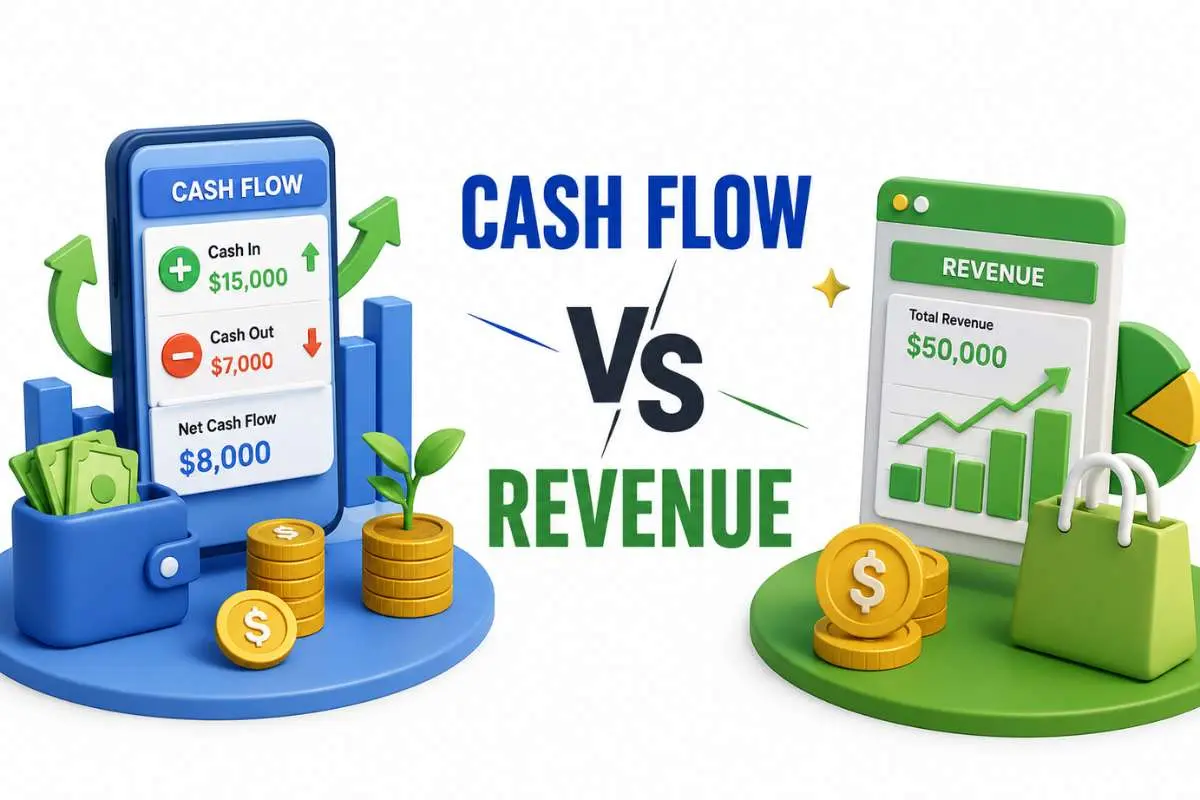
Strong sales often create the impression of financial success, but the reality is more complex when you compare cash flow vs revenue. Many businesses record rising sales figures while still facing cash shortages due to delayed payments and ongoing expenses. Understanding cash flow vs sale helps reveal whether a company is truly stable or simply appears successful on paper.
A company closes its best month ever. Record sales. Celebrations all around. Then, a week later, it struggles to pay salaries.
That contradiction is not rare. It happens more often than most founders expect, and it usually comes down to one misunderstood gap. Numbers that look strong on reports do not always translate into money available when it is needed.
This is where cash flow vs revenue stops being a textbook concept and becomes a real business decision. One tells you how much value you have created. The other tells you whether you can keep operating tomorrow.
Once you start seeing the difference, you stop trusting surface-level growth. You begin to track movement, timing, and liquidity with more intent. That is where control begins, and that is why cash flow and revenue are among the most important distinctions a business can understand early on.
Cash flow vs Revenue: what do they mean?
Money moves in and out of a business every day. Some of it stays. Some of it leaves fast. This often creates confusion. Many people see strong sales and assume the business is healthy. That is not always true.
The Cambridge Dictionary defines “Revenue” as the income that a business or government receives regularly or an amount representing such income. It shows the total money a business earns from its core activities. This number reflects sales, but it does not account for costs or timing of payments.
Cash flow shows how money actually moves through a business. It tracks cash coming in and going out over a period of time. This includes customer payments, salaries, rent, and other expenses. It focuses on real cash, not just recorded income.
A business can have high revenue but still face problems. This happens when payments are delayed or expenses pile up quickly. In contrast, strong cash flow helps a business stay stable and meet its daily needs.
Both terms sound similar, but they serve different purposes. Revenue shows what you earn on paper. Cash flow shows what you have in hand.
Cash flow vs Revenue: key differences explained

Both cash flow and revenue appear in financial reports, but they measure different aspects of performance. One focuses on earnings, while the other tracks actual money movement. These differences affect how businesses plan, spend, and evaluate their financial health.
The table below breaks down the distinctions between cash flow vs revenue clearly, followed by a deeper explanation of each point.
| Cash Flow | Difference | Revenue |
| Tracks actual money entering and leaving the business | Definition | The income that a business or government receives regularly, or an amount representing such income |
| Recorded when cash is received or paid | Timing | Recorded when a sale is made, even if payment is delayed |
| Includes all expenses and outgoing payments | Expenses | Does not include expenses, only total income |
| Shows real liquidity and available funds | Financial Health | Shows earnings, not actual cash position |
| Helps manage daily operations and payments | Purpose | Helps measure sales performance and growth |
| Highlights cash shortages and payment risks | Risk Indicator | May hide financial stress due to delayed payments |
1. Definition
Revenue gives a clear view of how much a business earns from its core activities. It adds up all sales within a given period, whether the cash has arrived or not. This makes it useful for tracking demand and growth trends.
Cash flow, on the other hand, focuses only on real money movement. It shows how much cash the business receives and how much it spends. This includes every inflow and outflow, from customer payments to utility bills. Because of this, cash flow reflects the money a business can actually use at any moment.
2. Timing
Revenue follows accounting rules, not cash movement. A business records revenue as soon as it completes a sale, even if the customer plans to pay later. This is common in credit-based transactions, where payment cycles can stretch over weeks or months.
Cash flow works in real time. It only records money when it enters or leaves the account. This difference creates gaps between reported income and available cash. A business may show strong revenue on paper while waiting for payments to arrive.
3. Expenses
Revenue does not subtract any costs. It shows the top line number before rent, salaries, taxes, or supplier payments. This makes it a clean measure of sales performance but not of profitability or stability.
Cash flow includes every expense the business pays. It captures outgoing money such as wages, inventory costs, and operational bills. This makes it easier to understand how quickly money leaves the business. By looking at cash flow, a business can see if it spends more than it brings in.
4. Financial Health
The next point of debate between cash flow vs revenue is financial health. Revenue alone cannot show whether a business is stable. A company may report rising sales while facing cash shortages at the same time. This often happens when customers delay payments or when expenses increase faster than income.
Cash flow gives a more grounded view. It shows whether the business has enough cash to cover its obligations. Positive cash flow means the business can sustain itself. Negative cash flow signals pressure and possible disruption.
5. Purpose
Revenue helps business owners and investors measure growth. It shows whether products or services attract buyers and generate income over time. This makes it useful for planning expansion and setting targets.
Cash flow serves a more practical purpose. It helps businesses manage daily operations, pay employees, and keep services running without interruption. While revenue shows direction, cash flow supports execution.
6. Risk indicator
Revenue can create a false sense of confidence when viewed alone. A business may see high sales numbers and assume everything is on track. However, if cash does not arrive on time, the business may struggle to meet its obligations.
Cash flow exposes these risks early. It highlights delays in collections, rising costs, and gaps between income and expenses. This allows businesses to act quickly and avoid deeper financial problems.
Cash flow vs Revenue: what is more important for a business

Cash flow and revenue both matter, but they serve different needs. Revenue shows how much a business sells. It reflects demand, pricing power, and market reach. Investors often look at revenue first to judge growth potential. A rising revenue line signals that the business is expanding its customer base and generating more sales over time.
Cash flow focuses on survival and stability. A business needs cash to pay salaries, suppliers, rent, and taxes. Even strong revenue cannot cover these needs if payments are delayed. Many businesses fail not because they lack sales, but because they run out of cash. Cash flow ensures that daily operations continue without disruption. It gives a real picture of financial strength at any moment.
In practice, cash flow often takes priority over revenue. A healthy business needs both, but cash flow keeps it alive while revenue drives long-term growth. Companies that balance both perform better in the long run. Strong revenue without cash flow creates pressure, while strong cash flow with low revenue limits expansion.
Cash flow vs Revenue: trends in 2026

Businesses are changing how they view cash flow vs revenue. The focus has shifted from only tracking performance to actively managing financial stability. Revenue still measures growth and market demand. Cash flow now drives daily decision-making. Companies want clearer visibility into liquidity, payments, and working capital. This shift reflects tighter financial conditions and rising operational costs.
According to a survey done by APCQ, almost half of all respondents (48%) said focusing on cash flow management was a top priority for 2026. This shows a strong global move toward liquidity control and better cash planning. Businesses are no longer treating cash flow as a secondary metric. They now treat it as a core part of financial strategy. Many companies are investing in forecasting systems, automation tools, and real-time monitoring to reduce uncertainty in cash movement.
At the same time, revenue tracking is becoming more integrated with cash flow systems. Finance teams now combine sales data with payment cycles to understand real financial health. This helps businesses avoid gaps between reported earnings and actual cash availability. In 2026, companies that balance revenue growth with strong cash flow control are better positioned to stay stable and scale efficiently.
Conclusion:
Strong revenue numbers can create confidence, but they do not always reflect financial stability. What truly determines how a business operates day to day is how money moves, not just how much is earned on paper.
When you separate cash flow vs revenue, you start seeing the business more clearly. Revenue shows performance. Cash flow shows reality. One reflects sales activity, while the other reflects financial health in real time.
Understanding this difference helps avoid false signals of success. It shifts focus from looking good in reports to staying functional in practice, which is what ultimately keeps a business steady and capable of long-term growth.
FAQs
1. What is the difference between cash flow vs revenue?
Revenue is the total income generated from sales, while cash flow is the actual money moving in and out of the business.
2. Why is cash flow more important than revenue?
Because a business can show high revenue but still struggle if it does not have enough cash available to cover expenses.
3. Can a business have high revenue and negative cash flow?
Yes, this can happen due to delayed payments, high expenses, or poor financial timing.