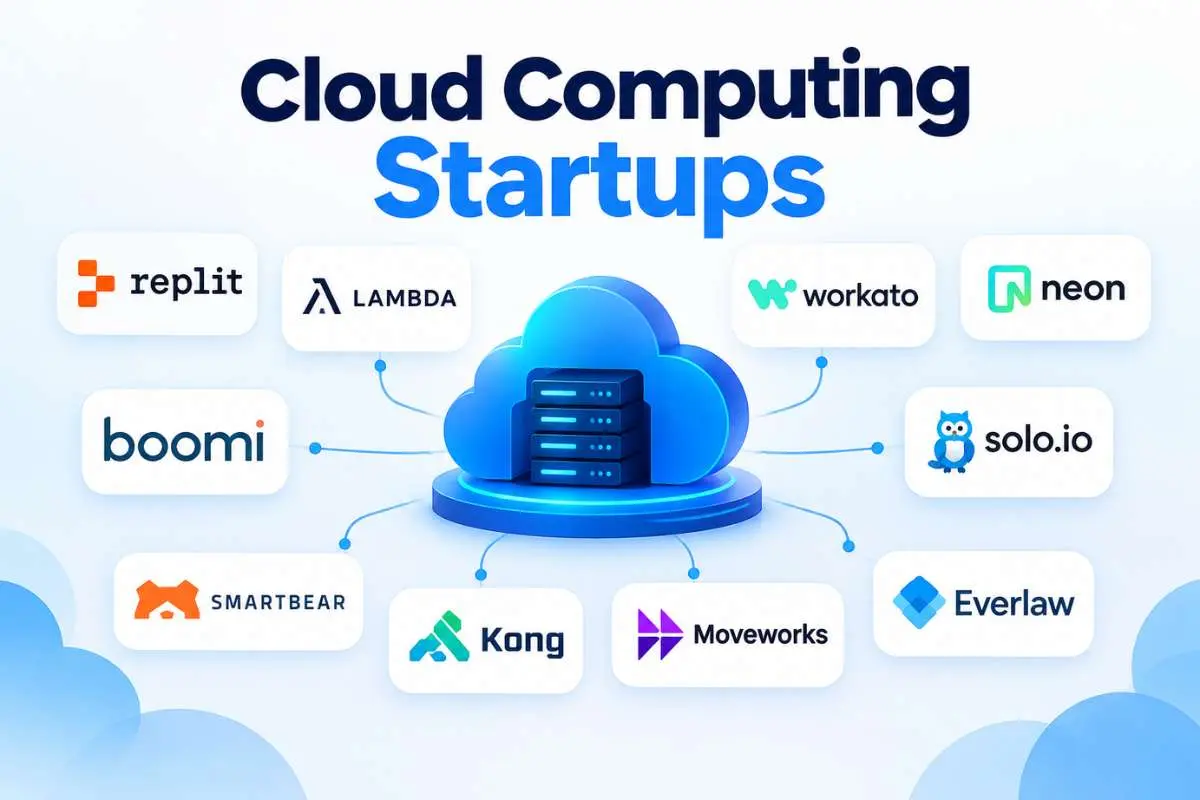
Big cloud providers like AWS, Google, and Microsoft dominate the market, but their services are expensive and complex. Today, in 2026, a new wave of cloud computing startups is stepping in to offer faster, cheaper, and simpler alternatives. These nimble companies build targeted tools that solve specific problems without forcing businesses to pay for bloat they do not need.
By focusing on speed and lower pricing, these startups are winning over development teams and small businesses fast. Their rise proves that you do not need to be a tech giant to build a highly profitable cloud business.
The 10 Cloud Computing Startups Bringing New Ideas to Enterprise Tech
The cloud startup ecosystem includes companies tackling very different problems. They range from GPU infrastructure and serverless databases to API management and enterprise automation. The 10 companies below were selected for their distinct roles within that ecosystem, giving a closer look at the products and technologies they are building.
1. Replit
- Founded: 2016
- Headquarters: Foster City, California, United States
- Core Focus: AI coding, software development, cloud deployment
Building and deploying software from a browser is the central idea behind Replit. Its platform combines coding, collaboration, and deployment in one environment, while AI tools help developers generate code, troubleshoot issues, and build applications.
Teams can move projects from development to deployment without managing traditional infrastructure separately. This combination of AI-assisted development and cloud-based deployment has helped Replit become a notable name among cloud computing startups serving developers and smaller technical teams.
2. Lambda
- Founded: 2012
- Headquarters: San Jose, California, United States
- Core Focus: GPU cloud, AI infrastructure, machine learning
As artificial intelligence demands more computing power, access to high-performance GPUs has become a major infrastructure requirement. Lambda addresses this need through GPU cloud services, dedicated GPU clusters, and computing systems built for machine learning workloads. Its infrastructure supports organizations in training and deploying AI models without requiring them to build extensive computing facilities themselves.
The company’s focus on specialized computing resources places it at the intersection of cloud infrastructure and the rapidly expanding AI ecosystem.
3. Workato
- Founded: 2013
- Headquarters: Mountain View, California, United States
- Core Focus: Cloud integration, workflow automation, enterprise applications
Connecting different business systems can become difficult as companies add more applications to their technology stack. Workato tackles this problem through cloud integration and workflow automation tools. Its platform connects applications, data, and processes across functions such as finance, customer service, and human resources.
Businesses can automate repetitive tasks while allowing information to move between systems more efficiently. This makes the platform useful for organizations seeking to modernize their operations without replacing every application they already use.
4. Neon
- Founded: 2021
- Headquarters: Menlo Park, California, United States
- Core Focus: Serverless PostgreSQL, cloud databases, developer infrastructure
For developers building modern applications, database infrastructure needs to scale alongside changing workloads. Neon approaches this through a serverless PostgreSQL platform that separates storage from compute. Resources can scale independently, while database branching allows developers to create environments for testing and development.
The architecture is designed around cloud native application development rather than traditional database infrastructure. As a result, Neon has established itself among cloud computing startups building infrastructure specifically for modern software teams.
5. Boomi
- Founded: 2000
- Headquarters: Conshohocken, Pennsylvania, United States
- Core Focus: Data integration, application integration, workflow automation
A growing enterprise can quickly accumulate dozens of applications that need to exchange information. Boomi helps bring these systems together through cloud-based application and data integration.
Its platform supports connections between enterprise applications, APIs, data sources, and automated workflows. This allows organizations to create more connected digital operations without building every integration internally. Boomi is particularly relevant to companies modernizing older technology environments while adding cloud applications and services to their existing infrastructure.
6. Solo.io
- Founded: 2017
- Headquarters: Cambridge, Massachusetts, United States
- Core Focus: Cloud networking, API management, microservices
Modern applications often consist of numerous services that need to communicate securely and reliably. Solo.io works in this layer of cloud infrastructure, helping engineering teams manage application networking, APIs, and microservices. Its technology is closely associated with open-source projects such as Istio and Envoy, which support communication across distributed applications.
The company’s tools are designed for organizations operating increasingly complex cloud environments where managing connectivity between services becomes a critical part of application infrastructure.
7. SmartBear
- Founded: 2009
- Headquarters: Somerville, Massachusetts, United States
- Core Focus: Software testing, API testing, application monitoring
Reliable software depends on more than simply writing and deploying code. SmartBear supports development teams with tools for software testing, API testing, application quality, and performance monitoring.
Its products help teams identify problems throughout the development process and maintain application reliability as software becomes more complex. With businesses increasingly developing and operating cloud-based applications, testing has become closely linked to the wider cloud development lifecycle. SmartBear operates in this space by giving teams tools to monitor and improve software quality.
8. Kong
- Founded: 2017
- Headquarters: San Francisco, California, United States
- Core Focus: API management, cloud networking, microservices
Managing how applications communicate becomes increasingly complex when services are distributed across cloud environments. Kong addresses this challenge through API management and cloud networking technology.
Its platform helps organizations connect, secure, and manage APIs and microservices across distributed application architectures. The company also builds around open-source technology, giving engineering teams tools to manage modern application connectivity. Its work reflects the growing infrastructure requirements created by companies running applications across multiple cloud platforms and increasingly decentralized environments.
9. Moveworks
- Founded: 2016
- Headquarters: Mountain View, California, United States
- Core Focus: Enterprise AI, employee support, workflow automation
Employees often need information or support from several different enterprise systems, creating repetitive work for internal teams. Moveworks uses artificial intelligence to automate these interactions, particularly across IT and human resources. Its platform can interpret employee requests and connect them with relevant information or actions across business systems.
By combining conversational AI with workflow automation, Moveworks helps enterprises reduce routine support tasks while giving employees a simpler way to interact with their organization’s digital infrastructure.
10. Everlaw
- Founded: 2010
- Headquarters: Oakland, California, United States
- Core Focus: Legal technology, document analysis, eDiscovery
Handling thousands of documents and digital records can make legal investigations and litigation highly complex. Everlaw brings these processes into a cloud-based platform built for eDiscovery, document analysis, litigation preparation, and internal investigations.
Legal teams can use the technology to organize large information sets, collaborate on cases, and analyze digital evidence in one environment. Its specialized approach shows how cloud computing startups and technology companies are extending cloud infrastructure into industries with highly specific data and workflow requirements.
These 10 cloud computing startups cover a broad mix of cloud technologies and business applications. Their different approaches show how startups are building specialized solutions around development, infrastructure, integration, automation, and data management.
Conclusion:
Cloud computing startups are expanding as businesses look for more efficient infrastructure, stronger security, and better ways to manage increasingly complex workloads. The companies covered in this section reflect that shift, with each startup addressing a specific challenge within the cloud market.
Their approaches vary, but the common thread is a focus on solving practical enterprise needs. Their products and services show how newer companies are adding competition and innovation across cloud infrastructure, security, automation, and management.
FAQs
1. What are cloud computing startups?
Cloud computing startups are companies building products or services around cloud infrastructure, software, data, networking, automation, and related technologies.
2. Which areas do these cloud computing startups focus on?
The list covers areas such as AI infrastructure, cloud databases, application integration, API management, software testing, and workflow automation.
3. Are all cloud computing startups focused on cloud infrastructure?
No. Some focus on supporting technologies such as software development, enterprise automation, testing, databases, and application networking that operate within cloud environments.
4. Why are cloud computing startups important for businesses?
They help businesses address specific technology needs without requiring them to build every cloud, integration, automation, or infrastructure capability internally.