

Leadership development has never been more popular. Organizations invest billions each year in coaching programs, leadership workshops, and assessment tools.
And yet something isn’t working.
Executive turnover remains high. Teams drift out of alignment. Carefully crafted strategy documents stall while familiar behavioral patterns quietly reassert themselves.
According to Dr. Ilona Jerabek, the problem is surprisingly simple: most leadership development focuses on skills, while the real drivers of leadership behavior remain hidden beneath the surface.
“Most leadership problems are not capability problems,” she explains.
“They are clarity problems. When leaders can clearly see the gap between intention and impact — between their role and how they actually operate — alignment becomes possible.”
In an industry crowded with motivational frameworks and one-size-fits-all models, Dr. Jerabek approaches leadership differently. A research psychologist, psychometrician, and President and CEO of PsychTests AIM Inc., she has spent nearly three decades building a leadership methodology grounded in behavioral science, refined through nearly 1,000 executive debriefs, and supported by an AI-driven assessment platform developed alongside her cofounder, AI researcher Vrat Jerabek.
Rather than coaching performance, her work focuses on mapping the leader’s mind — the internal patterns that shape how leaders perceive situations, make decisions, and influence others. She spotlights the strengths that lead to success — and exposes the hidden patterns and blind spots that create influence leaks.
Because, as she often says, the most magnetic leaders are not necessarily the brightest.
They are the most coherent — able to inspire through authenticity and presence, and lead without pushing.
The Origin Story of PsychTests AIM Inc.
The origin of PsychTests AIM Inc. is as much a story of migration and experimentation as it is of entrepreneurship.
In 1989, Dr. Ilona Jerabek and Vrat Jerabek arrived in Canada from the Czech Republic during a period of dramatic political and social transformation in Eastern Europe. They arrived without a professional network, investors, or institutional backing.
After completing their education, the two founded their first company in March 1996: Plumeus, a name derived from Latin meaning “soft as a feather.”
Their partnership combined two complementary disciplines.
Dr. Jerabek brought deep training in psychology and psychometrics — designing psychological assessments, validating measurement models, and interpreting behavioral data.
Vrat Jerabek specialized in artificial intelligence and computational modeling, developing scoring algorithms and learning systems long before AI became fashionable.
Their first software project was a menstrual calendar and pregnancy planner called Cyclic. To attract users to the platform, they introduced an idea that would unexpectedly reshape their company’s future: online psychological quizzes.
Dr. Ilona Jerabek began developing assessments — including IQ tests, communication style quizzes, and what was likely among the first emotional intelligence tests available online, inspired by Daniel Goleman’s work in 1995.
The response was immediate.
Traffic surged. Search engines began directing users to the site. Major platforms such as AOL occasionally featured the tests, sending waves of traffic that sometimes overwhelmed their early servers.
What began as a promotional feature quickly became the company’s core offering.
Over time, the assessment library expanded dramatically. Today, PsychTests AIM Inc. has developed over 200 validated psychological assessments, created through the combined efforts of psychologists, researchers, and developers working within the company’s research team.
From the beginning, the company operated differently from most technology startups.
Rather than relying heavily on marketing, growth came primarily through search visibility, media interest in research findings, and word of mouth. Large-scale validation studies generated insights that were frequently picked up by radio shows, television programs, and major publications.
Without initially intending to do so, the team had become pioneers of online psychological testing, driven by three key factors:
- Early mover advantage in search.
- Content that people genuinely wanted.
- A “low-marketing, high-signal” growth pattern that became their defining trait.
How a Single Image Reshaped a Coaching Philosophy?
Years later, a single coaching moment would permanently shape how Dr. Ilona Jerabek approaches leadership alignment.
During a 360-degree feedback debrief with the head of a large hospital system, she noticed something unusual. The executive was clearly capable — intelligent, committed, hardworking — yet constantly pulled into operational details. Phone calls interrupted the conversation. Small issues demanded immediate attention.
At one point, an image came to mind.
Dr. Jerabek paused and said:
“Your job is to set direction and guide your people — not to empty trash cans.”
The room went silent.
For a moment, she wondered if she had crossed a line.
Then the executive replied quietly:
“You know… I actually did that last week. A trash can in the hallway was overflowing, so I emptied it myself.”
The comment instantly revealed the deeper pattern. The executive saw herself as the kind of leader who solved problems personally — even small ones. But in doing so, she was unintentionally operating far below the altitude her role required.
That moment crystallized two lessons that have shaped Dr. Jerabek’s coaching approach ever since.
- Never ignore the intuitive hit. What seems instinctive in coaching is often rapid pattern recognition informed by experience and data, where softening the message would weaken its impact.
- Examples change leaders faster than explanations when insight becomes visual, it bypasses defensiveness entirely.
The Coaching Philosophy That Goes Deeper Than Skills
Dr. Ilona Jerabek’s coaching philosophy begins with a simple premise:
Strategy fails when leadership architecture is misaligned.
Surface-level techniques rarely resolve deeper issues. Leaders may adopt better communication habits or improve meeting discipline, but if the underlying patterns shaping their behavior remain unchanged, the same problems tend to resurface.
To uncover these patterns, Dr. Jerabek and her team developed the 360° Leadership MRI™, a diagnostic framework designed to surface perception gaps, pressure responses, decision-making tendencies, and subtle “micro-leaks” of authority that can erode leadership impact. Dr. Jerabek focuses on interpreting the diagnostic results and conducting executive debriefs, where patterns across leaders and organizations become visible.
The diagnostic process culminates in what she calls a Magnetic Leadership Portrait — a clear articulation of how a leader currently operates, how their leadership is experienced by others, and what alignment would look like in their specific role and organizational environment.
From there, the work unfolds through the ARE Model, the transformation backbone of her flagship program, the Magnetic Leadership Blueprint™.
- Awareness reveals the current architecture and blind spots.
- Recoding interrupts outdated internal narratives and decision patterns.
- Embodiment integrates new behaviors so that alignment holds under real-world pressure.
Several methodologies support this process, including Resonance Recode™, Resonance Embedding™, and the Lock-In Protocol™, all designed to translate insight into durable behavioral change.
What distinguishes this work is the integration of three elements rarely combined at depth:
- psychometric rigor developed through decades of assessment research
- executive pattern recognition refined through nearly 1,000 leadership debriefs
- and structured recalibration tailored to the leader’s personality, role, and organizational context.
When Naming the Pattern Changes Everything?
One coaching engagement illustrates how quickly alignment can shift once patterns become visible.
A newly appointed executive inherited an organization struggling with financial instability and internal resistance. A small group of managers repeatedly overwhelmed him with procedural distractions and secondary issues, creating the impression of constant complexity.
But to Dr. Ilona Jerabek, the pattern was clear.
“This isn’t complexity,” she told him.
“It’s a snow job.”
Once the pattern was named, the dynamic shifted.
The executive stopped interpreting the behavior as misunderstanding and began recognizing it as deliberate obstruction.
From there, he moved with precision:
- Revoked discretionary authority where misuse was evident
- Engaged an external audit to establish structural transparency
- Introduced task clarity with firm deadlines and accountability measures
- Reinforced attendance and performance standards across the organization
- Stopped negotiating his mandate
Within months, the organization transformed as employees aligned, discipline improved, engagement grew, and financial leakage slowed not through strategy, but by restoring clear authority and boundaries to replace gaps that had allowed manipulation.

Why Most Alignment Problems Begin at the Top?
Raise the question of team alignment, and Dr. Jerabek’s answer is immediate and candid: “Most alignment problems are not strategy problems. They are behavior problems, often beginning with the leader themselves.”
1. The Leader Is Slightly Out of Alignment
Leaders who are unclear, inconsistent, or internally conflicted transmit that instability immediately to their teams. For instance, often she sees executives champion long-term strategy while micromanaging daily details, leaving people unsure which signal to follow. You cannot expect alignment with a vision if your behavior contradicts it. Before fixing the team, the leader’s posture—how they decide, what they prioritize, and what they model—must be recalibrated. Alignment starts at the top.
2. Unconscious Patterns in the Leader and the Team
Leadership misalignment often stems from unconscious patterns in both the leader and the team. Some leaders avoid conflict, others over-control, micromanage under pressure, or step in to rescue rather than delegate. In one case Dr. Jerabek observed, a CEO’s reluctance to confront issues directly allowed two dominant personalities to fill the vacuum, creating side conversations, informal alliances, and growing tension. When the pattern was finally named — “We’re confusing harmony with alignment” — the dynamic shifted. When patterns remain invisible, they run the system; once they are visible, leaders regain the ability to choose differently.
3. Vision That Sounds Good But Doesn’t Land
Strategic vision often arrives in polished language — bold goals and aspirational statements — yet fails to translate into daily behavior. Leaders may understand the message and repeat it convincingly, but as it moves down the organization, team members often struggle to see how it connects to their actual work. Misalignment deepens when lofty mission statements conflict with established processes or performance metrics.
For example, a company may proclaim an “innovation-first culture,” while middle managers are still evaluated primarily on risk reduction and operational efficiency. In such cases, Dr. Ilona Jerabek emphasizes that alignment requires translation: leaders must interpret strategy in a way that resonates with their teams, clarifying priorities, decision guidelines, and trade-offs so people understand how the larger vision applies to their everyday work.
4. Values That Don’t Match Reality
Misalignment also arises when organizational values contradict everyday behavior. Companies may proclaim that “fast, imperfect decisions are better than slow, perfect ones,” only to criticize those very decisions in hindsight. They may advocate efficient meetings while senior leaders schedule long calls with dozens of participants and no clear agenda, or promote work-life balance while expecting constant availability. Over time, these inconsistencies quietly erode trust. As Dr. Jerabek notes, teams do not align with slogans — they align with lived experience. When words and behavior diverge, people believe the behavior, cynicism grows, and alignment becomes difficult to sustain. In such cases, leaders must either change the behavior or stop promoting the principle.
5. Difficult Personalities and Political Games
Alignment can also be disrupted by difficult personalities and internal political dynamics. Every organization has strong characters — some brilliant but abrasive, others quietly resistant to change or constantly testing boundaries. In one case Dr. Jerabek observed, a leader repeatedly tried to “win over” a politically savvy executive who was subtly undermining strategic decisions. The more inclusive the leader tried to be, the more room the behavior had to continue. The dynamic shifted only when boundaries and accountability were strengthened. As Dr. Jerabek notes, not every personality issue requires emotional confrontation; some require structural containment. Effective alignment depends on proportional response — neither overreaction nor avoidance.
6. Interruption Culture
Strategic alignment requires focus, yet many organizations operate in permanent reaction mode — back-to-back meetings, constant messaging alerts, “urgent” emails that aren’t truly urgent, and large calls where most participants say nothing. In one case Dr. Jerabek observed, a leadership team was spending more than 70% of its time in meetings while simultaneously complaining that there was no time left for strategic thinking or coaching their teams. The solution was not a new strategy but structural adjustments: redesigning meeting practices, clarifying decision ownership, and tightening escalation rules. Within weeks, clarity improved because attention had been reclaimed. As Dr. Jerabek notes, alignment ultimately requires protected cognitive space.
“When leadership signals are clean and consistent, teams don’t need to be pushed into alignment. They move with it.”
Teams do not align with slogans. They align with behavior.
How Real Transformation Gets Measured?
Dr. Ilona Jerabek measures the effectiveness of her coaching programs at three distinct levels:
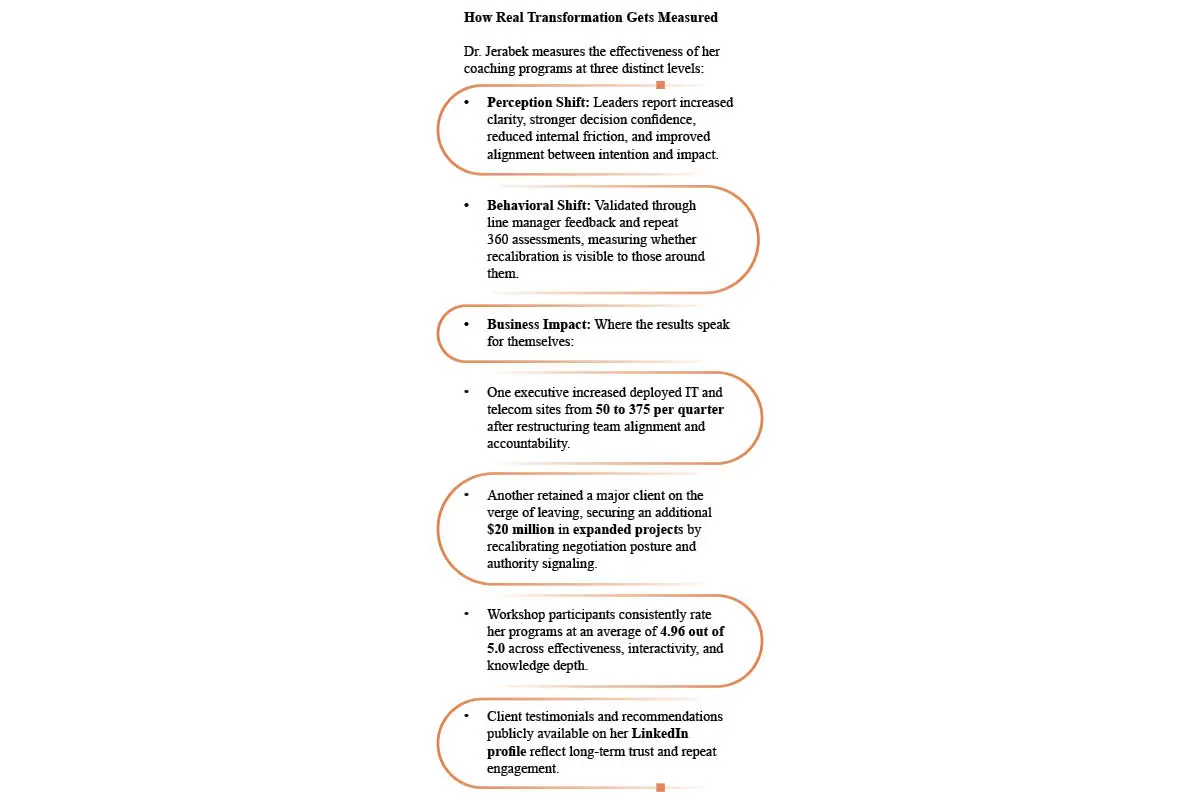
- Perception Shift: Leaders report increased clarity, stronger decision confidence, reduced internal friction, and improved alignment between intention and impact.
- Behavioral Shift: Validated through line manager feedback and repeat 360 assessments, measuring whether recalibration is visible to those around them.
- Business Impact: Where the results speak for themselves:
- One executive increased deployed IT and telecom sites from 50 to 375 per quarter after restructuring team alignment and accountability.
- Another retained a major client on the verge of leaving, securing an additional $20 million in expanded projects by recalibrating negotiation posture and authority signaling.
- Workshop participants consistently rate her programs at an average of 4.96 out of 5.0 across effectiveness, interactivity, and knowledge depth.
- Client testimonials and recommendations publicly available on her LinkedIn profile reflect long-term trust and repeat engagement.

Recognized Globally, Driven by Impact
Over three decades, Dr. Jerabek’s work has earned recognition through media features, academic honors, international awards, and published research.
Media & Broadcasting
- Featured in more than 50 radio and television programs, appeared on dozens of podcasts, and contributed to hundreds of newspaper and magazine articles.
- Many media features arose organically from PsychTests AIM Inc.’s large-scale validation studies, whose behavioral insights attracted attention from both broadcast and print outlets.
Speaking Recognition
- Selected among the Top 50 speakers in the “Next Top Speaker” competition out of more than 5,000 entries, a recognition of both thought clarity and stage presence
- Continues to speak internationally on leadership patterns, behavioral diagnostics, and alignment
International Business Recognition
- PsychTests AIM Inc. named Leader in Behavioural Diagnostics at the Go Global Awards 2025 by the International Trade Council recognizing long-standing work in AI-driven assessment systems developed since the mid-1990s
Academic & Professional Honors
- Recipient of the Governor General’s Silver Medal.
- Honored with the Top 10 After 10 Award from Bishop’s University for professional achievement.
- Authored or co-authored numerous scientific articles, textbook chapters, and industry publications.

Published Works
- Co-published two French-language books Chut! Je me teste (Tomes 1 and 2) and several eBooks on behavioral assessment and leadership themes.
Research Grants & Innovation
- The company’s research and development efforts have also been supported through Industry Canada’s SR&ED grants, recognizing the ongoing innovation behind its psychometric and AI-based tools.
The Trends Reshaping Executive Leadership
Looking ahead to the next three to five years, Dr. Jerabek believes one reality will define executive leadership: rising complexity will demand far more intentional leadership.
1. Hybrid Human + AI Coaching
AI will not replace executive coaches, but it can significantly enhance their precision through diagnostics, pattern recognition, and scenario simulations. While AI can accelerate insight and analysis, human coaches remain essential for nuance, judgment, and contextual understanding. The real advantage lies in using AI to amplify — not replace — human insight.
2. Emotional Intelligence Is No Longer Optional
What were once labeled “soft skills” are rapidly becoming strategic necessities. Emotional regulation, conflict clarity, psychological safety, and balanced authority are no longer optional traits but core leadership capabilities in increasingly complex organizational environments.
3. Ongoing Leadership Support — Not Sink-or-Swim
The traditional model of promoting high performers and expecting them to “figure it out” is gradually disappearing. More organizations are shifting toward continuous leadership development, recognizing that sustained support and regular recalibration produce stronger results than relying on individual heroics.
4. Inclusive and Participative Leadership
Leadership is moving toward more inclusive and participative management styles that encourage innovation and engagement. The most effective leaders balance collaboration with decisiveness, ensuring that participation strengthens — rather than dilutes — clarity and accountability.
5. Multi-Generational and Cross-Cultural Alignment
Today’s workplaces increasingly bring together multiple generations and culturally diverse teams, each with different expectations around stability, autonomy, and purpose. Leaders must therefore learn to align these perspectives through thoughtful translation and mutual understanding, not simply through top-down strategy communication.
6. Ethical Navigation of AI and Emerging Technologies
As AI and other emerging technologies become embedded in organizational life, leaders will face growing ethical questions around transparency, trust, decision-making, and workforce transformation. Navigating these challenges will require both technological literacy and strong psychological grounding.
Across all six trends, Dr. Ilona Jerabek sees one clear direction.
“The future belongs not to louder or more charismatic leaders, but to those who can integrate data, emotion, ethics, and strategy — and align teams without losing coherence.”
Built on Trust: Ethics, Privacy, and Client Integrity
At PsychTests AIM Inc., trust is central, built by meeting real needs, providing fit-for-purpose solutions, designing scalable systems, and treating every project with care and integrity.
1. No Data Selling Ever
Since inception in 1996, the company has maintained an absolute no data selling policy long before data privacy became a public concern:
- User data is never monetized
- Behavioral insights are never sold to third parties
- No hidden data marketplaces built or tolerated
2. Responsible Use of AI
With AI experience since the mid-1990s, the company emphasizes ethical, transparent use of AI to enhance scoring, simulations, and pattern recognition, keeping human judgment central and ensuring clients fully understand how their data and insights are applied.
3. Ethical Research Practices
All large-scale validation studies and published behavioral insights use fully anonymized and aggregated data. Individual identities are never disclosed. Research serves validation and understanding of human nature, not surveillance.
4. Secure Infrastructure and Internal Controls
At the operational level, the company maintains:
- Strong server security and encrypted transmission protocols.
- Role-based tiered access – team members access only what is necessary for their responsibilities.
- Professional confidentiality standards guiding all executive engagements.
But according to Dr. Jerabek, the strongest evidence of trust lies in longevity.
Many client relationships span decades.
“We focus on win-win outcomes,” she explains. “We don’t oversell. We design solutions that actually work for the client — and that can grow with them.”
Why Clarity Beats Capability?
Dr. Ilona Jerabek believes most leadership challenges arise from a lack of clarity, not capability, as unexamined patterns, misaligned incentives, or outdated identity narratives create gaps between intention and impact. True change begins when these gaps are recognized, and leaders consciously choose whether to adjust behavior, challenge the system, redesign their role, or step away, recognizing that repeated misalignment drains energy and weakens authority.
She sees strategy not as a document but as an alignment between leadership mindset and organizational behavior, where internal clarity meets external demands, strengthening trust, reducing friction, and accelerating execution.
Her entrepreneurial journey reinforced that integrity compounds over time, and even when it means declining lucrative opportunities, prioritizing values builds lasting trust. Ultimately, she believes performance and respect are not opposites, because when integrity anchors decisions, alignment and results follow naturally.
Alignment is less about effort — and more about coherence: between what leaders say, how they show up, and how their teams actually operate.

Open Letter to Emerging Leaders and Future Coaches
If you are stepping into leadership — or into the field of executive coaching — here is something worth saying out loud:
Depth beats charisma.
In a world that rewards visibility, it is tempting to optimize for presence before substance. Resist that urge. Study people. Study systems. Study yourself. Understand patterns before trying to influence them.
Leadership is not performance.
It is signal.
Your team reads everything — your tone, your reactions, your stress patterns, your inconsistencies. If your internal architecture is chaotic, no amount of polished language will create alignment.
Do the inner work early. Not to become perfect, but to understand your defaults.
If you are coaching leaders, remember this: do not fall in love with your frameworks — fall in love with accuracy. Your job is not to impress a client with insight. It is to surface what they are unconsciously protecting — and to do so without humiliating them. That requires rigor, courage, and restraint.
Also understand this: not every misalignment can be solved by adaptation. There will be moments when you or your client discover that the environment demands behavior that violates core values. That tension is real. Don’t dismiss it. Clarity matters more than compliance.
And finally — build range. No leader gets to operate in their preferred style all the time. You must be capable of collaboration and containment. Vision and execution. Empathy and firmness. Inspiration and boundaries.
Leadership maturity is not choosing one style. It is knowing when to switch.
Stay curious. Stay structurally honest. Never confuse activity with alignment.
The world doesn’t need louder leaders.
It needs coherent ones.
Dr. Ilona Jerabek
President and CEO, PsychTests AIM Inc.
Key Takeaways
- Strategy fails when leadership architecture is misaligned. Diagnose structure before coaching performance.
- Depth beats charisma. In a world that rewards visibility, substance is what truly lands.
- Leadership is not performance — it is signal. Your team is constantly reading your tone, reactions, and inconsistencies.
- Do not fall in love with your frameworks. Fall in love with accuracy and what is true for the person in front of you.
- Build range. Effective leaders can move between collaboration and containment, vision and execution, empathy and firmness.
- The world doesn’t need louder leaders. It needs coherent ones who understand that doing more is not the same as leading well.













