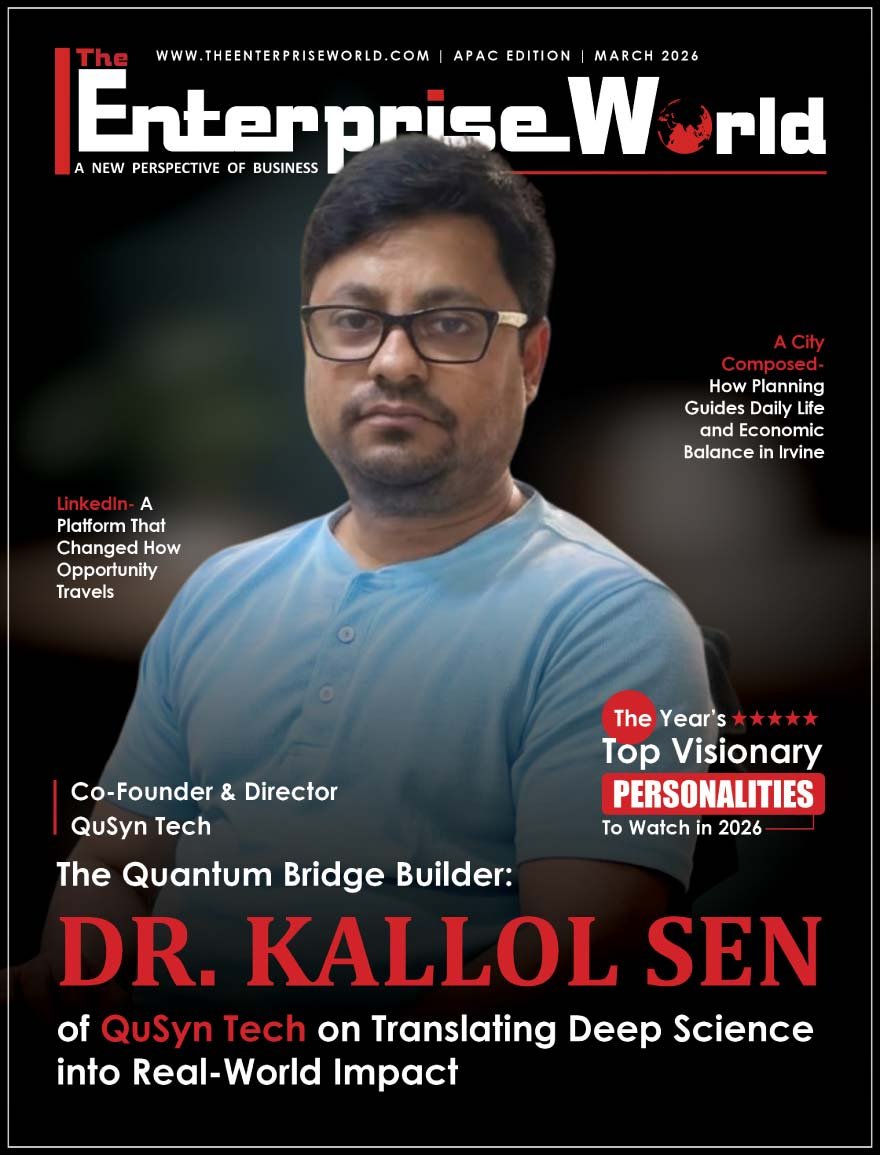
The quantum revolution is upon us, yet a stubborn gap remains: brilliant foundational research too often fails to translate into real-world technology, trapped between laboratory insights and scalable solutions. In this critical moment of transition, Dr. Kallol Sen emerges as a rare bridge-builder. Co-Founder & Director of QuSyn Tech and Senior Research Associate at the prestigious Raman Research Institute, he is not your typical quantum scientist. Trained as a theoretical high-energy physicist with a PhD from IISc Bangalore, his journey has taken him across Japan, Ireland, and Brazil before bringing him back to India, where he now works at the intersection of foundational science and practical implementation.
What sets him apart is his ability to move between worlds, from abstract equations in Quantum Field to hands-on problem solving in quantum computing and algorithms, from publishing in respected journals to co-founding a deep-tech QuSyn Tech that deliberately bridges the gap between theory and application. Yet for all his achievements, he speaks with the quiet humility of someone who believes that true progress comes not from chasing metrics, but from solving problems “just because you can.” As the quantum revolution accelerates, Dr. Sen represents a new breed of scientist, one who is as comfortable rethinking theoretical assumptions as he is building the collaborations and ecosystems that will shape the future of technology in India and beyond.
From Quarks to Qubits: A Journey Across Continents and Disciplines
Dr. Kallol Sen’s professional journey reflects deep intellectual curiosity and the courage to explore new frontiers. Trained as a theoretical high-energy physicist, he earned his PhD from the Indian Institute of Science (IISc), Bangalore, in 2016, and went on to gain extensive international experience through three postdoctoral positions in Japan, Ireland, and Brazil.
- Toward the end of his second postdoctoral tenure around 2020–21, Dr. Sen began reimagining his path, feeling a strong pull to expand beyond pure theory into more applied fields, especially quantum computing and algorithms.
- However, the shift was far from seamless, as stepping into a new field required him to navigate an overwhelming expanse of unfamiliar knowledge.
The turning point came when Dr. Kallol Sen focused on a simple problem in quantum walks, a decision that sparked his entry into the quantum domain and reinforced the value of tackling manageable problems to build momentum across disciplines.
- In 2023, another defining moment came when he reached out to Prof. Urbasi Sinha and Prof. Aninda Sinha, whose decisive encouragement played a crucial role in shaping his next steps.
- This collaboration gave rise to QuSyn Tech, a venture that united Dr. Sen’s theoretical physics background with his vision for quantum technology, becoming a defining milestone that continues to drive his motivation.
The Unchanged Soul of an Evolving Institute
Rooted in a timeless dedication to fundamental research, the Raman Research Institute continues to preserve its enduring scientific soul while evolving with purpose. As Dr. Kallol Sen reflects, although its unwavering emphasis on basic science remains unchanged, the institute has grown markedly more open to interdisciplinary work, consciously engaging with applied and national-level initiatives and strengthening its presence through expanding collaborations and participation in large-scale collaborative programs.
Yet, for Dr. Sen, the most remarkable aspect of this evolution is what the Raman Research Institute has managed to retain amidst all this change. In his reflection, Dr. Kallol Sen highlights that, even while expanding outward through interdisciplinary engagement and national collaborations, the institute has preserved a rare environment where researchers are not pressured for immediate results but are free to think long-term and pursue challenging problems, an exceptional balance that makes it a place where deep, meaningful research can truly flourish.
The Bridge Between Theory and Reality
Stepping beyond the abstractions of pure theory reshaped Dr. Kallol Sen’s scientific outlook. After joining Prof. Urbasi Sinha’s group, he came to appreciate that aligning theoretical models with realistic experimental constraints is not only far more demanding but also far more rewarding. Among the most inspiring projects he worked on was a study of decoherence in photonic systems and its implications for quantum computing reliability, distinguished by an experimental realization that enabled the team to both reduce and actively control decoherence within a single setup.
The main challenge was to support the experimental observations with a consistent theoretical framework, which required them to rethink their initial assumptions and develop a more flexible theoretical description that could accurately capture the behaviour of the system. The outcome was a model that explains their experimental results while remaining compatible with established theoretical approaches, thereby bridging the gap between idealized theory and practical implementation.
QuSyn Tech’s Vision for Quantum Innovation
Some ideas are too important to remain trapped in academic papers, and that belief sits at the heart of QuSyn Tech, a deep-tech venture co-founded by Dr. Kallol Sen with Prof. Urbasi Sinha and Prof. Aninda Sinha after observing that brilliant foundational research too often stops at the laboratory door. QuSyn Tech was born to build that bridge between discovery and deployment, and in a domain surrounded by significant hype, the team deliberately chooses systematic progress over ambitious claims, operating on a simple creed: realism, disciplined execution, and careful assessment of constraints matter more than visibility.
Currently engaged where foundational quantum research meets practical application, QuSyn Tech works closely with the QuIC lab at Raman Research Institute while extending collaborations to academic and industry partners. Dr. Sen believes innovation comes from sustained effort, not exaggeration, making patience and integrity operational necessities rather than abstract virtues. At its core, QuSyn Tech stands as proof that a theoretical physicist can also thrive as an entrepreneur, demonstrating that deep science and real-world impact are not opposing forces but powerful partners waiting to be united.
As he puts it,

“If the science is solid and the approach is honest, long-term impact becomes possible.”
Why Limits Can Lead to Breakthroughs?
Every researcher encounters the inevitable walls of limited funding, tight timelines, and the constant question of scale. In Dr. Kallol Sen’s experience, these aren’t obstacles to fight against; they are simply a normal part of research, especially when the work is exploratory or interdisciplinary. He has learned that the most practical way to deal with these constraints is to pause and get clear about what really matters, resisting the urge to try to do everything at once. What works for him is a simple but powerful discipline: break large goals into smaller, well-defined problems.
By breaking ambitious goals into smaller, clearly defined problems, Dr. Kallol Sen makes progress easier to measure, creates space to adapt when setbacks inevitably arise, maintains realistic timelines through transparent communication, and ultimately treats constraints not as limitations but as valuable teachers that sharpen thinking and produce more focused, thoughtful outcomes than unrestricted freedom.
The Luxury of Depth in a World of Speed
In an era where research output is often measured in publications per year, and impact factors dominate conversations, what sets Raman Research Institute apart from other institutions in India or globally is something far quieter but far more powerful: an unwavering emphasis on depth and long-term thinking. Here, research is not driven by immediate deliverables. There is no frantic race to the next paper or pressure to declare results before they are ready; instead, RRI fosters a culture that values deep understanding of problems before pursuing solutions.
This philosophical stance, in his view, creates an environment that is becoming rare, one where researchers are genuinely encouraged to take intellectual risks and explore difficult questions without constant pressure to produce quick results. He sees this freedom as the foundation of discovery, a space where scientists can dwell on questions for years, fostering the breakthroughs that drive meaningful and lasting innovation.

Where No One Works Alone Anymore?
Science, he observes, is no longer a solitary pursuit. In recent years, the most clear shift in scientific research has been toward stronger interdisciplinary collaboration, a movement largely driven by national-level initiatives that deliberately bring together academia, industry, and technology development. He has watched this unfold in the quantum domain, where programs such as the National Quantum Mission have played an important role in creating shared platforms where ideas can finally move beyond isolated research groups.
The days of physicists talking only to physicists, Dr. Kallol Sen notes with a smile, are fading. And Raman Research Institute is not just watching this shift from the sidelines; it is actively participating, including through projects focused on quantum memory and networking. These efforts, in his view, are doing something vital: they are helping shape how we think about distributed computing and communication in quantum systems, while simultaneously ensuring that foundational research remains connected to long-term technological goals. It is the kind of work that keeps one foot firmly in the realm of fundamental questions and the other stepping toward the future.
Reaching the Next Generation
A published paper reaches a few hundred pairs of eyes, a talk at a conference reaches a few hundred more, but a young student at their first summer camp, he reflects, might just discover their entire future in a single afternoon. Dr. Sen’s own journey reflects this balance: while continuing to publish in academic journals, he actively participates in collaborations, serves as a reviewer for respected international journals, and contributes through summer schools, invited talks, and lecture series at globally recognized institutes.
These activities, he acknowledges, form the backbone of academic life, but he also recognizes their limitations, as they often remain confined to established circles. Dr. Sen believes that truly strengthening the ecosystem requires going beyond conventional formats embracing messier, more expansive, and generous approaches, such as large-scale workshops and summer camps that provide hands-on engagement not only to train the next generation of researchers but to inspire bright young minds who might otherwise never find their way into the field, because while a paper can inform, only a human connection can truly inspire.
When Individual Brilliance Reflects Institutional Strength?
Dr. Kallol Sen views awards as never truly personal, seeing them instead as a reflection of the entire ecosystem of mentors, colleagues, and institutions that provide the space to dream and achieve.

- Research from the Raman Research Institute and its labs has earned consistent national and international recognition, underscoring the institution’s esteemed standing.
- He points to Prof. Urbasi Sinha, pioneer of the QuIC lab and co-founder of QuSyn Tech, whose recent accolades tell a larger story.
- Prof. Sinha has received several notable honors, including the prestigious Bhatnagar Award (2024), one of India’s highest scientific recognitions, and the Gates Cambridge Impact Prize (2025), which carries global weight.
- He views these achievements as proof that a supportive research ecosystem drives both impact and global recognition.
The Numbers We Can Confidently Share
He prioritizes honesty and precision, choosing to admit uncertainty rather than provide unsupported numbers.
- At this stage, Dr. Kallol Sen honestly admits he does not have verified statistics that he can confidently share regarding research growth, funding trends, or institutional metrics.
- He follows a simple principle: rely on verified data from official sources rather than offer approximations.
- He highlights tangible evidence of RRI’s impact, such as its active role in national initiatives like the National Quantum Mission.
- He also highlights its growing number of interdisciplinary projects and collaborations, which anyone following the quantum landscape can observe.
- These, he believes, serve as meaningful indicators of its research activity and impact, proof that does not always require a number.
Where Academia Shakes Hands with Industry?
Some of the most exciting conversations, he notes, happen not in lecture halls or laboratory meetings, but at the messy intersection where academic curiosity meets industrial pragmatism. His direct exposure, he clarifies with characteristic honesty, is primarily through collaborations associated with the QuIC lab and now wearing the QuSyn Tech hat, which involve partnerships with both academic institutions and industry groups working in quantum technologies. From where he sits, these are not just contracts or formal agreements; they are living bridges where theorists, experimentalists, and engineers sit together and wrestle with the same problems.
And for him, these specific collaborations reflect Raman Research Institute’s broader role as a facilitator of joint research efforts, a place where foundational science and applied development can progress together under the same roof, often fueled by the same conversations. Dr. Kallol Sen emphasizes that such partnerships are particularly important in emerging areas like quantum technologies, where the distance between a laboratory breakthrough and a real-world application can feel impossibly wide. It is only through sustained interaction between academia and industry, he believes, that this gap can be closed, making building a robust and scalable research ecosystem not just an ambition but an achievable reality.
The Unwritten Rules of Honest Science
Trust, in his experience, is not built by grand declarations but by small, consistent choices made every day in the laboratory and at the writing desk. At Raman Research Institute, ethical conduct and transparency are central to how research is carried out, supported both through institutional review processes and everyday academic practice. There are systems in place, of course. In addition to these mechanisms, there is a formal coursework component on ethical practices in research, which helps establish a shared understanding of responsible conduct early on for everyone who joins the institute.
Beyond structured guidelines, Dr. Sen believes science is truly sustained by a culture of honesty, humility, and mutual trust, where transparency about limitations and uncertainties, generous credit, clear communication of even messy or inconclusive results, and genuine openness to critique are essential practices that uphold the collective integrity of the research community.
An Open Letter to the Next Generation of Researchers
Dear Young Researcher,
A few years ago at ICTP, Trieste, an eminent string theorist, ended his talk with words I have never forgotten: “If you can solve a problem, solve it, just because you can.”
That is the essence of real research, not impact factors or citations, but the pure joy of understanding something that once puzzled you. We need that motivation more often.
My advisors and mentors taught me three things: take risks, aim for quality over quantity, and think outside the box. These are not slogans; they are survival tools.
When I transitioned into quantum computing, the unknown felt overwhelming. What saved me was picking a smaller, simpler problem and solving it first. That single step gave me momentum.
So here is my advice: Do not fear difficult questions. Break them down. A complex problem is just a collection of smaller ones waiting to be solved.
Stay honest. Give credit. Welcome critique. Your integrity will outlast any discovery.
The world needs researchers who chase questions just because they can.
Be one of them.
Dr. Kallol Sen
Co-Founder and Director, QuSyn Tech
Key Takeaways:
- Solving problems just because you can, curiosity, not citations, should drive meaningful research.
- Break down complex questions into smaller, solvable pieces; every hard problem is just a collection of simpler ones.
- Take risks and prioritize quality over quantity; safe choices lead to incremental work, not breakthroughs.
- Constraints are creative catalysts working within limits often forces sharper thinking and better outcomes.
- Integrity is non-negotiable; transparency, attribution, and openness to critique build lasting trust.
- Momentum comes from starting small; solve one tractable problem, and the rest will follow.