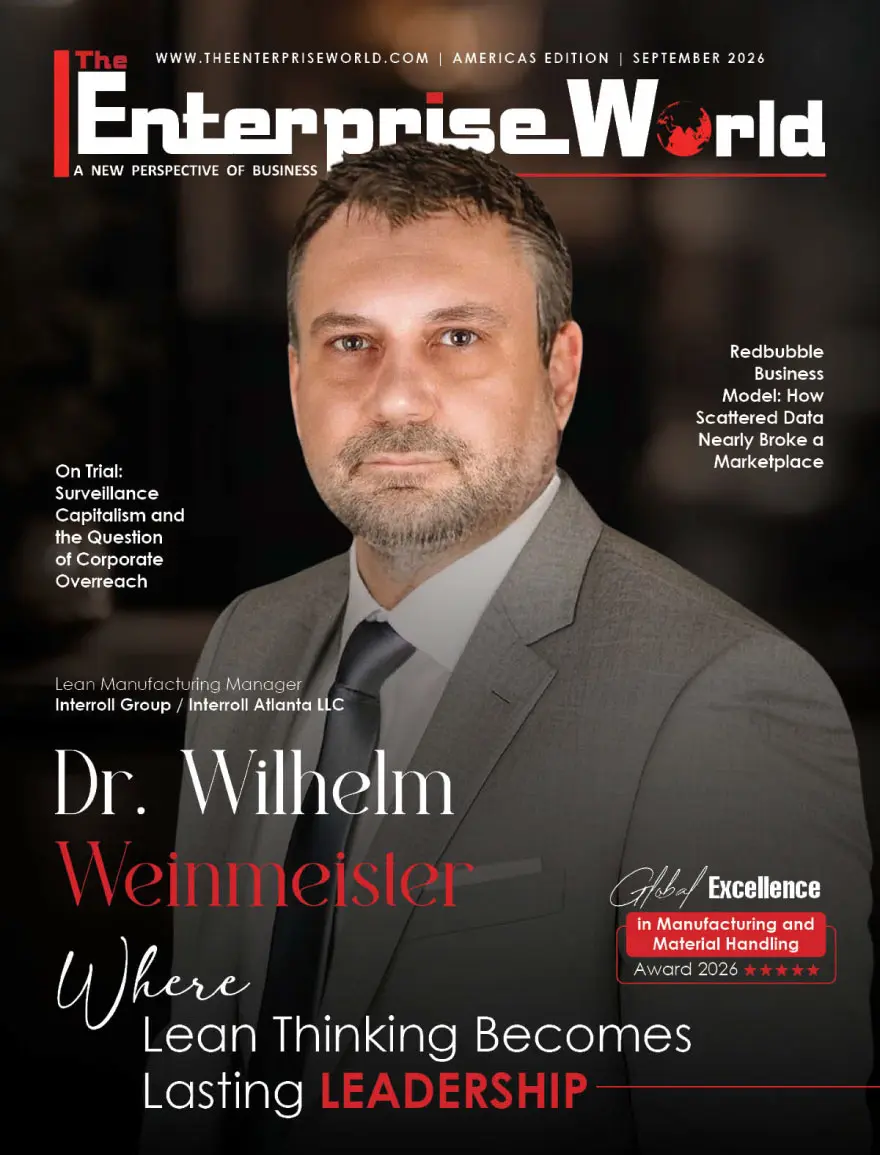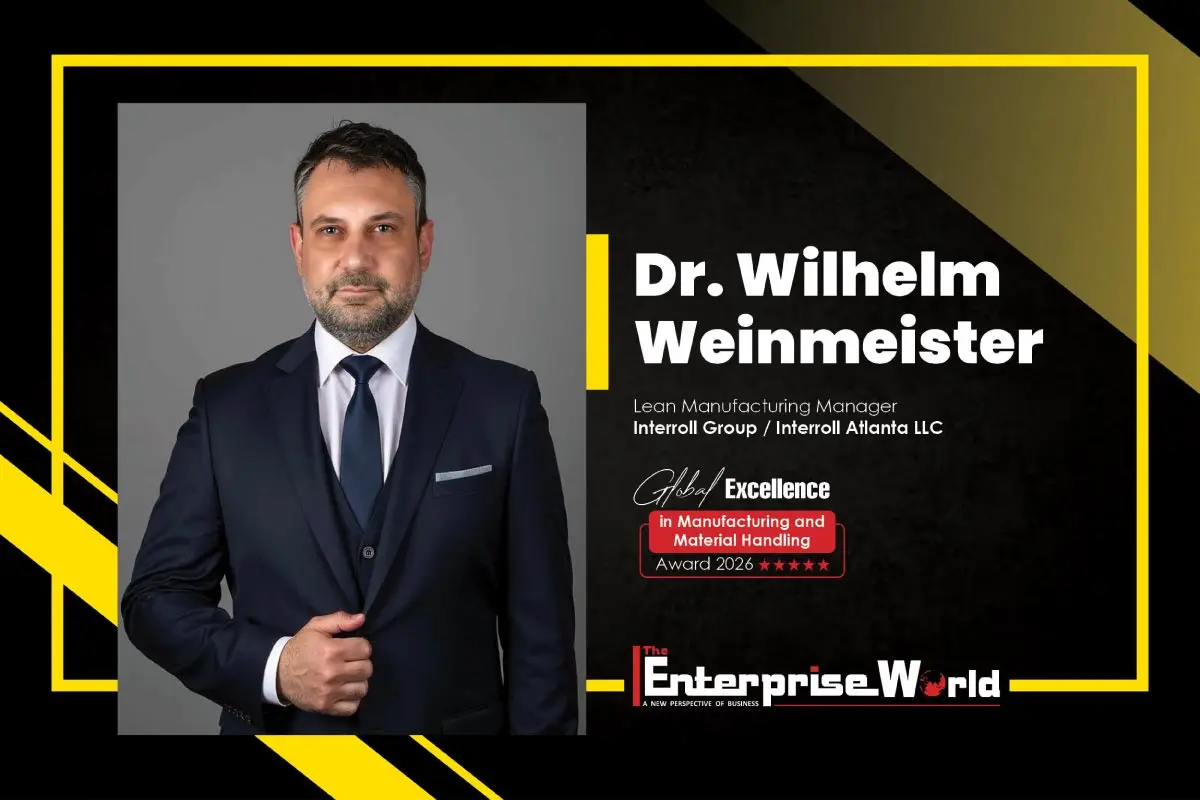
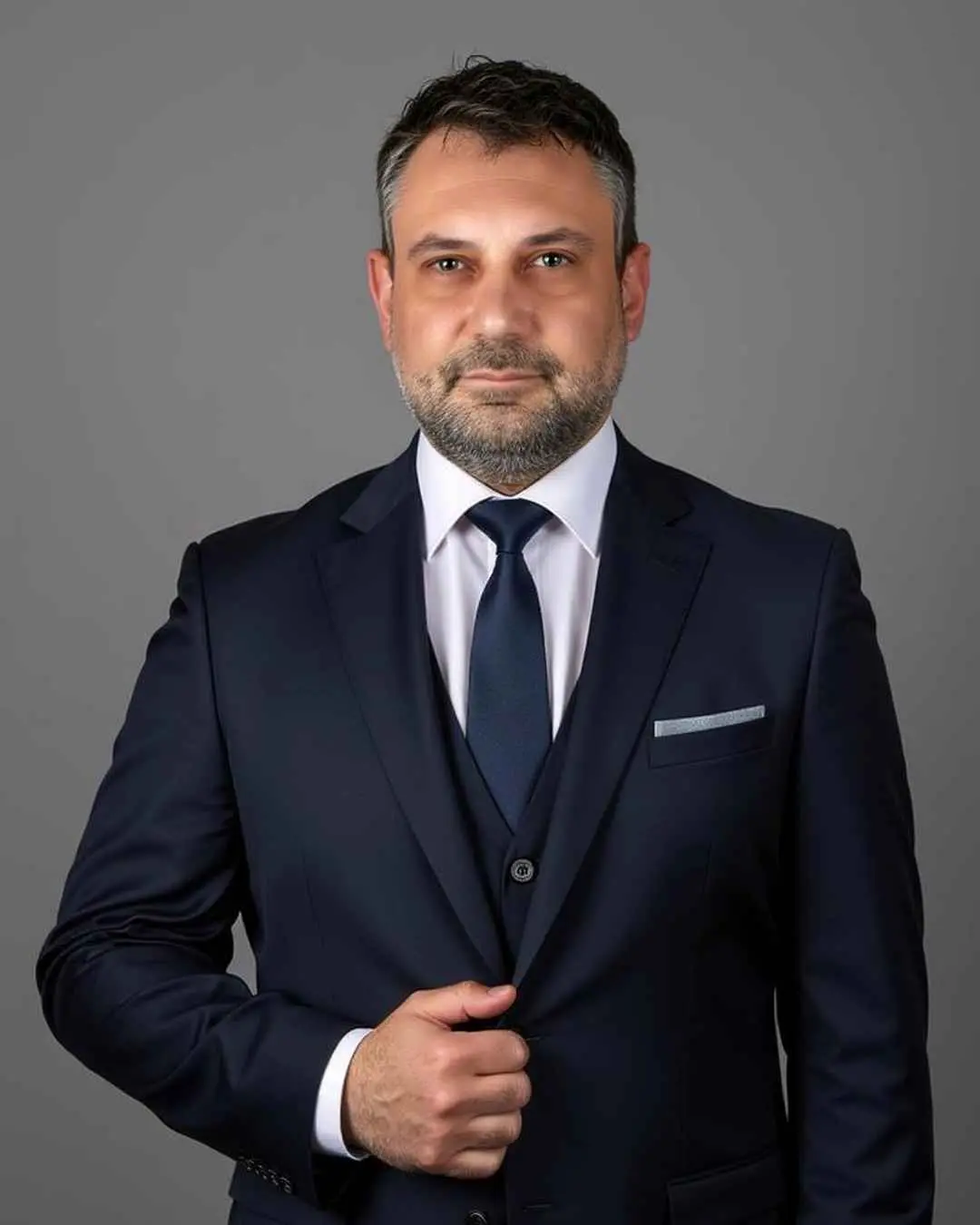
Operational excellence begins where discipline meets the willingness to improve. That principle defines Dr. Wilhelm Weinmeister, Lean Manufacturing Manager at Interroll Atlanta LLC, part of the Interroll Group. His career spans automotive engineering, patented innovation, international capital programs, and Lean transformation, with a consistent focus on turning complex ideas into scalable systems that people can operate, own, and improve.
At Interroll, Dr. Wilhelm Weinmeister connects people, processes, data, technology, safety, and quality to create improvements that endure. For him, operational excellence depends on capable people as much as on well-designed processes.
Dr. Wilhelm Weinmeister: forged by discipline and driven by improvement
Dr. Weinmeister’s leadership foundation was shaped by service in the German Federal Armed Forces, where discipline, responsibility, resilience, and teamwork were essential. It taught him that leadership is not primarily authority; it is accepting responsibility, remaining dependable under pressure, and helping a team accomplish its mission.
Dr. Wilhelm Weinmeister entered engineering and industrial manufacturing through project control at Volkswagen, followed by roles in process engineering, industrialization, project management, and operations. Work with BMW, Daimler, and Tesla exposed him to demanding environments where quality, safety, cost, timing, automation, and global supply chains had to function as one system.
Dr. Wilhelm Weinmeister is a named inventor on three indirect hot-forming patents—two developed with BMW and one with voestalpine. The lasting lesson was not the patent itself, but converting innovation into a reliable production process meeting quality, safety, maintenance, and customer requirements.
Through his international experience, Dr. Wilhelm Weinmeister worked on large capital-investment, greenfield, industrialization, and manufacturing programs across China, Russia, South Africa, and the United States. Sustainable implementation also depends on local conditions, culture, skills, communication, organizational readiness, and ownership.
Shop-floor and leadership mentors reinforced the importance of going to the Gemba, observing the actual work, listening to employees, and validating facts. These lessons shaped his view of Lean as an integrated system connecting people, processes, technology, data, safety, quality, and leadership.
Joining Interroll in 2024 brought this experience into material handling, with a focus on developing people and systems that continue improving beyond a single project or leader.
Interroll group | material-handling at global scale
GLOBAL LEADER
- Leading global provider of material-handling solutions for conveying, sorting, storing, and picking goods.
- 1959
- Founded
Over six decades of industry experience - 1997
- SIX Swiss Exchange
Listed on the SIX Swiss Exchange
4 CORE SOLUTION AREAS
- Rollers – Conveyor rollers
- Drives – Motors and drives for conveyor systems
- Conveyors & Sorters – Automated conveying and sorting solutions
- Pallet Handling – Flow storage systems
GLOBAL REACH
- Switzerland Headquarters
- 36 Operating Companies worldwide
- CHF 514.2 Million
Sales in 2025 - 2,400 Employees
Average number of employees in 2025
INDUSTRIES SERVED
- E-commerce, Express & Postal, Airports, Food & Beverage, Fashion, Automotive, and many more
TRUSTED BY GLOBAL BRANDS
- Amazon | Bosch | Coca-Cola | DHL | Nestlé | Procter & Gamble | Siemens | Walmart | Zalando
THE INTERROLL DIFFERENCE
- Interroll enables system integrators and OEMs with platform-based products and services that help businesses convey, sort, store, and pick goods efficiently across diverse industries.
Turning lean thinking into daily practice
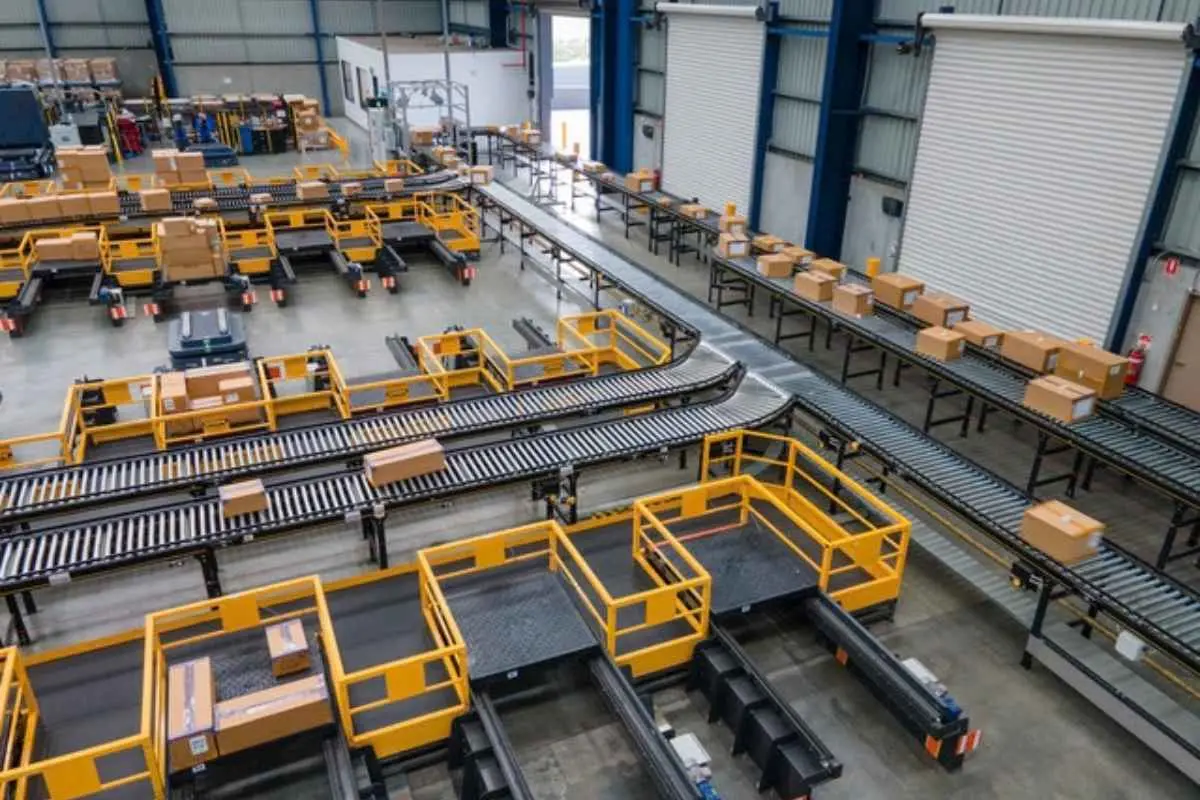
As Lean Manufacturing Manager at Interroll Group, Dr. Wilhelm Weinmeister’s day begins with the fundamentals: safety, quality, delivery, productivity, and people. He reviews performance data, joins daily management discussions, walks the production areas, coaches employees, and follows up on improvement actions.
His responsibilities span Lean strategy, tier-management systems, 6S, Kaizen, OEE, process engineering, time studies, capacity analysis, material-flow and layout optimization, SAP data integrity, training, and integrated management systems. Together, these areas help create greater visibility, efficiency, and consistency across operations.
The most demanding challenges arise where physical production meets SAP processes, master data, departmental responsibilities, customer commitments, and employee behavior. At the Atlanta operation, several product families move through fabrication and assembly across two buildings. He must balance customization with standardization, support growth, improve capacity, and increase transparency without adding unnecessary administration.
For him, Lean is therefore more than a collection of improvement tools. It is about connecting people, processes, data, and operational priorities so that problems become visible and solutions can be sustained. His focus remains on creating a manufacturing system that is flexible enough to support customer needs while disciplined enough to deliver consistent performance.
When the process became the problem
At Interroll Atlanta, Dr. Weinmeister identified a challenge that extended beyond one workstation or department. Waiting, unnecessary movement, work in process, unclear handoffs, manual workarounds, and gaps between physical production and SAP information were slowing the flow.
He took the investigation to the Gemba, bringing operators, supervisors, logistics, engineering, planning, and SAP specialists together. They mapped material and information flows, reviewed transactions and master data, spoke with employees, and documented pain points, testing assumptions against facts before making decisions.
Pareto thinking separated issues requiring quick action from larger structural projects, while RACI clarified ownership. The biggest hurdle was changing workarounds that had become part of normal operations, compounded by inconsistent data and different departmental interpretations.
The initiative produced a shared process map, common root-cause understanding, clearer responsibilities, and a prioritized implementation roadmap. More importantly, decisions shifted from opinions and departmental escalation to facts, ownership, and coordinated action.
The five principles behind his approach
Dr. Wilhelm Weinmeister’s approach to improvement rests on five connected principles: Gemba, Data, People, Governance, and Sustainment. He begins by understanding the customer requirement, business need, and risk before going to the actual process rather than relying solely on reports.
01 | Observe the reality
Gemba Walks reveal what is really happening on the shop floor.
02 | Validate with data
SAP, quality records, OEE, time studies, and capacity data are compared with actual conditions.
03 | Find the real cause
Value-stream mapping, Pareto analysis, 5 Why, cause-and-effect analysis, and process-capability thinking help uncover the key drivers.
04 | Build with the team
Solutions are developed alongside the people who perform and support the process.
05 | Make improvement last
Standard work, training, ownership, KPIs, review routines, and audits are established to sustain results.
What sets Dr. Weinmeister’s approach apart is the combination of Lean, Six Sigma, process engineering, digital data, compliance, and leadership. For him, an improvement is complete only when its results can be measured and sustained.
Building ownership beyond the shop floor
Dr. Wilhelm Weinmeister sees a strong improvement culture as one where people can point out problems without hesitation. His leadership style encourages employees to surface irregularities through tier boards, Gemba Walks, OEE loss tracking, 6S reviews, and open conversations, with leaders focusing on understanding the issue rather than assigning blame.
The response after a concern is raised matters just as much. When employees see that their input leads to action, confidence builds and participation becomes stronger.
The OEE process at Interroll offers a clear example. Operators capture hourly performance and losses, supervisors check the information, managers work to clear obstacles, and process engineers support the teams through audits and coaching. The aim is not to create paperwork or use poor figures against a team. It is to understand where performance is being lost, strengthen data accuracy, and help employees focus on the issues that matter.
According to Dr. Weinmeister, real ownership develops when employees have a role in understanding the problem, shaping the response, and seeing it through to completion. That involvement turns continuous improvement into a shared responsibility.
When innovation proves its worth
The three hot-forming patents are important, but Dr. Weinmeister considers successful industrialization the greater achievement. Turning innovation into repeatable production required close collaboration among engineering, operations, quality, maintenance, supply chain, and shop-floor teams.
International programs confirmed that technically sound solutions can still fail when ownership, communication, training, or cultural context is overlooked.
His doctorate, Six Sigma Master Black Belt qualification, project-management background, auditor credentials, safety training, patents, and recognitions are meaningful milestones. Yet his preferred measure of leadership is a team that continues to own and improve a system after he steps away.
Excellence without compromise
Dr. Weinmeister sees quality standards, certifications, audits, safety, environmental responsibility, and ethical manufacturing as part of doing the job well, not as barriers to efficiency.
His qualifications in Six Sigma, project management, ISO 9001, ISO 14001, ISO 45001, and occupational safety guide how he assesses improvement work. At Interroll, ISO systems, environmental certification, customer audits, and sustainability assessments reinforce one clear principle: performance must be responsible and trustworthy.
He builds risk assessment, quality checks, training, change management, corrective actions, and auditability into improvement projects. A faster process is not a success if it creates defects, ergonomic risks, environmental harm, or uncertainty for customers.
Every efficiency improvement must protect or strengthen safety, quality, legal compliance, and ethical conduct. Certifications and awards provide proof, but the real test is what employees and customers experience every day.
The right technology for the right problem
Dr. Wilhelm Weinmeister sees the greatest value in technology that improves visibility, speeds up decisions, strengthens consistency, and enhances safety. ERP and MES integration, connected machinery, real-time OEE, digital work instructions, automated data capture, simulation, predictive maintenance, and AI-based analytics are creating meaningful gains. In material handling, flexible automation and intelligent controls also help manufacturers respond to changing volumes and product mixes.
Technology, however, cannot fix a process that has not been understood or stabilized. Weak master data, unclear accountability, and inconsistent standard work can remain unresolved beneath automation, often making problems faster and more expensive.
Before any investment, Dr. Weinmeister considers five questions: What problem needs solving? Can the data be trusted? Who owns the process? What value should be created, and how will employees be trained?
He views AI as support for human judgment and structured problem-solving, not a replacement for responsibility, experience, or process discipline.
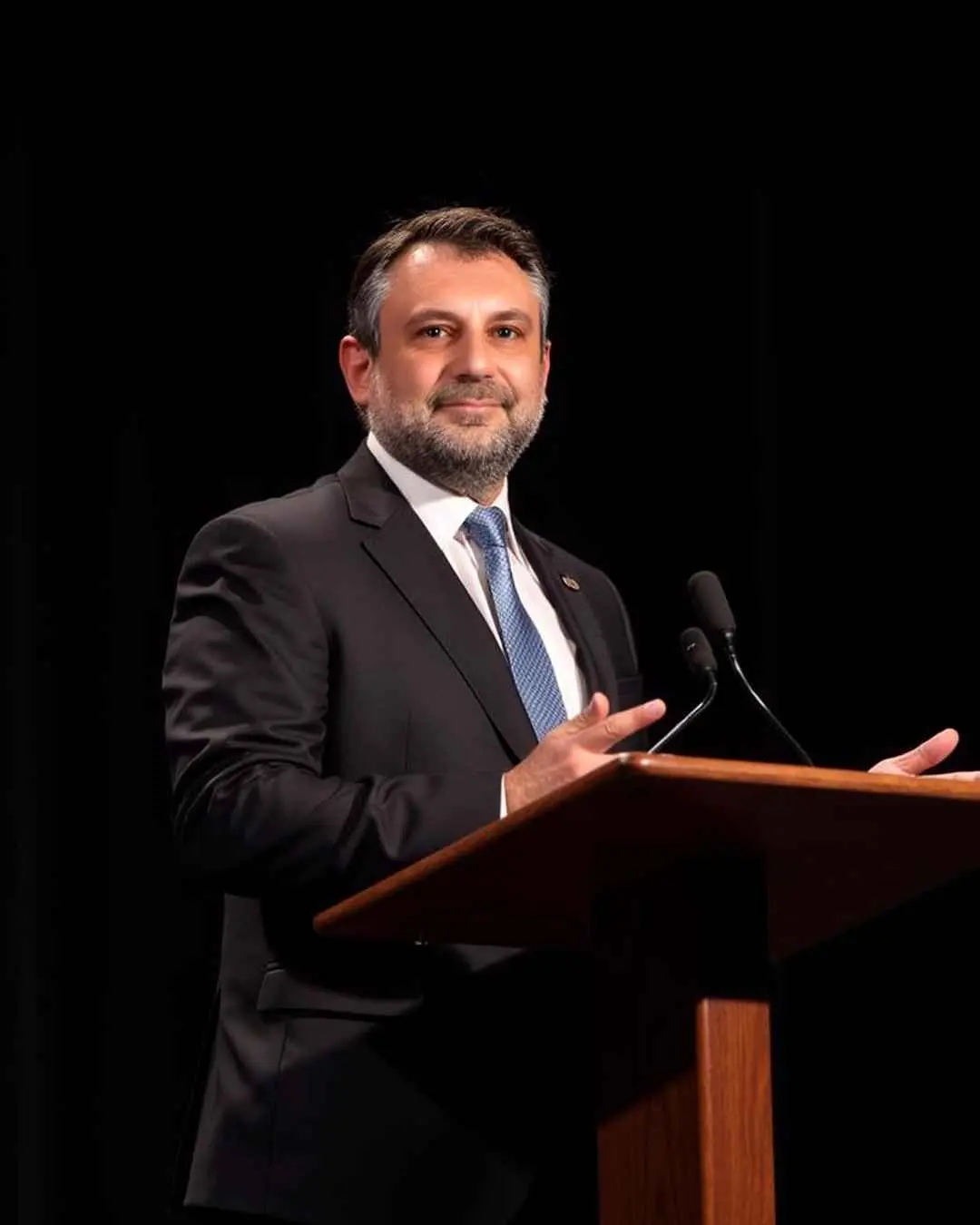
Reading the future of manufacturing
Dr. Weinmeister sees the manufacturing and material-handling landscape entering a decisive three-to-five-year period. Labor and skills shortages, rising customization, connected automation, AI-assisted decisions, resilient supply chains, sustainability pressures, and stronger demands for traceability and compliance will reshape daily operations.
Material handling is moving toward a connected ecosystem where equipment, controls, software, data, and customer-service platforms operate in closer alignment.
Leaders will need dependable core processes without losing the flexibility to adapt. Strong data governance, clear process ownership, and people who understand both manufacturing fundamentals and digital tools will become increasingly important.
Sustainability, safety, cybersecurity, and ethical sourcing must become part of everyday operations, not separate reporting exercises. Dr. Weinmeister believes the strongest organizations will not simply be those with the most technology. They will be those that connect technology with strategy, capable people, and disciplined execution.
Passing the torch of better thinking
Dr. Weinmeister sees knowledge-sharing as part of leadership. He develops people through daily coaching, formal training, cross-functional workshops, Lean exchanges, professional networks, university collaboration, and discussions with colleagues across countries and business units. He also supports young talent through the Dr. Wilhelm Weinmeister Academic Awards at Ulm University and Ulm University of Applied Sciences and student collaboration in operational excellence.
His training philosophy centers on practical learning. He explains the purpose, demonstrates the method, lets the learner apply it, reviews the outcome, and provides respectful feedback.
Dr. Weinmeister believes Lean must be understood as more than cost reduction or a collection of tools. He sees it as a leadership and management system grounded in respect, transparency, stability, learning, and continuous problem-solving.
The real test of improvement is what remains after a project ends. As the saying goes, “Give a person a fish, and you feed them for a day; teach them to fish, and you feed them for a lifetime.” To Dr. Weinmeister, lasting progress means building skills and capability that remain within the organization.
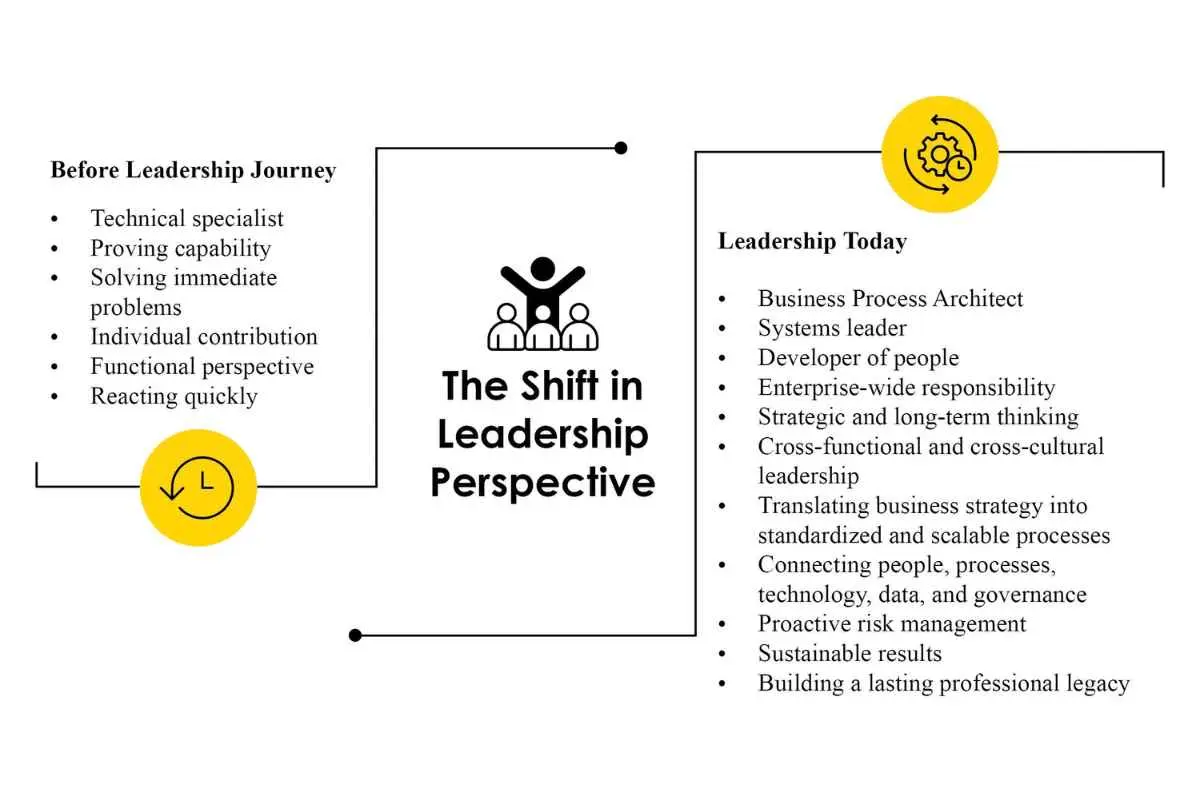
The shift in leadership perspective
Before leadership journey
- Technical specialist
- Proving capability
- Solving immediate problems
- Individual contribution
- Functional perspective
- Reacting quickly
Leadership today
- Business Process Architect
- Systems leader
- Developer of people
- Enterprise-wide responsibility
- Strategic and long-term thinking
- Cross-functional and cross-cultural leadership
- Translating business strategy into standardized and scalable processes
- Connecting people, processes, technology, data, and governance
- Proactive risk management
- Sustainable results
- Building a lasting professional legacy
A day in the life of dr. Wilhelm weinmeister
5:15–6:15 A.M. | EARLY MORNING
Exercise, breakfast, reflection, and setting the day’s priorities.
7:00 A.M. | WORKDAY BEGINS
Safety, quality, delivery, OEE, project actions, and urgent communications take priority.
7:30–10:30 A.M. | MORNING GEMBA
Tier meetings, production-floor visits, team coaching, and follow-up on open issues.
12:00 P.M. | MIDDAY PAUSE
Lunch paired with informal conversations across functions.
1:00–4:30 P.M. | CORE WORK HOURS
Process analysis, SAP and capacity matters, project reviews, standards, training, and regional or global meetings.
AROUND 6:00 P.M. | EVENING RESET
Family, dinner, and time to recharge.
AROUND 9:00 P.M. | WIND-DOWN
Reading, writing, professional development, and planning for the day ahead.
Open Letter
Dear future manufacturing professionals and leaders,
Never lose respect for the people who perform the work. Technology, automation, and AI will continue to change manufacturing, but leadership will still begin with listening, observing, and understanding the real process.
Go to the Gemba. Ask questions before offering answers. Learn to work with data, but remember that data needs context and ownership.
Do not be discouraged by problems. A visible problem is an opportunity to learn; a hidden problem is a risk. Build the discipline to define the issue clearly, verify the facts, identify root causes, test countermeasures, and standardize what works.
Resilience does not mean repeating the same action with more effort. It means learning, adapting, and continuing with purpose.
Measure success not only by speed, cost, or output, but also by safety, quality, environmental responsibility, employee growth, and customer trust. Develop people instead of making them dependent on you.
The best manufacturing system is not the one that looks most advanced in a presentation. It is the one that performs reliably, exposes abnormalities early, and improves through the knowledge and ownership of its people.
Sincerely,
Dr. Wilhelm Weinmeister,
Lean Manufacturing Manager
Interroll Group / Interroll Atlanta LLC
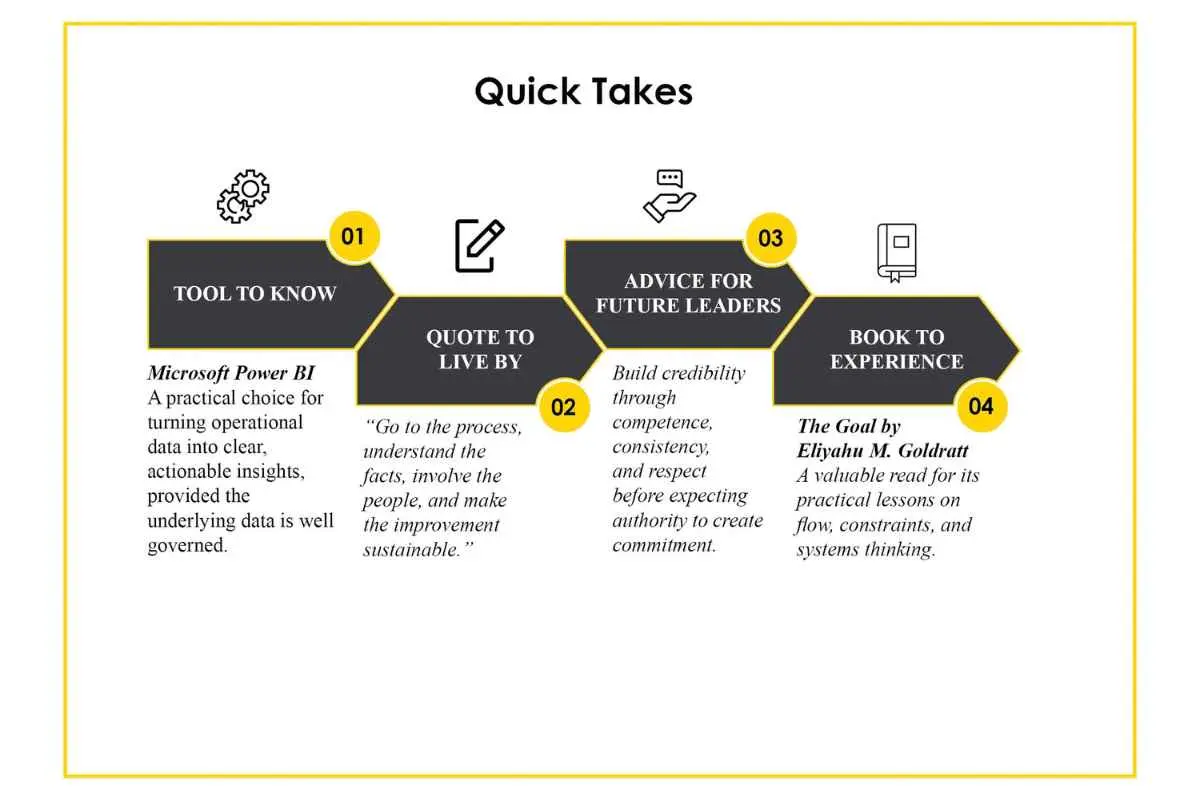
Quick Takes
01 | TOOL TO KNOW
Microsoft Power BI
A practical choice for turning operational data into clear, actionable insights, provided the underlying data is well governed.
02 | QUOTE TO LIVE BY
“Go to the process, understand the facts, involve the people, and make the improvement sustainable.”
03 | ADVICE FOR FUTURE LEADERS
Build credibility through competence, consistency, and respect before expecting authority to create commitment.
04 | BOOK TO EXPERIENCE
The Goal by Eliyahu M. Goldratt
A valuable read for its practical lessons on flow, constraints, and systems thinking.