


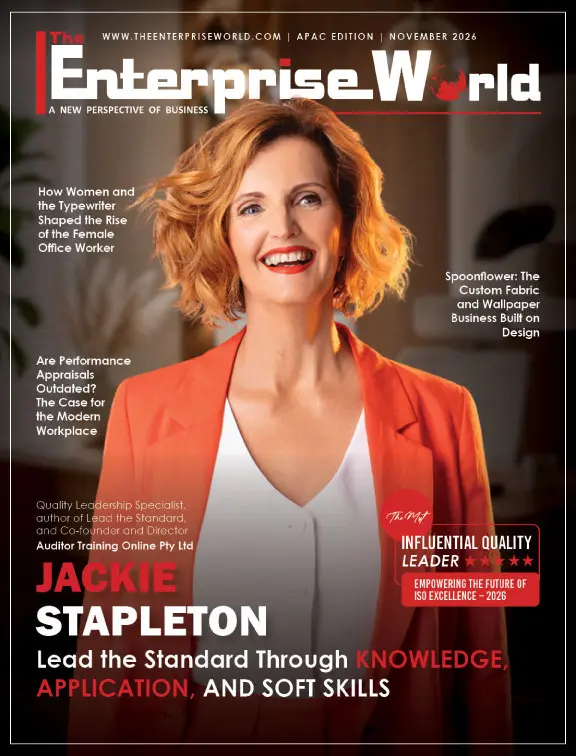
The quality industry is evolving in exciting ways, with quality no longer just about conformance and certificates but increasingly connected with behaviour, culture, ethics, risk, and organisational decision-making. This shift is opening new opportunities for professionals to make a real difference.
Jackie Stapleton, Quality Leadership Specialist, author of Lead the Standard, and Co-founder and Director of Auditor Training Online Pty Ltd, has embraced this shift wholeheartedly. She has spent more than 25 years in quality and management systems, with over 15 years in certification auditing and training. Through Auditor Training Online, she has helped provide training to more than 8,000 students across more than 100 countries. Her work centres on her Lead the Standard principle, which bridges the gap between technical knowledge and practical capability through three key elements: knowledge, application, and essential people skills.
Her credibility is grounded in Lead Auditor qualifications across ISO 9001, ISO 14001, and ISO 45001, the 2025 Kevin Foley Award from the Australian Organisation for Quality, her role on the Exemplar Global Industry Advisory Panel, and her service as Membership Chair for the ASQ Australia and New Zealand Section.
For Jackie, the strongest validation remains seeing people take what they have learned, apply it with confidence, and become more effective in the way they influence quality within their organisations.

From Training Room to Leadership, The Inspiration Behind a Quality Leadership Career
Jackie’s journey toward becoming a Quality Leadership Specialist was shaped by her training experience as co-founder of Auditor Training Online, where she noticed people completing their training and certificates only to ask, “What now?” That question highlighted a gap: training gives knowledge, but knowledge is only one part of becoming capable in a quality role, since people still need to apply it in real situations and learn even more through that application. Beyond this lay another often-overlooked layer: the soft skills needed to influence, communicate, ask difficult questions, manage resistance, build relationships, and work effectively with managers and teams.
This realization pushed her further into quality leadership, and she came to see capability as a combination of knowledge, application, and soft skills. Knowing the standard is important, but knowing how to use that knowledge with people is what often determines whether quality actually works in practice. That gap also became one of the reasons she wrote her book, Lead the Standard, which was designed to address what happens after the training course and to help quality professionals move from simply knowing ISO requirements to applying them with confidence, judgement, and leadership.
The Influence Gap: Why Qualifications Alone Are Not Enough
One of the most difficult challenges Jackie encounters when working with leaders and organisations is the common assumption that having a qualification will automatically give someone influence, yet it does not, because a person can complete the training, understand the standard, and hold the certificate without any guarantee that people will listen to them, trust them, or act on what they say. This comes back to how they communicate, and communication is much more than the words used. It is tone, body language, facial expressions, where one positions themselves in a conversation, how one listens, and how one asks questions.
For quality professionals, asking good questions matters more than simply telling people what to do. If they simply tell people what to do, they can end up owning every problem and every solution themselves. That is not leadership and can quickly become micromanagement. A stronger approach is to guide people to think through issues themselves, challenge assumptions, and uncover solutions. Those who contribute to a solution understand it better and take ownership of it. This has shaped much of how Jackie works with quality professionals: technical knowledge matters, but influence, questioning, listening, and bringing people along are what make that knowledge genuinely useful.
A common misunderstanding among leaders, according to Jackie, is that quality culture can be created through communication campaigns or values statements. In reality, it is shaped by what people in positions of responsibility repeatedly do, reward, question, and tolerate. If management accepts shortcuts when deadlines are tight, employees quickly learn which message carries more weight.
For Jackie, quality leadership means creating the conditions in which people can consistently do good work. This involves setting clear expectations, understanding risks, making evidence-based decisions, listening to concerns, following through on commitments, and ensuring accountability sits in the right place.

Building Quality Capability, From ISO Intent to Measurable Culture
Jackie encourages people to look at the intent behind individual ISO requirements and ask what outcome the requirement is designed to support, which changes the conversation from compliance to organisational performance. She also uses practical diagnostic approaches to identify where responsibilities, decision-making, behaviours, and systems are not aligned. A principle that runs through her work is Lead the Standard, which is also the title of her book. She developed it around the idea that technical knowledge alone is not enough, and that quality capability is built through knowledge, application, and the soft skills needed to influence, communicate, and work effectively with people.
More recently, Jackie has been working on a passion project: a Quality Culture Assessment based on ISO 10010:2022. Designed as a self-check that organisations can use themselves, it explores personal contribution, team and peer culture, and leadership and organisational environment. The aim is to help organisations recognise patterns and decide where to take action, rather than reduce quality culture to a single score.
When Quality Becomes Everyone’s Responsibility
The procedures existed, the audits were happening, and the certificate was on the wall, but quality was still seen as the responsibility of the quality team. Across her consulting, auditing, and training work, Jackie has worked with organisations where the management system had become something maintained mainly for certification, which usually points to a broader cultural issue. The work then becomes about reconnecting the management system with how the organisation actually operates and how people make decisions every day. This can involve removing unnecessary documentation, clarifying responsibilities, improving how issues are raised and discussed, and making sure the measures and controls relate to real business risks.
It also means changing the conversation around quality. When people start to see risk management, competence, objectives, corrective action, customer feedback, and performance evaluation as part of normal management rather than “ISO activities,” ownership starts to shift. Cultural change is often just as important as the system change. People are more likely to speak up, take responsibility for problems, and contribute to solutions when quality is seen as part of how work gets done. For Jackie, the real transformation is when the management system stops being something the organisation maintains for certification and becomes something people are genuinely engaged with, want to use, and want to keep improving.
Reaching Further Through People, A Different Approach to Quality Leadership
A large part of Jackie’s work is supporting people in quality, auditing, and management systems. Their influence reaches the organisations they work with, which is where she sees the greatest multiplier effect. She does not limit her role to working directly with organisations, since helping a quality professional become more confident, ask better questions, communicate effectively, challenge in the right way, and apply ISO in practice means they can carry that into every organisation, team, and conversation. That is why her work focuses on knowledge, application, and soft skills: technical knowledge matters, but using it well with people is what creates influence.
Jackie adapts her approach based on the person and the environment they are working in. A consultant working with small businesses will need a different approach from an internal quality manager in a large organisation, and an auditor will need something different again. The principles stay consistent, but the way they are applied needs to fit the role, the organisation, and the people involved.

Curiosity Over Defensiveness: How Feedback Becomes a Pathway to Improvement
According to Jackie, a lot depends on the culture created within an organisation, as feedback may be interpreted as criticism in one culture but seen as useful information in another. She tends to view feedback, resistance, and even criticism as positive, because every time something is raised, it is telling you something. Resistance, in particular, gives her something to explore. Rather than seeing the person as the problem, she asks what sits behind it: whether something they know has been overlooked, whether they understand why the change is happening, whether a practical issue has been missed, or whether they are concerned about how it will affect their work.
The same applies to complaints, audit findings, staff feedback, and performance results; they are all messages. The important part is creating a culture where people are comfortable raising those messages and where the response is curiosity rather than defensiveness. If something has been raised, there is an opportunity to learn from it. You may not ultimately agree with every piece of feedback or make every suggested change, but there is still value in understanding why it was raised and what it might be telling you about the organisation.
A Natural Progression in Business Quality and Leadership
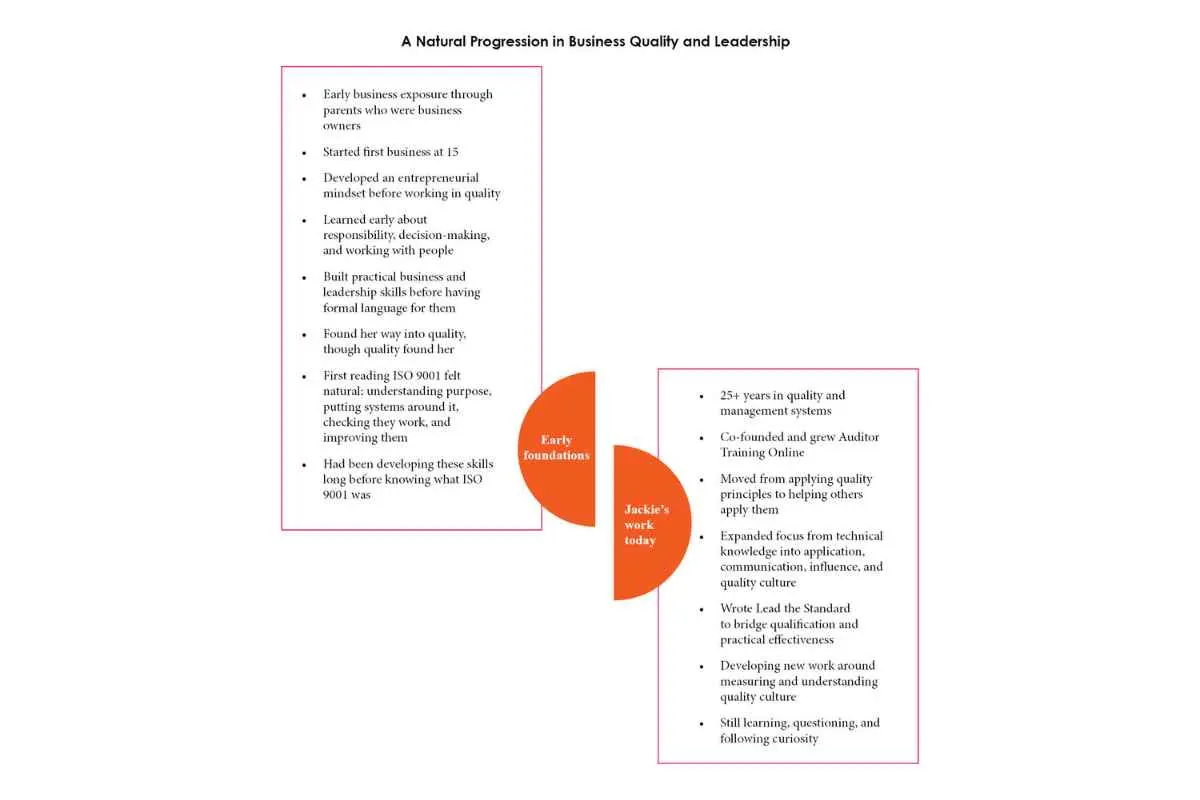
- Early foundations
- Early business exposure through parents who were business owners
- Started first business at 15
- Developed an entrepreneurial mindset before working in quality
- Learned early about responsibility, decision-making, and working with people
- Built practical business and leadership skills before having formal language for them
- Found her way into quality, though quality found her
- First reading ISO 9001 felt natural: understanding purpose, putting systems around it, checking they work, and improving them
- Had been developing these skills long before knowing what ISO 9001 was
- Jackie’s work today
- 25+ years in quality and management systems
- Co-founded and grew Auditor Training Online
- Moved from applying quality principles to helping others apply them
- Expanded focus from technical knowledge into application, communication, influence, and quality culture
- Wrote Lead the Standard to bridge qualification and practical effectiveness
- Developing new work around measuring and understanding quality culture
- Still learning, questioning, and following curiosity
For Jackie, it has been less of a sudden move into leadership and more of a natural progression of business, quality, and leadership developed alongside each other throughout her career.
AI, Ethics and Accountability, The Changing Landscape of Quality Leadership

Technology is changing how organisations operate, and while AI creates significant opportunities, it raises practical quality questions around competence to use these tools appropriately, verification of AI-generated information before it is relied upon, accountability for decisions when AI has contributed, and the controls needed to ensure appropriate use within the organisation. According to Jackie, these are quality management questions, not simply technology questions, as quality becomes more closely connected with behaviour, culture, ethics, risk, and organisational decision-making. The published ISO 9001:2026 edition reinforces quality culture and leadership, with clearer treatment of risks and opportunities.
As technology changes the way work is performed, organisations need to be clear about where responsibility sits, what needs human judgement, and how they know that the outputs they are relying on are accurate and appropriate. That makes the management system even more relevant, because it provides a structure for thinking about competence, risk, accountability, evidence, and how work is controlled.
Curiosity, Community and Continual Learning, A Broader Contribution to Quality
Curiosity is probably Jackie’s favourite word, because she sees continual learning as part of the job. No matter how much experience you have, there is always more to question, test, learn, and understand. Education has been a major part of her work, both in what she provides to others and in how she approaches her own development.
Through Auditor Training Online, she has helped provide auditor and management systems training to students in more than 100 countries, with more than 8,000 students having completed training. She also writes and speaks regularly about ISO, auditing, quality management, and leadership, and she works directly with quality professionals through coaching and professional development. Jackie is involved with the ASQ Australia and New Zealand Section and participates in the Exemplar Global Industry Advisory Panel.
That thinking also sits behind her current work in quality culture, where she is developing ways for organisations to assess culture in a way that produces useful evidence for decision-making and action.
Credentials, Recognition and the True Measure of Credibility
Jackie’s credibility in the quality field is built on decades of hands-on experience, formal qualifications, and a consistent commitment to contributing to the profession.
- 25+ years in quality and management systems; 15+ years as a certification auditor; 15+ years training quality and auditing professionals.
- Auditor Training Online founded in June 2013; trained 8,000+ students across 100+ countries.
- Lead Auditor qualifications across ISO 9001, ISO 14001, and ISO 45001, plus broader auditor, management systems, and training experience.
- 2025 Kevin Foley Award from the Australian Organisation for Quality, recognising a substantial body of published work: training resources, eGuides, articles, and 100+ pieces of online content.
- Credibility is built by showing up consistently, sharing knowledge, voicing opinions, and contributing to the professional conversation; over time, people understand how you think, what you stand for, and the perspective you bring.
- Member of the Exemplar Global Industry Advisory Panel; Membership Chair for the ASQ Australia and New Zealand Section.
- Strongest validation: seeing people apply what they have learned with confidence and become more effective in influencing quality within their organisations.
A Day in the Life, Routine, Rhythm and Time Blocking
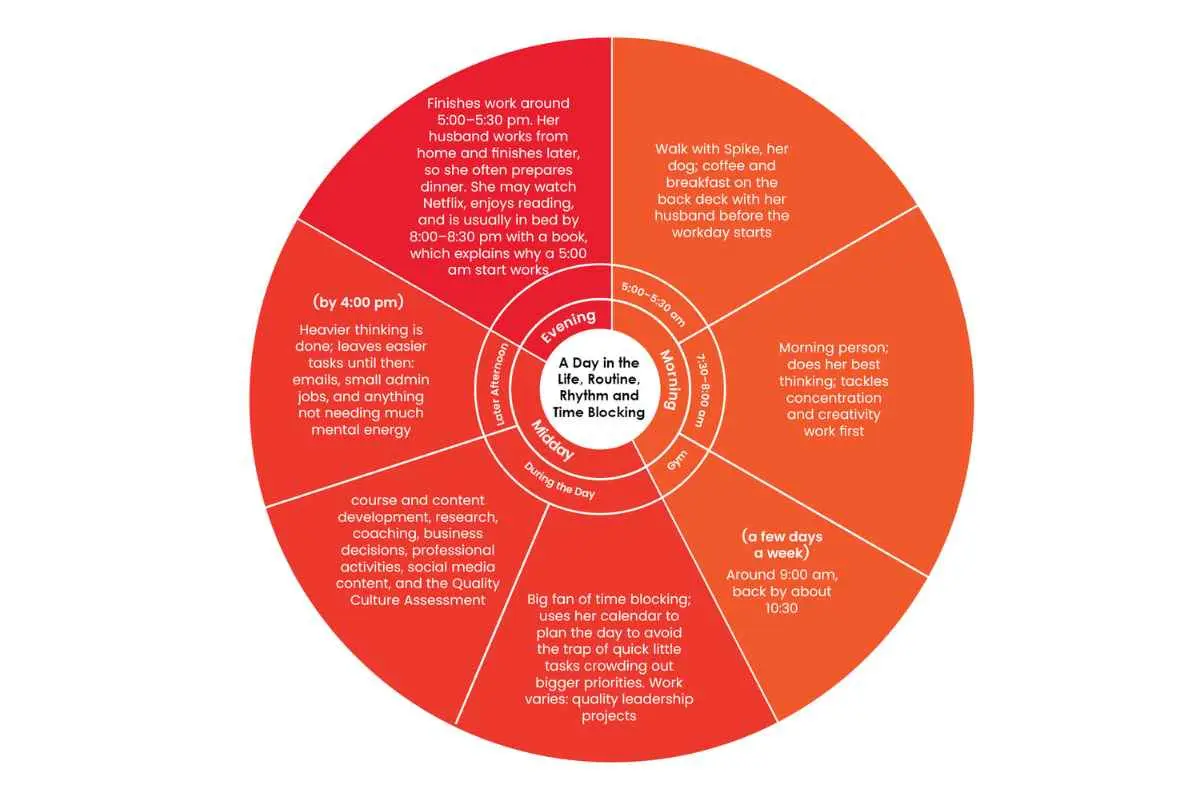
- Early Morning (5:00–5:30 am): Walk with Spike, her dog; coffee and breakfast on the back deck with her husband before the workday starts.
- Start of Workday (7:30–8:00 am): Morning person; does her best thinking; tackles concentration and creativity work first.
- Gym (a few days a week): Around 9:00 am, back by about 10:30.
- During the Day: Big fan of time blocking; uses her calendar to plan the day to avoid the trap of quick little tasks crowding out bigger priorities. Work varies: quality leadership projects, course and content development, research, coaching, business decisions, professional activities, social media content, and the Quality Culture Assessment.
- Later Afternoon (by 4:00 pm): Heavier thinking is done; leaves easier tasks until then: emails, small admin jobs, and anything not needing much mental energy.
- Evening: Finishes work around 5:00–5:30 pm. Her husband works from home and finishes later, so she often prepares dinner. She may watch Netflix, enjoys reading, and is usually in bed by 8:00–8:30 pm with a book, which explains why a 5:00 am start works.
An Open Letter to Emerging Quality Leaders
To those coming into quality and stepping into roles where you have the chance to influence how organisations work, my first thought is simply thank you, and I am genuinely excited that you are here and that you will carry the baton forward.
My biggest piece of advice is to focus on the people, not the processes and not the paperwork, because quality works through people, so learn to listen well, be open, be empathetic, ask great questions, and then give people the space to think through their own answers.
Take your time as well, because you cannot change a bad system in a day and you cannot build trust overnight, and while meaningful change sometimes takes months and sometimes takes years, what matters is consistency: keep asking the right questions, and keep helping people see what better could look like.
Do not rush to prove that you have the answer, because your role is not to be the smartest person in the room but to help people understand what is happening, what needs to change, and how they can be part of that change.
If you can keep the people at the centre of the work, the processes and systems will be much stronger because of it.
Jackie Stapleton
Quality Leadership Specialist, Author of Lead the Standard
Co-founder and Director, Auditor Training Online Pty Ltd
Key Takeaways from Jackie Stapleton’s Perspective
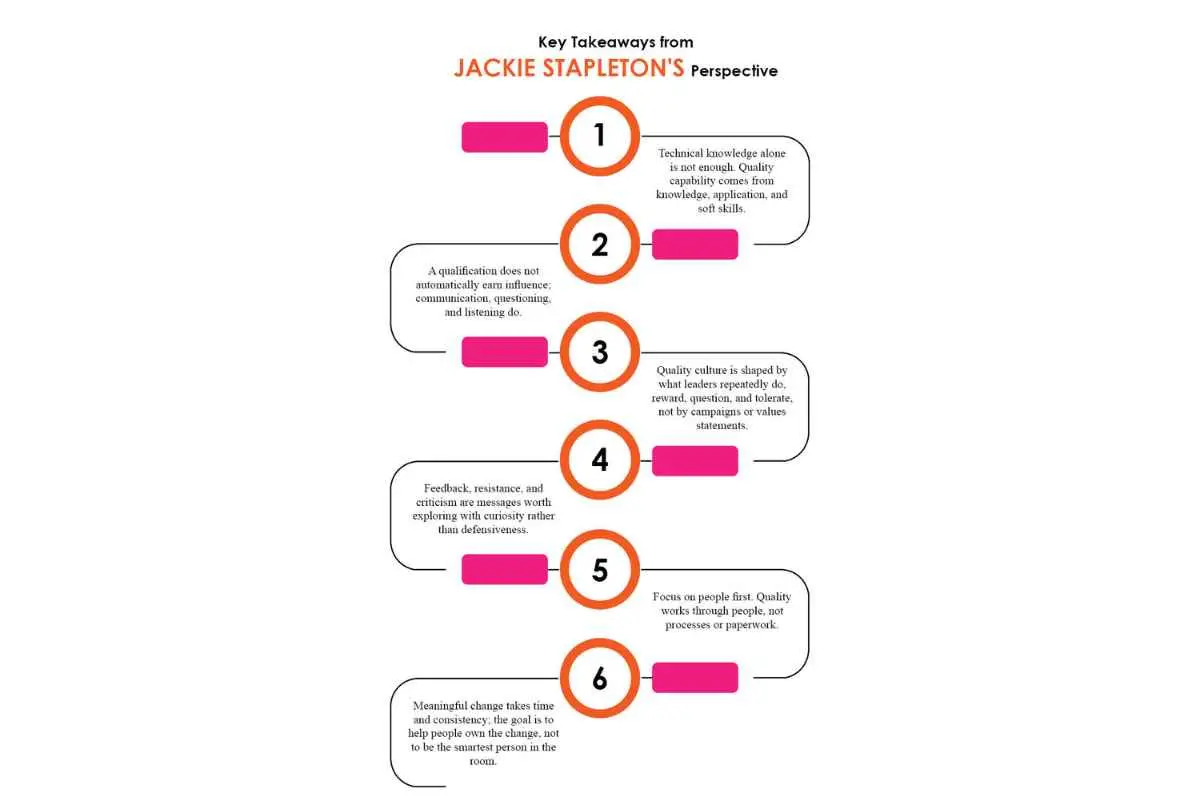
- Technical knowledge alone is not enough. Quality capability comes from knowledge, application, and soft skills.
- A qualification does not automatically earn influence; communication, questioning, and listening do.
- Quality culture is shaped by what leaders repeatedly do, reward, question, and tolerate, not by campaigns or values statements.
- Feedback, resistance, and criticism are messages worth exploring with curiosity rather than defensiveness.
- Focus on people first. Quality works through people, not processes or paperwork.
- Meaningful change takes time and consistency; the goal is to help people own the change, not to be the smartest person in the room.













