“A leader knows the way, goes the way, and shows the way.”
John C. Maxwell.
True leadership is tested not in comfort, but in challenge. In 1972, Kiran Bedi became India’s first woman IPS officer, entering a male-dominated police force where women were less than 5% of the workforce. She faced skepticism, resistance, and high-stakes situations from day one—but her approach of courage, fairness, and accountability set a standard that many still look up to today.
Her work at Tihar Jail, one of Asia’s largest correctional facilities, brought transformative change. Bedi introduced education, meditation, and skill-building programs that impacted over 10,000 inmates, turning a system focused on punishment into one that fostered rehabilitation and hope. Beyond India, she also advised the United Nations on policing and peacekeeping, sharing her expertise on reforming institutions under challenging conditions.
This March, Bedi will join the Bharat 2.0 Conclave in Mumbai as the Honorary Guest, an event that gathers policymakers, business leaders, and innovators to discuss the ideas shaping India’s next phase of growth. Her participation reflects the Conclave’s focus on practical leadership, ethical governance, and nation-building, providing attendees with real-world insights from someone who has repeatedly led by example.
Her journey is more than inspiring stories; it’s a blueprint for leadership in action. From taking responsibility for tough decisions to creating systems that work for everyone, Bedi’s approach shows how principles like discipline, accountability, and trust translate into measurable impact. The lessons from her decades-long career are not just theoretical; they are actionable strategies that any leader can apply.
With that in mind, here are 7 powerful leadership lessons from Kiran Bedi that highlight the mindset and behaviors driving her extraordinary career and how leaders today can adapt them to their own challenges.
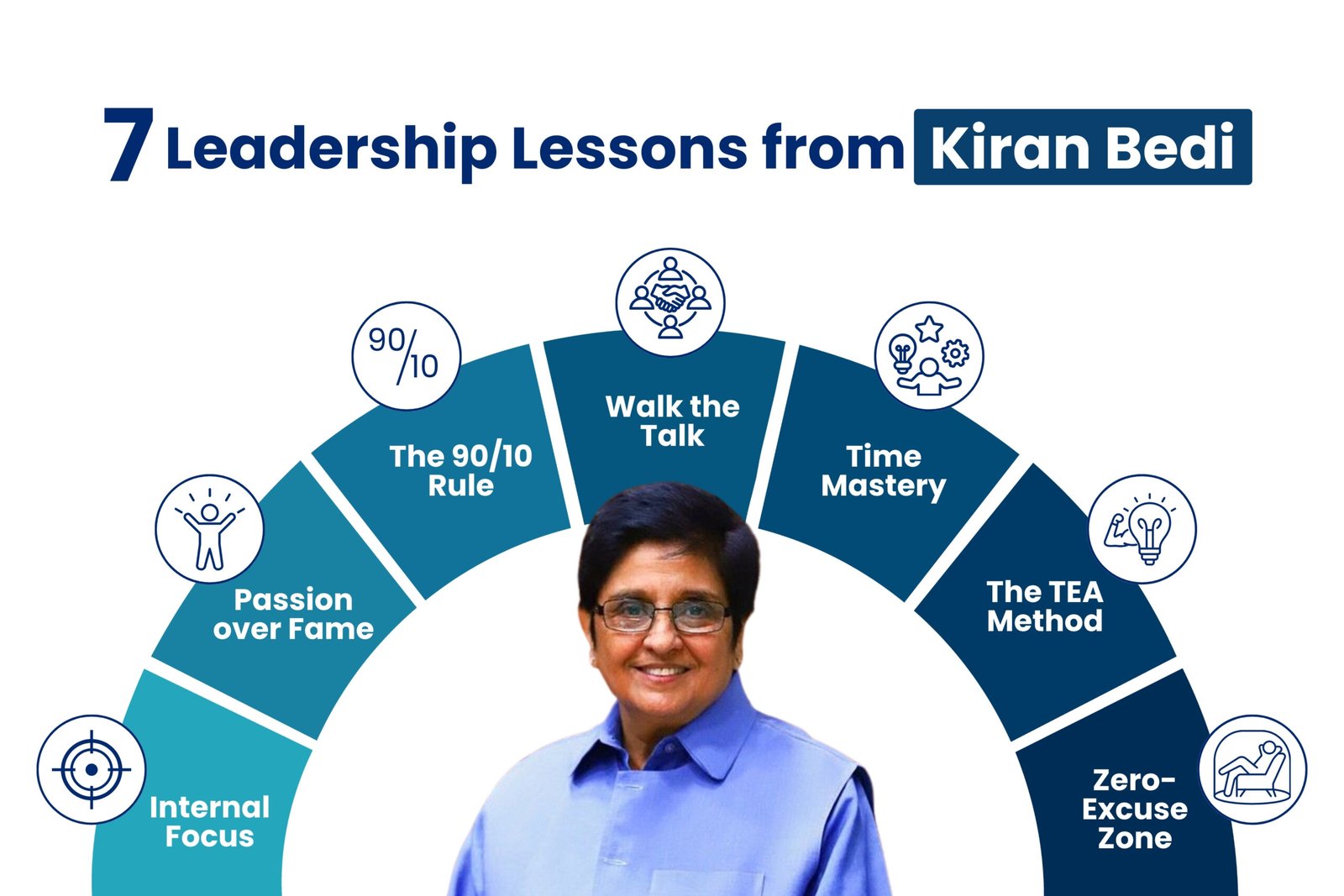
7 Powerful Lessons Leaders Can Learn from Kiran Bedi
1. Internal Focus of Control
One of the strongest leadership ideas Kiran Bedi often emphasizes is taking responsibility for your own standards. Instead of waiting for recognition or approval from others, she believes leaders should first hold themselves accountable.
In many organisations, professionals measure success by external signals—a manager’s praise, a promotion, or public appreciation. While these things matter, strong leaders do not depend on them to stay motivated. They set their own expectations and push themselves to improve regardless of who is watching.
This mindset helps leaders stay focused on progress rather than validation. When you measure yourself against your own past performance, growth becomes consistent and intentional. You stop blaming circumstances and start focusing on what you can control.
For business leaders, this approach creates credibility. Teams trust leaders who hold themselves to the same standards they expect from others. It also builds resilience because the motivation to perform well comes from within, not from external rewards.
What Internal Accountability Looks Like in Leadership?
| Situation at Work | Common Reaction | Leader’s Internal Focus Approach |
| A project fails or underperforms | Blamethe lack of support or resources | Analyse what could have been planned or executed better |
| A team member makes a mistake | Focus on the individual’s error | Reflect on whether expectations and guidance were clear |
| Performance reviews are delayed | Wait for feedback to improve | Conduct personal performance reviews regularly |
When leaders develop this internal focus, they create a culture where accountability starts at the top. Teams naturally follow leaders who are willing to evaluate themselves honestly.
How Leaders Can Implement This?
- Audit your self-talk: When something goes wrong, pause and ask, “What could I have done better?” instead of immediately looking for external reasons.
- Set silent goals: Define a few personal performance targets that only you track. Achieving them builds confidence that is not dependent on recognition.
- Weekly leadership review: At the end of each week, assess your leadership decisions. Ask yourself three questions:
- What worked well?
- What could have been handled better?
- What will I improve next week?
By developing an internal focus of control, leaders strengthen discipline, self-awareness, and credibility qualities that have consistently defined Kiran Bedi’s leadership journey.
2. Passion for Your Work
Another leadership lesson that stands out from Kiran Bedi’s journey is the importance of genuine passion for the work itself. Throughout her career, she has often emphasized that real satisfaction does not come from titles, rewards, or recognition, but rather from doing meaningful work with commitment and honesty.
Many professionals begin their careers with strong motivation, but over time the focus can shift toward promotions, public recognition, or financial rewards. While these outcomes are important, leaders who rely only on external rewards often lose their drive when those rewards slow down.
Bedi’s approach is different. She believes leaders should focus on the value of the work itself. When the work becomes the source of motivation, effort remains steady even when recognition is delayed. This mindset builds consistency, which is one of the most important qualities in leadership.
For leaders, passion also has a ripple effect. Teams tend to mirror the energy and attitude of the people leading them. When a leader shows genuine enthusiasm for solving problems and improving systems, it inspires others to care about the work as well.
How Passion Reflects in Leadership Behaviour?
| Leadership Situation | Reward-Driven Approach | Passion-Driven Leadership |
| Handling a difficult project | Focus on how it affects promotion or reputation | Focus on solving the problem and improving the outcome |
| Facing setbacks | Lose motivation quickly | Stay committed because the work itself matters |
| Leading a team | Expect results from others | Inspire effort by demonstrating dedication |
Leaders who care deeply about their work tend to bring focus, energy, and resilience to everyhaveallenge. Over time, this creates a culture where people take pride in what they do rather than simply completing tasks.
How Leaders Can Apply This Mindset?
- Reconnect with the purpose: Before starting a major task, ask yourself who benefits from it your team, your organisation, or the community. This keeps the work meaningful.
- Focus on quality over recognition: Commit to doing a job well even when no one is watching. Over time, consistent quality speaks louder than short-term praise.
- Create time for deep work: Block a period each day where you focus only on the core work that requires your expertise and attention. Avoid distractions during this time.
Passion for work is not about excitement every single day, it is about staying committed to the mission even during difficult phases. This steady dedication is one of the traits that has defined Kiran Bedi’s leadership over the years.
3. Own Your Choices
One of the most practical leadership lessons Kiran Bedi often speaks about is taking ownership of your choices. She draws inspiration from leadership principles popularised by Stephen Covey, which highlight a simple but powerful idea: much of our lives is shaped by the decisions we make, not just by the circumstances we face.
In professional environments, it is easy to blame pressure, limited resources, or unexpected problems when things go wrong. While external factors do play a role, effective leaders understand that their responses and decisions ultimately determine the outcome.
When leaders accept responsibility for their choices, they move away from a reactive mindset and toward a proactive one. Instead of focusing on what went wrong, they focus on what can be improved. This shift creates stronger decision-making and builds trust within teams.
For business leaders, this principle is especially important. Teams feel more confident when they see leaders who acknowledge mistakes, learn from them, and move forward with clarity.
Leadership Mindset: Blame vs Ownership
| Situation at Work | Blame-Oriented Response | Ownership-Oriented Leadership |
| A strategy fails | Blame market conditions or team performance | Review decisions and identify lessons |
| Deadlines are missed | Point to workload or external delays | Reassess planning and priorities |
| A wrong hire is made | Blame the recruitment processes | Reflecting on the evaluation and decision criteria |
Leaders who take ownership create a culture where accountability becomes normal rather than uncomfortable. Over time, this builds stronger teams and clearer decision-making.
How Leaders Can Practice This
- Separate what you can control: When a challenge appears, write down two columns: things you cannot change and things you can influence. Focus your energy on the second list.
- Avoid the blame habit: For a full day, consciously avoid blaming people, systems, or circumstances. Instead, ask what action you can take to move forward.
- Keep a decision journal: When making important choices, briefly note why you made them. If the outcome is not ideal, reviewing your reasoning helps improve future decisions.
Owning your choices does not mean being perfect. It means being honest about your decisions and willing to learn from them. This mindset has been a defining part of Kiran Bedi’s leadership throughout her career.
4. Walk Your Talk
One of the most powerful ways leaders build credibility is by practicing what they expect from others. Kiran Bedi’s career offers several examples of this principle in action. One of the most well-known moments came when a vehicle from the Prime Minister’s convoy was The leaderor violating parking rules. The leadership incident earned her the nickname “Crane Bedi,” but it also sent a clear message: rules apply to everyone.
For leaders, consistency between words and actions is essential. When leaders say one thing but do another, trust within the team quickly weakens. On the other hand, when leaders follow the same standards they expect from others, it creates a culture of fairness and accountability.
Teams often observe leaders closely. Small actions such as keeping commitments, respecting deadlines, or following organisational policies shape how employees perceive leadership. Over time, these behaviours influence how the entire organisation operates.
What “Walking the Talk” Looks Like in Leadership
| Leadership Situation | When Words Don’t Match Actions | When Leaders Lead by Example |
| Emphasising punctuality | Leader arrives late to meetings | Leader consistently arrives early |
| Promoting transparency | Information is withheld from the team | Important updates are shared openly |
| Expecting accountability | Leaders avoid admitting mistakes | Leaders acknowledge errors and correct them |
Leaders who demonstrate consistency build stronger trust within their teams. Employees are far more likely to follow standards when they see those standards being upheld by leadership.
How Leaders Can Apply This Principle
- Use the mirror test: Before giving instructions or setting expectations, ask yourself if you are following the same standard.
- Practice micro-integrity: Small commitments matter. If you promise a call at a specific time or a deadline for feedback, honour it.
- Stay consistent under pressure: The real test of leadership often appears in difficult moments. Standing by principles during these situations strengthens credibility.
Walking the talk may seem simple, but it requires discipline and courage. Leaders who consistently align their actions with their words create an environment where trust, fairness, and accountability naturally thrive.
5. Master Your Time
Kiran Bedi has often spoken about the importance of discipline in managing time. Long before she entered public service, she developed this mindset as a competitive tennis player, where every second on the court mattered. That early training shaped the way she approached her professional life, treating time as one of the most valuable resources a leader has.
For leaders, time management is not just about staying busy. It is about prioritising what truly matters. When leaders organise their time effectively, they bring clarity to their work, respond to challenges faster, and create a sense of direction for their teams.
Poor time management, on the other hand, often leads to rushed decisions, missed opportunities, and unnecessary stress within organisations. When leaders manage their schedules well, it sends a strong signal to the team that discipline and focus are part of the culture.
How Effective Time Management Shows in Leadership
| Leadership Situation | Poor Time Management | Disciplined Time, Leadership |
| Meetings | Meetings start late or run too long | Meetings start on time with clear agendas |
| Daily priorities | Constantly reacting to urgent issues | Planning the day around key priorities |
| Team expectations | Unclear deadlines | Clear schedules and well-defined milestones |
Leaders who respect time both their own and their team’s create a more productive and focused work environment.
How Leaders Can Improve Time Discipline
- Adopt the five-minute rule: Aim to arrive at meetings or commitments at least five minutes early. This simple habit builds reliability and respect.
- Use time blocking: Assign specific time slots in your calendar for important work instead of leaving the day open to interruptions.
- Create a “not-to-do” list: Identify activities that repeatedly waste time, unnecessary meetings, excessive emails, or distractions and limit them.
- Protect deep work hours: Reserve at least one uninterrupted block of time each day for tasks that require strategic thinking or problem-solving.
Mastering time does not mean filling every minute with work. It means using time deliberately so that leaders can focus on what truly moves their organisation forward.
6. Build Trust Through Connection
One of the most effective leadership approaches Kiran Bedi has consistently practiced is leading with trust and connection. Instead of creating distance between leaders and teams, she has often emphasised working closely with people, understanding their challenges, and giving them the confidence to contribute.
Strong organisations are not built only on strategies and policies they are built The leaderationships. When leaders create an environment where people feel trusted and valued, teams become more engaged and motivated. Employees are more likely to take initiative when they know their ideas are heard and their contributions matter.
Kiran Bedi often refers to a simple leadership app, roach called TEA that is Trust, Empowerment, and Accountability. The idea is straightforward: leaders should first trust their teams, then empower them to make decisions, and finally ensure that everyone takes responsibility for the outcomes.
This approach encourages ownership within teams. Instead of relying entirely on top-down instructions, people feel responsible for delivering results.
How Trust-Based Leadership Works
| Leadership Situation | Control-Based Leadership | Trust-Based Leadership |
| Delegating tasks | The leader monitors every step | Leader sets goals and allows independence |
| Decision-making | All decisions stay with the leader | Team members are encouraged to contribute ideas |
| Handling mistakes | Focus on blame; | Focus on learning and improvement |
When leaders build genuine connections with their teams, communication improves and collaboration becomes easier. Over time, this creates a workplace culture where people are not just completing tasks but actively contributing to the organisation’s success.
How Leaders Can Apply the TEA Approach
- Trust your team: Assign responsibilities clearly and resist the urge to constantly check on progress.
- Empower decision-making: Instead of immediately giving answers, ask team members how they would approach the problem.
- Create accountability: Encourage teams to review what worked and what didn’t after major projects.
- Listen more than you speak: In meetings, allow others to share their ideas first. Leaders often gain better insights when they listen carefully.
Trust does not mean the absence of structure, it means creating a system where people feel responsible for the outcomes they help produce. This balance of trust, empowerment, and accountability has been a defining feature of Kiran Bedi’s leadership style.
7. Rise Above Circumstances
One of the most defining traits of Kiran Bedi’s leadership has been her refusal to be limited by circumstances. Throughout her career, she has often emphasised that while challenges are unavoidable, how leaders respond to them determines the outcome.
In many professional settings, people blame difficult environments, limited resources, or systemic issues when progress slows down. While these challenges are real, strong leaders focus on what they can improve rather than what they cannot control. Bedi has repeatedly encouraged individuals to invest in themselves until they become stronger than the obstacles they face.
She often describes this mindset as “constructive discontent.” It means never becoming too comfortable with mediocrity. Even when things appear to be working well, leaders should continue looking for ways to improve systems, processes, and outcomes.
For leaders, this attitude creates resilience. Teams feel more confident when they see leaders who remain solution-oriented instead of getting discouraged by setbacks.
Leadership Mindset: Limitation vs Growth
| Situation at Work | Limitation-Focused Response | Growth-Oriented Leadership |
| Lack of resources | Wait for better tools or conditions | Find creative ways to work with existing resources |
| Operational challenges | Accept inefficiencies as normal | Identify ways to improve processes |
| Personal skill gaps | Avoid difficult tasks | Learn new skills to overcome limitations |
Leaders who rise above circumstances encourage their teams to think the same way. Instead of dwelling on obstacles, they focus on possibilities and improvements.
How Leaders Can Practice This Mindset
- Create a zero-excuse zone: When something goes wrong, focus first on solutions rather than explanations.
- Invest in learning: Identify one skill that could significantly improve your leadership and dedicate time each week to developing it.
- Improve small systems: Once a month, review a process in your organisation and look for a way to make it faster or more effective.
- Adopt constructive discontent: Even when things are working well, ask how they could be improved by 10%.
Rising above circumstances does not mean ignoring challenges. It means choosing progress over excuses. This mindset has allowed Kiran Bedi to drive reforms and create impact across multiple roles throughout her career.
Kiran Bedi’s Fearless Rise From IPS Pioneer to National Reformer
The leadership lessons from Kiran Bedi’s life become even clearer when we look at the milestones that shaped her journey. Over the years, she has consistently taken roles that required courage, discipline, and a willingness to challenge the status quo. From policing to governance and social reform, each stage of her career reflects a strong commitment to accountability and public service.
Below is a snapshot of the key moments that defined her leadership path.
| Year / Phase | Role or Milestone | Why It Mattered |
| 1972 | Became the first woman to join the Indian Police Service (IPS) | Broke a major gender barrier in Indian policing and opened doors for women in law enforcement. |
| Early Police Career | Earned the nickname “Crane Bedi” after towing a Prime Minister’s car for a parking violation | Demonstrated that the rule of law should apply equally to everyone, regardless of status. |
| Tihar Jail Reforms | Served as Inspector General of Prisons at Tihar Jail | Introduced education, yoga, meditation, and skill-building programs to reform the prison system and focus on rehabilitation. |
| International Role | Served as a United Nations Police Advisor | Contributed her exp,ertise in policing and reform to international peacekeeping efforts. |
| Governance | Appointed Lieutenant Governor of Puducherry | Focused on transparent governance, direct communication with citizens, and administrative accountability. |
| Social Impact | Founded Navjyoti India Foundation | Works on education, drug rehabilitation, and community development programs. |
| Prison Reform Advocacy | Established the India Vision Foundation | Supports prison reform initiatives and helps families affected by incarceration rebuild their lives. |
Each of these milestones reflects a leadership approach built on discipline, fairness, and reform-driven thinking. Rather than simply holding positions of authority, Kiran Bedi used those roles to challenge existing systems and introduce meaningful change.
Her journey shows that leadership is not defined only by titles it is defined by the willingness to take responsibility, act with integrity, and improve the systems around you.
What Is Kiran Bedi Doing Now?
Even after decades of public service, Kiran Bedi continues to remain active in areas that focus on leadership, governance, and social reform. In recent years, she has shifted from administrative roles to mentoring, public speaking, and sharing practical leadership lessons with younger generations and professionals.
Her current work reflects a broader mission: helping individuals and institutions develop ethical and responsible leadership practices.
- Launched the Kiran Bedi Leadership Learning Program at CGC University, Mohali, in 2026
- Area of work: Leadership Education
- Why it matters: Uses real-life simulations and case studies to train students in decision-making and leadership under pressure.
- Supports the Viksit Bharat vision for 2026 and beyond
- Area of work: National Development Advocacy
- Why it matters: Encourages proactive governance and greater citizen participation in nation-building.
- Advocates for stronger policies to tackle air pollution
- Area of work: Environmental Responsibility
- Why it matters: Has proposed the creation of a National Clean Air Data Centre to improve monitoring and policy responses.
- Writes columns for national publications such as Hindustan Times
- Area of work: Public Thought Leadership
- Why it matters: Shares views on governance, ethics, and the importance of moral authority in leadership.
- Runs a YouTube channel called “Demonstrative Learning.”
- Area of work: Youth Mentorship
- Why it matters: Provides practical guidance on discipline, mindset, and leadership for young professionals and students.
Through these initiatives, Kiran Bedi continues to shape conversations around leadership, accountability, and responsible governance. Rather than stepping away from public life, she has redirected her experience toward mentoring the next generation of leaders.
Her insights remain highly relevant in a world where institutions are constantly evolving, and leaders are expected to balance ethics, efficiency, and public trust.
As part of this ongoing dialogue on leadership and nation-building, Kiran Bedi will also be joining the Bharat 2.0 Conclave as the Honorary Guest. The event will bring together leaders, innovators, and policymakers to discuss the ideas shaping India’s next phase of growth.
Conclusion:
Kiran Bedi’s journey shows that leadership is defined less by position and more by principles in action. From becoming the first woman in the Indian Police Service to leading major reforms in public institutions, her career reflects courage, discipline, and accountability.
The seven lessons explored here owning your choices, walking your talk, mastering time, building trust, and rising above circumstances offer practical guidance for leaders across industries. These ideas are not theoretical; they come from real experiences and decisions made under pressure.
As leadership conversations continue to evolve, voices like Kiran Bedi’s remain highly relevant. With her joining the Bharat 2.0 Conclave in Mumbai on March 14, 2026, as the Honorary Guest, the event presents a chance to hear insights from a leader whose career continues to inspire professionals and institutions alike.