
Why Counting Documents Does Not Prove Success
Imagine your team has uploaded 5,000 documents, yet employees still ask the same questions every Monday. Is your knowledge management program working, or have you built a very organized digital cupboard?
Counting files, views, and contributions only tells part of the story. You also need to know whether people can find, trust, and use what they need. That means measuring three things: knowledge capture, knowledge use, and business impact. The right KPIs help you spot gaps and make better choices. After all, a colorful dashboard means little if nobody works better. That is where knowledge management metrics come in.
What Should You Measure in Knowledge Management?
Before choosing KPIs, ask one simple question: What does your organization need its knowledge to help people do?
A team trying to preserve expert know-how needs different measures from a support team aiming to solve customer issues faster. Good knowledge management metrics start with that business goal, not a long list of numbers.
Three measurement groups can help you focus:
| Measurement group | What it tells you |
| Capture | Is important knowledge recorded and preserved? |
| Use | Can employees find, trust, and apply it? |
| Impact | Does it improve work or business results? |
These groups show why activity and outcomes are not the same. Uploading a document is an activity. Reducing repeat errors is an outcome.
Start with one clear business goal, then choose two or three KPIs to track progress. You do not need a dashboard packed with numbers. You need a few useful measures that show what works, what fails, and what needs fixing.
Which KPIs Measure Knowledge Capture and Reuse?

If a key employee left tomorrow, would your team still know how to do their job? That is a useful test of knowledge capture.
Capturing knowledge means recording important know-how so others can use it. Reuse means applying that knowledge to real work, not letting it gather dust in a folder.
| KPI | What to measure | Why it matters |
| Knowledge capture rate | Share of critical knowledge items documented | Shows how much key knowledge is preserved |
| Content review rate | Share of due items reviewed on time | Helps prevent outdated advice |
| Knowledge reuse rate | Share of eligible tasks using existing knowledge | Shows whether captured knowledge helps |
| Expert transfer completion | Share of planned knowledge transfers completed and checked | Reduces dependence on one person |
| KPI | Suggested formula |
| Knowledge capture rate | (Critical knowledge items documented ÷ Critical knowledge items identified) × 100 |
| Content review rate | (Knowledge items reviewed on time ÷ Knowledge items due for review) × 100 |
| Knowledge reuse rate | (Eligible tasks using existing knowledge ÷ Total eligible tasks) × 100 |
| Expert transfer completion | (Knowledge transfers completed and verified ÷ Knowledge transfers planned) × 100 |
Good knowledge management metrics help teams spot gaps before they become costly. A repeatable knowledge management process helps employees identify, record, and review important know-how.
This matters when experienced employees leave. APQC’s 2025 research found that only 8% of surveyed organizations consistently captured knowledge from departing retirees. That is a strong reason to plan knowledge transfer before the farewell cake arrives.
A stronger knowledge retention approach can help teams preserve valuable experience before it walks out the door.
How Can You Measure Knowledge Use and Content Quality?
A knowledge base can attract plenty of traffic and still be as useful as a broken search bar. The real test is whether employees find the right answers and use them. That is where knowledge management metrics help separate busy systems from useful ones.
Track these four KPIs:
- Successful search rate: Share of searches that find a useful answer.
- Time to find an answer: How long employees take to locate relevant knowledge.
- Knowledge helpfulness score: Share of users who rate answers as useful.
- Content accuracy rate: Share of reviewed items that meet quality standards.
For example, if 72 out of 100 searches find useful answers, the success rate is 72%. Define success clearly before tracking it.
Views and downloads alone prove little. Use feedback, content reviews, and failed search reports to spot gaps. Review failed searches monthly to find missing answers or confusing labels.
The right knowledge management tools can track these signals, while knowledge management systems help teams assess how easily employees find and use information. Compare results over time, not against one universal target.
Which KPIs Show Business Impact and Value?
Leaders rarely approve a budget because a knowledge base gets more visits. They want to know what improved because employees could use the knowledge.
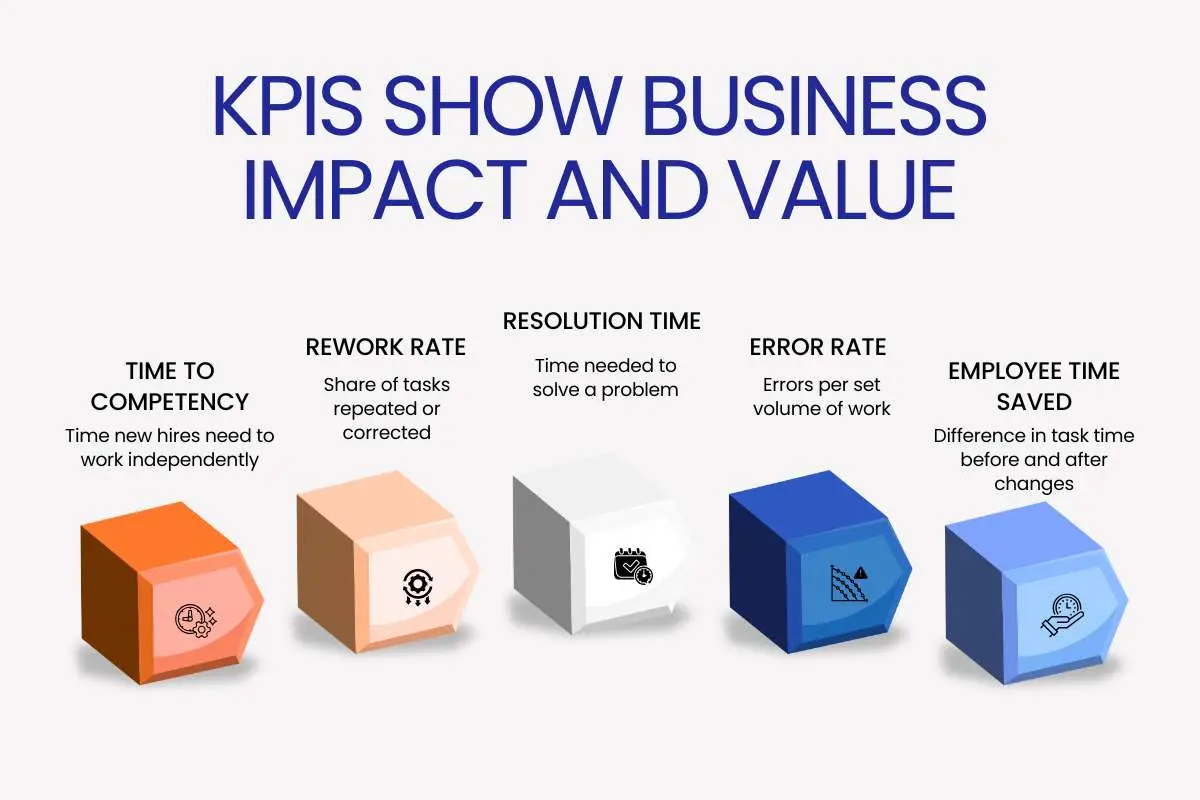
Track these five outcome KPIs:
| KPI | What to measure |
| Time to competency | Time new hires need to work independently |
| Rework rate | Share of tasks repeated or corrected |
| Resolution time | Time needed to solve a problem |
| Error rate | Errors per set volume of work |
| Employee time saved | Difference in task time before and after changes |
To judge results fairly, record a baseline before making changes. Then compare similar tasks or teams and check for other factors that may explain the improvement. These knowledge management metrics help connect better access to knowledge with real work results.
APQC’s 2025 research found that 67% of KM programs measuring innovation speed or time to market reported high or enormous business value, compared with 43% of programs that did not measure those outcomes. This shows an association, not proof that measurement alone caused better results.
Tracking time saved and fewer errors can also support a credible knowledge management ROI calculation. Be careful not to claim every improvement came from KM alone.
How Do You Build a Useful Measurement Dashboard?
A dashboard should help people decide what to fix next, not win a design award. Keep yours simple with five steps:
- Choose one business problem.
- Record current performance as a baseline.
- Select two to four relevant KPIs.
- Assign an owner and review schedule to each.
- Review results and decide what to change.
| Goal | KPI | Review |
| Improve search | Successful search rate | Monthly |
| Preserve expertise | Knowledge capture rate | Monthly |
| Reduce repeat work | Rework rate | Monthly |
| Speed up onboarding | Time to competency | Quarterly |
Knowledge management metrics work best when every KPI has a clear formula, data source, owner, and target. Set review dates based on how quickly results change. A knowledge management framework can connect measures to wider goals, while avoiding common knowledge management mistakes keeps your dashboard focused on results, not numbers for their own sake.
What Measurement Mistakes Should You Avoid?

More numbers do not always mean better measurement. Sometimes, they just mean more numbers to explain at the next meeting.
Good knowledge management metrics help you avoid four common mistakes:
- Treating page views as proof of business value.
- Tracking every activity instead of a few priority KPIs.
- Setting targets without recording a baseline.
- Claiming savings without checking other possible causes.
APQC’s 2025 research found that 38% of KM programs documented success stories and assigned each one a dollar value. This shows how teams can connect real examples to business results, though stories alone cannot prove success.
The best approach combines clear numbers, employee feedback, and real examples of what changed. Together, they help you see whether knowledge management is making work better, not just making reports look busy.
Conclusion: Measure What Changes, Not Just What Moves
Strong knowledge management measures capture, use, and business impact together. A growing knowledge base is only the start. What matters is whether people can find answers and do their jobs better. Start with one business problem, record a baseline, and choose three KPIs to review over the next month.
A clear Knowledge Management strategy connects these measures to wider business goals. It helps teams capture valuable expertise, share knowledge, improve daily work, and build lasting results.
FAQs About Knowledge Management Metrics
1. What is a good benchmark for knowledge management KPIs?
Benchmarks vary by industry, team size, and business goals. Compare performance against your baseline first.
2. Who should be responsible for tracking knowledge management metrics?
Knowledge managers should coordinate tracking, while content owners and team leaders monitor relevant KPIs.
3. How do you measure knowledge sharing between teams?
Track cross-team knowledge reuse, contributions, completed knowledge transfers, and employee feedback.
4. What tools can help track knowledge management performance?
Knowledge bases, analytics dashboards, search reports, and employee surveys can help measure performance.
5. How long does it take to see results from knowledge management?
Adoption and search improvements may appear within weeks, while productivity and financial outcomes often require longer observation.