

Delivering effective fintech compliance requires leadership, technical precision, and measurable outcomes. In a world of growing financial crime and regulations, platforms must combine speed, accuracy, and transparency while maintaining client trust.
Mark Watson, Chief Product and Technology Officer of ComplyAdvantage, brings over 26 years of experience leading technology organisations across global enterprises and high-growth startups. Before joining ComplyAdvantage in 2022, he served as CTO at WorldRemit, managing compliance in fast-moving cross-border payments. He states, “You cannot bolt AI onto a broken architecture and expect it to work. You need to own the entire stack.” At ComplyAdvantage, Mark built an integrated platform that processes proprietary data through a unified pipeline and continuously learns via a centralised knowledge graph.
Under his leadership, the company applies AI at scale, automates up to 85% of false positives, and embeds explainability, auditability, and ethical AI principles into every decision. Mark’s vision positions ComplyAdvantage to anticipate risk, deliver measurable outcomes, and maintain strict regional compliance across the global fintech ecosystem.
Leadership Grounded in Architectural Control

With more than 26 years of leading technology organisations across global enterprises and high-growth startups, Mark built a career defined by scale and precision. As CTO at WorldRemit, he confronted the operational strain of managing compliance within a rapidly expanding cross-border payments business. Product innovation consistently collided with fragmented compliance systems that relied on reactive processes.
This experience shaped his conviction that artificial intelligence cannot succeed when layered onto disjointed infrastructure. When Mark joined ComplyAdvantage in 2022, he committed to building an integrated architecture that ingests proprietary data, processes it through a unified pipeline, and connects it within a continuously learning knowledge graph to ensure transparency and speed.
Vision for 2026 and Beyond
Mark Watson envisions an AI native compliance platform where intelligence forms the architectural core. He is advancing autonomous agents that operate within client environments, execute decisions, and continuously contribute intelligence back into a centralised knowledge graph, positioning compliance as an embedded operational capability for the future.
Designing Systems that Anticipate Risk
A decisive shift is underway in fraud detection and anti-money laundering toward predictive risk management, a transition Mark actively advances. He observes a sharp rise in AI-enabled financial crime, where generative tools create synthetic identities, deepfake documentation, and advanced social engineering at scale. Static rule-based systems fail to keep pace with this sophistication.
“The future of compliance belongs to platforms that can anticipate risk before it surfaces, not report on it afterwards.”
Mark states
Under his leadership, ComplyAdvantage advances agentic workflows that combine intelligent client-facing agents, a knowledge graph of 23 million entities, and retrieval augmented generation that reasons securely over private client data. This structure enables earlier identification of emerging threats and delivers clear auditability. Mark also recognises a regulatory shift. Authorities now focus on ensuring AI systems remain explainable and defensible within compliance frameworks.
He has prioritised investment in transparency and governance, positioning ComplyAdvantage to meet rising supervisory expectations while maintaining operational precision.
Executing Compliance Logic at Machine Speed
Mark Watson applies AI advancements directly within production environments at ComplyAdvantage. He oversees the processing of approximately 8 million articles daily, where large language models classify adverse media across 34 distinct risk subcategories under strict governance and monitoring standards. He integrates graph technology with machine learning to enable continuous inference, with the knowledge graph identifying nearly 20000 new facts per hour, including corporate associates, relatives, and beneficial owners that the source data does not explicitly state.
Large language models generate natural language rules within the platform, converting compliance instructions into executable logic under Mark’s direction. Compliance teams describe detection logic in plain English, and the system converts those instructions into executable code. He states, “AI must operate at scale, with accountability built into every layer.” Through this approach, Mark delivers measurable operational capability while maintaining transparency and control.
Automating Case Decisions With Accountable AI
Client impact rests on 2 foundational innovations that improve accuracy and operational throughput at scale. Mark prioritises measurable outcomes and embeds accountability within every system deployed across thousands of organisations.
Core Innovations Under Mark Watson’s Leadership:
- Machine Learning Based Entity Resolution
Mark implemented vector-based search and probability scoring to reduce false positives generated by traditional fuzzy matching across sanctions, PEP, and adverse media datasets. Clients calibrate thresholds according to risk appetite, achieving false positive reductions of up to 82%.
- Autonomous Remediation Agents
AI agents now operate within case management workflows, documenting reasoning and executing decisions with full audit trails. In production, these agents resolve 65 to 85% of false positives without human intervention.
Standout Outcome: Sutherland Partnership
Through platform integration, Sutherland achieved a 70% reduction in false positives and a 50% increase in investigation speed, screening 99% of payments in under 0.5 seconds while handling 7 times the workload with the same staff.
“Impact must be measurable. Precision and autonomy must translate into real operational advantage.”
Mark Watson states
Architecting Jurisdictional Precision
Mark treats global compliance as an architectural priority. He builds systems that centralise intelligence while enforcing strict regional control.
- Strategic Context: A multi-cloud, multi-tenant platform operates across the UK, Ireland, France, the US, Canada, Singapore, Australia, and India. The central challenge lies in maintaining unified global intelligence while meeting strict local regulatory requirements.
- Architectural Blueprint: The data platform is centralised in Brussels as the single source of truth for the knowledge graph. Intelligence replicates to regional environments via Kafka, enabling sanctions updates to propagate globally in under 1 minute. Private client data remains within its jurisdiction, ensuring compliance with data residency mandates while preserving the benefits of shared intelligence.
- Regional Expansion Example: Regional hosting in India was prioritised to meet local regulatory requirements. The architecture supports rapid regional deployment, allowing new markets to activate efficiently without structural redesign.
Mark Watson proves that precise architecture enables global scale without compromising regulatory control.
Addressing the Black Box Challenge
The black-box problem, Mark explains, remains the primary obstacle to building a trusted AML platform within regulatory environments such as PSD3 and DORA. Regulators reject unexplained model outputs, regardless of predictive accuracy. He recognises that without a clear justification for why an alert was raised or dismissed, compliance risk persists.
To address this, Mark embedded explainability into the platform’s architecture as a non-negotiable requirement. Every decision executed by autonomous agents generates a detailed, immutable audit log. When an agent clears a false positive, it records the attributes assessed and the reasoning applied. Human analysts can review this documentation in real time, and regulators can audit each step with clarity.

“If a decision cannot be explained, it cannot be defended.”
Mark Watson states,
He also commissions independent third-party validation to align models with standards such as NYDFS 504 and OCC guidance. Through structured documentation and external review, Mark ensures automated decisions remain transparent, traceable, and defensible under regulatory examination.
A Clear Path to 95% Automation
Mark Watson sets a bold objective for 2026: achieve 95% automation in financial crime detection while maintaining near-zero false positives and full regulatory defensibility. He anchors this ambition in disciplined architecture and measurable performance, building on the 65 to 85% automation already operating in production.
Strategic Pillar 1: Expanding the Agents and Graph Loop
An autonomous agent framework now deploys directly within client systems under Mark’s leadership. These agents execute compliance decisions locally and exchange intelligence with a centralised knowledge graph. This structure ensures distributed execution with unified oversight and measurable control.
Strategic Pillar 2: Federated Intelligence at Scale
Federated learning models combine risk insights across institutions without transferring private data outside their jurisdiction. This structure preserves data control while unlocking collective intelligence across the network.
Strategic Pillar 3: Closing the Final Automation Gap
Focused attention on edge cases, explainability, and regulatory assurance supports progress toward the 95% automation benchmark.
“True scale requires autonomy, shared intelligence, and regulatory confidence built into the architecture,”
says Mark.
Ethical AI Built Into Every Layer
Mark Watson ensures that ethical AI is a core principle at ComplyAdvantage. He designs agents to augment human analysts, giving them visible roles in the case management workflow to make AI actions comprehensible. Human oversight remains central, guiding decision-making while preserving efficiency.
From a privacy standpoint, Mark’s architecture shares risk intelligence globally while keeping sensitive client data isolated within its hosting region. The knowledge graph learns from patterns across the client base without exposing individual data outside permitted boundaries.
Governance reinforces accountability. Mark Watson established a Model Review Board to oversee all models, each governed by a formal Model Requirements Document specifying use, training data, performance thresholds, and monitoring. He states, “Clear boundaries empower teams to innovate responsibly while maintaining trust and regulatory compliance.”
Operational Metrics that Define Impact
Operational performance and platform scale are demonstrated through measurable statistics reflecting speed, efficiency, accuracy, and intelligence across global compliance operations. These metrics demonstrate the platform’s ability to handle complex compliance workloads across the global fintech ecosystem.
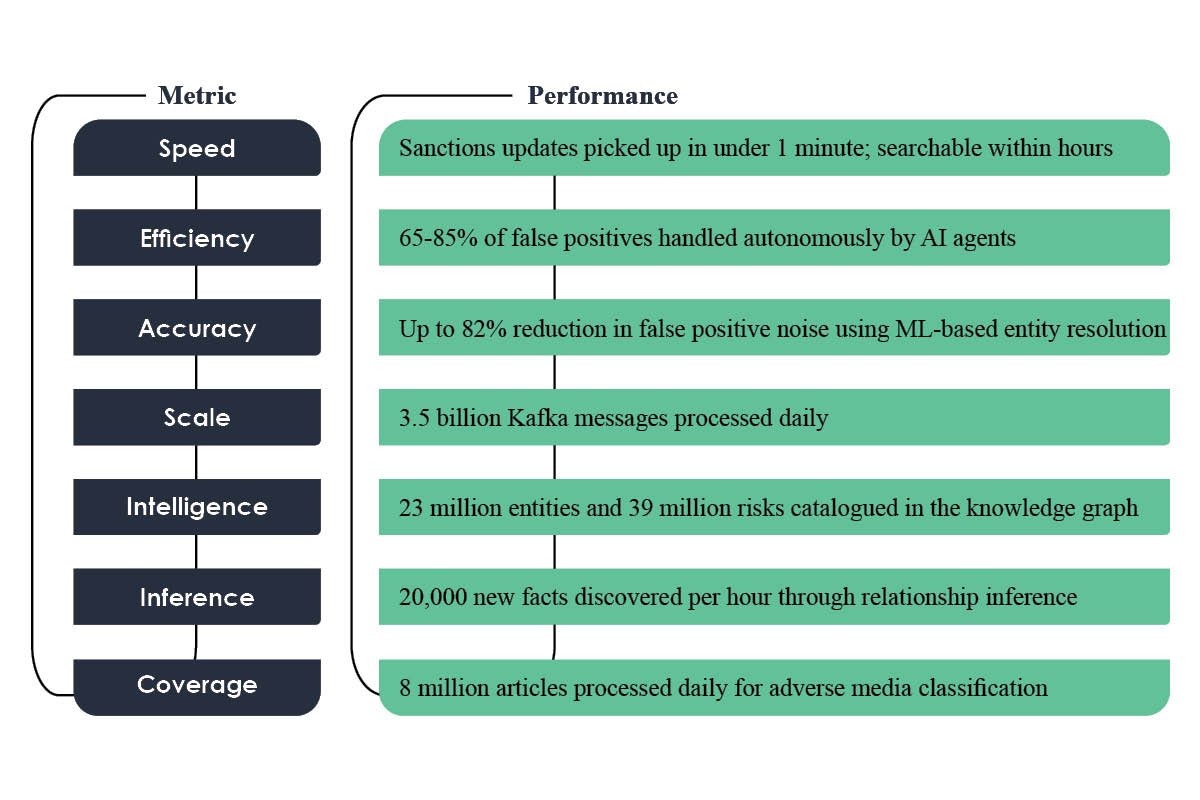
| Metric | Performance |
| Speed | Sanctions updates picked up in under 1 minute; searchable within hours |
| Efficiency | 65-85% of false positives handled autonomously by AI agents |
| Accuracy | Up to 82% reduction in false positive noise using ML-based entity resolution |
| Scale | 3.5 billion Kafka messages processed daily |
| Intelligence | 23 million entities and 39 million risks catalogued in the knowledge graph |
| Inference | 20,000 new facts discovered per hour through relationship inference |
| Coverage | 8 million articles processed daily for adverse media classification |
These metrics reflect Mark’s commitment to delivering precise, scalable, and auditable compliance intelligence.
Key Takeaways from Mark Watson’s Leadership and Vision
- Mark Watson prioritises owning the entire technology stack to ensure AI functions effectively and transparently.
- He advances predictive risk management to anticipate financial crime before it occurs.
- Autonomous remediation agents and ML-based entity resolution reduce false positives by up to 82%.
- Global intelligence is centralised while maintaining strict regional compliance and data residency.
- Explainability and auditability are embedded in every automated decision to satisfy regulators.
- Mark targets 95% automation in financial crime detection, with human oversight integrated throughout.
- Ethical AI principles guide platform design, balancing human oversight, innovation, and client privacy.
- Operational metrics demonstrate scale, speed, accuracy, and intelligence across billions of transactions daily.

An Open Letter to Emerging Leaders in Fintech Compliance
To the next generation of professionals, entrepreneurs, and leaders entering the fintech compliance space, I want to share a few lessons that have guided my journey.
Curiosity is your most durable asset. You do not need to master AML regulation from day one, but you must be fascinated by how systems operate at scale and what technology makes possible. The regulatory environment will change, and the technology will change faster. Staying curious allows you to adapt and uncover new opportunities.
For those stepping into leadership roles, remember that management is a leverage role. Your responsibility is not to be the smartest person in the room. It is to create an environment where your team can perform at its best. This requires a balance of psychological safety and high accountability. People must feel they can experiment without fear, while also meeting clear standards.
Finally, measure everything. Whether it is developer velocity, model accuracy, or client outcomes, let data guide your decisions. Metrics create clarity, accountability, and continuous improvement.
The fintech compliance sector needs thoughtful, bold, and disciplined leaders. If that describes you, embrace the challenge and the opportunity it brings.
Warmly,
Mark Watson
CPTO, ComplyAdvantage












