


College life can be expensive. Tuition, books, accommodation, and daily expenses can put pressure on your budget. A part-time job can help, but fixed shifts may not always fit around classes, assignments, and exams.
Starting an online business gives you a chance to earn while studying, put your skills to use, and work on a schedule that suits you. You can begin with something you already know, such as writing, designing, or tutoring, and build your experience as you go.
But which business should you choose? Let’s look at some ideas that can help you put your skills to work and earn money without stepping away from college.
What Are the Best Online Business Ideas for Students?
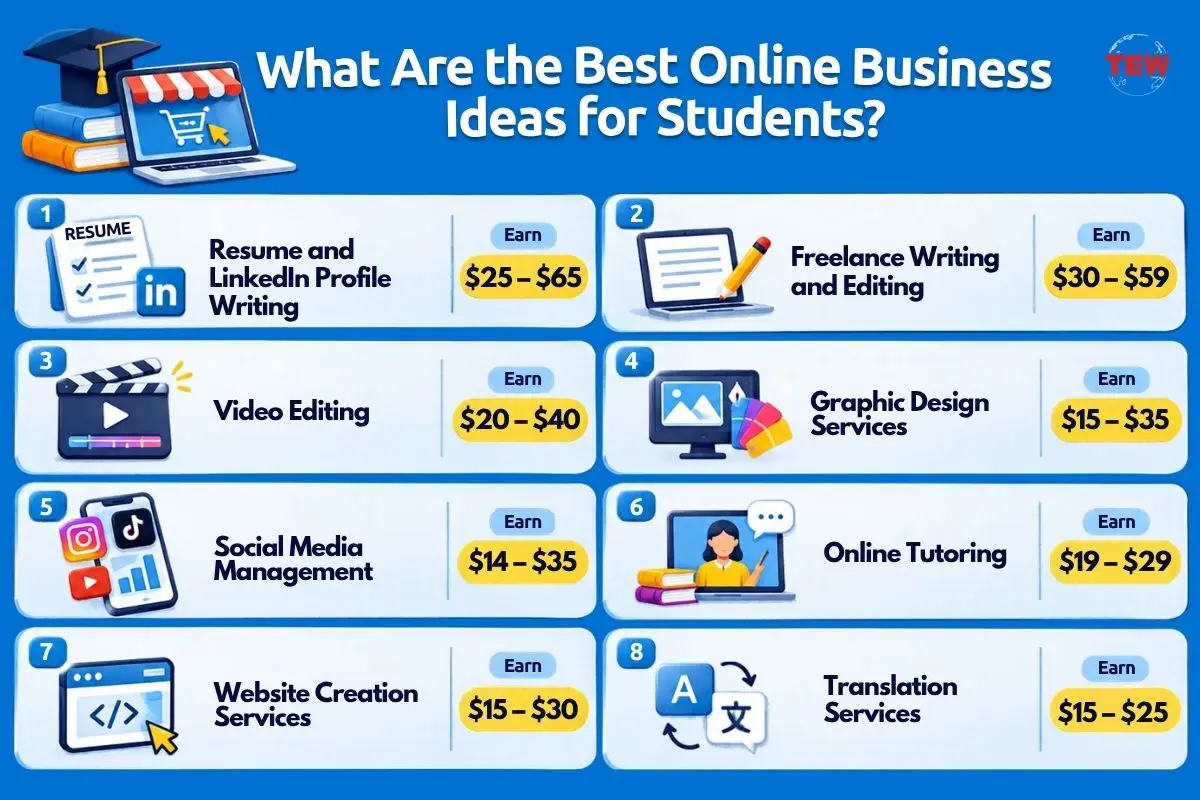
The table below gives a quick comparison of the earning potential of each business. The figures are indicative market rates in the US, not guaranteed earnings for students. Actual rates depend on experience, work quality, client demand, and project scope.
| Rank | Online business idea | Estimated hourly earning potential |
| 1 | Resume and LinkedIn Profile Writing | $25–$65 |
| 2 | Freelance Writing and Editing | $30–$59 |
| 3 | Video Editing | $20–$40 |
| 4 | Graphic Design Services | $15–$35 |
| 5 | Social Media Management | $14–$35 |
| 6 | Online Tutoring | $19–$29 |
| 7 | Website Creation Services | $15–$30 |
| 8 | Translation Services | $15–$25 |
Ranking method: Each business idea is ranked by the median of its estimated hourly earning range, calculated from freelance marketplace rate guides and published pay estimates. These figures are indicative benchmarks, not guaranteed earnings or directly comparable salaries.
1. Resume and LinkedIn Profile Writing
Students and recent graduates often need help presenting their skills and experience when applying for internships or entry-level jobs. If you understand what recruiters look for, you can turn that need into a small resume-writing business.
You can offer services such as resume formatting, proofreading, rewriting work experience, improving LinkedIn headlines, and writing professional summaries. You can also create packages that combine a resume review with LinkedIn profile updates.
Who will pay for it? College students, recent graduates, job seekers, and professionals looking to change careers.
How to find your first customer: Start with your college placement groups, alumni network, and student communities. Offer a few resume reviews to build examples of your work, then ask satisfied clients for referrals. LinkedIn can also help you reach job seekers directly.
What you need to start: Strong writing and editing skills, an understanding of common resume formats, and basic knowledge of how applicant tracking systems (ATS) read resumes. You can create documents using Google Docs or Microsoft Word without investing in expensive software.
2. Freelance Writing and Editing
Businesses need written content to explain their products, attract customers, and stay visible online. Many small companies cannot maintain an in-house writing team, which creates opportunities for student writers who can produce clear, well-researched content.
You can specialise in blog posts, website copy, product descriptions, newsletters, case studies, or social media captions. Editing is another service worth offering. It can include checking grammar, improving sentence flow, restructuring drafts, and making content easier to understand.
Who will pay for it? Small businesses, digital marketing agencies, website owners, startups, and independent professionals.
How to find your first customer: Choose a subject you understand and write two or three relevant samples. For example, a student interested in technology could create a sample blog about a new software tool. Share your work on LinkedIn, approach small businesses with outdated website content, or apply for beginner writing projects on freelance platforms.
What you need to start: Good grammar, research skills, and the ability to adapt your writing to different audiences. Google Docs is enough for drafting and editing. Tools such as Grammarly can help with proofreading, but they should not replace your own editing.
3. Video Editing
Short-form videos have become a regular part of how creators and businesses communicate online. However, recording content and editing it are two different tasks. Many creators have footage ready but need someone to turn it into videos that hold viewers’ attention.
You can start by offering specific editing services rather than taking on every type of video project. These could include editing Instagram Reels and YouTube Shorts, adding subtitles, removing pauses, improving audio, inserting transitions, or creating longer YouTube videos. You can also offer thumbnail design as an additional service.
Who will pay for it? Content creators, YouTubers, podcasters, coaches, small businesses, and marketing agencies.
How to find your first customer: Look for small creators who publish regularly but have inconsistent editing. Make a short sample using footage you have permission to use, or create a before-and-after editing demonstration. Reach out with one specific suggestion about how you could improve their videos instead of sending a generic service pitch.
What you need to start: Editing skills, a computer or capable smartphone, and editing software. Beginners can practise with tools such as CapCut or DaVinci Resolve. As you gain experience, you can offer more advanced services such as motion graphics, colour correction, and audio editing.
4. Graphic Design Services
Businesses need visual content for their websites, social media pages, presentations, and marketing campaigns. A student with a good eye for layout and design can offer these services without setting up a physical studio.
Start with a few clearly defined services. You could design social media posts, presentation slides, event posters, brochures, digital invitations, or simple brand kits. Focusing on a particular type of design can make it easier for customers to understand what you offer and decide whether your work fits their needs.
Who will pay for it? Small businesses, student organisations, event organisers, independent professionals, and early-stage startups.
How to find your first customer: Approach college clubs, local businesses, and student event organisers who regularly need posters or promotional material. You could also redesign a sample social media post or presentation slide to demonstrate how your work can improve an existing design.
What you need to start: Knowledge of typography, colour, spacing, and visual hierarchy. Canva is useful for simpler designs, while Adobe Illustrator and Photoshop offer more advanced options. Behance can help you display your work, while freelance marketplaces can connect you with potential clients.
5. Social Media Management
You can offer services such as creating monthly content calendars, writing captions, designing posts, scheduling content, and tracking engagement. Start with one platform, such as Instagram or LinkedIn, and help a business maintain its posting schedule and respond to customer queries. As you gain experience, you can take on content planning and performance reporting.
Who will pay for it? Local shops, restaurants, independent professionals, small service businesses, and startups.
How to find your first customer: Look for businesses with inactive accounts, inconsistent posts, or incomplete profiles. Suggest a simple content plan based on their audience and business goals. A short sample calendar with a few post ideas can help demonstrate what you bring to the table.
What you need to start: An understanding of social media trends, content planning, copywriting, and basic design. Tools such as Canva and Meta Business Suite can help with content creation and scheduling. You should also know how to read basic engagement and reach metrics so you can explain what is working.
6. Online Tutoring
Students who perform well in a particular subject can use that knowledge to earn by teaching others. Online tutoring allows you to work with learners outside your college or local area, and you can choose subjects and schedules that fit around your classes.
You could teach school subjects, college-level topics, languages, or skills such as basic coding and mathematics. You can also offer exam preparation, homework guidance, or one-to-one lessons for students who need help with specific topics. It is better to begin with subjects you know well than to advertise yourself as a tutor for everything.
Who will pay for it? School students, college students, parents, and adult learners preparing for exams or learning a new skill.
How to find your first customer: Start with referrals from classmates, family contacts, and local student communities. You can also create a tutor profile on platforms such as Wyzant, Preply, or Superprof, depending on their eligibility requirements and the subjects you teach.
What you need to start: Strong subject knowledge, clear communication, and the ability to explain difficult concepts in simple terms. A laptop or smartphone, a stable internet connection, and a video-calling platform are usually enough for online lessons. Prepare a sample lesson or short explanation to show prospective students how you teach.
7. Website Creation Services
Small businesses often need a website but may not have the budget to hire a full web development agency. Students who understand website builders and basic design principles can help these businesses establish an online presence.
You can start with simple projects such as building a business website, creating a landing page, setting up a portfolio, or updating an existing website. For example, a local salon might need a website with its services, prices, location, and booking details. A freelancer might need a portfolio that displays previous projects and contact information.
Who will pay for it? Local businesses, independent professionals, consultants, creators, and early-stage startups.
How to find your first customer: Look for businesses that rely only on social media or have outdated websites. Prepare a sample homepage for a fictional business or redesign a page as a demonstration. When approaching a potential customer, explain the practical improvement your website could provide, such as making services easier to find or giving visitors a way to contact the business.
What you need to start: Basic knowledge of website layout, navigation, mobile-friendly design, and content organisation. Website builders such as WordPress, Wix, and Squarespace can help you create sites without advanced coding skills. More complex projects may require HTML, CSS, or JavaScript knowledge.
8. Translation Services
Businesses that communicate with customers in different regions often need content translated into local languages. Students who are fluent in more than one language can offer translation services to companies, publishers, and individuals.
You can begin with manageable projects such as translating website pages, product descriptions, marketing material, subtitles, or business documents. Specialising in a particular type of content can help you build relevant experience.
Who will pay for it? Businesses entering new markets, marketing agencies, publishers, content creators, and individuals who need documents translated.
How to find your first customer: Connect with businesses that serve multilingual audiences and look for translation projects. Prepare a short sample that shows the original text alongside your translation. This helps potential clients assess your accuracy and writing style.
What you need to start: Strong reading and writing skills in both languages, an understanding of cultural context, and careful proofreading habits. Translation tools can assist with terminology and first drafts, but you should review every sentence yourself. Avoid accepting legal, medical, or other specialised translation work unless you have the necessary subject knowledge.
Conclusion::
Starting an online business while studying lets you earn money, build practical skills, and gain experience working with clients. These online business ideas for students include freelance writing, resume writing, video editing, tutoring, and virtual assistance, so you can choose an option that matches your skills and interests.
Choose a business that fits your abilities and academic schedule. Start with a manageable workload, create a few samples to showcase your work, and take on more projects as you gain experience. This way, you can earn while studying and build skills that will benefit your future career.
FAQs
1. What are the easiest online business ideas for students to start?
Freelance writing, virtual assistance, transcription, and online tutoring are accessible options if you already have the required skills and tools.
2. Can you start an online business with no money?
Yes. You can start services such as writing, tutoring, and virtual assistance using a laptop or smartphone, an internet connection, and free tools.
3. How can you manage an online business while studying?
Set weekly work limits, choose flexible projects, and plan deadlines around your classes and exams. Avoid taking on more work than you can handle.
4. Which online business skills are in demand?
Writing, graphic design, video editing, website creation, social media management, translation, and administrative support are common freelance services.
5. Do you need to register an online business in the US as a student?
It depends on your business structure and location. Check your state’s registration, licensing, and tax requirements before starting.
Source: