Key takeaways:
- Unitree Robotics IPO shows enormous investor confidence in humanoid robotics.
- China is rapidly positioning itself as a global leader in robotics.
- The real test is turning impressive robots into commercially useful machines.
Chinese robotics company Unitree Robotics IPO made a dramatic debut on the Shanghai Stock Exchange’s STAR Market on Wednesday, August 19, as investors rushed to buy shares of one of China’s most prominent humanoid robot makers.
The Hangzhou-based company, officially known as Yushu Technology, raised approximately 6.1 billion yuan ($904 million) through its initial public offering. It sold about 40.4 million shares at an IPO price of 150.80 yuan each.
The market response was far stronger than expected. Unitree shares opened at 1,100 yuan, representing a 629% increase over the IPO price and briefly giving the company a market capitalization of around 445 billion yuan, or approximately $66 billion. The stock later pulled back below 900 yuan during early trading.
The listing makes Unitree the first publicly traded humanoid robot maker on a mainland Chinese exchange. Its IPO had already attracted extraordinary investor interest before trading began, with millions of retail investors competing for a limited number of shares.
The company’s debut also came as China’s robotics industry received fresh attention at the World Robot Conference in Beijing. The event brings together hundreds of robotics companies and highlights the country’s growing push to develop technologies that combine artificial intelligence with physical machines.
Unitree’s rise from robot dogs to humanoids
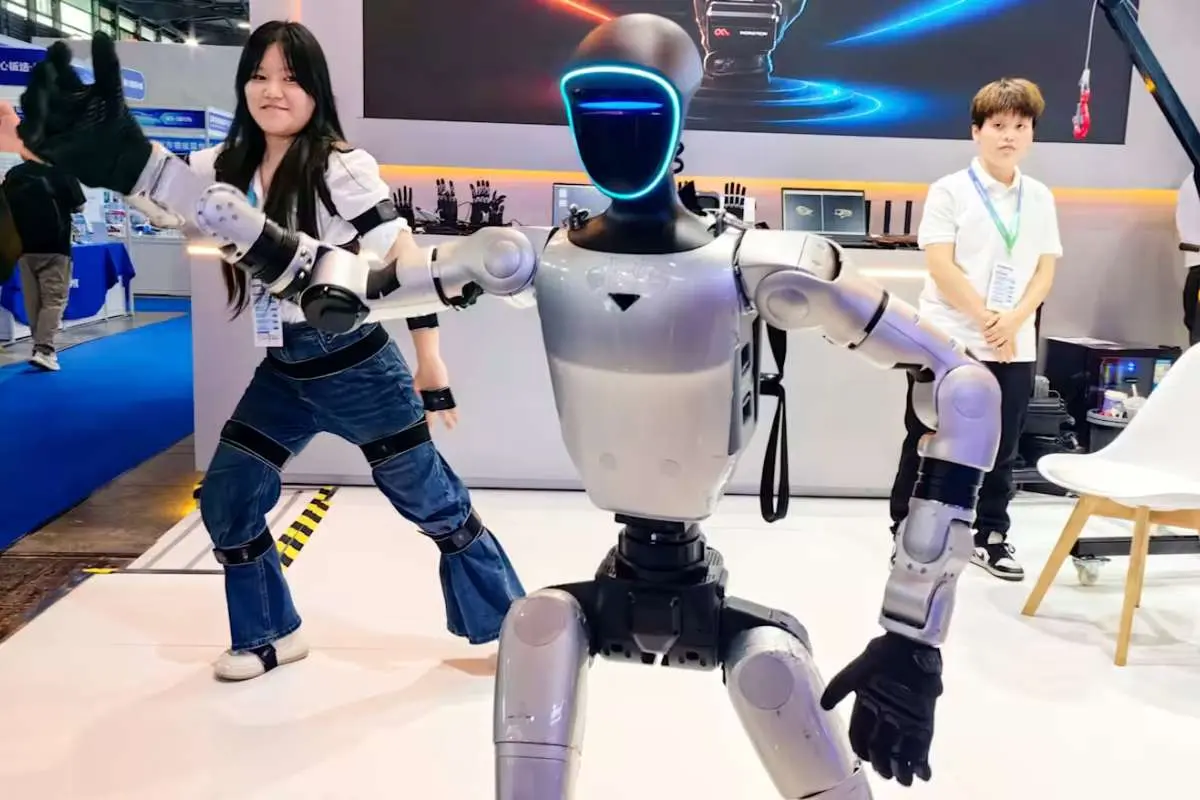
Unitree has become widely known for developing highly mobile robots capable of running, jumping, dancing, and performing complex movements. The company initially gained attention through its quadruped robot dogs before expanding aggressively into humanoid robotics.
Its humanoid machines have increasingly become the focus of its business, with products designed for research, education, entertainment and potential industrial applications.
Just before its IPO, Unitree Robotics IPO unveiled its latest humanoid robot, called “Superman.” The company said the machine can reach a top speed of 12.66 metres per second and perform a two-metre vertical jump. Unitree also said the robot was developed in slightly more than three months.
The announcement reinforced the company’s reputation for prioritising mobility and physical performance as it competes in the rapidly developing humanoid robotics market.
Unitree’s growth reflects a broader shift in the artificial intelligence industry. As companies and investors move beyond software-based AI systems, increasing attention is being directed toward embodied AI, technologies that allow machines to perceive their surroundings, make decisions, and physically interact with the world.
China has positioned robotics as a strategic technology and has invested heavily in developing the manufacturing capabilities needed to support the sector. The country currently accounts for a dominant share of global humanoid robot shipments, giving domestic companies such as Unitree an important advantage in production and supply chains.
Commercial success will be Unitree’s next challenge
Despite the excitement surrounding Unitree’s IPO, the company and the wider humanoid robotics industry still face a major test: turning impressive demonstrations into commercially valuable products.
Robots capable of performing backflips, running at high speeds, or completing choreographed routines attract considerable public attention, but businesses ultimately need machines that can perform useful tasks reliably, safely, and at a cost that makes financial sense.
The industry is already beginning to move toward applications in manufacturing, logistics, retail and other workplaces. However, widespread adoption remains limited. The cost of humanoid robots, along with challenges involving battery life, autonomy, dexterity and artificial intelligence capabilities, continues to restrict their deployment.
Industry participants are therefore increasingly focused on whether robots can deliver measurable productivity gains rather than simply demonstrate technical capabilities. Some humanoid robots are currently being used primarily to collect training data and improve AI systems rather than to replace workers in large-scale commercial operations.
For Unitree, the challenge following its blockbuster listing will be to prove that its technology can translate into sustainable revenue and long-term growth.
The company’s stock market performance nevertheless represents a significant moment for China’s robotics industry. The extraordinary investor response signals strong confidence that humanoid robots could become an important part of the next phase of artificial intelligence and automation.
For now, Unitree Robotics IPO Shanghai debut has transformed it from a robotics startup known for viral robot demonstrations into a publicly traded company facing intense market expectations. Its future success will depend on whether its robots can move beyond spectacular performances and become practical machines capable of delivering real value in the workplace.