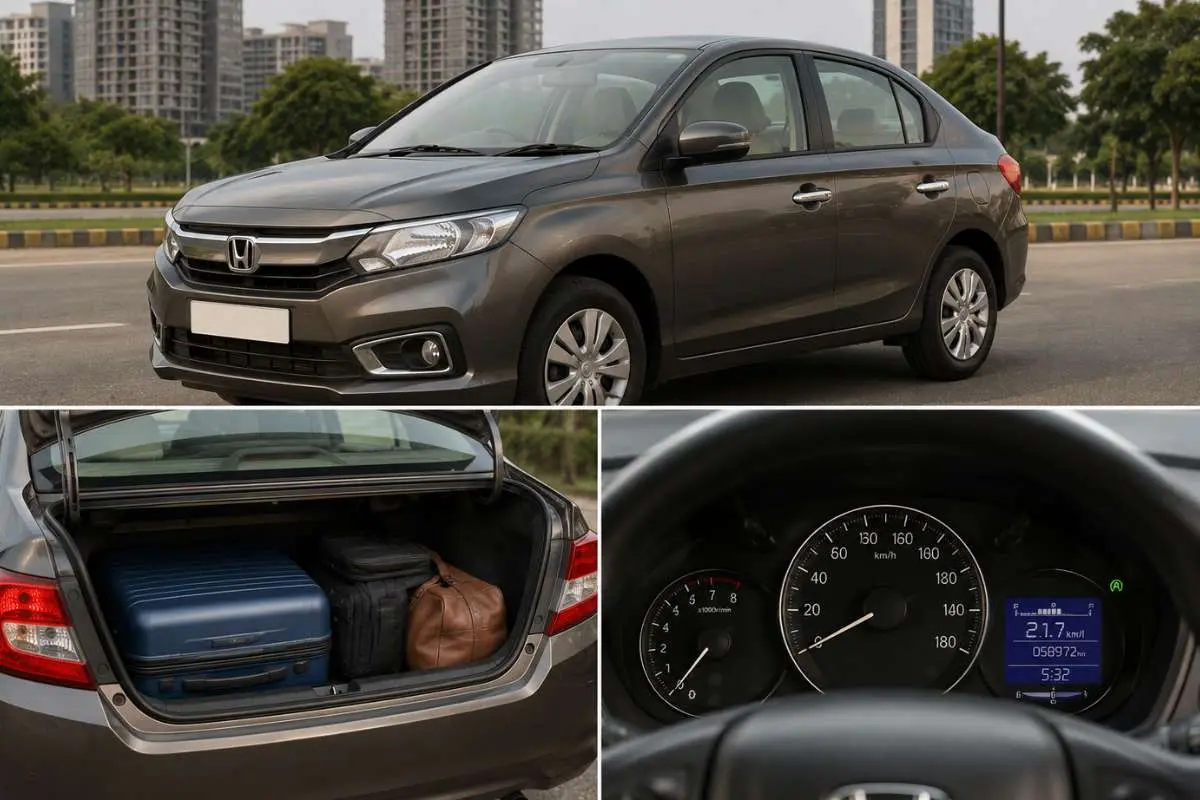
The Honda Amaze occupies a particular niche in India’s compact car market, it’s a sub-4-metre sedan, competing in the same space as the Maruti Dzire and Tata Tigor, but carrying Honda’s specific engineering sensibility in a package that prioritises refinement and durability over feature-count or segment price leadership. In the used market, this combination tends to age very well, which explains why well-maintained Amaze examples consistently attract buyers across generations.
For buyers exploring used Honda Amaze cars in the certified market, the Amaze offers a combination of practicality and durability that is hard to match at the price, and it holds up well against the wider 2nd hand Honda cars range for buyers who want the Honda ownership experience on a tighter budget.
Boot space and why it matters
Let’s start with the most practically useful attribute: the boot. The second-generation Amaze (2018 onwards) has a 420-litre boot, which is among the largest in the compact sedan category. This isn’t just a spec sheet number, it translates to actually fitting two large suitcases, a stroller, or a week’s worth of family grocery shopping without creative stacking. For buyers who use their car for regular airport runs, weekend trips, or transporting work equipment, this capacity is a genuine day-to-day advantage over hatchback alternatives at similar prices.
The engine lineup in the second-gen Amaze is where the most significant used car decision lies. The petrol option is a 1.2-litre i-VTEC naturally aspirated unit making 90ps, smooth, reliable, and easy to maintain. The diesel is a 1.5-litre i-DTEC making 100ps, paired with either a 6-speed manual or a CVT. The diesel Amaze is where the real-world mileage story gets interesting.
Under ARAI testing conditions, the diesel Amaze manual returned figures around 24 km/l. In real-world mixed driving, consistent users report 20-23 km/l, which is exceptional for a car that offers this level of interior space and refinement. This economy, maintained over years of ownership, is a significant part of why diesel Amaze owners hold onto the car longer, and why good-condition diesel examples tend to sell faster in the used market.
Reliability, running costs, and what to check

Reliability is Honda’s most enduring legacy in India. The i-VTEC petrol engine family has been in use for decades, and its engineering reputation is genuine, not marketing. Service items, timing chain (not belt) on the petrol, which eliminates one of the most expensive scheduled replacements, oil changes, and brake maintenance are straightforward. Independent mechanics who know Honda engines are widely available, which means you’re not captive to authorised service centres for routine maintenance, though the dealer network itself is reasonably strong.
What to check when buying a used Honda Amaze: the CVT variant requires confirmation that the transmission fluid has been changed at proper intervals (Honda recommends 40,000 km or every 3 years). The diesel variants should be asked about carbon build-up management, regular long drives to ensure the exhaust system stays clean are important for longevity. In cars used primarily for short city trips, the diesel may develop soot accumulation issues over time.
If you’re exploring used Honda Amaze cars, focus your search on 2019-2022 examples in VX and VX CVT trims, these offer the best feature-to-reliability balance, with sunroof, lane watch camera, and the cleaner Honda CONNECT infotainment interface. Prices in this range typically sit between ₹6 and ₹9 lakh in good condition.
For buyers who want to explore the wider 2nd hand Honda cars market, the Jazz and City are both worth considering depending on whether you prioritise hatchback practicality or the full sedan experience, but the Amaze is the sweet spot of affordability and genuine Honda quality at the ₹6-9 lakh used budget.
The generational difference between the first and second generation Amaze also matters for used car buyers. The first-generation Amaze (2013-2018) used an older platform and an older diesel engine technology, the 1.5L i-DTEC unit was introduced with the first gen, but the cabin quality, feature set, and refinement levels were noticeably lower than the 2018-onwards second generation. Buyers who find a very cheap Amaze listing should confirm which generation they’re looking at before proceeding.
In the petrol Amaze, the CVT variant deserves specific mention as a used car consideration. The Amaze CVT is smooth and refined for city use, and Honda’s CVT has a reliable track record. But the rateless nature of the transmission can feel uninvolving on highway undulations, and fuel economy, while better than a torque converter automatic, is slightly lower than the manual. For city-primary buyers who commute in stop-and-go conditions daily, the CVT remains the most comfortable long-term choice.
Second-generation Amaze interiors have held up well in the used market. The materials are slightly better than segment average, and the layout is sensible. Check specifically that the touchscreen (if equipped) is responsive and the Honda CONNECT connected car features are working, these systems were not always updated consistently, and some units have software that hasn’t received later patches.
Thanks for reading
see next
“Second Hand Toyota Fortuner: Why It Remains the Most Trusted Used Toyota Car in India“