Email returns an average of $36 for every $1 spent, yet most startups pour limited budgets into ads that vanish the moment funding does. If you’re launching with little cash, you don’t need a bigger budget; you need smarter tactics. Low-cost marketing strategies for startups, like SEO, email, referrals, and community building, let you reach customers where they already spend time. And with 92% of consumers trusting recommendations from people they know, word-of-mouth compounds fast.
In this guide, you’ll learn which channels deliver the best returns, how to test ideas before spending heavily, and how to measure what actually drives leads and sales in 2026.
What makes a marketing strategy low-cost?
A low-cost marketing strategy minimizes upfront spending while using assets a startup can build over time. Such as content, customer relationships, search visibility, referrals, email lists, and communities.
However, low-cost does not mean completely free. Most channels require an investment of time, skills, software, or people. The goal is to find the combination that can produce meaningful results without creating unsustainable costs.
15 low-cost marketing strategies for startups
1. Build an SEO-focused website
Your website can become a long-term source of organic traffic when it answers the questions potential customers are already searching for.
Start with:
- Keyword-focused service and product pages
- Helpful blog content
- Clear page titles and descriptions
- Internal linking
- Fast, mobile-friendly pages
- Strong calls to action
- Content that directly answers customer questions
For a new startup, focus on specific, lower-competition searches rather than trying to rank immediately for broad keywords.
2. Create useful content

Content marketing allows startups to demonstrate expertise without paying for every impression.
Create:
- How-to guides
- Comparison articles
- Original research
- Case studies
- Checklists
- Short videos
- Industry explainers
- Customer stories
Instead of producing content simply to publish frequently, connect every piece to a customer problem, search intent, or business goal.
3. Use social media strategically
You do not need to maintain an active presence on every platform.
Among the most effective low-cost marketing strategies for startups is choosing the platforms where your target customers are most active and focusing on useful, repeatable content.
Short-form video, educational posts, founder-led content, behind-the-scenes material, and customer stories can help startups build visibility organically.
4. Turn one piece of content into many
Content repurposing can reduce the time and cost of marketing.
For example, one detailed blog post can become:
- Three LinkedIn posts
- Several short videos
- An email newsletter
- An infographic
- A carousel
- A customer FAQ
This approach helps a small team get more value from every piece of content it creates.
5. Start an email list early
An email list gives startups a direct way to communicate with interested customers without depending entirely on social media algorithms.
Offer something useful in exchange for an email address, such as a guide, checklist, template, free trial, or product-related resource.
Then send useful updates rather than turning every email into a sales pitch.
6. Encourage referrals
Happy customers can become one of your most affordable acquisition channels.
Create a simple referral system that rewards customers for introducing relevant new customers. Depending on the business, rewards could include discounts, account credits, upgrades, free products, or exclusive access.
7. Collect reviews and user-generated content
Customer reviews, testimonials, photos, videos, and social posts can provide social proof that a startup cannot easily create through advertising.
Make it easy for customers to share their experiences, but do not incentivize reviews in ways that violate platform policies.
8. Work with micro-creators

Large influencers can be expensive, while smaller creators may have highly engaged niche audiences.
Look for creators whose audience actually matches your customer profile. Depending on the creator and campaign, collaborations can involve paid sponsorships, affiliate arrangements, free products, or other mutually agreed partnerships.
Focus on audience relevance rather than follower count alone.
9. Build partnerships with complementary businesses
Find businesses that serve the same audience without directly competing with you.
For example:
- A fitness coach can partner with a healthy meal business.
- A web designer can partner with a copywriter.
- A wedding photographer can partner with a wedding planner.
- A software startup can collaborate with an industry consultant.
Joint webinars, newsletters, bundles, referrals, and events can introduce your business to an established audience.
10. Invest in local SEO
For startups serving a specific geographic area, local search can be more valuable than trying to reach a global audience.
Keep your business information accurate across relevant platforms, maintain your Google Business Profile where eligible, collect genuine reviews, and create useful location-specific website content.
11. Participate in relevant communities
Online communities are one of the most practical low-cost marketing strategies for startups, helping founders understand customer problems while building relationships. Participate in relevant forums, professional communities, industry groups, and social communities. Answer questions genuinely instead of repeatedly promoting your business.
12. Use founder-led marketing

People often connect more easily with people than with logos.
Founders can share:
- Lessons from building the company
- Customer problems they discovered
- Product development decisions
- Industry insights
- Behind-the-scenes experiences
- Mistakes and what changed afterward
Authentic founder-led content can also give a young brand a recognizable voice.
13. Use AI to reduce marketing work
In 2026, AI can help small teams with tasks such as brainstorming, content repurposing, research organization, customer segmentation, email drafts, data analysis, and workflow automation.
But AI should support, not replace, human judgment.
Review AI-generated claims, statistics, customer-facing content, brand messaging, and sensitive information before publishing or using them.
14. Run small experiments before scaling
Instead of committing your entire marketing budget to one campaign, start with controlled tests.
Test variables such as:
- Audience
- Message
- Offer
- Landing page
- Creative
- Channel
Measure meaningful outcomes such as qualified leads, conversions, customer acquisition cost, or revenue, not just likes and impressions.
15. Turn customers into a community

Online communities are one of the most practical low-cost marketing strategies for startups, helping founders understand customer problems while building relationships. Participate in relevant forums, professional communities, industry groups, and social communities. Answer questions genuinely instead of repeatedly promoting your business.
How much should a startup spend on marketing?
There is no universal marketing budget that fits every startup.
A better approach is to determine what the business can afford, understand its customer acquisition economics, and increase spending only when a channel demonstrates sustainable results.
Consider these approximate starting approaches:
| Monthly Marketing Budget | Recommended Focus |
|---|---|
| $0–$100 | SEO basics, founder-led content, organic social, networking, referrals, community engagement |
| $100–$500 | Content tools, email software, design tools, small experiments, micro-creators |
| $500–$1,500 | Content production, creator partnerships, SEO, email automation, selective paid testing |
| $1,500+ | Scale proven channels, paid acquisition experiments, professional creative, partnerships, and automation. |
These are planning ranges rather than fixed rules. A startup with strong organic distribution may need less, while a business in a highly competitive market may need more.
Low-cost marketing strategies: what to focus on by budget
If you have almost no budget
Prioritize:
- Founder-led content
- SEO basics
- Networking
- Customer referrals
- Community participation
- Reviews and testimonials
If you have $100–$500 a month
Add:
- Email marketing
- Content and design tools
- Micro-creator experiments
- Website improvements
- Small promotional tests
If you have $500–$1,500 a month
Consider:
- Professional content production
- Creator partnerships
- SEO content
- Marketing automation
- Small paid campaigns
- Conversion-rate testing
Rule of thumb: Do not increase spending simply because you have more budget. Increase it when you have evidence that a channel can generate valuable customers.
Real examples of low-cost marketing
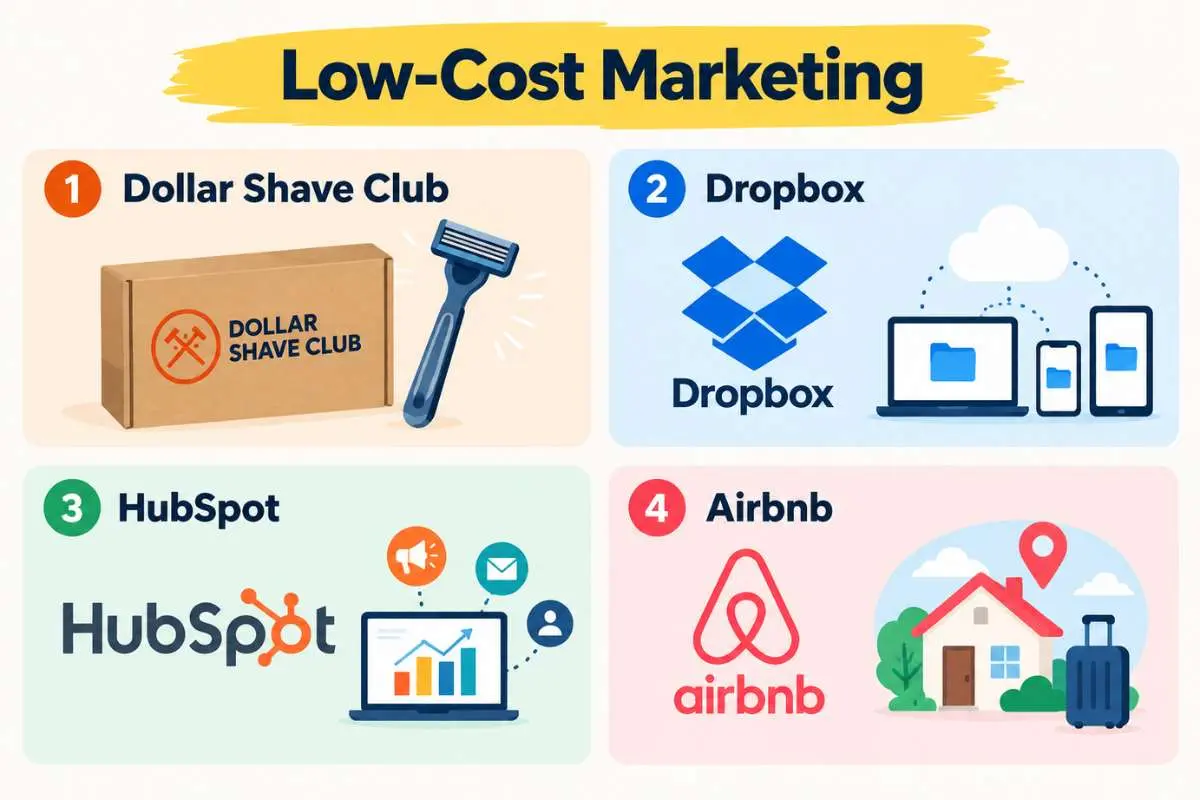
Several well-known businesses demonstrate how creative distribution can reduce dependence on traditional advertising.
Dollar Shave Club
Dollar Shave Club became widely known after its humorous launch video demonstrated the product and brand personality in a highly shareable format. The example shows how a distinctive creative concept can generate attention without relying on a traditional large-scale campaign.
Dropbox
Dropbox used a referral program that rewarded existing users with additional storage for bringing in new users. The strategy aligned the reward with the product itself and encouraged customers to drive additional sign-ups.
HubSpot
HubSpot built a significant part of its marketing around educational content, resources, tools, and inbound marketing. The approach demonstrates how useful content can become an acquisition channel over time.
Airbnb
Airbnb has used multiple growth and distribution strategies throughout its development, including referral and community-driven approaches. Its growth illustrates the value of reducing friction between existing users and potential new customers.
These examples should not be treated as formulas to copy. Startups should adapt the underlying principle, such as referrals, useful content, or shareable creative work, to their own audience and business model.
What to avoid when marketing on a small budget
A limited budget makes prioritization even more important. Avoid:
Trying every channel at once
Being everywhere can spread a small team’s time too thin. Start with channels that match your customers.
Spending before validating demand
Do not invest heavily in advertising before understanding whether people actually want your product or offer.
Measuring vanity metrics
Followers and impressions can be useful indicators, but they do not automatically translate into revenue. Track leads, conversions, retention, and customer acquisition costs where possible.
Using AI without reviewing the output
AI-generated information can contain errors, outdated claims, or messaging that does not fit your audience. Human review remains essential.
Copying competitors
Competitor research can reveal opportunities, but copying their messaging can make your startup indistinguishable from them.
Scaling too early
A marketing channel that works for 10 customers does not automatically work at 1,000. Test, measure, improve, and then scale.
Conclusion:
Low-cost marketing strategies for Startups prove that a small budget is never the real obstacle. Unfocused effort is. The startups that grow steadily start with a few channels, learn what their customers respond to, and build assets like content, email lists, referrals, and communities that keep paying off over time.
Begin with one or two tactics from this guide, run a small experiment, and track results that matter, such as qualified leads and conversions. Once a channel proves itself, scale it with confidence.
Ready to get started? Pick one strategy today and put it into action this week.
FAQ:
1. How can a startup market with no money?
Use organic content, SEO, social media, networking, referrals, community engagement, and customer-generated content.
2. What is the cheapest way to market a startup?
Founder-led content, referrals, community engagement, and organic social media can be started with little or no direct spending.
3. How much should a startup spend on marketing?
Start with an affordable test budget and increase spending when a channel consistently produces measurable business results.
4. Which marketing channel is best for startups?
The best channel depends on where the target customers are and which channel can consistently generate qualified leads or sales.
5. Can AI help startups reduce marketing costs?
Yes, AI can assist with research, content workflows, personalization, analysis, and automation while humans review and approve the output.