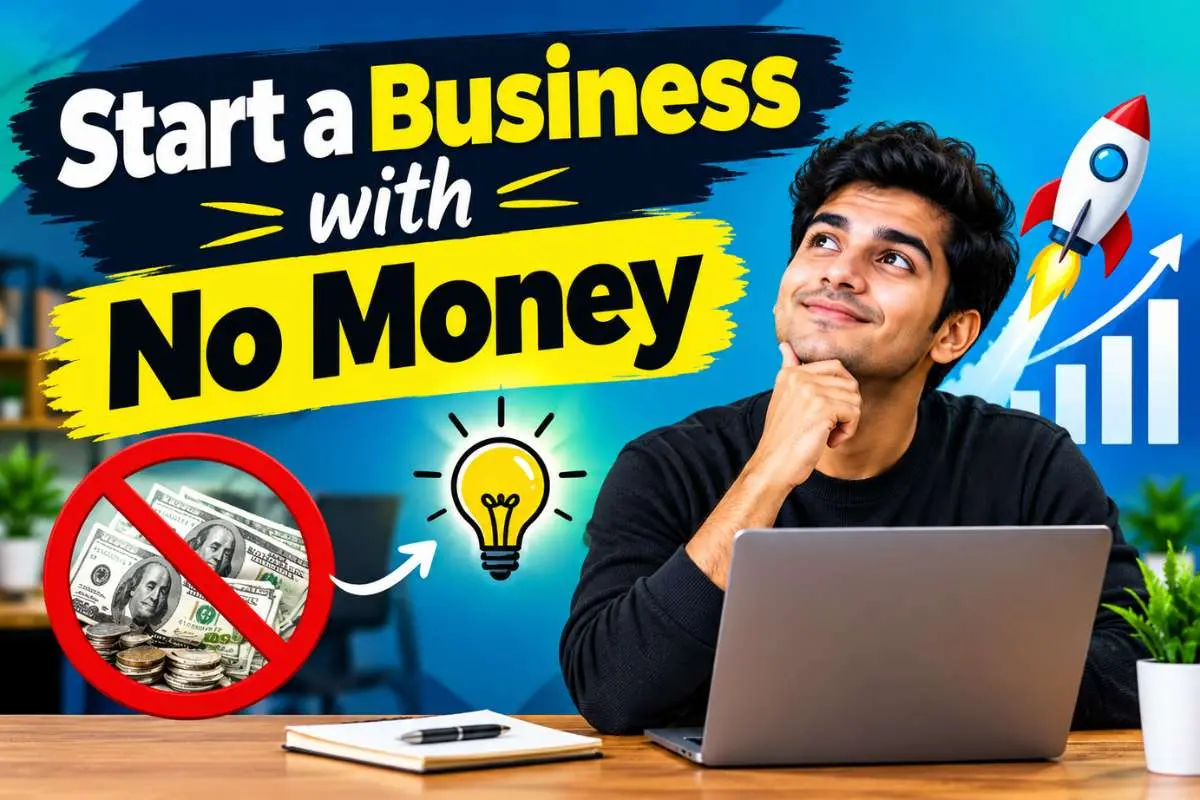
Start a Business with No Money does not mean building a company with literally zero expenses. It means starting with as little upfront capital as possible, testing demand before making major investments, and using early revenue to fund the next stage.
In 2026, entrepreneurs have access to AI tools, digital marketplaces, social media, online payment systems, and low-cost software that can reduce the need for employees, office space, and expensive technology at the beginning.
But access to cheap tools does not guarantee success. A strong idea still needs customers, a clear offer, and a practical way to generate revenue.
The smarter approach is to start lean: identify a real problem, test whether people will pay for a solution, keep initial costs low, and invest more only when the business shows demand.
What Does “No Money” Really Mean?
Before you start a business with no money, it helps to define what “no money” actually means.
Some businesses can be launched with almost no upfront investment, particularly service businesses based on skills, knowledge, or professional experience you already have. However, most businesses eventually involve some expenses.
These may include:
- Business registration and licenses
- Website or domain costs
- Software subscriptions
- Equipment and supplies
- Insurance
- Payment processing
- Inventory
- Marketing
- Taxes
- Accounting or legal services
The goal is not to avoid every expense. It is to avoid unnecessary spending before you have evidence that customers will pay.
The U.S. Small Business Administration recommends calculating startup costs before launching because expenses differ across service, online, and brick-and-mortar businesses. It also recommends separating one-time expenses from ongoing costs.
A useful way to think about starting a business with no money is:
Idea → Validation → First customer → First revenue → Reinvestment → Repeatable sales → Growth
How to Start a Business with No Money and Make Your First Sale
1. Choose a Business Idea That Fits a Low-Cost Model
If you want to start a business with no money, choose a model that depends more on skills, expertise, relationships, or digital distribution than expensive physical assets.
Business Ideas to Consider in 2026
| Business idea | Why it can be low-cost | What you may need |
| Freelance writing or editing | Uses existing writing skills | Computer and internet |
| Social media management | Can be run remotely | Social media and scheduling tools |
| Virtual assistance | Primarily skill-based | Computer and communication tools |
| Consulting | Sells existing expertise | Industry knowledge and client outreach |
| Online tutoring | Can be delivered remotely | Subject expertise and video tools |
| AI-assisted services | Uses AI to improve productivity | AI tools and human expertise |
| Digital products | No physical inventory | Creation and payment platform |
| Pet care or local services | Can start with local customers | Basic supplies and transport |
| Print-on-demand | No need to hold large inventory | Designs and storefront |
| Niche content business | Can begin with free platforms | Content skills and audience-building |
These businesses are not automatically profitable. Their advantage is that many can be tested without committing to a large lease, inventory order, or payroll.
For example, someone with marketing experience could offer a small social media package to three local businesses rather than immediately creating a full agency.
A professional with years of industry experience could also test consulting by selling a paid strategy session before building a larger practice.
The best idea is therefore not simply the one that costs the least. It is one where your existing skills can solve a problem customers already have.
2. Validate Before You Spend

One of the most important principles when you start a business with no money is to validate the idea before investing heavily.
Do not spend weeks building a product that nobody has agreed to buy.
Start by researching your potential customers and ask:
- Who has the problem?
- How are they solving it now?
- What alternatives already exist?
- What do those alternatives cost?
- What would make customers switch?
- Can someone pay for a basic version of your solution?
The SBA recommends market research to understand demand, market size, competition, pricing, and potential customers. Direct research can include surveys, questionnaires, focus groups, and interviews.
Simple Ways to Validate an Idea
| Method | How it works |
| Talk to potential customers | Speak with people who fit your target audience and ask about their actual problems. |
| Offer a paid pilot | Sell a smaller version of your service to a limited number of customers. |
| Use pre-orders | When appropriate, see whether customers will commit to buying before you produce a large quantity. |
| Test manually | Use a spreadsheet, email process, or basic landing page instead of building sophisticated software. |
| Track real behavior | A customer paying, signing up, or referring someone provides stronger evidence than simply saying an idea sounds interesting. |
The Rule to Remember
Do not spend money to solve a problem that customers have not confirmed exists.
3. Estimate Your Startup Costs
Once an idea shows early demand, calculate what it will actually cost to operate.
When you start a business with no money, identifying which expenses can be delayed is just as important as calculating the total cost.
The SBA divides startup expenses into categories such as equipment, supplies, communications, licenses and permits, insurance, professional services, inventory, employee costs, marketing, and websites.
Startup Cost Comparison
| Business type | Typical upfront cost level | Major potential expenses |
| Freelancing | Very low | Computer, software, internet |
| Consulting | Very low | Website, marketing, professional services |
| Virtual assistance | Very low | Computer, software |
| Online tutoring | Low | Equipment, software, marketing |
| Digital products | Low | Creation tools, platform fees |
| Local service business | Low to moderate | Equipment, transport, insurance |
| Print-on-demand | Low | Design, platform and transaction fees |
| Dropshipping | Low to moderate | Store, marketing, transaction fees |
| Physical retail | High | Rent, inventory, equipment, staffing |
| Restaurant/food business | High | Premises, equipment, permits, inventory, staffing |
These are relative cost categories, not fixed 2026 prices. Actual expenses depend on location, business structure, industry, and operating model.
The main takeaway is that service and digital businesses can often be easier to bootstrap than businesses requiring inventory, premises, or significant equipment.
4. Set Up the Business Properly

If you start a business with no money in the United States, your setup requirements depend on your location, business structure, and type of activity.
Common structures include:
- Sole proprietorship
- Partnership
- Limited liability company (LLC)
- Corporation
The structure can affect taxes, paperwork, fundraising, and personal liability. The SBA notes that requirements vary by state, so entrepreneurs should check their state and local rules before choosing a structure.
Basic U.S. Setup Process
| Choose a business structure. | Decide whether a sole proprietorship, LLC, partnership, or corporation fits your situation. |
| Choose a business name. | Check whether the name is available and whether you need to register a trade name or DBA. |
| Register where required. | Registration requirements depend on the structure and location. In some cases, someone operating under their own legal name may not need to register a separate business entity. |
| Obtain an EIN if required. | An Employer Identification Number is a federal tax ID for a business. The SBA states that it is free to apply for an EIN through the IRS. Certain businesses, including corporations and partnerships, generally need one. |
| Check licenses and permits. | Requirements vary by industry, state, county, and city. |
| Separate business finances. | Once appropriate, use a dedicated business bank account and maintain accurate financial records. |
| Check insurance needs. | Some businesses may need specific insurance based on their activities, employees, or location. |
Because U.S. requirements vary by jurisdiction, this section should be treated as a starting point rather than legal or tax advice.
5. Can You Start a Business Without Registering It?
Sometimes, yes. If you start a business with no money in the U.S., the SBA states that someone conducting business under their legal name may not need to register a separate business entity. However, registration, licensing, and permit requirements vary by location and industry.
Operating without forming an LLC or corporation does not mean operating without legal obligations.
You may still need to deal with:
- Taxes
- Local licenses
- Industry permits
- Insurance
- Contracts
- Sales-tax obligations where applicable
- Employer requirements if you hire workers
Operating without a separate legal entity may also mean you do not have the liability protection associated with certain business structures.
Before accepting customers, check the requirements for your specific state, city, and business activity.
6. Use Free and Low-Cost Tools to Launch
When you start a business with no money, you do not need an expensive technology stack on day one.
Start with tools that cover the basics:
| Need | Low-cost approach |
| Website | Simple website or landing page |
| Design | Free or low-cost design software |
| Communication | Email and video-conferencing tools |
| Project management | Basic task-management software |
| Marketing | Social media and email |
| Scheduling | Online booking tools |
| Accounting | Basic bookkeeping or invoicing software |
| Customer research | Online surveys and interviews |
| AI assistance | AI tools for drafting, research, and repetitive tasks |
The principle is simple: use the least expensive tool that solves the current problem.
Do not purchase ten subscriptions because you expect to need them later. Add tools when they solve a real operational problem.
7. Use AI and Automation in 2026

AI has become an important part of the low-cost business toolkit.
U.S. Census Bureau data collected from December 2025 through May 2026 showed overall business AI use hovering between 17% and 20%, while 20% to 23% of businesses expected to use AI within the following six months. Adoption was substantially higher among larger firms.
The 2026 Census research also found that sales and marketing were among the common areas for AI use among adopting businesses, alongside strategy and business development and IT.
For a small business, AI can help with:
- Drafting marketing content
- Research and information gathering
- Customer-service responses
- Sales emails
- Meeting summaries
- Content planning
- Basic data analysis
- Administrative workflows
- Product descriptions
- Brainstorming
- Early prototypes
Automation can also connect repetitive steps, such as capturing a lead, sending a confirmation email, and creating a follow-up task.
But AI should reduce work, not reduce quality. Review outputs, protect customer information, and avoid relying on AI for legal, tax, financial, or other professional decisions without appropriate human oversight.
8. How to Get Your First Customer
Once the offer is ready, focus on getting the first paying customer rather than trying to build a huge audience.
1. Start With People You Already Know
Former colleagues, professional contacts, local businesses, and relevant communities can be useful starting points.
2. Use Referrals
Ask satisfied customers whether they know someone who could benefit from your service.
3. Use Direct Outreach
Create a short, specific message explaining:
Who you help → What problem you solve → What you offer → What the next step is
4. Demonstrate Expertise
Use LinkedIn, Instagram, TikTok, YouTube, newsletters, or another relevant platform to answer questions your target customers actually have.
5. Build Partnerships
A complementary business may already have access to your target audience. Referral relationships can create opportunities without requiring a large advertising budget.
6. Make the First Offer Easy to Understand
Instead of saying:
“We provide comprehensive digital transformation solutions.”
Say:
“I help local businesses turn their existing website traffic into more customer inquiries.”
Specific offers are easier to understand and test.
Your first objective should be proof of demand, not scale.
9. Funding Options After Validation
Once you start a business with no money and have evidence that customers want your offer, external funding may become useful for specific growth needs.
Potential options include:
| Funding option | How it works |
| Bootstrapping | Use customer revenue to fund the next stage while retaining ownership. |
| Microloans | The SBA Microloan Program provides loans of up to $50,000, with loans averaging around $13,000, through approved intermediary lenders. |
| Grants | Government agencies, nonprofits, universities, and other organizations may offer grants for specific activities or eligible groups. Availability varies. |
| Crowdfunding | Can provide capital while also testing customer interest in a product. |
| Investors | Equity investment may suit businesses with significant growth potential that need capital to expand. |
The SBA notes that it does not generally provide grants to start or expand ordinary small businesses.
The key is to raise money for a defined purpose, such as inventory, equipment, product development, or customer acquisition, rather than borrowing simply because funding is available.
10. Hidden Costs to Expect

A business may appear almost free to launch but still accumulate smaller expenses.
Watch for:
- Payment processing fees
- Domain and email costs
- Software subscriptions
- Accounting fees
- Business licenses
- Insurance
- Taxes
- Refunds and returns
- Shipping
- Packaging
- Advertising
- Contractor costs
- Equipment replacement
- Professional services
The SBA recommends separating one-time and recurring expenses and calculating startup costs before launch.
Keeping a small cash reserve can help prevent an unexpected bill from disrupting the business.
11. Common Mistakes to Avoid
Starting cheaply does not mean starting carelessly.
| Mistake | Why it matters |
| Spending Before Validating | A beautiful website cannot compensate for an offer nobody wants. |
| Trying to Serve Everyone | A narrow target customer can be easier to reach than an undefined mass market. |
| Buying Too Many Tools | Start with essentials and add software only when there is a clear need. |
| Confusing Revenue With Profit | Sales are not the same as money left after expenses. |
| Scaling Too Early | Hiring, inventory, and advertising can increase costs before demand becomes predictable. |
| Ignoring Legal Requirements | Low-cost does not mean exempt from taxes, licenses, permits, or other obligations. |
| Depending Entirely on AI | AI can increase productivity, but expertise, quality control, and customer trust remain important. |
| Underpricing | Prices need to cover the business’s costs and the value of the owner’s time. |
12. A 30-Day Action Plan
If you want to start a business with no money, use the first month for testing rather than perfection.
| Days | Action |
| 1–3 | Choose one problem and define your target customer. |
| 4–7 | Research competitors, pricing, and customer demand. |
| 8–10 | Speak with potential customers and identify their biggest needs. |
| 11–14 | Create a simple offer or minimum viable product. |
| 15–17 | Set a price and prepare a basic sales message. |
| 18–21 | Contact potential customers through your network, outreach, and relevant platforms. |
| 22–24 | Deliver the first pilot or paid service. |
| 25–26 | Collect feedback and improve the offer. |
| 27–28 | Review revenue, costs, and customer response. |
| 29 | Complete the legal and operational requirements that apply to your business. |
| 30 | Decide whether to continue, refine the model, or invest further. |
By day 30, the goal is not necessarily to have a large company.
The goal is to have evidence.
You should know whether people want the offer, what they are willing to pay, and what needs to change.
Real Examples: What Starting Lean Can Look Like
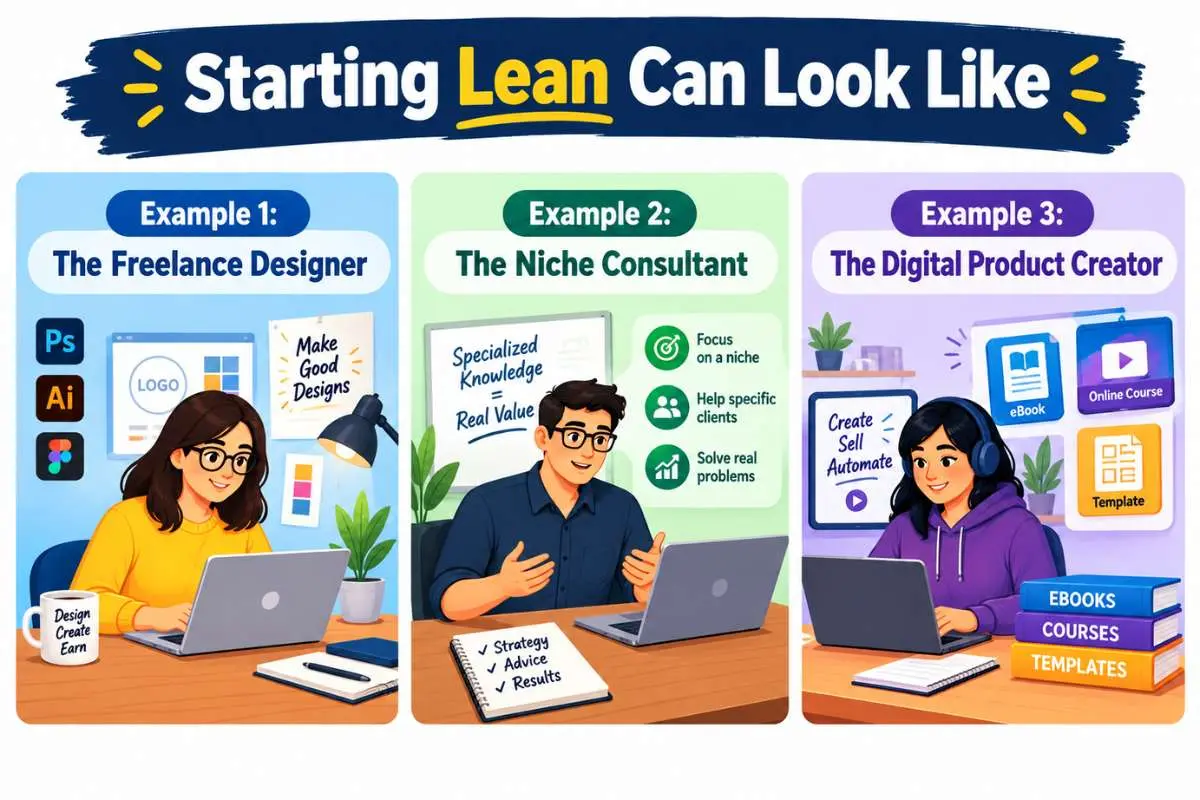
Consider three hypothetical entrepreneurs.
Example 1: The Freelance Designer
A graphic designer already owns a laptop and has experience creating marketing materials. Instead of opening a studio, she creates three simple service packages and approaches local businesses.
Her first investment is limited to essential software and business setup costs. After securing customers, she reinvests part of the revenue into better tools and eventually outsources repetitive production work.
Example 2: The Niche Consultant
A former HR professional notices that small companies struggle with interview processes. She begins by offering a paid hiring-process review instead of building a large consultancy.
After several clients identify the same problem, she creates a standardized package and uses customer referrals to generate additional business.
Example 3: The Digital Product Creator
A professional with expertise in project management creates a small template package for independent consultants.
Instead of spending thousands developing a large course, the creator tests a low-cost digital product, gathers customer feedback, and expands the product only after seeing demand.
The common pattern is:
Start with existing resources → Test demand → Make the first sale → Improve → Reinvest
Conclusion:
To start a business with no money successfully, think less about having zero dollars and more about controlling your initial costs.
Choose a business model that uses resources you already have. Validate demand before spending heavily. Use affordable technology and AI where they genuinely save time. Focus on getting your first paying customers before trying to scale.
Once revenue becomes consistent, reinvest strategically and consider outside funding only for clearly defined needs.
You do not need to build everything at once. You need to prove that one useful solution can become a repeatable business.
FAQs
1. Can I really start a business with no money?
Yes. Service-based businesses can often start with little upfront capital. However, expenses such as taxes, licenses, software, equipment, or marketing may arise later.
2. What is the easiest business to start with $0?
There is no single easiest option. Freelancing, consulting, tutoring, virtual assistance, and local services can have low startup costs when you already have the required skills.
3. How can I get my first customer?
Use your existing network, referrals, social media, targeted outreach, and partnerships. Clearly explain who you help, the problem you solve, and your offer.
4. Can I start a business without registering it?
Sometimes. In the U.S., operating under your legal name may not require forming a separate business entity, but requirements vary by location and industry. Licenses, permits, and tax registrations may still apply.
5. How much money should I have before starting a business?
There is no fixed amount. Calculate your essential startup and ongoing costs, then delay nonessential expenses until you have customers.
6. Is AI enough to start a business in 2026?
No. AI can reduce costs and save time, but you still need customer demand, a useful offer, quality control, and a reliable way to generate revenue.