In the wide ocean of today’s business. Countless marketing methods exist that promise the moon. They include content marketing, social media blitzes, SEO wizardry, and much more. Unfortunately and for many companies, these methods fail to deliver. This results in disappointing strategies and wasted money. The frustration grows in finding a new technique or strategy. That will help to generate a real, sustainable engine of growth in a business. Is there a secret methodology that cuts through the noise? Which will help to deliver real growth that is rapid and predictable? Surprisingly, there is. It’s a strategic powerhouse called B2B Growth Marketing.
This is not just a buzzword. It is a tested framework that businesses are finding potentially helpful. It allows them to market to each other and grow together in a way. This benefits both companies’ growth and market share. But what is so different about this model? What are the core and transformational aspects of this process? How does it create such an extraordinary level of business accelerator? Join us while we unpack and reveal. How this engine of success works in the B2B world.
What is B2B Growth Marketing? What is the Future of B2B Lead Generation?
Think about this. You run a lemonade stand that sells lemonade not just to people walking by. But other lemonade shops that is called B2B (business-to-business). B2B Growth Marketing means finding clever ways to help your business grow. Like testing new ideas, learning what works, and keeping other businesses happy. So they keep coming back for more.
This type of marketing is a data-driven, experimentation-led approach. It unites marketing, product, and sales. To help achieve predictable and scalable business outcomes. Traditional marketing focuses mainly on top-of-funnel awareness or lead generation. Growth marketing continuously optimizes the entire buyer journey. Through testing, analytics, and cross-functional collaboration. As Mountain.com explains, it’s a full-funnel strategy. It emphasizes attraction, engagement, and retention of high-value business customers.
Let’s see how growth marketing is different than traditional marketing.
| Aspect | Traditional B2B Marketing | B2B Growth Marketing |
| Goal | Brand awareness & lead generation | End-to-end customer lifecycle growth |
| Mindset | Campaign-driven | Experimentation-driven (A/B testing, data loops) |
| Measurement | Output metrics (leads, clicks) | Outcome metrics (CAC, LTV, churn, pipeline velocity) |
| Approach | Siloed departments | Aligned marketing, product, & sales for compounding results |
Angela DeFranco, GM of HubSpot Marketing Hub. She stated in Gartner’s 2025 Magic Quadrant report:
“Marketers don’t need another point solution or temporary workaround. They need a playbook and a platform built for today’s reality.”
The B2B Growth Marketing Framework:
The B2B Growth Marketing Framework is a continuous “growth loop.” It builds momentum at each stage of the customer lifecycle. Attract → Engage → Convert → Retain → Expand. Instead of being static campaigns. Each stage utilizes data to inform the next cycle. And it allows scalable and predictable growth.
At its core, the framework is built on four key pillars:
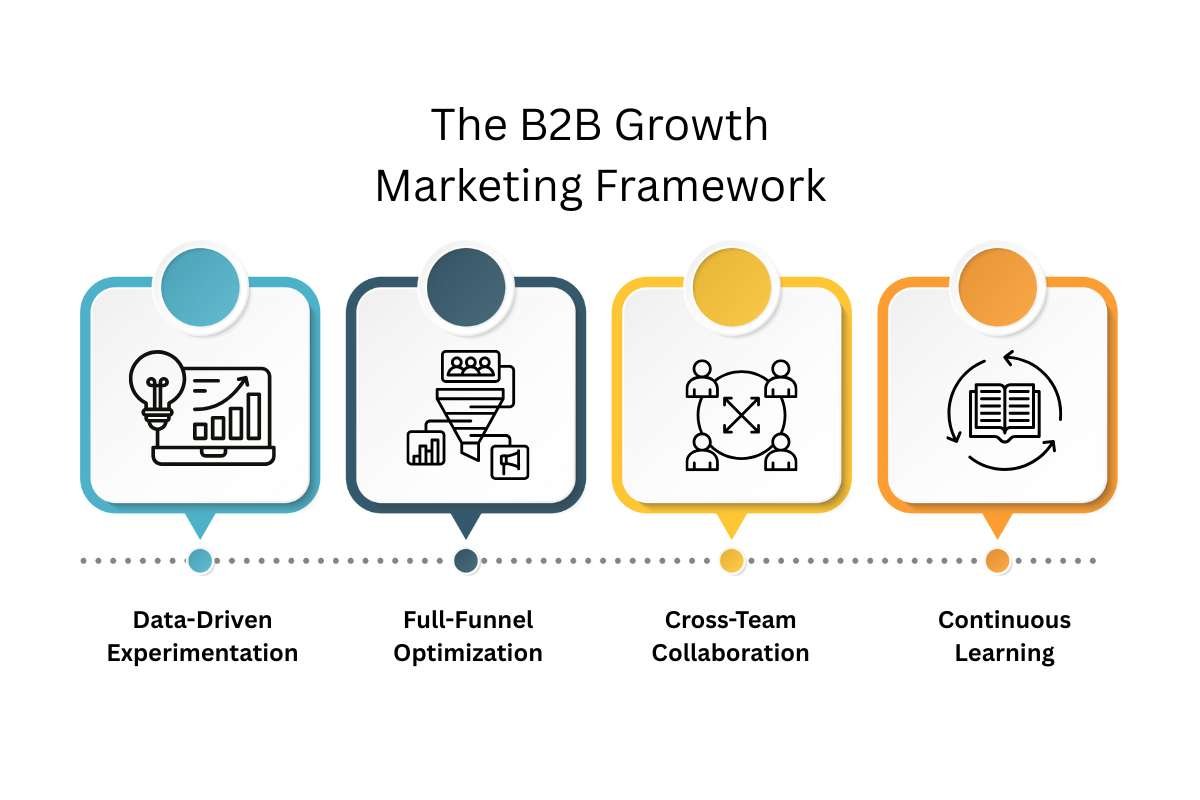
- Data-Driven Experimentation – Testing hypotheses across touchpoints to maximize ROI. With the help of analytics and A/B testing. This involves meticulously tracking conversions. And segment performance to ensure every marketing dollar is optimized.
- Full-Funnel Optimization – Aligning acquisition, activation, retention, and expansion. To help nurture customer value end-to-end. The goal is to eliminate drop-off points. This ensures a seamless, value-driven journey. Starting from prospect to loyal advocate.
- Cross-Team Collaboration – Synchronizing marketing, sales, and product around shared KPIs and real-time insights. Breaking down traditional silos is crucial. This helps in delivering a consistent and impactful customer experience at every stage.
- Continuous Learning – Using performance feedback to refine strategies and compound results over time. This active approach establishes a ‘build-measure-learn’ loop. This makes adaptation and improvement an ongoing, automatic process.
For example, a SaaS company might run multiple onboarding experiments. Varying email sequences and UX designs. This helps to see which journey activates the highest number of users. And then apply it to other customer segments.
Top B2B Growth Marketing Channels in 2025:
Top B2B Growth Marketing Channels emphasize a mix approach. It consists of organic, paid, and emerging strategies. These help to match evolving buyer behavior:
Organic Growth Channels:
- SEO: Essential for capturing buyers during their research phase. This is done through optimized content and technical web improvements.
- LinkedIn Content: Dominates professional networking with industry insights, posts, and engagement. This helps to build authority and trust.
- Thought Leadership: Establishes brand credibility through expert articles, whitepapers, and speaking engagements.
- Newsletters: Maintain direct, personalized communication with prospects and customers. This nurtures relationships and drives retention.

Paid Channels:
- LinkedIn Ads: Targeted ads on the leading B2B social platform. This delivers high-quality leads.
- Google Performance Max: AI-powered campaigns optimize ad delivery. Across Google’s network for maximum ROI.
- Intent-based Targeting Platforms: Reach prospects actively researching relevant solutions. With the help of behavioral signals.
Emerging Spaces:
- Podcast Guesting: Engages niche audiences. With authentic, thought-provoking discussions.
- Interactive Webinars: Drive engagement with live demos and real-time interaction.
- Community-Led Growth: Builds brand loyalty through dedicated user communities.
- AI-Driven ABM: Hyper-personalized targeting and content delivery at scale using AI technologies.
B2B Growth Marketing by Business Stage:
To align tactics with company maturity. Here is a comparison table of growth marketing efforts. This helps understand the different business stages. Ensuring optimal focus from startup validation to enterprise expansion.
| Stage | Goals | KPIs | Strategies |
| Startup | Rapid experimentation, product-market fit, and viral growth | Activation rate, CAC, and churn rate | Run fast user feedback loops, viral onboarding, and A/B test funnels |
| Scale-Up | Optimize unit economics and scale channels | CAC vs LTV and conversion rates | Expand paid/organic channels, refine targeting, and optimize funnels |
| Enterprise | Maximize retention, upsell revenue, and brand advocacy | Customer retention, upsell %, NPS | Customer success programs, community advocacy, and account expansion |
In the startup phase. Growth marketing is about running many experiments. Listening to the users and quickly iterating on your product. Adding an onboarding experience. Scale-ups will focus on maximizing customer acquisition costs to lifetime value (CAC vs LTV). Along with effort diversification to grow efficiently. By using multiple different channels. Larger enterprises concentrate on optimizing retention, upselling, and empowering the user community. So, they become advocates and prolong lifetime value over time.
Metrics That Matter:
Key metrics in B2B growth marketing measure meaningful impact. Across acquisition, activation, retention, and revenue stages rather than vanity numbers. Here are some effective metrics:
- Acquisition Metrics: Lead-to-demo rate tracks the percentage of leads progressing to product demos. While cost per qualified lead (CQL) measures efficiency in generating sales-ready prospects.
- Activation Metrics: Onboarding completion and hitting engagement milestones. It shows how effectively new customers are adopting the product.
- Retention Metrics: Churn rate and renewal rate gauge ongoing customer loyalty. While Net Promoter Score (NPS). It provides insight into customer satisfaction and advocacy.
- Revenue Metrics: The CAC: LTV ratio evaluates profitability. By comparing acquisition costs to lifetime value. And ARR growth reflects overall business expansion.
Advanced B2B Growth Tactics:
Advanced Growth Tactics focus on using AI and product strategies. Along with automation and content as core growth engines:

- AI-Powered Personalization uses predictive lead scoring and personalized website content. This helps to engage prospects with highly relevant experiences in real time. This approach boosts engagement and improves lead quality. It also accelerates sales velocity by serving content. These offers are matched to buyer intent and stage.
- Product-Led Growth (PLG) focuses on converting free users into paying customers. It advocates by optimizing onboarding, usage, and value delivery within the product itself.
- Marketing Automation enables hyper-segmented drip campaigns and chat-based engagement. This intelligently nurtures leads and customers based on behavior and interests.
- Content as a Growth Engine builds topical authority. And increase trust using consistent publishing of insightful blog posts. Along with whitepapers and case studies that are personalized to buyer needs.
Also Read:
- Growth Marketing Strategy Guide for Smart Entrepreneurs 2025
- How AI is Revolutionizing B2B Marketing Strategies?
Case Study: How Spotify Used Creative B2B Growth Marketing to Drive Engagement
Spotify Advertising showcased a standout example of B2B Growth Marketing. With its “All Ears on You Campaign.” By creating personalized songs for C-suite leaders. And a compelling film highlighting diverse Spotify users. The campaign educated brands on Spotify’s digital audio advertising. While positioning the platform as an innovative media solution. The effort generated 1.5 billion impressions. It engaged 10,000 high-value targets. And attracted 185,000 new users. It shows how creative, data-informed B2B strategies are. They can deliver measurable business growth and industry recognition.
Source: https://www.impactmybiz.com/blog/b2b-marketing-case-studies/
Conclusion
B2B Growth Marketing won’t produce results overnight. But it is the engine of business collaboration and expansion. It is mainly needed for today’s rapidly evolving economy. It overtakes wishful campaigns with predictable, measurable growth loops. This method uses data-driven experiments, full-funnel optimizations, and cross-team alignment. This helps to stop wasting money, time, and other resources. It also provides businesses with an ecosystem. That is resilient, self-sustaining, and engaged for the long term. No matter where you are starting.
FAQ:
1. Can small businesses benefit from Business-to-Business Growth Marketing?
Absolutely. Even startups can use growth experiments, customer feedback loops, and digital marketing channels. This helps to attract high-value clients and scale efficiently. That is without huge budgets.
2. How long does it take to see results from B2B Growth Marketing?
Results vary by business stage and strategy. But measurable improvements like increased qualified leads or higher engagement. It can often appear within 3–6 months. If campaigns are data-driven and consistently optimized.
3. What channels work best for Growth Marketing in 2025?
Top channels include LinkedIn content and ads. Along with SEO, newsletters, webinars, podcast guesting, and AI-driven account-based marketing. Emerging tactics also include interactive content and community-led engagement.