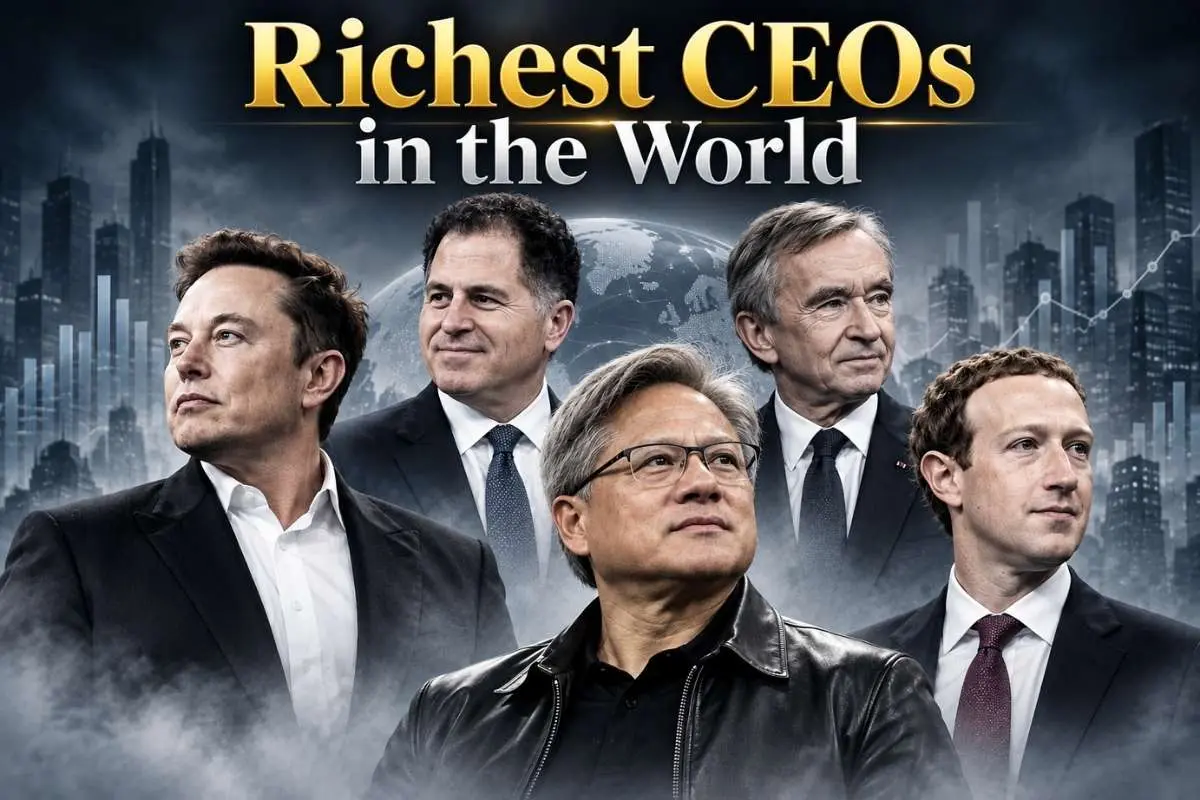
In 2026, the Richest CEOs in the World are sitting on fortunes measured in tens or even hundreds of billions of dollars. Yet most of that money did not come from a CEO paycheck. It came from owning valuable companies and watching those stakes grow.
Technology and AI have reshaped the list, but they are not the whole story. Finance, luxury, retail, gaming, and manufacturing have also created enormous fortunes. And while some CEOs collect huge annual compensation, their pay can look small next to the value of the shares they own.
So who holds the biggest fortunes in 2026, which companies are behind them, and what actually drives CEO wealth?
Who counts as a CEO on this list?
For this list of the Richest CEOs in the World, a person must hold a current chief executive role as of 2026. A founder or chairman does not qualify on that title alone.
This changes the list quite a bit.
Jeff Bezos is Amazon’s founder and executive chairman, but Andy Jassy is Amazon’s CEO. Larry Page and Sergey Brin remain major Alphabet shareholders, but Sundar Pichai is the CEO of Alphabet. Steve Ballmer is Microsoft’s former CEO.
This approach keeps the list focused on people who actually hold the top executive job today.
Who are the 15 richest CEOs in the world in 2026?
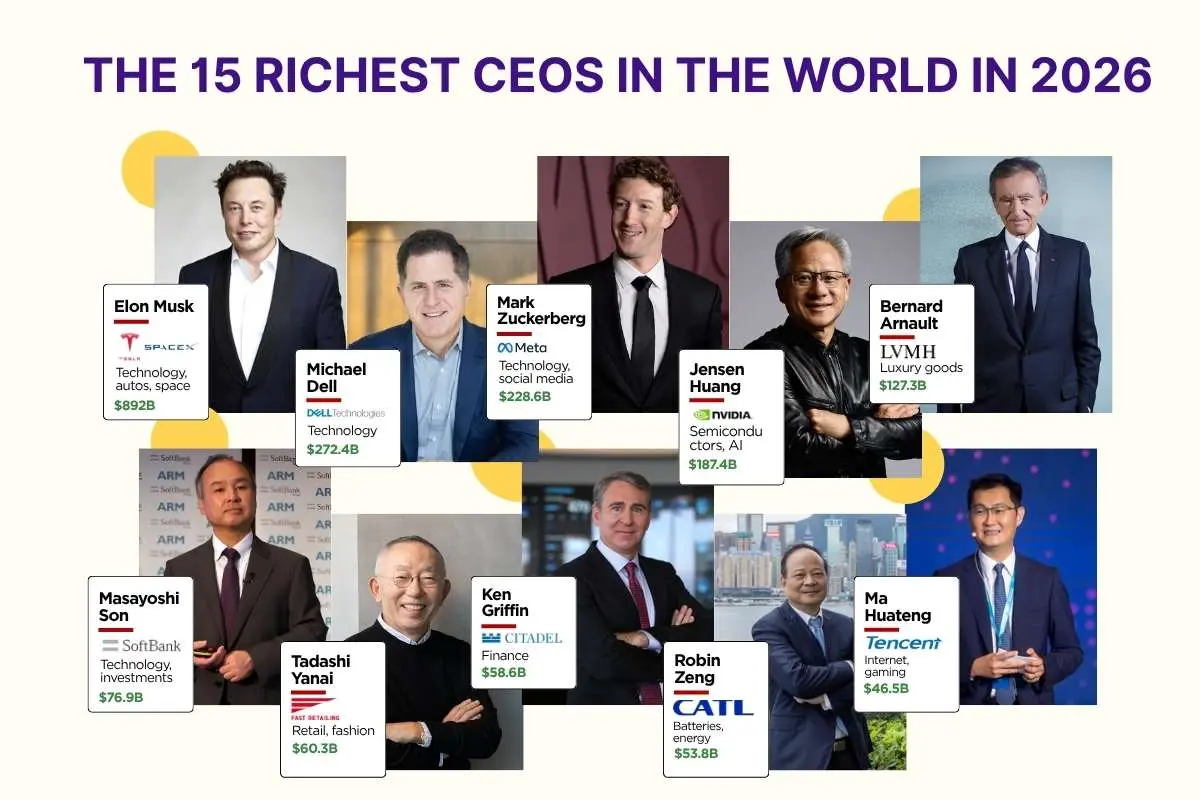
The table gives a September 2026 snapshot of the Richest CEOs in the World. Net worth figures come from Forbes real-time estimates and can change with market prices.
| Rank | CEO | Company | Industry | Approx. Net Worth |
| 1 | Elon Musk | Tesla, SpaceX | Technology, autos, space | $892B |
| 2 | Michael Dell | Dell Technologies | Technology | $272.4B |
| 3 | Mark Zuckerberg | Meta | Technology, social media | $228.6B |
| 4 | Jensen Huang | NVIDIA | Semiconductors, AI | $187.4B |
| 5 | Bernard Arnault | LVMH | Luxury goods | $127.3B |
| 6 | Masayoshi Son | SoftBank Group | Technology, investments | $76.9B |
| 7 | Tadashi Yanai | Fast Retailing | Retail, fashion | $60.3B |
| 8 | Ken Griffin | Citadel | Finance | $58.6B |
| 9 | Robin Zeng | CATL | Batteries, energy | $53.8B |
| 10 | Ma Huateng | Tencent | Internet, gaming | $46.5B |
| 11 | Stephen Schwarzman | Blackstone | Finance, private markets | $44.1B |
| 12 | William Ding | NetEase | Gaming, internet | $39.2B |
| 13 | Chen Tianshi | Cambricon Technologies | AI semiconductors | $30.4B |
| 14 | Robert Pera | Ubiquiti | Networking technology | $29.6B |
| 15 | Lei Jun | Xiaomi | Consumer technology, EVs | $20.9B |
The figures are estimates, not cash balances. Some were updated on different September trading days, so the order can move quickly. Forbes also notes that billionaire wealth can change daily as stock prices move.
A closer look at the 15 CEOs
These short profiles explain where the money comes from. The people on this Richest CEOs in the World list built their fortunes in very different ways.
1. Elon Musk
Musk is CEO of Tesla and SpaceX. Much of his wealth is tied to his ownership of those companies. Tesla confirmed his role as CEO, while Forbes continues to list SpaceX and Tesla as the main sources of his fortune.
Tesla gives Musk exposure to the electric vehicle and energy markets, while SpaceX adds private-company value through its launch and satellite businesses. His fortune can therefore move sharply when Tesla’s stock changes or private valuations rise.
2. Michael Dell
Dell is chairman and CEO of Dell Technologies. He founded Dell as a student and kept a large ownership position as the company grew. Forbes says much of his fortune is also held through his private investment firm.
His wealth reflects decades of ownership across technology and investments rather than CEO compensation alone. Through his investment firm, Dell has also built exposure to other companies and assets beyond Dell Technologies.
3. Mark Zuckerberg
Zuckerberg co-founded Facebook and remains Meta’s chairman and CEO. His fortune mainly comes from his Meta shares, rather than his salary.
Meta now spans Facebook, Instagram, WhatsApp, advertising, artificial intelligence, and virtual reality. The size of Zuckerberg’s ownership means changes in Meta’s market value can have a major impact on his personal fortune.
4. Jensen Huang
Huang co-founded NVIDIA and has served as CEO since 1993. His wealth rose sharply as NVIDIA became a central supplier of chips used for AI computing.
NVIDIA’s graphics processors have become critical infrastructure for training and running advanced AI systems. As demand for AI computing has grown, the company’s soaring valuation has made Huang one of the world’s wealthiest technology executives.
5. Bernard Arnault
Arnault is chairman and CEO of LVMH. His family controls a large stake in the luxury group, linking his wealth closely to the value of LVMH and its many brands.
LVMH owns major names across fashion, jewelry, watches, wines, and spirits, including Louis Vuitton, Dior, and Tiffany & Co. Its global brand portfolio gives Arnault exposure to the high-end consumer market across multiple categories.
6. Masayoshi Son
Son founded SoftBank and remains its chairman and CEO. His fortune is tied to SoftBank’s own shares and its large investment portfolio, with AI now playing a much bigger role in the group’s strategy.
SoftBank has built stakes in technology companies around the world, making Son’s wealth closely linked to the performance of its investments. The group’s growing focus on AI also gives his fortune exposure to one of the fastest-moving areas of technology.
7. Tadashi Yanai
Yanai runs Fast Retailing, the parent company of Uniqlo. He serves as chairman, president, and CEO, and his wealth is mainly linked to his ownership in the retail group.
Uniqlo has grown into a global clothing brand with stores across Asia, Europe, and North America. Fast Retailing’s expansion and the performance of its international retail business are key factors behind Yanai’s wealth.
8. Ken Griffin
Griffin founded Citadel and remains its CEO. His fortune comes from hedge funds and financial markets rather than a large public-company salary.
Citadel has become one of the world’s largest and most influential investment firms, with businesses spanning hedge fund investing and market making. Griffin’s long career in trading and investing has allowed him to build wealth through financial-market performance.
9. Robin Zeng
Zeng founded CATL and serves as chairman and CEO. His wealth is closely linked to the global market for electric vehicle batteries and energy storage.
CATL has become one of the world’s leading battery manufacturers, supplying automakers in China and international markets. The company’s growth is tied not only to electric cars but also to the wider demand for batteries used in energy storage systems.
10. Ma Huateng
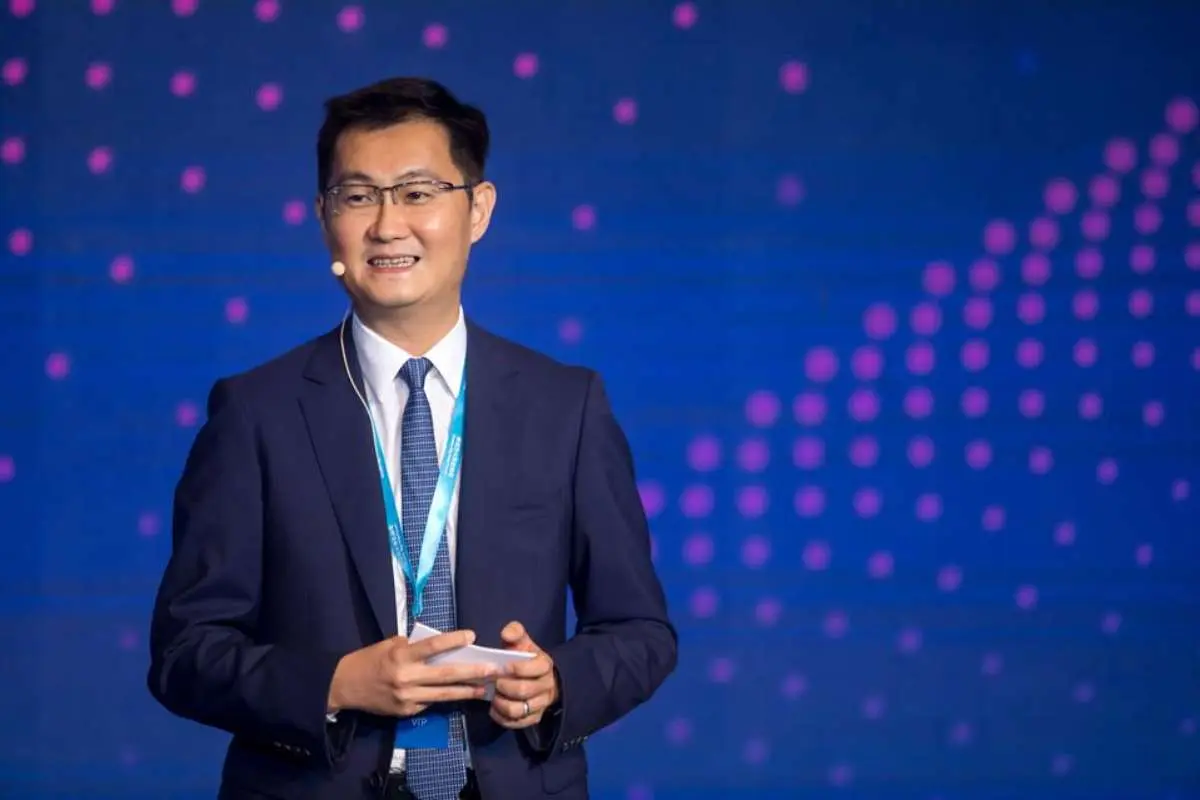
Known as Pony Ma, he is Tencent’s co-founder, chairman and CEO. Tencent’s huge gaming, social media, cloud, and online businesses support his fortune.
The company operates some of the world’s largest digital platforms, including WeChat, while also holding a major position in gaming. Its broad mix of consumer and technology businesses gives Ma several sources of long-term wealth.
11. Stephen Schwarzman
Schwarzman co-founded Blackstone and still serves as chairman and CEO. His wealth comes from his stake in the investment firm and decades of gains from private markets.
Blackstone manages investments across private equity, real estate, credit, and other alternative assets. As the firm has expanded its assets and global operations, its growth has helped increase the value of Schwarzman’s ownership.
12. William Ding
Ding founded NetEase and remains its CEO. Games are the main engine behind the company, with newer products also using AI and other technology.
NetEase has built a major presence in the global video game market, publishing titles for both Chinese and international audiences. Its continued investment in games, digital entertainment, and technology keeps Ding’s fortune closely connected to the company’s performance.
13. Chen Tianshi
Chen is chairman and CEO of Cambricon Technologies. His fortune comes from his large stake in the Chinese AI chip company.
Cambricon develops processors and related technologies designed for artificial intelligence and high-performance computing. As demand for domestic AI computing capabilities grows, the company’s market value can have a direct effect on Chen’s wealth.
14. Robert Pera
Pera founded Ubiquiti and is its CEO. Forbes says he owns about 93% of the company, which means changes in Ubiquiti’s share price can have a direct effect on his wealth.
Ubiquiti develops networking products used by businesses, service providers, and consumers. Because Pera owns such a large portion of the company, his personal fortune remains unusually sensitive to Ubiquiti’s stock performance.
15. Lei Jun
Lei is the founder, chairman, and CEO of Xiaomi. The company has moved beyond smartphones into electric vehicles and other connected products.
Xiaomi has built a broad consumer technology ecosystem covering smartphones, smart home devices, wearables, and connected hardware. Its move into electric vehicles has also created another major growth opportunity for the company and Lei’s wealth.
What drives CEO wealth?
Ownership is the big reason the Richest CEOs in the World are so far ahead of normal executive pay.
A CEO who owns 5% of a giant company can build far more wealth than one who receives a $50 million annual package but owns very little stock.
The main drivers are:
- Founder ownership: Founders often keep large stakes after a company goes public.
- Stock growth: A rise in the share price can add billions to a founder’s paper wealth.
- Private companies: A new funding round can raise the value of an unlisted company.
- Investments: Some CEOs own stakes in many businesses.
- Long time periods: Wealth can compound for decades.
That is why salary alone does not explain the fortunes on this list.
Richest vs. highest-paid CEOs: what is the difference?
It is easy to mix up wealth and pay. They are not the same thing.
For the Richest CEOs in the World, net worth measures the estimated value of what a person owns. CEO compensation measures what the person receives or is awarded for running a company during a set period.
| Measure | Richest CEOs | Highest-Paid CEOs |
| What it measures | Total personal wealth | Annual executive pay |
| Main source | Shares, ownership, investments | Salary, bonus, stock awards |
| Time period | Built over many years | Usually one year |
| Can it jump quickly? | Yes | Yes |
| Does it mean cash? | No | Not always |
Equilar’s 2026 CEO pay study reported median compensation of $29.4 million in 2025, up 23.2% from the previous year. It also reported a $132.3 billion long-term stock award for Elon Musk. That award is compensation, not the same thing as his total net worth.
How has AI changed CEO wealth in 2026?
AI is now a major force behind several fortunes on this list.
NVIDIA sells the chips used to train and run many AI systems. Meta is spending heavily on AI for ads, recommendations and new products. SoftBank has made AI infrastructure a bigger part of its investment plans. Chinese firms such as Tencent, CATL and Cambricon are also increasing their AI and advanced computing work.
Gartner expects worldwide AI spending to reach $2.7 trillion in 2026, with AI infrastructure making up the largest part of that spending.
The effect is easy to see. When investors expect strong growth from AI-related companies, the value of those companies can rise. When a CEO owns a large stake, their net worth can rise with it.
Where do the richest CEOs come from?

Geography gives a useful look at where huge corporate fortunes are being built. The Richest CEOs in the World list includes leaders from the United States, China, Japan and France.
The U.S. leads the group, with major fortunes tied to technology, finance and consumer platforms. China has produced major CEO fortunes in gaming, internet services, batteries and AI chips.
Japan stands out through SoftBank and Fast Retailing. France is represented by Bernard Arnault and LVMH.
The bigger point is that the path to extreme wealth is not limited to Silicon Valley. Large markets, strong company ownership, and global demand can create fortunes in many places.
Which industries create the most CEO wealth?
Technology remains the strongest theme in this group. Semiconductors, social media, cloud services, networking, gaming, and consumer electronics all appear near the top.
Finance is also important. Griffin and Schwarzman built huge fortunes through investment firms.
Luxury and retail show another side of the picture. Arnault and Yanai built wealth through global consumer brands rather than software or chips.
For the Richest CEOs in the World, the common thread is scale. The companies behind these fortunes serve huge markets or hold valuable assets.
Read More: Think You’re Paid Well? These 20 Highest Paid CEOs in the World Will Change Your Mind
Conclusion: What does this list tell us about CEO wealth?
The biggest fortunes rarely come from salary alone. Ownership is the part that can change the game.
A founder who keeps a large stake can see that stake grow from millions to billions as a company expands. A hired CEO can also become very wealthy, but the path is usually slower because their personal ownership is much smaller.
That is the main reason the Richest CEOs in the World look so different from a list of the highest-paid executives.
In 2026, technology and AI are major forces, but finance, retail, luxury, batteries, and gaming still produce enormous wealth.
FAQs about the Richest CEOs in the World
1. Who is the richest CEO in 2026?
Elon Musk is at the top of this September 2026 snapshot, with Forbes estimating his net worth at about $892 billion.
2. Is net worth the same as CEO salary?
No. Net worth is the estimated value of a person’s assets and investments. Salary and compensation are payments or awards linked to a job.
3. Why are founders often richer than hired CEOs?
Founders often keep large company stakes. That ownership can grow in value much faster than a normal salary.
4. Can a CEO’s net worth fall?
Yes. A large part of billionaire wealth is linked to stocks and other assets, so market moves can change the estimate quickly.
5. Why is Jeff Bezos not on this list?
Bezos is Amazon’s founder and executive chairman, but he is not Amazon’s current CEO.
6. Why is AI important to CEO wealth in 2026?
AI is driving major spending on chips, data centers, cloud services, and software. That has increased investor interest in several companies led by CEOs on this list.
Source
- https://www.investopedia.com/terms/s/stockcompensation.asp
- https://www.berkshirehathaway.com/news/nov0125.pdf
- https://www.cnbc.com/2025/11/03/warren-buffett-may-have-again-cut-berkshires-stake-in-apple-in-q3-.html?&qsearchterm=Berkshire
- https://www.gartner.com/en/newsroom/press-releases/2025-11-04-gartner-survey-finds-regular-ai-system-assessments-triple-the-likelihood-of-high-genai-value
- https://investor.atmeta.com/home/default.aspx
- https://www.investopedia.com/terms/s/stockoption.asp