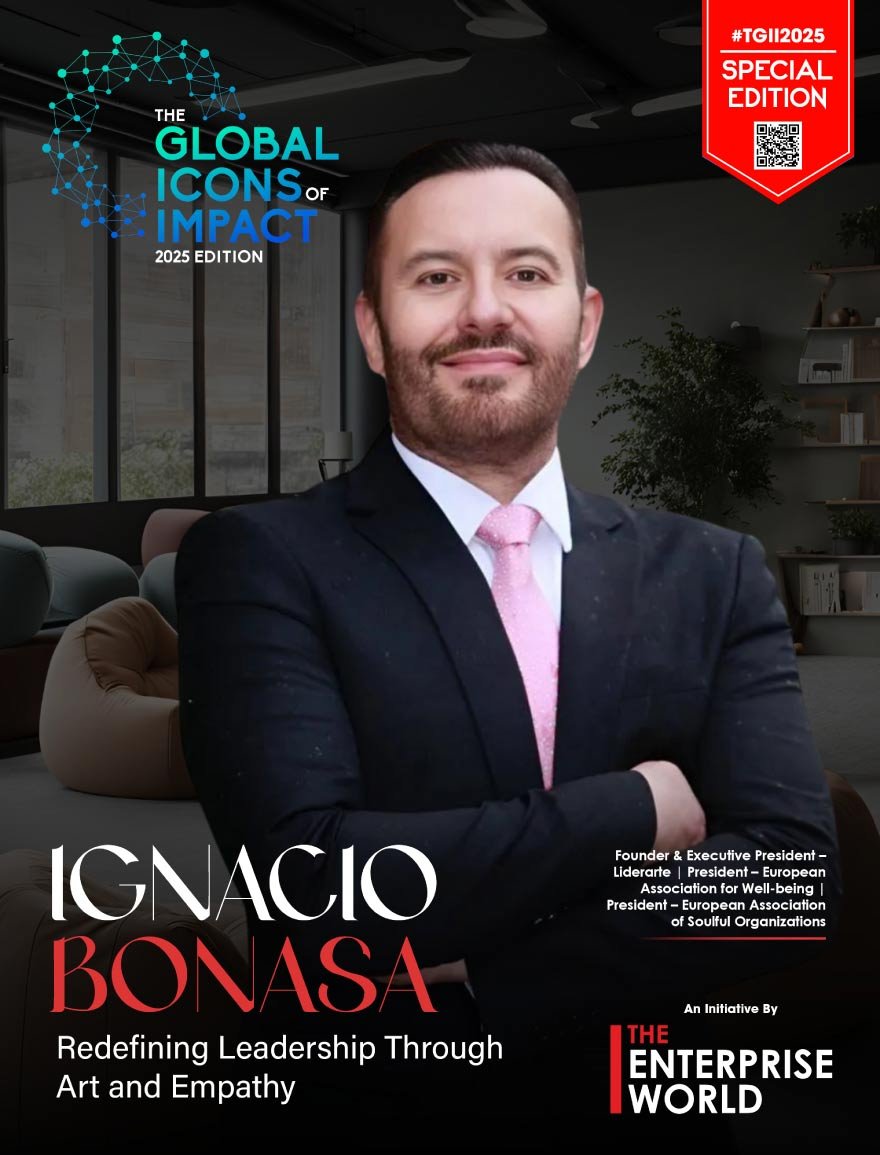
Modern leadership asks for performance and purpose. Ignacio Bonasa answers that call by fusing executive discipline with artistic practice. As President and Founder of Liderarte (Madrid) and President of the Latin American Leaders Parliament, he has created initiatives such as Resetéate, ARTEcoaching, and the movement Dale la Vuelta a la Tortilla.
Holding doctorates in Leadership and Organizational Transformation (European International University, Paris) and Education and Human Development (UNICAP, Mexico), Bonasa blends academic rigor with creative insight. His work has earned distinctions including The BIZZ, FLUXX, PRIME, and Impact Awards, reflecting a lifelong mission to link leadership with art, empathy, and human growth.
In a recent conversation with The Enterprise World, Ignacio Bonasa shares his vision, experiences, and the philosophy that continues to inspire leaders across continents. Here are some excerpts from the fascinating interview!
1. Could you briefly share your professional journey and how it led you to your current role?
My professional journey has unfolded in three defining stages.
- The first was my career in executive banking, where I learned to lead under pressure, think strategically, and assume great responsibility. I served as General Director at institutions such as Banco Exterior de España, Argentaria, BBVA, BBVA Portugal, and Caja Rural de Aragón. That period taught me that leadership without purpose ends up feeling empty.
- The second stage marked my transition into the world of human development. I discovered that talent is not managed, it’s awakened, and people do not need bosses, they need inspirational references.
- The third and current stage is Liderarte, the space where everything converges: leadership, art, emotion, and learning. From there, I’ve built an ecosystem of soulful projects that help individuals, teams, and organizations flourish authentically.
2. What has been the biggest driving force behind your career growth?
Without a doubt, purpose.
I’ve always felt the need to transform pain into learning and learning into action. My greatest motivation has been turning adversity into vitamin.
I believe art is the universal language of the soul, and when applied to leadership or wellbeing, it heals, unites, and elevates. That conviction inspired me to create projects that don’t just generate results, but meaning. Every doctorate, every international award, every social movement I’ve launched stems from that same driving force: to leave the world a little more human than I found it.
3. How do you approach leadership within your organization and industry?
At Liderarte, we see leadership as an act of coherence, service, and soul.
It’s not about directing—it’s about inspiring.
It’s not about control—it’s about connection.
That’s why we created the 4A Model (Aprendizaje, Actitud, Alma, Acción— Learning, Attitude, Soul, Action), a methodology that helps people lead from the inside out, merging art with management. We believe that beauty, emotion, and creativity are as essential as strategy or technique. To lead is to serve with purpose and act with an awakened heart.
4. Which initiatives or projects are you most proud of leading?
Each project reflects a part of my soul. Liderarte is my foundational project, where art becomes a transformative tool for organizations.
Resetéate (Reset Yourself) was born to help people rediscover themselves and rise again after chaos. Dale la Vuelta a la Tortilla (Turn the Table) has evolved into a global social movement that transforms pain into vitamin for the soul and it’s also the title of my upcoming book, based on my doctoral thesis.
Finally, the Latin American Leaders Parliament represents my commitment to the region and to a new model of collective leadership—one grounded in emotional, ethical, and cultural intelligence instead of ego and politics.
5. How do you ensure your work creates a lasting impact beyond business success?
I constantly ask myself: Does this leave a mark on someone’s soul?
My mission is not only to train competent leaders, but conscious human beings. I strive for my work to inspire others to live with values, serve with integrity, and transform through empathy. That’s why I founded projects such as Soulful Organizations, where success is not measured in profit but in collective wellbeing.
True profitability, to me, is emotional and human.
6. What has been the most valuable leadership lesson you’ve learned so far?
That vulnerability is not weakness—it’s authenticity. A leader without soul is merely a manager of tasks. Humility, I’ve learned, is the highest form of wisdom.
Leadership is not about always being right; it’s about listening deeply. And sometimes, the best step forward is to pause—and feel.
7. How do you stay adaptable in a world shaped by AI, technology, and constant disruption?
I firmly believe that artificial intelligence will never replace emotional intelligence.
My response to technological acceleration is to strengthen Human Skills — empathy, compassion, creativity, resilience. Technology can optimize processes, but only emotions transform people.
For me, the key lies in combining innovation with purpose, digitalization with humanity, and leadership with sensitivity.
8. Who has been your greatest influence or mentor in leadership?
I’ve had many mentors of the soul.
My Aunt Tere holds a very special place in my heart—she taught me the power of tenderness and unique kindness, that ability to look with gentleness even when life hurts.
Mozart also inspires me, for his harmony; María de Ávila, for her artistic discipline; Viktor Frankl, for his existential meaning; and María Zambrano, for her philosophical depth.
And, of course, the many partners and collaborators who share my journey—they teach me every day that true leadership is born from humanity, not hierarchy.
9. What excites you most about the future of your industry and your role in it?
The future of leadership will be more human, more artistic, and more emotional.
It excites me to see companies finally embracing art and wellbeing as strategic pillars. I dream of a time when every organization will have a Chief Soul Officer—a guardian of corporate soul.
My role is to keep planting consciousness, helping leaders and companies reconnect with their essential purpose: making work an act of humanity.
10. What message would you like to share with the global audience attending The Global Icons of Impact 2025?
The leadership of the future is not about changing the world—it’s about changing the way we look at the world. Every challenge is an opportunity to learn, every failure a door to resilience, every act of kindness a silent victory. When we transform a wound into learning, we contribute to the common good—and that, to me, is the true definition of impact.