



In the fast-moving, often noisy world of leadership advice, where trends can be as fleeting as quarterly earnings and buzzwords pile up faster than results, Dr. Patrick Jinks has carved a path defined by clarity, intentionality, and transformation that endures. As the founder of The Leader’s Perspective, Jinks works with leaders not just to polish their language or improve their image, but to rethink the way they think, act, and align their organizations for meaningful, measurable progress.
His work has taken him from small, mission-driven nonprofits to multi-million-dollar enterprises. He has spoken on stages as varied as TEDx, The Citadel, and the United Nations. His voice reaches global audiences through The Leadership Window, a podcast consistently ranked among the top 10 nonprofit leadership shows worldwide. He’s been featured in Forbes Coaches Council articles and co-authored books with names like world-renowned executive coach, Dr. Marshall Goldsmith, and Chicken Soup for the Soul creator, Jack Canfield.
But none of that is where the story begins — and it’s certainly not where the meaning lies for Jinks. For him, the heart of leadership coaching is human: equipping people to discover their own best thinking, build habits that last, and lead organizations with intention.
“Coaching isn’t about fixing leaders,” Jinks says. “It’s about helping them find their own solutions and then build the habits that make those solutions sustainable.”
Early Lessons in Speed and Clarity
Long before he was a coach, Patrick Jinks was learning the importance of speed, clarity, and adaptability in another high-pressure environment: print media. For a decade, he worked in an industry where deadlines were non-negotiable and precision mattered. It was here that he honed the ability to distill complex information into concise, compelling narratives — a skill he uses daily with clients.
“Print media teaches you to move fast and communicate clearly,” he says. “Those two things alone can change the trajectory of a leader’s work.”
That foundation would prove invaluable when he transitioned into nonprofit leadership, a move that shaped the next 20 years of his career.
Two Decades in the Crucible of Nonprofit Leadership
The nonprofit sector offered a very different kind of challenge. As an executive leader, Jinks managed tight budgets, navigated the expectations of boards and donors, and led teams charged with delivering mission-critical work in environments often defined by scarcity.
“It was a crucible,” he recalls. “Every day required balancing the organization’s mission with the realities of its resources — and doing that while keeping the team aligned and motivated.”
During those years, he discovered his greatest professional strengths: strategic thinking, organizational framing, and leadership development. “I started to realize that the most meaningful work I was doing wasn’t tied to a single program or initiative,” he says. “It was helping people think differently about their work, their teams, and their mission.”
By 2007, those insights had pushed him to launch The Leader’s Perspective as a part-time endeavor while still leading a local nonprofit. The work resonated immediately with clients, but his own schedule was stretched thin. The decision point came while running a nonprofit with a $10 million annual budget.
“I had to choose where I could make the biggest impact,” he says. “Coaching was calling to me — and eventually, I knew it had to be my full-time work.”
He made the leap about a decade ago and has been coaching leaders full-time ever since.
Mission Over Statements
One of Patrick Jinks’s most counterintuitive beliefs centers on the mission. “It’s more important to know your mission than to know your mission statement,” he says.
He has seen organizations invest months of energy in perfecting the language of a mission statement while failing to create meaningful alignment between that statement and daily action. This conviction is rooted in both practice and scholarship; his doctoral dissertation in organizational leadership examined how nonprofits measure their performance against their stated missions. He learned that most do not, because they write mission statements that aren’t conducive to measurement, an indicator that the charge is not clear enough.
At The Leader’s Perspective, the mission is simple and active: to help leaders break through the barriers that slow them down — such as lack of agility, leadership isolation, and scarcity mindset — so they can accomplish meaningful work toward their own missions.
Values That Drive Action

Instead of a standard list of corporate values (e.g., honesty, transparency, integrity, etc.), Jinks’s firm operates around four that directly influence behavior:
- Speed — the belief that leaders and organizations can move far and fast at the same time. Speed is not recklessness; it’s fully-committed and disciplined action without unnecessary delay.
- Simplicity — the art of making complexity actionable. Simplicity doesn’t mean shallow or simplistic; it means stripping away the noise so people can focus on what matters.
- Clarity — ensuring everyone leaves a meeting with the same understanding of priorities. Without clarity, even the best plans dissolve into misaligned effort.
- Alignment — connecting every part of the organization — budgets, systems, talent — to the overarching strategy. Misalignment, Jinks notes, is one of the fastest ways to waste both resources and momentum.
“It’s amazing how many organizations have great ideas that never go anywhere because their systems aren’t aligned to support them,” he says.
A Transformational Approach
Patrick Jinks describes his coaching as transformational, but not in the abstract, inspirational sense often associated with the term. For him, transformation comes from consistent, incremental change. His mantra — “Big goals, little actions” — reflects this belief.
“If I hand a leader the answer, they might agree with it, but they won’t own it,” he explains. “When they arrive at the solution themselves, they’re invested — and investment changes everything.”
One of his signature tools is culture mapping, in which every member of an organization participates in defining the desired culture. The resulting “culture map” becomes a mirror for behavior: a shared reference point that empowers teams to recognize and reinforce the culture they’ve chosen together.
“Culture is defined as ‘the way we do things around here,” Patrick Jinks says. “Once a team sees that in writing — and knows they created it — accountability becomes part of the daily rhythm.”
The Challenges Leaders Can’t Ignore
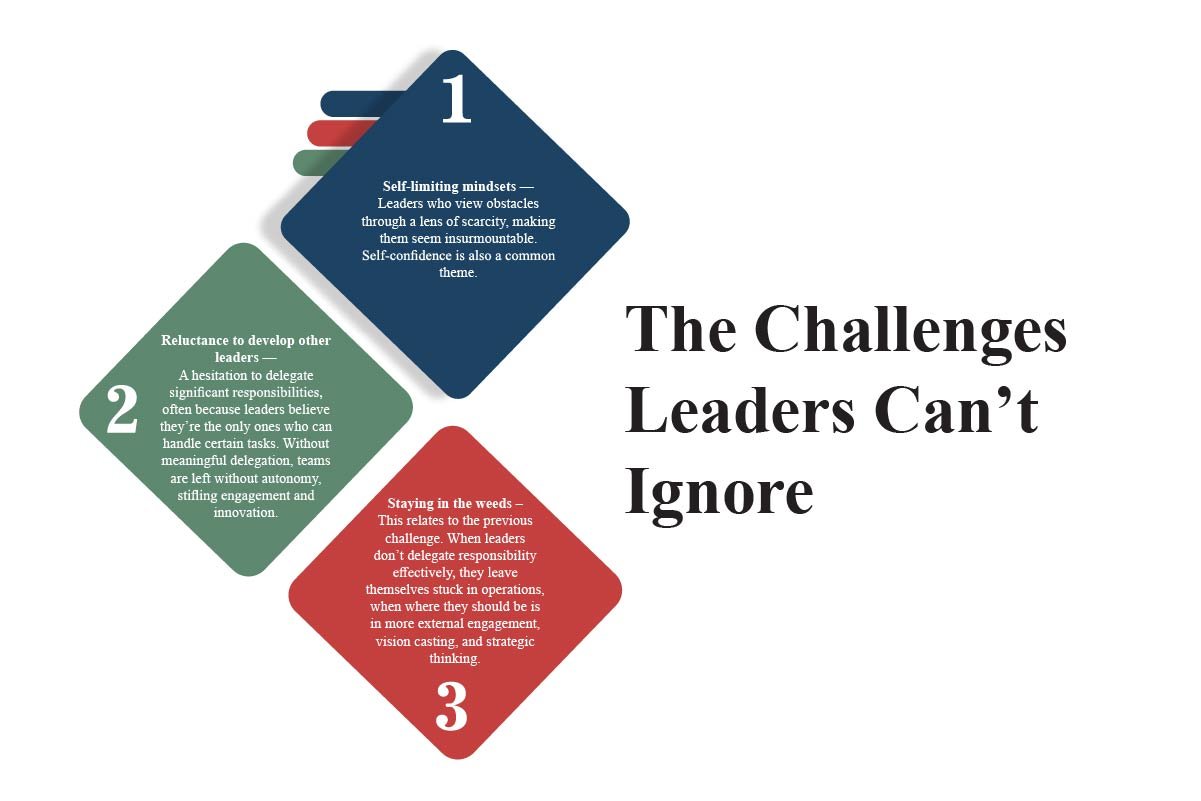
Across industries and sectors, Jinks sees three leadership challenges again and again:
- Self-limiting mindsets — Leaders who view obstacles through a lens of scarcity, making them seem insurmountable. Self-confidence is also a common theme.
- Reluctance to develop other leaders — A hesitation to delegate significant responsibilities, often because leaders believe they’re the only ones who can handle certain tasks. Without meaningful delegation, teams are left without autonomy, stifling engagement and innovation.
- Staying in the weeds – This relates to the previous challenge. When leaders don’t delegate responsibility effectively, they leave themselves stuck in operations, where they should be in more external engagement, vision casting, and strategic thinking.
“These aren’t just operational issues,” he says. “They directly impact trust, morale, and the organization’s ability to achieve its mission.”
In his coaching work, he helps leaders dismantle these barriers by shifting their perspectives, building confidence in their teams, and creating systems that support empowerment at every level.
Staying Relevant in a Changing World
For Patrick Jinks, leadership is influence — a concept he credits to John Maxwell — but influence must evolve to remain effective. “The acceleration rate of change is only increasing,” he says. “Leaders can’t afford to operate from a static plan. They have to keep their eyes up and forward.”
His prescription is a discipline of continuous planning — both strategic and operational — so organizations remain agile and ready to respond to shifting landscapes.
Ethics, Confidentiality, and the Coaching Profession
Coaching may be an unregulated industry, but Jinks believes it should be approached with the same level of professionalism and confidentiality as law or medicine. He is board-certified by the Center for Credentialing and Education (CCE) and requires all coaches certified under The Leader’s Perspective to adhere to a strict code of ethics.
“Without confidentiality, you lose trust. Without trust, you lose openness. And without openness, you can’t have the conversations that matter,” he says.
Work-Life Integration
Patrick Jinks challenges the popular notion of work-life balance, which he sees as artificial. “Work is part of life,” he says. “It’s not about balancing two separate worlds; it’s about managing your energy and bandwidth so you can be fully present in both.”
He encourages leaders to focus on integration rather than separation, a shift that can reduce stress and create more sustainable performance.
A Lifelong Learner
Even with decades of experience, Patrick Jinks commits to formal learning every year. He holds a PhD, is a certified practitioner in systemic team coaching under Dr. Peter Hawkins, and has earned certification in vertical development assessment through Global Leadership Associates. He is pursuing additional credentials with them in the coming year.
“These aren’t just lines on a résumé,” he says. “There are ways to stay relevant in a profession that’s becoming more nuanced and complex by the day.”
AI and the Future of Coaching
Artificial intelligence is one of the most disruptive forces in leadership development, but Jinks doesn’t see it replacing human coaches. “AI won’t replace coaching,” he says. “But coaches who don’t know how to use AI effectively will fall behind.”
For him, AI is a tool that can enhance — but never replace — the human connection and trust that make coaching effective.
Quick Takes — Beyond the Soundbite
- One tool or app to recommend: “Get proficient with AI. Not just one tool — the skill of using AI effectively will be as essential to leaders as email became two decades ago.”
- A quote that motivates: “Am I being the person I want to be right now?” — For Jinks, this isn’t a rhetorical flourish but a practical compass. “It’s a question I can ask myself in any moment, in any setting, to make sure my actions align with my values.”
- Advice for future leaders: “Learn from others, but be yourself. Authenticity is king. Borrow ideas and best practices, but don’t lose your own voice in the process.”
- A book every leader should read: Crucial Conversations. “It’s a blueprint for navigating the high-stakes conversations that define culture and drive results.”
From the newsroom to the nonprofit boardroom to coaching leaders at the highest levels, Dr. Patrick Jinks has built a career on clarity, simplicity, and alignment, and the belief that leadership is as much about who you are as what you do. His methods are grounded in experience, refined by study, and proven in the results his clients see.
“Leadership is a human endeavor,” he says. “When leaders become intentional about how they think, decide, and act, they create organizations that can adapt, grow, and succeed — no matter what the world throws at them.”














