It’s not your fault if adjectives seem confusing. Most people never learn what an adjective really is or how to use them properly. We don’t study adjectives because they’re cute. We study them because language is how we connect. Think of it like the difference between watching a film in black and white versus in color. Sure, you understand the story either way. However, when a great cinematographer adds depth, texture, and mood through color, the entire experience transforms. That’s what adjectives do to your writing and speech. They’re the difference between saying “I had coffee” and “I had strong, bitter coffee on a cold morning.” One tells a fact. The other lets someone feel what you felt.
Knowing what an adjective is means grasping a fundamental tool of human expression. It’s not grammar for grammar’s sake. It’s about learning to speak and write in a way that reflects how humans actually communicate. Whether you’re crafting a job application, penning an email, or just trying to describe how your day went, adjectives matter more than you think.
In this article, you’ll find a prominent answer to the question: What is an adjective?, how to use them without overdoing it, and the sneaky mistakes that even good writers make.
What Is An Adjective?
An adjective is just a word that tells you something about a noun. That’s all. When you say “hot coffee,” hot is the adjective. When you say “my dog,” my is the adjective. They describe stuff or point to stuff. They answer questions like, ‘What kind of thing is this?’ How many do you have? Which one are you talking about?
To put it simply, nouns are things. Adjectives explain what those things are like. You can say, “I drank coffee,” and people understand. But you say “I drank cold, black coffee,” and suddenly they know precisely what you mean. They can practically taste it. That’s what adjectives do.
Most adjectives are straightforward. Big, small, red, angry, broken, happy. You know them. Some count things like “five” or “many.” Some point to specific items, such as “this” or “that.” Some show ownership, such as “my” or “your.” And then you get weird ones that came from verbs, like “burning” in “burning building” or “scared” in “scared kid.” They’re all adjectives doing the same basic job: telling you something about the noun.
The Five Key Functions of Adjectives
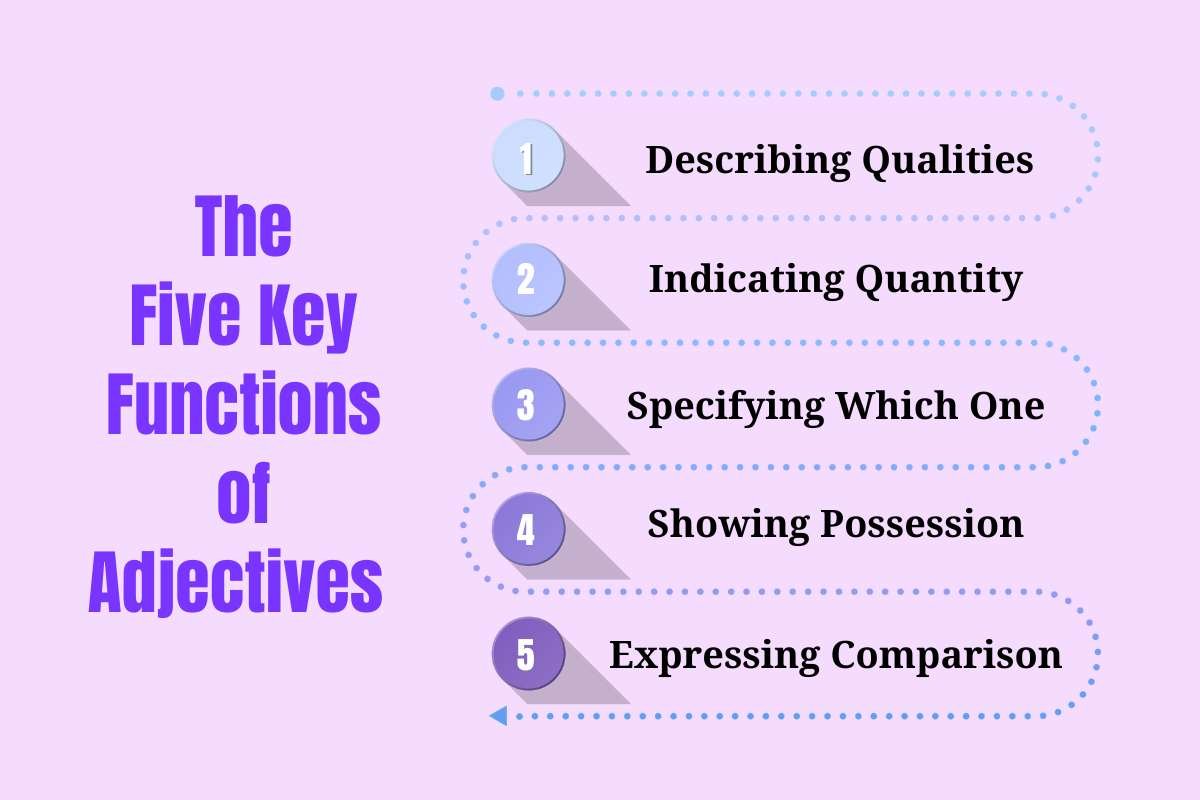
Adjectives don’t just sit around describing things. They’ve got different jobs to do. Here are the five ways they actually work:
→ Function 1: Describing Qualities
This is the one everyone knows. Big, small, red, angry, happy. You’re painting a picture of what something is like. “The angry customer yelled.” “She has blue eyes.” “The food was delicious.” These adjectives tell you what the noun is actually like.
→ Function 2: Indicating Quantity
Sometimes you need to say how much or how many. “I have three dogs.” “She drank some coffee.” “There’s enough time.” You’re not describing what the thing is like. You’re saying how much of it exists. Many, few, some, all, several. These are all adjectives too, but they count stuff instead of describing it.
→ Function 3: Specifying Which One
You point to something specific. “This car is mine.” “That house is huge.” “These books are old.” You’re using adjectives to say which one you’re talking about. This, that, these, those. They narrow it down. You’re not describing the thing. You’re pinpointing it.
→ Function 4: Showing Possession
“My phone,” “your jacket,” “his wallet,” “their house.” These tell you who owns something. My, your, his, her, its, our, their. Simple as that.
→ Function 5: Expressing Comparison
You’re stacking things against each other. “This coffee is hotter than that one.” “She’s the smartest person here.” “Your dog is faster than mine.” These adjectives let you measure one thing against another. Bigger, bigger than, the biggest.
All five of these are adjectives doing their own thing. Same word type, different jobs.
Types of Adjectives
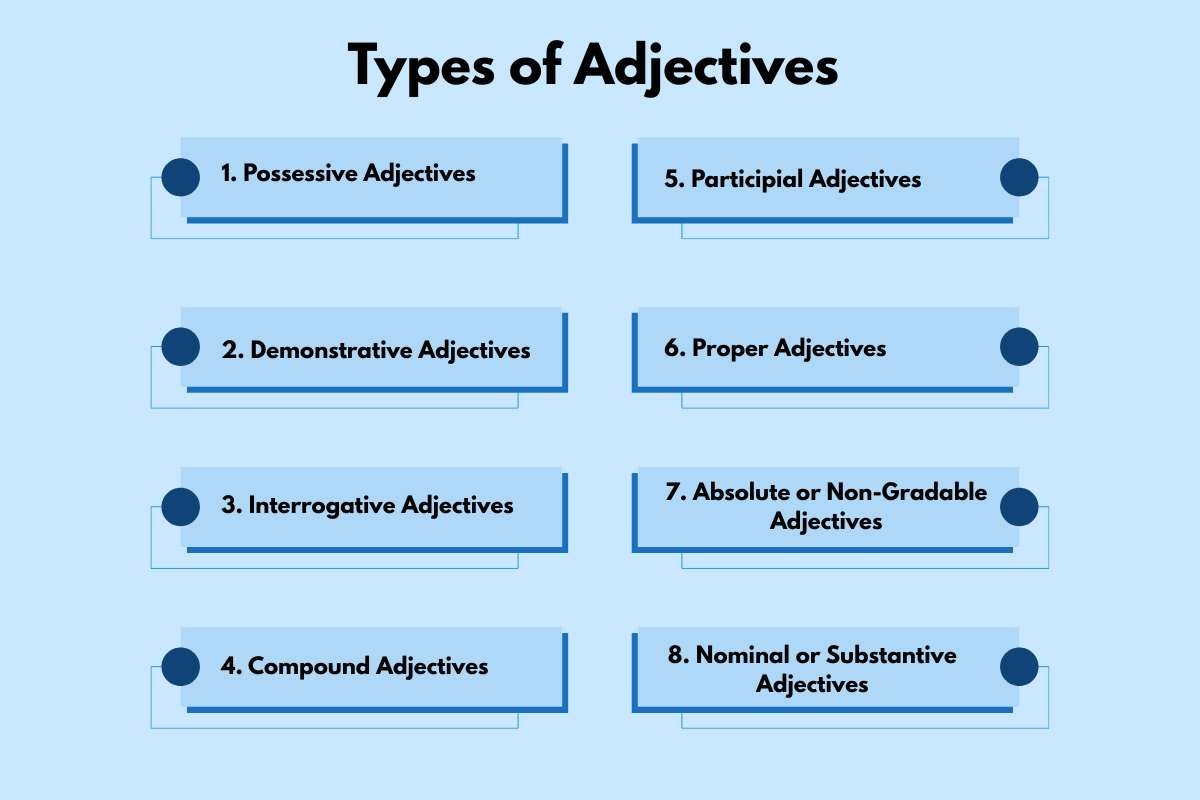
There are different kinds of adjectives, and each one does its own thing. You’ve already learned about descriptive adjectives (big, red, happy). But there’s more.
1. Possessive Adjectives
These show who owns something. My, your, his, her, its, our, their.
- “My phone is dead.”
- “Her jacket is in the closet.”
- “Their dog barks at everything.”
You’re not describing the thing. You’re saying who it belongs to.
2. Demonstrative Adjectives
These point to a specific thing. This, that, these, those.
- “This coffee is cold.”
- “That house is huge.”
- “These books are mine.”
- “Those people are loud.”
They narrow it down. You’re saying which one you’re talking about.
3. Interrogative Adjectives
These ask questions. Which, what, whose.
- “Which car is yours?”
- “What reason did he give?”
- “Whose shoes are these?”
They’re asking you to identify something.
4. Compound Adjectives
These are two words smashed together with a hyphen. They describe the noun as a unit of measurement.
- “Well-prepared meal.”
- “Fast-moving train.”
- “High-quality product.”
- “Brand-new car.”
The hyphen shows they work together to describe one thing. If the compound comes after the noun, you drop the hyphen. “The meal was well prepared.”
5. Participial Adjectives
These come from verbs. They end in “ing” or “ed.”
- “Burning building.”
- “Broken window.”
- “Running water.”
- “Scared kid.”
- “Interesting book.”
- “Bored student.”
They describe the noun using verb forms.
6. Proper Adjectives
These come from appropriate nouns and get capitalized.
- “French wine.”
- “American football.”
- “Italian pasta.”
- “Japanese technology.”
You take the place name and turn it into an adjective.
7. Absolute or Non-Gradable Adjectives
These can’t be compared. You can’t say something is “more unique” or “very perfect.” Either it is, or it isn’t.
- “Perfect.”
- “Complete.”
- “Unique.”
- “Infinite.”
- “Essential.”
You don’t modify these with words like “very” or “more.” It sounds dumb.
8. Nominal or Substantive Adjectives
Sometimes an adjective acts like a noun. You drop the noun, and the adjective becomes the thing you’re talking about.
- “The rich are getting richer.” (Rich people)
- “Help the poor.” (Poor people)
- “The young and the old.” (Young people and old people)
You’re using adjectives as if they’re nouns. It happens most with groups of people.
The Three Degrees of Comparison Explained
When you want to compare stuff, adjectives change form. There are three levels.
1. Positive (Absolute Form):
This is the basic adjective. Just the word itself. “The car is fast.” “She’s tall.” “That book is good.” You’re not comparing anything. You’re just saying what something is like.
2. Comparative Form:
Now you’re comparing two things. “My car is faster than yours.” “She’s taller than her brother.” “That book is better than this one.” You add “er” to short adjectives or put “more” in front of longer ones. Fast becomes faster. Good becomes better. Beautiful becomes more beautiful.
The pattern depends on the word:
→ One syllable? Add “er.” Fast, faster. Cold, colder. Big, bigger.
→ Two syllables ending in Y? Change Y to I and add “er.” Happy, happier. Angry, angrier.
→ Two or more syllables otherwise? Use “more” before the word. More beautiful. More intelligent. More complicated.
→ Then you use “than” to finish the Comparison. “Faster than.” “Happier than.” “More beautiful than.”
3. Superlative Form:
This is the top of the ladder. You’re saying something is the most (or least) of its kind. “That’s the fastest car I’ve ever seen.” “She’s the tallest person in our group.” “This is the best book ever.”
→ You add “est” to short adjectives or use “most” with longer ones. Fast becomes fastest. Cold becomes coldest. Beautiful becomes most beautiful.
The pattern is the same as comparative:
→ One syllable? Add “est.” Fast, fastest. Cold, coldest. Big, biggest.
→ Two syllables ending in Y? Change Y to I and add “est.” Happy, happiest. Angry, angriest.
→ Two or more syllables otherwise? Use “most” before the word. Most beautiful. Most intelligent. Most complicated.
→ And here’s the thing: with superlatives, you almost always use “the.” “The fastest,” “the tallest,” “the most beautiful.” Not just “fastest car.” The fastest car.
Irregular ones that screw everything up:
- Good, better, best.
- Bad, worse, worst.
- Little, less, least.
- Much, more, most.
These don’t follow the rules. You have to remember them.
Coordinate vs. Non-Coordinate Adjectives
Here’s where most people get confused. You’ve got two adjectives sitting next to each other. Do you put a comma between them or not? It depends on whether they’re coordinate or non-coordinate. Let me break it down.
Coordinate Adjectives
These are adjectives that work independently. They both describe the noun the same way. You can swap them around, and the meaning stays the same. You can throw “and” between them, and it still sounds right.
“I bought a red, juicy apple.”
- Flip it: “I bought a juicy, red apple.” Still makes sense.
- Add “and”: “I bought a red and juicy apple.” Sounds fine.
- So they’re coordinated. You use a comma.
“She wore a long, blue dress.”
- Flip it: “She wore a blue, blue dress.” Works.
- Add “and”: “She wore a long and blue dress.” Works.
- A comma goes between them. Done.
Non-Coordinate Adjectives (Cumulative)
These build on each other. The first adjective modifies the second adjective plus the noun as a unit. Flip them, and it sounds off. Add “and” and it sounds weird.
“I have a rusty bread knife.”
- Flip it: “I have a rusty knife.” Nope, sounds stupid.
- Add “and”: “I have a rusty and bread knife.” Nope.
- These aren’t coordinates. You don’t use a comma. “Rusty” is modifying “bread knife” as one thing.
“He wore a dark green shirt.”
- Flip it: “He wore a green dark shirt.” Wrong.
- Add “and”: “He wore a dark and green shirt.” Wrong.
- No comma.
The Simple Test
Can you reverse the adjectives without sounding like an idiot? Can you add “and” without making it weird? If yes to both, use a comma. If no, don’t.
That’s what an adjective really does to your writing when you understand how to place them. It either connects two separate ideas or combines them.
Word Order Matters: Mastering Adjective Sequencing
Here’s something that blows people’s minds: English speakers know the correct order for adjectives without ever being taught it. You do it. You never say “big red ball.” You say “red big ball,” and it sounds wrong, but you can’t explain why. That’s because there’s an actual order.
Understanding what an adjective is includes knowing that it follows a sequence. No one agreed on this. It’s how English works. If you break the order, people notice something’s off.
The Order:
- Determiner (a, the, this, that, my, your)
- Opinion (beautiful, ugly, terrible, amazing)
- Size (big, small, tiny, huge)
- Age (old, new, young, ancient)
- Shape (round, square, flat, curved)
- Color (red, blue, green, yellow)
- Origin (French, American, Chinese, Italian)
- Material (wooden, plastic, metal, silk)
- Purpose or type (cooking, sports, winter, camping)
- The noun itself
So you could say: “a beautiful small old wooden rocking chair.”
Let’s break that down:
- “a” = determiner
- “beautiful” = opinion
- “small” = size
- “old” = age
- “wooden” = material
- “rocking chair” = noun with purpose
Say it a different way? “A small, old, beautiful wooden rocking chair.” It’s awkward. Your brain knows it doesn’t fit the pattern.
Why Does This Matter?
Nobody knows for sure. However, the closer an adjective sits to the noun, the more it’s tied to it. “Wooden chair” is one thing. “Rocking chair” is one thing. “Beautiful wooden rocking chair” stacks them. The opinion sits furthest away.
Examples
1. “The old Italian leather jacket.” Opinion (old) comes first, then origin (Italian), then material (leather). You don’t say “the leather Italian old jacket.” It’s wrong.
2. “Three blue cotton shirts.” Number (three) comes first, then color (blue), then material (cotton). You don’t say “three cotton blue shirts.”
3. “Her new French sports car.” Determiner (her), opinion (new), origin (French), purpose (sports), noun (car).
Get the order wrong and people stop understanding what you mean. Or they understand, but they know something doesn’t quite sound right. Your writing feels clunky.
The Weird Part
You’ve never learned this rule, but you follow it every day. English speakers born and raised know. Someone learning English has to memorize it. That’s how ingrained this order is in the language.
When you use adjectives, please put them in this order, and your writing flows. Mess with the order and it sticks out like a sore thumb.
Where Do Adjectives Go? Attributive vs. Predicative
Adjectives can sit in two different places in a sentence, and they change their job depending on where they are.
Attributive Adjectives
These come right before the noun. They modify the noun directly.
“The tall building.” “She has a blue car.” “That angry customer yelled.” “I need a strong coffee.”
The adjective is stuck to the noun. Tall building. Blue car. Angry customer. Strong coffee.
This is where most adjectives live. Use attributive adjectives all the time without thinking about it.
Predicative Adjectives
These come after a linking verb. They describe the subject of the sentence, not the noun directly.
“The building is tall.” “Her car is blue.” “The customer seems angry.” “I feel tired.”
Notice the linking verb sits between the subject and the adjective. The adjective describes the subject, but it comes after the verb.
Common linking verbs: is, am, are, was, were, be, seem, feel, look, sound, appear, become, stay, grow, taste, smell.
When you use these verbs, the adjective goes after them.
“He feels sick.” “The milk smells sour.” “She looks happy.” “That sounds wrong.” “It became clear.”
Here’s where people screw up: They use an adjective when they need an adverb.
→ “I feel bad.” (Correct. You’re describing yourself.)
→ “I feel bad.” (Wrong. This means you’re bad at feeling things.)
→ “The food looks good.” (Correct. It is good.)
→ “She speaks good English.” (Wrong. Should be “speaks English well.”)
The linking verb needs an adjective after it, not an adverb. That’s the rule.
Adjectives vs. Adverbs: The Critical Distinction
People often confuse these two. Understanding what an adjective is means also understanding how it’s different from an adverb.
| Adjective | Adverb |
| Describes: Nouns and pronouns | Describes: Verbs, adjectives, other adverbs |
| Example: “The fast car” (fast describes the car) | Example: “She ran fast” (fast describes how she ran) |
| Position: Usually before the noun | Position: Varies, often after the verb |
| Typical ending: No specific pattern | Typical ending: Often ends in “-ly” |
| Example: “She’s beautiful” | Example: “She sings beautifully” |
| Example: “That’s a good idea.” | Example: “She did well on the test.” |
| Example: “The quick solution” | Example: “He works quickly” |
| Example: “I feel happy” (linking verb) | Example: “I’m happily married” |
| Example: “He looks tired.” | Example: “He looked at me tiredly.” |
| Example: “The bad weather” | Example: “The weather is badly damaged” (incorrect usage) |
Why People Get It Wrong?
Most words ending in “ly” are adverbs. Beautiful becomes beautifully. Quick becomes quickly. Happy becomes happily. So your brain thinks all “ly” words are adverbs. They’re not.
“Friendly,” “lonely,” “cowardly,” “deadly,” “costly.” These are adjectives, not adverbs.
“He behaved cowardly.” Wrong. You’d say “He behaved in a cowardly manner” or “He acted like a coward.”
“He laughed silly.” Wrong. You’d say, “He gave a silly laugh.”
The other mistake: Linking verbs.
“I feel bad.” Correct. Bad is an adjective describing you.
“I feel bad.” Wrong. This means you’re bad at feeling things.
“The coffee tastes good.” Correct. Good describes the coffee.
“The coffee tastes good.” Not even a real word.
Get these right and you sound like you know what you’re doing. Get them wrong and people notice.
Wrapping Up
By now, you can probably see that adjectives aren’t just “grammar stuff.” They’re the small, clever tools that make your sentences feel alive. Once you understand what an adjective is and how it behaves, you start noticing how much easier it becomes to express yourself. Apart from naming things, you’re giving them shape, mood, and meaning. Use them with intention, skip the unnecessary ones, and let the right words do the heavy lifting. Your writing will sound more like you, and that’s the whole point.