Key Points:
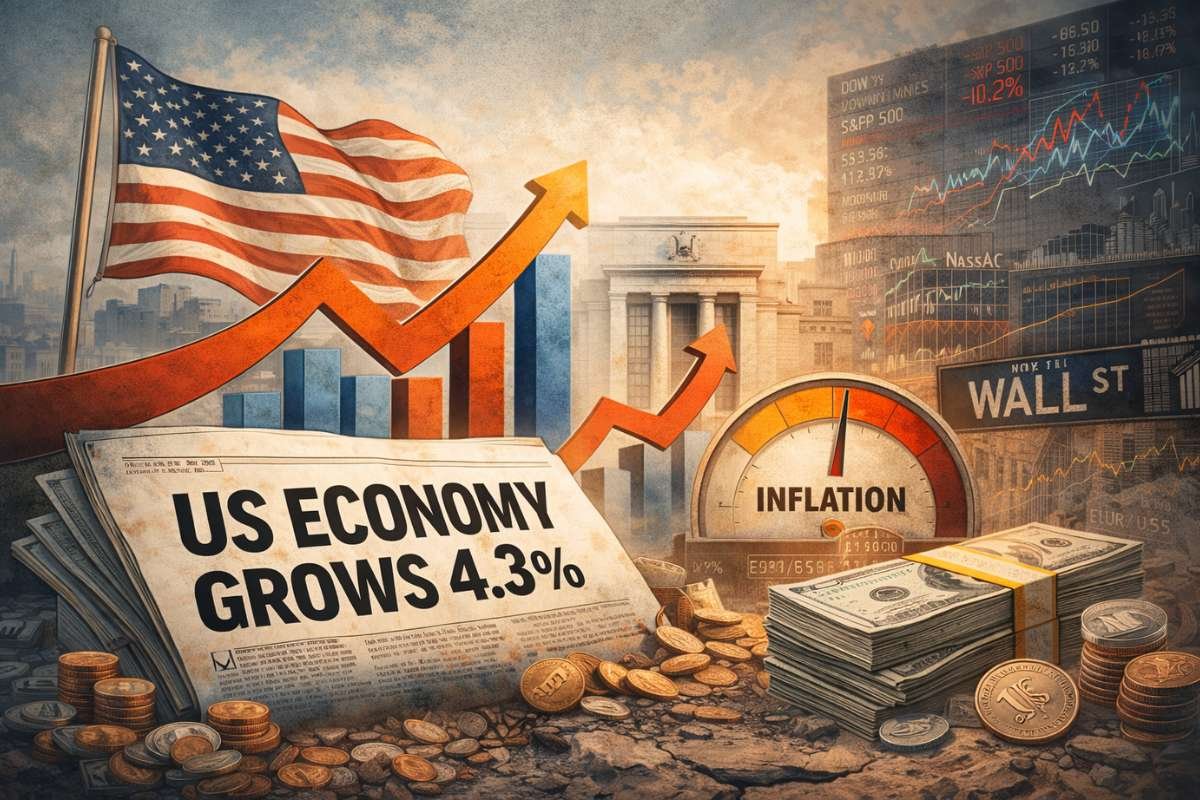
- U.S. growth hit 4.3% in Q3.
- Spending and exports boosted the economy.
- Inflation and jobs cooled momentum.
The US economy expanded at a robust 4.3% annualized rate in the third quarter of 2025, significantly outperforming market expectations and marking the strongest pace of growth in nearly two years. The figures were released in a delayed government report issued just before the year-end, following disruptions caused by a federal shutdown.
Economists had anticipated a more moderate expansion of just over 3%, making the final estimate a notable upside surprise. The third-quarter performance also surpassed the revised growth rate recorded in the previous quarter, reinforcing signs of underlying economic resilience despite ongoing inflation and labor market adjustments.
The sharp increase in economic output was largely driven by strong consumer spending, which remains the backbone of the US economy. Household expenditures rose at a healthy pace, supported by increased spending on services, healthcare, travel, and durable goods. At the same time, exports rebounded after earlier weakness, while imports declined, narrowing the trade gap and adding to overall growth.
Government spending at both the federal and state levels also contributed positively, further lifting economic activity during the quarter. While the delayed timing of the report blended data typically released in stages, economists broadly agree that the underlying trend points to stronger-than-anticipated momentum heading into the final months of the year.
Key Drivers and Mixed Economic Signals
Consumer demand remained the central engine of growth, offsetting softer performance in areas such as private investment and residential construction. Spending on services, in particular, showed sustained strength, reflecting continued confidence among higher-income households.
Exports of both goods and services accelerated during the quarter, benefiting from improved global demand and a more favorable trade environment. Government outlays, including infrastructure and public services, further supported economic expansion.
However, not all indicators painted an equally optimistic picture. The labor market showed signs of cooling, with unemployment edging higher in recent months. Hiring remained solid in sectors such as healthcare and technology, while other industries experienced slower job creation. This uneven trend has fueled concerns about a two-speed economy, where growth benefits are not evenly distributed across income groups.
Inflation pressures also persisted. Core price measures remained above the Federal Reserve’s long-term target, adding complexity to the broader economic outlook. While price growth has moderated from earlier peaks, it continues to influence household purchasing power and monetary policy considerations.
Market Reaction and Policy Implications
The stronger-than-expected growth report was welcomed by financial markets, with major stock indices extending gains as investors responded positively to signs of economic durability. The data reinforced confidence that the US economy has avoided a sharp slowdown despite higher interest rates and global uncertainty.
Policymakers highlighted the role of domestic investment, technological innovation, and trade activity in sustaining growth. Some officials pointed to increased investment in advanced technologies as a potential catalyst for future productivity gains and job creation.
Still, economists caution that the 4.3% growth rate may be difficult to sustain. Lingering inflation risks, uneven employment trends, and the aftereffects of government disruptions could weigh on momentum in the fourth quarter.
For the Federal Reserve, the data underscores a delicate balancing act. Strong growth strengthens the case for patience on rate cuts, while persistent inflation and labor market softness argue for caution. As policymakers assess incoming data, the third-quarter performance stands as a clear signal that the US economy entered the final stretch of 2025 on firmer footing than many had anticipated.