



And Every Industry Will Feel It
For thirty years, the internet has been quietly shaped by a structural limitation almost no one ever questioned. It affected every software platform, every e-commerce store, every enterprise system, and every workflow performed in a browser. It determined how people searched, purchased, analyzed, managed, and interacted with information online. This limitation was so universal and so deeply ingrained that it became invisible. It simply became how the internet worked.
That limitation is the One Page At A Time model. OPAT defined everything. You opened a page, clicked a link, waited, watched the browser reload, then repeated the cycle again and again. Every action replaced the previous one. Every task required giving up context. Every system forced users into a narrow, linear experience that prevented true multitasking inside a single browser session.
Despite all the visual evolution of the internet, this core constraint never changed. Not for Amazon. Not for Walmart. Not for Shopify. Not for Salesforce, Oracle, Microsoft, SAP, NetSuite, Intuit QuickBooks, or HubSpot. Not for any SaaS platform or ecommerce powerhouse on earth. The OPAT model governed them all.
ProBuilt Software is the first company to break it.
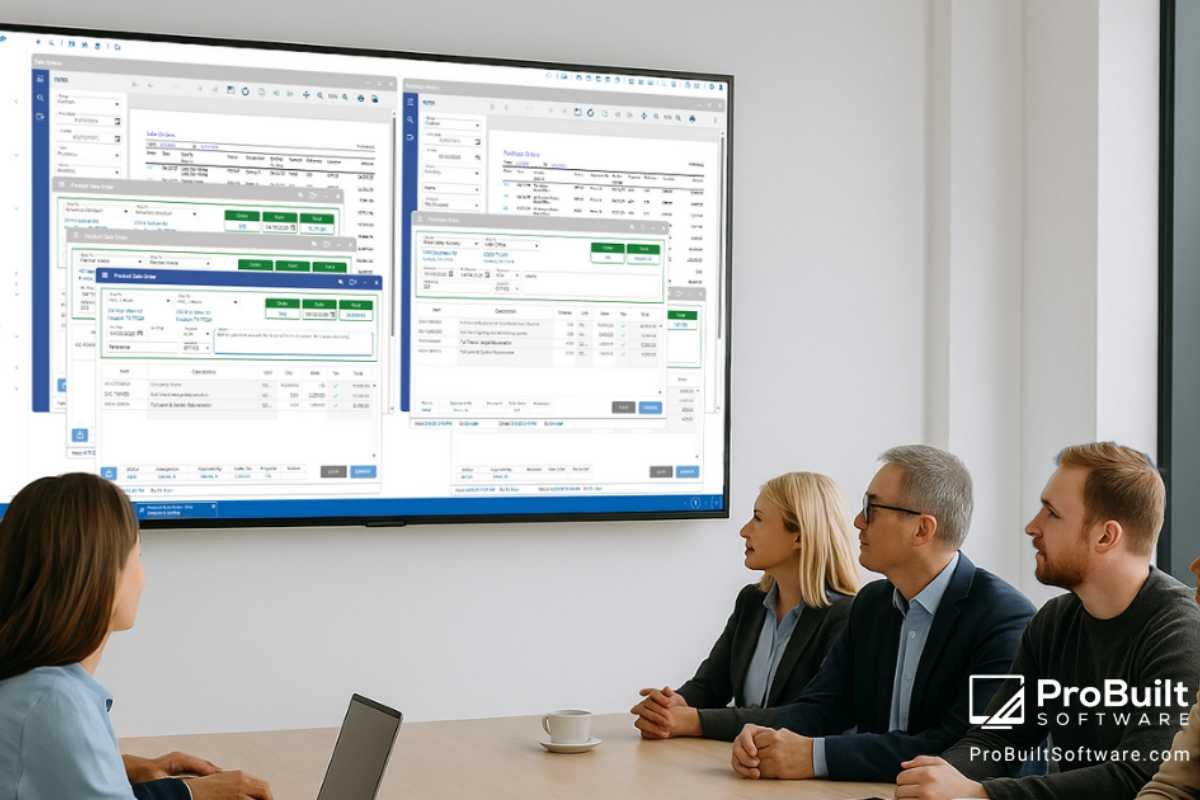
What ProBuilt Software created is not a faster page load or a clever interface trick. It is not a new front-end framework, a new workflow system, or an improved version of a traditional application. This patent-pending technology is called Floating Forms, and it allows users to open multiple live windows inside a single browser session without losing context, without reloading anything, and without being forced to work One Page At A Time.
This invention does not upgrade the old model. It replaces it.
And once you understand what OPAT has cost the world over the past thirty years, you begin to understand why this shift changes everything.
The Internet Froze In Time
If you have ever opened multiple tabs just to compare products, you have felt the limitations of OPAT. If you have ever clicked between reloads while managing information in a SaaS platform, you have lived inside its constraints. OPAT was never built for multitasking. It was never designed for complex workflows. It was never intended to support the modern internet.
Yet the entire world was built on top of it.
E-commerce became a race to reduce friction. SaaS became a race to reduce steps. Entire industries invested billions of dollars trying to minimize the symptoms of OPAT without ever addressing the core architectural limitation. For thirty years, the internet looked more modern but acted exactly the same.
ProBuilt Software saw something the rest of the industry had accepted as permanent. There was no rule of physics requiring OPAT. It was not a natural law of computing. It was simply a missing architectural layer that no one had ever built.
So ProBuilt built it.
The Breakthrough: Patent-Pending Floating Forms Architecture
Patent-pending Floating Forms introduces a new way for information to exist and interact inside a browser session. Instead of one page replacing another, users can open multiple forms, windows, or work areas at the same time. Each one remains active. Each one remains alive. Each one can be moved, resized, layered, or referenced without losing anything.
There are no page reloads. No lost context. No tab sprawl. No pop-up traps. No iframe illusions. This is not a workaround. It is a foundational change to how information is displayed and interacted with in the browser environment.
In practical terms, it means a user can perform work the way the human mind actually functions. People do not think linearly. They think in multiple concepts at once. Floating Forms finally gives the browser the ability to match that reality.
This is why ProBuilt Software calls it an architecture, not a feature. Features enhance. Architects redefine.
SaaS Companies Cannot Compete Without It
The global SaaS market has been shaped entirely by what OPAT allowed and what OPAT prevented. Platforms like Salesforce, Oracle, Microsoft Dynamics, SAP, NetSuite, HubSpot, and Intuit QuickBooks became market leaders through scale, integration,s and massive product ecosystems. But they all sit on the same OPAT foundation.
No matter how powerful these systems become, they cannot escape the structure their interfaces are forced to live inside. Every action replaces another. Every workflow is a series of reloads. Every complex task becomes a path of sequential steps, with tabs acting as the only escape mechanism.
With Floating Forms, none of that is necessary.
Users can work across multiple records at once. Compare information instantly. Drag one form over another. Layer data visually. Complete workflows without giving up context. Move at the speed of thought instead of the speed of the browser reload cycle.
This changes CRM. It changes ERP. It changes accounting. It changes operations. It changes every multi-step workflow that previously required navigating between screens to accomplish anything meaningful.
And this change is not directional. It is absolute.
Once one major SaaS vendor adopts the Floating Forms architecture, every other vendor will have to follow. Not because ProBuilt Software says so. Because users will never return to OPAT once they experience the alternative.
Ecommerce Has Been Held Back For Thirty Years
E-commerce is perhaps the most visibly constrained by OPAT. Every shopper has experienced the frustration of switching between product pages, losing filters, restarting comparisons, bouncing between carts, reloading details, and repeating the same process over and over.
OPAT created an entire generation of shoppers who learned to endure the limitations of the architecture rather than benefit from the capabilities of the internet.
Floating Forms eliminates those limitations entirely.

Shoppers can view multiple products at once. Keep relevant information visible. Compare instantly. Move items into view. Interact with the cart without losing the current page. Explore without penalty. Navigate without friction. Everything becomes fluid.
When you consider the scale of e-commerce giants like Amazon, Walmart, Shopify, Best Buy, Target, and Wayfair, the implications are enormous. Their checkout funnels, product views, comparison experiences, and conversion rates have been shaped for decades by the reload model. When that model is removed, the conversion math changes. The user experience changes. The competitive dynamics change.
This will not be a small shift. This will be the architectural rewrite that e-commerce has been waiting for since the beginning.
The Proof Of Concept Is Already Live
ProBuilt Software did not introduce this architecture as a theoretical idea. The company launched a full national-scale enterprise platform built entirely on Floating Formsarchitecture. ProBuilt ERP is a complete accounting, CRM, and operations system competing directly in the U.S. SMB market, and it is the first commercial application to operate fully on the new architecture.
Inside ProBuilt ERP, Floating Formsruns every workflow. Users manage accounting, sales, and operations without page reloads, without losing context, and without relying on tabs to survive complex tasks. The system proves exactly how much the OPAT model has been holding the industry back, and it demonstrates the architectural advantage that Floating Forms provides in real business environments.
This is not a prototype or a lab demo. It is a production system already in use, serving real companies today and showcasing what becomes possible when OPAT is eliminated from the browser.
And the industry has noticed.
ProBuilt Software was recently shortlisted in five global categories in the 2025/2026 Cloud Awards program. The Cloud Awards is one of the most respected independent recognitions of cloud innovation worldwide, and ProBuilt was the only company out of 78 shortlisted across all five categories simultaneously. Finalist selections will be announced around mid-December. This recognition places ProBuilt on the global stage not simply as a software provider but as the inventor of a new architecture for interactive computing.
Licensing The Next Architecture Of The Internet

ProBuilt Software does not intend to be the only company using this technology. The company’s long term strategy is to license the architecture to SaaS vendors, ecommerce platforms, and any organization that depends on complex browser-based interactions.
Licensing creates a path for companies to leapfrog years of development. They do not have to reinvent the architecture. They do not have to experiment or prototype, or guess. They can adopt a fully realized system that already solves the OPAT limitation that has defined the internet for decades.
For SaaS vendors, this means competitive differentiation at the architecture level. For e-commerce giants, it means unlocking user experiences that have never been possible. For government agencies, financial institutions, and enterprise systems, it means the ability to support modern workflows without relying on outdated reload-based patterns.
When you consider the size of the industries built on OPAT, the potential impact is enormous. Floating Forms is not a competitive feature. It is a structural advantage that will become the new standard across the internet.
The Future: The Internet Is Moving Toward
Every major era of computing has a before and after. Before broadband. After broadband. Before mobile. After mobile. Before cloud. After cloud.
The internet is now moving from the OPAT era to the Floating Forms era.
This transition is not theoretical. It is not speculative. It is not an idea waiting for adoption. It is already here, and it is already operating inside a live, full-scale enterprise system.
ProBuilt Software did not wait for the industry to ask for a new architecture. It built one. It built the missing layer that the internet should have had thirty years ago. It built the architecture that removes the biggest bottleneck in modern computing. And it built the foundation that software companies and e-commerce platforms will adopt in order to remain competitive in the next decade.
The shift has already started.
The companies that understand it early will lead the next era of the internet. The companies that ignore it will feel the consequences of staying inside the One Page At A Time model long after their competitors have moved on.
ProBuilt Software introduced the breakthrough. The rest of the industry will follow.
Because once the world experiences the internet without OPAT, it will never go back.














