Every day, we use apps and tools that started as just a small idea in a crowded garage or a quiet home office. These companies often grow behind the scenes until they suddenly change everything about our world. Staying updated on the most valuable unicorn companies helps us see which new ideas are actually working in the real world.
Looking toward the future reveals a shift in what people and businesses value most right now. These startups are solving practical problems for millions.
By understanding who the most valuable unicorn companies are and what they do, we can better prepare for the new tools and opportunities heading our way.
Unicorn Companies Explained: Origins, Rarity, and Modern Meaning
Unicorns were first mentioned in Indica, a book by the ancient Greek historian Ctesias. He used it to describe a rare species of wild asses only found in India. Later, it became the name for the mythical single-horned horse. But that’s not what we are talking about when we say “most valuable unicorn companies.”
But there’s a reason behind the explanation. Unicorns exist, yet they are mythical and rare. And that’s what unicorn companies are. They are these rare, mythical organizations, privately owned, that have reached a $1 billion valuation.
A unicorn company is valuable in its actual nature. Between 2013 and 2025, there have been, on average, around 700 unicorns yearly. According to Hurun’s report, there are 1523 unicorns in the world today.
But which of them are valuable? Let’s find out!
The Global Ranking of the 15 Most Valuable Unicorn Companies in 2026:
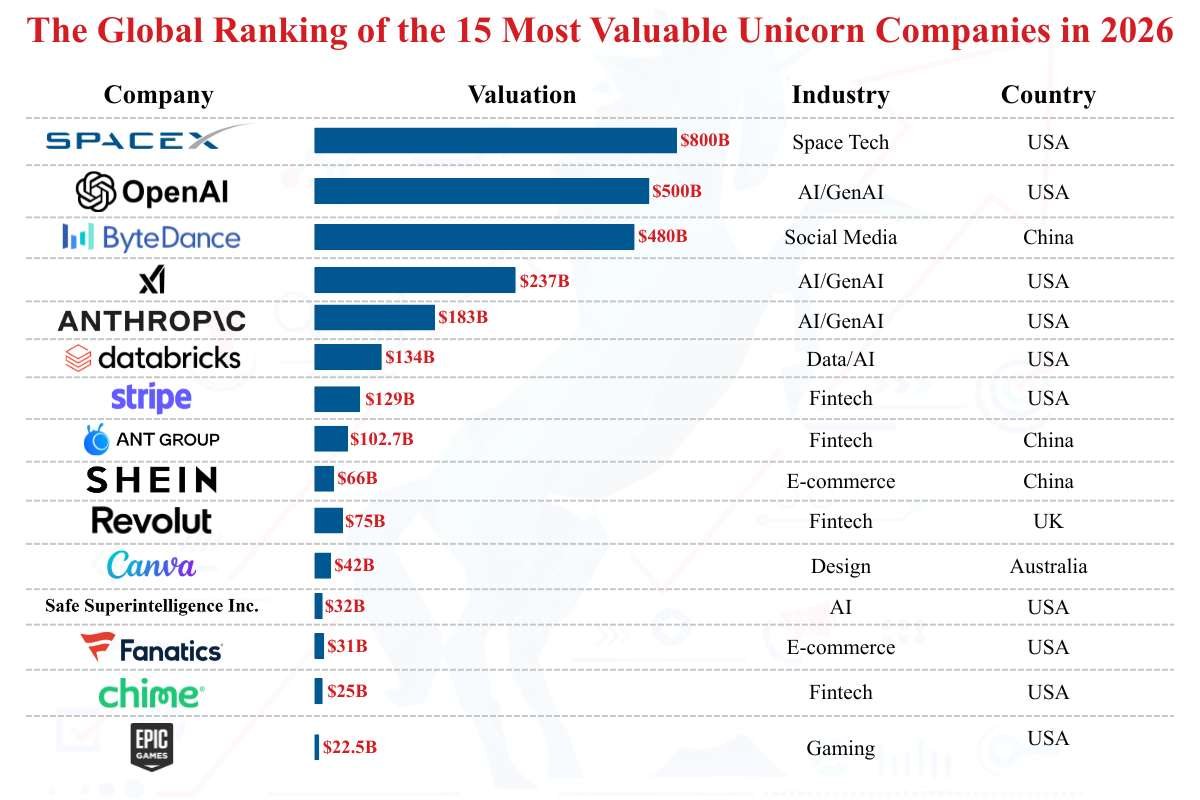
We have reviews and ranked 15 unicorns all over the world. In the following blog, we will see how these companies are impacting the world and the products they sell.
So, how do you rank the most valuable unicorn companies? By their value. That’s the criteria we based our list on.
We have gathered the latest available valuation of all unicorns and curated an updated list for 2026.
| Rank | Company | Valuation | Industry | Country |
|---|---|---|---|---|
| 1 | SpaceX | $800B | Space Tech | USA |
| 2 | OpenAI | $500B | AI/GenAI | USA |
| 3 | ByteDance | $480B | Social Media | China |
| 4 | xAI | $237B | AI/GenAI | USA |
| 5 | Anthropic | $183B | AI/GenAI | USA |
| 6 | Databricks | $134B | Data/AI | USA |
| 7 | Stripe | $129B | Fintech | USA |
| 8 | Ant Group | $102.7B | Fintech | China |
| 9 | Shein | $66B | E-commerce | China |
| 10 | Revolut | $75B | Fintech | UK |
| 11 | Canva | $42B | Design | Australia |
| 12 | Safe Superintelligence | $32B | AI | USA |
| 13 | Fanatics | $31B | E-commerce | USA |
| 14 | Chime | $25B | Fintech | USA |
| 15 | Epic Games | $22.5B | Gaming | USA |
1. SpaceX
- Sector: Space Technology
- Valuation: $800B
- Country: USA
SpaceX is currently valued at approximately $800 billion, following recent internal share sales, with analysts targeting a $1.5 trillion valuation as it moves toward a potential 2026 IPO. Primarily owned by Elon Musk and a group of private equity firms like Fidelity, the company has secured a staggering 80% market share in global rocket launches.
The real value of SpaceX lies in Starlink. According to Bloomberg, it is projected to generate $22–$24 billion in revenue this year. With over 7.8 million users, Starlink ensures that even a remote retail shop or a mountain-based consultancy has the same high-speed digital tools as a skyscraper in New York.
2. OpenAI
- Sector: AI / Generative AI
- Valuation: $500B
- Country: USA
OpenAI, operating as a public benefit corporation with Microsoft as a strategic partner, has reached a massive $500 billion valuation on the secondary market. Their revenue, projected to exceed $15–$20 billion this year, is fueled by over 10 million paid subscribers for ChatGPT Plus and Pro.
OpenAI has moved beyond simple chat; it is now a comprehensive creative suite. With 700 million weekly active users, their niche is “generative utility,” providing tools that can write code, design marketing assets, and manage customer service instantly. It allows a small team to perform the workload of a department three times its size.
3. ByteDance
- Sector: Social Media
- Valuation: $480B
- Country: China
ByteDance remains a powerhouse in the most valuable unicorn companies with a valuation of nearly $480 billion, according to recent private transactions. The parent company of TikTok is on track for a $50 billion annual profit in 2025-2026, rivaling the earnings of Meta.
TikTok is no longer just for videos; it’s an engine for commerce. TikTok Shop, projected to grow its buyer base by 67% by 2026, has already supported over 7 million businesses in the U.S. alone. Their “discovery-led shopping” introduces your products to a global audience of 2.14 billion users without the need for a massive traditional ad budget.
4. xAI
- Sector: AI / Generative AI
- Valuation: $237B
- Country: USA
Elon Musk maintains a controlling 59% stake in xAI, which recently reached a secondary market valuation of $237 billion. The company is actively operating Colossus, a massive supercomputer in Tennessee, as it scales toward one million processing units.
This infrastructure powers the Grok platform, which processes live information to help people stay ahead of shifting global trends. By 2026, the company aims to generate $14 billion in revenue by providing a fast and unfiltered window into the world’s data. It helps anyone needing real-time insights to make smarter choices in an economy.
5. Anthropic

- Sector: AI / Generative AI
- Valuation: $183B
- Country: USA
Anthropic has become a favorite for enterprises, with Amazon and Google as its most significant financial partners. The company’s valuation has soared to over $183 billion as it approaches a $20 billion annual revenue run rate for 2026.
Their primary product, Claude, now serves over 300,000 business customers who prioritize its “Constitutional AI” framework for safer, more reliable automation. Anthropic provides high-accuracy data processing, its primary selling point in this list ofthe most valuable unicorn companies. It allows teams to automate legal and financial reviews with far fewer errors than traditional tools.
6. Databricks
- Sector: Data & AI Platforms
- Valuation: $134B
- Country: USA
Databricks recently hit a $134 billion valuation after raising $4 billion in its latest funding round. The company is currently on track to reach a $4.8 billion annual revenue run rate. It is growing at the rate of 55% year-over-year. Their “Lakehouse” platform is the product of choice for over 700 large-scale customers who spend more than $1 million annually.
However, they are increasingly opening up to smaller businesses, offering a niche in predictive analytics. It means a business owner can now use their own sales data to predict inventory needs with nearly the same precision as a Fortune 500 company.
7. Stripe

- Sector: Fintech & Payments
- Valuation: $129B
- Country: USA
Brothers Patrick and John Collison still guide Stripe, which holds a private valuation of roughly $129 billion. The company processes a staggering $1.4 trillion in annual payments, contributing to over 1% of the global GDP.
It simplifies the complicated world of digital money, helping over 7 million users accept payments and manage their finances with just a few lines of code. By 2026, it will expand into automated accounting and stablecoin support. It makes it easier for a single person to run a professional operation that reaches customers in dozens of countries instantly.
8. Ant Group
- Sector: Fintech
- Valuation: $102.7B
- Country: China
Ant Group remains an affiliate of Alibaba, with ownership transitioning toward a more regulated structure involving several state-backed entities. While its massive IPO remains on hold, the company continues to dominate with a valuation estimated at around $80 billion by 2026.
Its primary platform, Alipay, connects over 1.3 billion users and 80 million merchants through a seamless digital payment system. It makes daily life easier by handling everything from grocery bills to small business loans in a few seconds. Today, it stands as the world’s largest digital gateway, proving that financial tools can be both powerful and incredibly simple, at the same time.
9. Revolut
- Sector: Fintech, Digital Banking
- Valuation: $75B
- Country: UK
Nik Storonsky leads Revolut, a financial giant now valued at $75 billion following a major share sale. The company is heading into 2026 with a goal of $9 billion in revenue and a healthy profit of $3.5 billion. With a community of over 65 million users, it has transformed from a travel app into a global financial hub.
It supports international life by allowing people to hold over 25 currencies and send money across borders without high fees. Today, it stands as a primary choice for anyone living a digital, global lifestyle.
Read Next:
- 20 Richest Companies in the World: Trillion-Dollar Giants Powering the 2025 Economy
- Largest Companies in the United States in 2026: Revenue, Market Cap, Employees, and More
10. Shein
- Sector: E-commerce & Fashion
- Valuation: $66B
- Country: China
Sky Xu remains at the helm of Shein as it prepares for a public listing with a valuation near $66 billion. The company has captured a 2.2% share of the global apparel market by delivering 2,000 new items every day. It uses a real-time feedback loop to match production with precisely what people want to wear.
With over 145 million monthly users in Europe alone, Shein has transformed the fashion industry, making it one of the most valuable unicorn companies. It provides a vibrant marketplace where style is affordable and accessible to millions of shoppers globally.
11. Canva
- Sector: Design & Visual Communication
- Valuation: $42B
- Country: Australia
By late 2025, Canva achieved a valuation of $42 billion. The platform currently supports over 260 million monthly users across 190 countries, with 95% of Fortune 500 companies relying on its tools for designing. Canva can turn complex design work into a fun and intuitive experience that anyone can master in minutes.
With a projected revenue of over $3 billion this year, it has become the go-to workspace for students, teachers, and professionals alike. It empowers millions to share their stories and build their brands without needing years of technical training.
12. Safe Superintelligence (SSI)

- Sector: Artificial Intelligence
- Valuation: $32B
- Country: USA
Ilya Sutskever, a pioneer in the field, leads Safe Superintelligence alongside co-founders Daniel Gross and Daniel Levy. The company recently achieved a private valuation of $32 billion despite being founded in 2024. Backed by major firms like Andreessen Horowitz and Sequoia, SSI avoids the rush to release small apps.
Instead, it focuses entirely on the single goal of creating a digital intelligence that is fundamentally safe and reliable for humanity. By 2026, it will act as a guiding light for those who believe that technology should be developed responsibly and with a focus on long-term impact.
13. Fanatics

- Sector: E-commerce, Sports Commerce
- Valuation: $31B
- Country: USA
Michael Rubin leads Fanatics, a sports powerhouse valued at roughly $31 billion, as it prepares for a potential public listing in 2026. The company is on track to generate over $8 billion in revenue by connecting fans with the teams they love. Through its massive marketplace, it offers everything from official jerseys to unique digital collectibles and sports betting.
Fanatics manages relationships with over 900 sports properties globally. Being named among the most valuable unicorn companies, it ensures that every fan can find a way to celebrate their passion. It has redefined the sports experience, moving beyond just retail to become a vibrant home for the global sports community.
14. Chime
- Sector: Fintech, Neobanking
- Valuation: $25B
- Country: USA
Chris Britt and Ryan King lead Chime, which recently achieved a valuation of $25 billion after reaching profitability in 2025. The company serves more than 9 million active members and projects to achieve $2.2 billion in annual revenue by 2026. It focuses on making banking simple by removing hidden fees and offering instant fund transfers.
With a 21% growth rate, it has become a trusted place for people to manage their paychecks and build their savings. Chime helps everyday people gain more control over their financial futures without the stress of traditional banking.
15. Epic Games
- Sector: Gaming & Interactive Entertainment
- Valuation: $22.5B
- Country: USA
Founder Tim Sweeney maintains majority control of Epic Games, which holds a valuation of $22.5 billion following a strategic investment from Disney. The company is famous for Fortnite, which attracts over 70 million monthly players, and the Unreal Engine, a tool used by creators to build stunning virtual worlds.
In 2026, Epic is championing a fairer digital economy by allowing developers to keep 100% of their first $1 million in revenue. It provides the building blocks for the next generation of entertainment, ensuring that both giant studios and solo creators have the same high-powered tools to bring their imaginations to life.
Conclusion
Coined by Aileen Lee, a venture capitalist, unicorn companies are truly rare and mythical, just like their names. If anything, these 15 most valuable unicorn companies are proof of their very rare nature. These are valuable for two main reasons: their growth rate and the industry they serve.
If you notice, every unicorn company in this list is part of a never-dying industry, at least for the foreseeable future. And that’s why these remain at the top of the most valuable unicorn companies of 2026.
FAQs
1. What is the difference between a “Unicorn” and a “Decacorn” in 2026?
A Unicorn is a private company valued at $1 billion. As they grow, they earn new titles: a “Decacorn” passes the $10 billion mark, while a “Hectocorn” exceeds $100 billion. These labels help us quickly identify which teams are truly transforming the global economy.
2. Why are so many of the most valuable unicorn companies staying private instead of joining the stock market?
Staying private allows leaders to focus on long-term goals without the pressure of quarterly reports. In 2026, plenty of private funding and “secondary markets” exist. This gives companies the cash they need to grow while keeping their independence and unique internal cultures.
3. What is the “Secondary Market” and why does it matter for these valuations?
The secondary market is a private place where investors and employees trade shares before a company goes public. In 2026, these trades set the real-world price for companies like OpenAI. It offers a clear look at a company’s value based on actual demand.