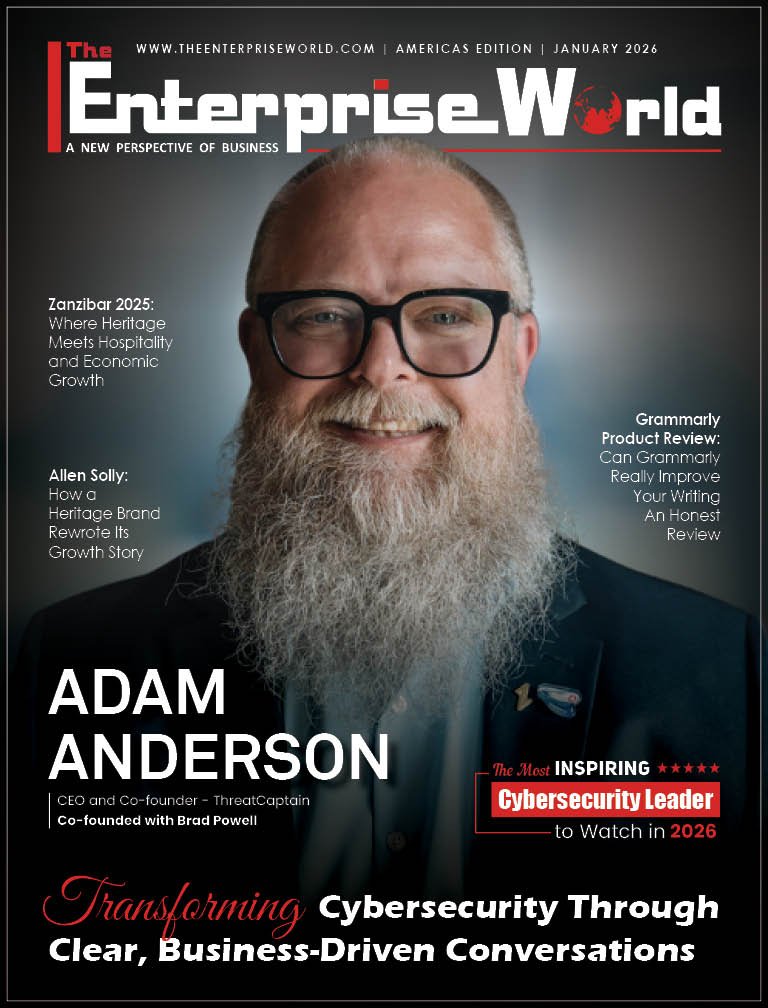
Cybersecurity has become a world of constant change and complexity, where clear communication is often the hardest part. The key advantage now lies in the ability to explain technical risks in a way that shows real business value. As organizations face increasing digital threats and tighter technology budgets, one fact is clear: security solutions don’t sell themselves; they need to be presented through a story that connects with business leaders. The people driving this change are not just creating tools; they are improving the conversations between technical experts and business decision-makers.
Leading this shift is Adam Anderson, CEO and Co-founder of ThreatCaptain, co-founded with Brad Powell, a sales enablement platform that helps Managed Service Providers (MSPs) sell cybersecurity more effectively. With extensive experience in the MSP industry, Adam has a strong track record of turning complex security ideas into clear business benefits. Under his guidance, ThreatCaptain helps MSPs address customer concerns by using financial data and straightforward risk explanations, allowing them to close deals faster and establish themselves as trusted partners in cybersecurity.
A Journey Toward Clearer, More Effective Cyber Conversations
Adam Anderson began his career in cybersecurity in the late 1990s, working on the Y2K issue, and has accumulated 26 years of experience in the field. Over this time, he has founded four cybersecurity companies, sold one of them, serves as acting chair of the board for Hook Security, and currently leads ThreatCaptain as its CEO.
Throughout his career, Adam often felt frustrated when trying to help business owners understand the importance of investing in cybersecurity programs. This challenge became even more apparent when he transitioned from managing internal budgets to focusing on cybersecurity sales.
Drawing from his extensive experience advising hundreds of small and medium-sized business CEOs and conducting numerous tabletop exercises, Adam developed ThreatCaptain. The platform was created to translate cybersecurity risks into business terms – specifically, into financial risk – making these conversations clearer and more relevant for decision-makers.
As a result, ThreatCaptain is a SaaS solution that enables cybersecurity professionals to engage in meaningful business discussions without relying on complex risk assessments or fear-based tactics.
ThreatCaptain at a Glance

- 70% month-over-month growth
- 15-member team driving expansion
- 280+ active customers on the platform
- 3,700+ business impact simulations and risk assessments completed
- Entering 2nd year of rapid growth
Finding the Right Audience for the Biggest Impact
One of the most significant challenges ThreatCaptain faced in its early stages was identifying its ideal customer. While all cybersecurity professionals need to learn how to communicate risk in business terms, attempting to serve everyone often means effectively serving no one.
Through this experience, the company realized that focusing on Managed Service Providers (MSPs) would allow it to make the greatest impact on reducing cybercrime, as MSPs serve the small and medium-sized business (SMB) market. This focus aligns closely with ThreatCaptain’s mission of combating global cybercrime and addresses a critical need in an underserved market for customized business risk software.
Overcoming this challenge helped shape the leadership approach and company culture by emphasizing clarity, focus, and a mission-driven mindset.
The Budget Problem Behind Rising Cyber Risks
Adam Anderson delivered a talk in London titled, “The number one cyber risk facing the world is a nerd’s inability to win budget.” This statement remains true as we approach 2026. The challenge has never been that cybersecurity teams lack the knowledge to prevent cybercrime; rather, it is that they are often under-resourced and struggle to secure executive support for long-term protection and risk reduction.
ThreatCaptain tackles this issue by providing financial impact simulations that clearly demonstrate to executives the potential severity of a breach, its likelihood, how cyber insurance would respond, and how to spread the risk over time so that the potential damages can be managed within financial plans.
As Adam emphasizes, “If you can’t understand the risk, you don’t deploy capital to address it.” ThreatCaptain uniquely solves this problem by translating cyber risk into understandable financial terms, enabling better decision-making and investment in cybersecurity.
How a Major Crisis Shaped a Leadership Mindset

One of the high-pressure incidents Adam experienced was during the events of 9/11. At the time, Adam was 24 years old and working for Royal Dutch Ahold in Greenville, South Carolina. When the Twin Towers collapsed, the company lost connection to its data centers and critical security systems. As a result, over 400,000 employees were unable to access their accounts.
Adam Anderson and his team worked around the clock for 72 hours to rebuild the entire security infrastructure supporting 397 web applications. This crisis required him to go beyond his expertise in a specific area of security and actively support all related systems, such as WebSphere and DB2.
This experience taught Adam that “security is a team sport” and that “servant leadership from the middle is sometimes more powerful than being a smart executive giving orders.” Since then, he has dedicated much of his time to mentoring the next generation of cybersecurity leaders and professionals.
A Framework That Makes Cybersecurity Easier to Discuss
ThreatCaptain’s most significant innovation is the development of the Anchor Point Methodology. In late 2025, the company published a book detailing this approach, which guides Managed Service Providers (MSPs) on how to communicate about cybersecurity with their customers effectively. The methodology focuses on addressing global cybercrime by gaining a deeper understanding of the specific business challenges that customers face.
At its core, the Anchor Point Methodology is a structured process designed to identify the pain points that businesses are willing to act upon and to monitor how these concerns evolve over time. By spreading the cost of risk management over time in a way that business leaders can easily understand, this approach supports the continuous improvement of an organization’s security posture.
This proprietary framework sets ThreatCaptain apart by enabling more meaningful business conversations around cybersecurity and fostering long-term risk reduction strategies.
A Commitment to Reliability, Transparency, and Compliance
ThreatCaptain recognizes that trust and reliability are the foundation of every client relationship. As Managed Service Providers (MSPs) often hold critical access to their clients’ systems, ThreatCaptain takes its responsibility to safeguard sensitive data extremely seriously. The company handles risk data for numerous SMBs on behalf of MSPs, which makes transparency, compliance, and ethical practices non-negotiable. To maintain the highest security standards, ThreatCaptain partners with three independent firms that continuously audit and evaluate its application, infrastructure, and operational security.
Sharing a personal example, Adam Anderson stated, “I actually used ThreatCaptain on my own company to show my chief of staff the financial impact to us if we were breached! Good news – it worked! I got the money. (Yes, I am the CEO… but you have to go through the motions.)”
In addition, ThreatCaptain actively supports and follows the GTIA TrustMark program, reflecting its commitment to the same best practices it encourages within the MSP community. The company truly believes in “practicing what we preach.”

Collaborations That Drive Growth and Cybersecurity Impact
ThreatCaptain’s primary partnerships are with communities that support Managed Service Providers (MSPs). The company is actively involved with IT Nation Evolve, 7 Figure MSP, and Tech Degenerates. Additionally, ThreatCaptain considers its distribution partners as key components of its strategic advantage and plans to announce an important partnership in the first quarter of 2026 that will further accelerate its growth.
Adam is also proud to share that ThreatCaptain is an active partner in CyberRISE, a 501(c)(3) non-profit organization that assists MSPs during their most challenging times following a breach. In his 2025 TEDx talk at Unity Park, Adam discusses in detail the challenges related to the cybersecurity workforce and the difficulties MSPs face in finding the right talent, as well as how these issues can be addressed.
As Adam states, these collaborations reflect the company’s commitment to growth and support within the cybersecurity community.
A Strong Presence in Publications and Industry Talks
Adam Anderson and ThreatCaptain have been featured in several notable publications and media outlets. Key articles include his contributions to Forbes on company culture and security, “Why Your Company’s Security Starts With Company Culture” and “Survive A Cyberattack: 7 Things Business Owners Must Do”, as well as coverage in “Greenville startup’s belief in ‘psychological security’ featured in Forbes” and “Protecting Your Business from Cybercrime with Adam Anderson”. Additional profiles highlight his entrepreneurial journey, such as “Serial entrepreneur Adam Anderson, making money”.
Anderson is also a published author, with books available on Amazon, “Adam Anderson Author Page”. He has delivered numerous speaking engagements, including TEDxGreenville talks like “Cyber Crime Isn’t About Computers: It’s About Behavior”, “A Case For Psychological Security”, and others on entrepreneurship, emotional intelligence in cybersecurity, and the digital economy (“The Four Stages of Entrepreneurship”, “Emotional Intelligence for Cyber Security Professionals”, “Show me the Money, Careers in Cyber Security”, “Entrepreneurial Mindset”, “The Digital Economy”, “Behavioural Psychology in the Fortune 500”, “How to start a business as a Cyber Security Professional”). He has also appeared on numerous podcasts.
Building Strong Teams Through Training and Growth
Adam believes the most effective way to build a strong cybersecurity team, or any team of technical professionals, is to establish mentorship and apprenticeship programs. Currently, many cybersecurity job openings require five years of experience, yet there are limited opportunities to gain that experience. To address this gap, Adam emphasizes the need to revive apprenticeships and commit to long-term investment in people.
He firmly believes that giving individuals a chance to grow in their technical skills and in understanding the business reasons behind the technology is highly beneficial. As Adam explains, “When they get a job offer way beyond what I can pay and take that job, I know I’ve been successful!”
This approach highlights a leadership style focused on nurturing talent, fostering growth, and preparing professionals to thrive in the demanding cybersecurity industry.
A Vision for Smarter, More Effective Cyber Risk Management
Looking ahead to 2026 and beyond, Adam envisions a significant shift in the cybersecurity industry through the adoption of Business and Financial Risk Assessments as a foundation for cyber risk evaluations. He believes this approach will “revolutionize the industry” by helping business leaders better understand cybersecurity while enabling cybersecurity professionals to grasp the underlying business risks.
This deeper understanding will allow for more effective prioritization of mitigations and controls. As a result, not only will organizations secure increased funding and resources, but they will also use these resources more efficiently to combat the growing threat of cybercrime.
This vision highlights the importance of bridging the gap between business and cybersecurity to create stronger, more resilient defenses.
Open Letter for Future Leaders in the Cyber Industry
Dear future leaders,
Over the last 25 years, I’ve started and/or invested in roughly 30 companies, and there’s one pattern that shows up more than any other when a business fails: entrepreneurial burnout. It’s not usually the market, the product, or even the competition that ends things; it’s when the founders reach a level of emotional exhaustion and numbness where they simply can no longer do the work.
My best advice is to take care of yourself physically, emotionally, and financially. With ThreatCaptain, I started training in Muay Thai in the mornings. It wasn’t just about the physical exercise, although that was a huge benefit. It was the mental discipline and holistic approach to wellness that helped keep me from burning out and allowed me to show up better for my team and our customers.
You also need to spend time with people who are building businesses, but who are not building your business. Being the person who always has to have the answers can become a trap. Spend time with entrepreneurs who are at a similar stage to you – whether that’s through formal mastermind groups or informal social circles – so you have a place to be honest, vulnerable, and supported.
And one more thing: having a rock star spouse like Kerry Anderson really helps. Sorry folks, she’s taken. Go find your own partner in crime, someone who believes in you, grounds you, and reminds you that there is life outside of the next milestone.
Sincerely,
Adam Anderson, CEO and Co-founder
ThreatCaptain
5 Key Takeaways from Adam Anderson’s Impact on the Cybersecurity Industry
- Turning Cyber Risks into Business Language: Adam focuses on helping cybersecurity professionals communicate risk in simple, financial terms so business leaders can make smarter decisions.
- A Mission to Support MSPs: ThreatCaptain targets Managed Service Providers, giving them tools to explain cyber risk clearly and serve SMBs more effectively.
- Leadership Shaped by Real-World Crisis: Adam’s 9/11 experience taught him that teamwork, humility, and servant leadership matter more than titles.
- A Framework That Simplifies Cyber Conversations: The Anchor Point Methodology helps MSPs identify real customer pain points and guide long-term security decisions.
- A Vision for Smarter Cyber Risk Management: Adam believes the future of cybersecurity lies in business and financial risk assessments, helping organizations spend wisely and strengthen defenses.